
Choosing between void fill, cushioning, and surface protection is less about the material name and more about the protection job your product actually needs. A light item moving inside an oversized carton has a different risk than a heavy part with fragile corners, a glossy surface, or multiple pieces packed together. Foam, bubble wrap, paper, air cushions, dividers, and inserts can all work well or poorly depending on product size, weight, shape, surface finish, carton space, packing method, and shipping route.
This article helps packaging buyers define the real problem before requesting a quote or approving a sample. It explains when to control movement, absorb impact, prevent scratches, separate products, or add structural support, and why total pack cost should include labor, carton size, freight volume, damage risk, and repeatability—not only material price.
A practical packaging recommendation is easier to trace when the buyer and supplier connect each step: product information, confirmed specification, sample review, production details, finished product checking, packing review, and shipment preparation. For Daipak-style custom packaging work, this means the quote should not stand alone; it should reflect the product size, weight, photos or drawings, packing quantity, carton layout, labels, carton marks, and destination details that were actually confirmed.
Quick Packaging Decision Guide
| Buyer Question | Practical Reading | What to Check |
|---|---|---|
| Is the product moving inside the carton? | Start with void fill or movement control before adding more cushioning. | Carton space, product position, shake movement, and pack repeatability. |
| Is the main risk impact during handling? | Use cushioning that matches product weight, drop risk, and fragile areas. | Corner protection, compression, material thickness, and shipping distance. |
| Does the product have a sensitive surface? | Prioritize surface protection instead of bulky filler that may still rub. | Glossy finish, coated parts, sharp contact points, and material softness. |
| Are multiple items packed together? | Separation may be more important than adding loose fill around the bundle. | Dividers, sleeves, interleaving sheets, and product-to-product contact. |
| Will the shipment face export or long-route handling? | Layer protection functions instead of relying on one material alone. | Palletizing, stacking pressure, transit time, humidity exposure, and handling steps. |
| Is the lower material price actually cheaper? | Compare total pack cost, not just unit material cost. | Labor time, carton size, freight volume, sample results, and damage claims. |
Quick Questions Before You Read
Q: Can one packaging material handle every protection need?
Usually not. One material may fill space, cushion impact, or protect a surface depending on its thickness, shape, and placement, but many packs need combined functions.
Q: When is custom packaging worth considering?
Custom inserts, pouches, sheets, or dividers make sense when product fit, packing speed, surface safety, or repeat order consistency matters.
Q: What should I send before asking for a packaging quote?
Send product dimensions, weight, photos, fragile areas, surface concerns, carton size, packing quantity, shipping route, and any current damage issues.
Q: How should I judge a packaging sample?
Check real fit, movement control, surface contact, cushioning position, carton closure, packing time, and whether workers can repeat the pack consistently.
Start With the Protection Job, Not the Material Name
A common packaging mistake is to start with a material name: “We need bubble wrap,” “Can you quote foam sheets?” or “What is the cheapest filler?” Those questions are understandable, but they skip the more important first step. Before comparing packing materials, the buyer needs to define the packaging function: what job must the packaging perform inside the carton or shipment?
The main job may be to stop movement, absorb impact, prevent scratches, keep parts separated, or support the product so it does not bend or deform. These are different problems. A material that works well for one problem may perform poorly for another if it is used in the wrong way. Bubble wrap, EPE foam, air pillows, plastic film, paper dunnage, and corrugated inserts can all be useful, but only after the protection job is clear.
A function-first approach also helps buyers avoid false savings. A lower unit price may look attractive on a purchase order, but it can cost more if the product shifts in the carton, arrives with scuffed surfaces, requires slow packing, or needs extra material to compensate for a poor fit. Good packaging selection starts with the product, the carton, and the shipping risk, then matches the right protective packaging to those conditions.
Function-first selection should also separate ordinary protection choices from regulated or claim-sensitive packaging decisions. If the package will be used for direct food contact, medical or pharmaceutical items, hazardous goods, electronics with static-control needs, moisture-sensitive products, or environmental marketing claims, the buyer should identify those requirements before production. In these cases, material name and appearance are not enough; supporting documents, destination-market rules, and end-use conditions may need to be reviewed separately.
What each packaging function is responsible for
Void fill controls empty carton space. Its main purpose is to stop the product from moving around during handling and transit. It is useful when the carton is larger than the product or when several items leave open gaps in the pack.
Cushioning absorbs shock. Its job is to reduce the force that reaches the product during drops, vibration, or rough handling. Cushioning matters most for fragile products, sharp corners, delicate edges, and items that can crack, dent, or break under impact.
Surface protection prevents contact damage. It protects against scratches, rub marks, dust, light abrasion, and finish transfer. This is important for glossy, painted, coated, polished, printed, or easily marked surfaces, even when the product itself is not highly fragile.
Separation keeps items apart. It prevents product-to-product contact inside a carton, which can reduce chipping, rubbing, tangling, or pressure marks. Separation is often needed for sets, components, accessories, glass items, hardware, and finished parts packed in multiples.
Structural support helps the pack keep its shape and position. It may support a product edge, hold a part upright, reinforce a weak area, or prevent compression. This function becomes more important for heavier items, irregular shapes, and export cartons that may face stacking or repeated handling. When compression resistance is a concern, packaging performance should be checked against the actual container and load condition rather than assumed from material name alone.[1]
Many real shipments need more than one function. For example, a painted metal part may need surface protection against scuffing, cushioning around corners, and void fill to stop movement in the carton. Treating these as separate jobs makes the packaging decision clearer and easier to quote correctly.
For purchasing teams, it helps to write the intended function directly into the internal packaging request. A note such as “prevent surface scuffing during carton vibration” or “hold the part away from the carton wall during parcel handling” gives the supplier a clearer basis for recommending thickness, density, cut size, bag format, or insert structure. This also makes later sample review more objective because the buyer can check whether the packaging solved the agreed problem instead of judging only by material appearance.
Why material names can mislead buyers
Material names are not the same as protection jobs. “Foam” can mean a thin surface layer, a die-cut insert, a corner pad, a bag, or a thick cushion. “Bubble wrap” can be used for wrapping, light cushioning, or filling space. “Plastic film” may protect against dust, hold groups together, or cover a finished surface, but it may not provide impact protection by itself.
This is why a material-only quote can miss the real need. If a buyer asks only for the lowest-cost bubble wrap, the supplier may not know whether the goal is to wrap a fragile item, fill carton space, protect a surface, or separate parts. Each goal changes the recommended thickness, size, format, packing method, and carton layout.
At Daipak, the discussion usually starts with product details rather than the material name. Product size, weight, shape, fragile areas, surface finish, carton space, and shipping route all affect whether the pack needs void fill, cushioning, surface protection, separation, structural support, or a combination of functions.
How Void Fill, Cushioning, Surface Protection, and Separation Differ
The easiest way to compare packaging functions is to ask what risk each one controls. Void fill stops shifting. Cushioning absorbs impact. Surface protection prevents scuffing and marking. Separation keeps items apart. Structural support holds shape, position, or load. These functions often work together, but they should not be confused.
A carton can look full and still be poorly protected. Loose fill may reduce movement but offer limited edge protection for a fragile item. A soft wrap may protect a finish but still allow the product to slide inside an oversized carton. A strong outer box may handle stacking but still allow parts inside to hit each other. The packaging system needs to match the actual failure risk, not just fill visible space.
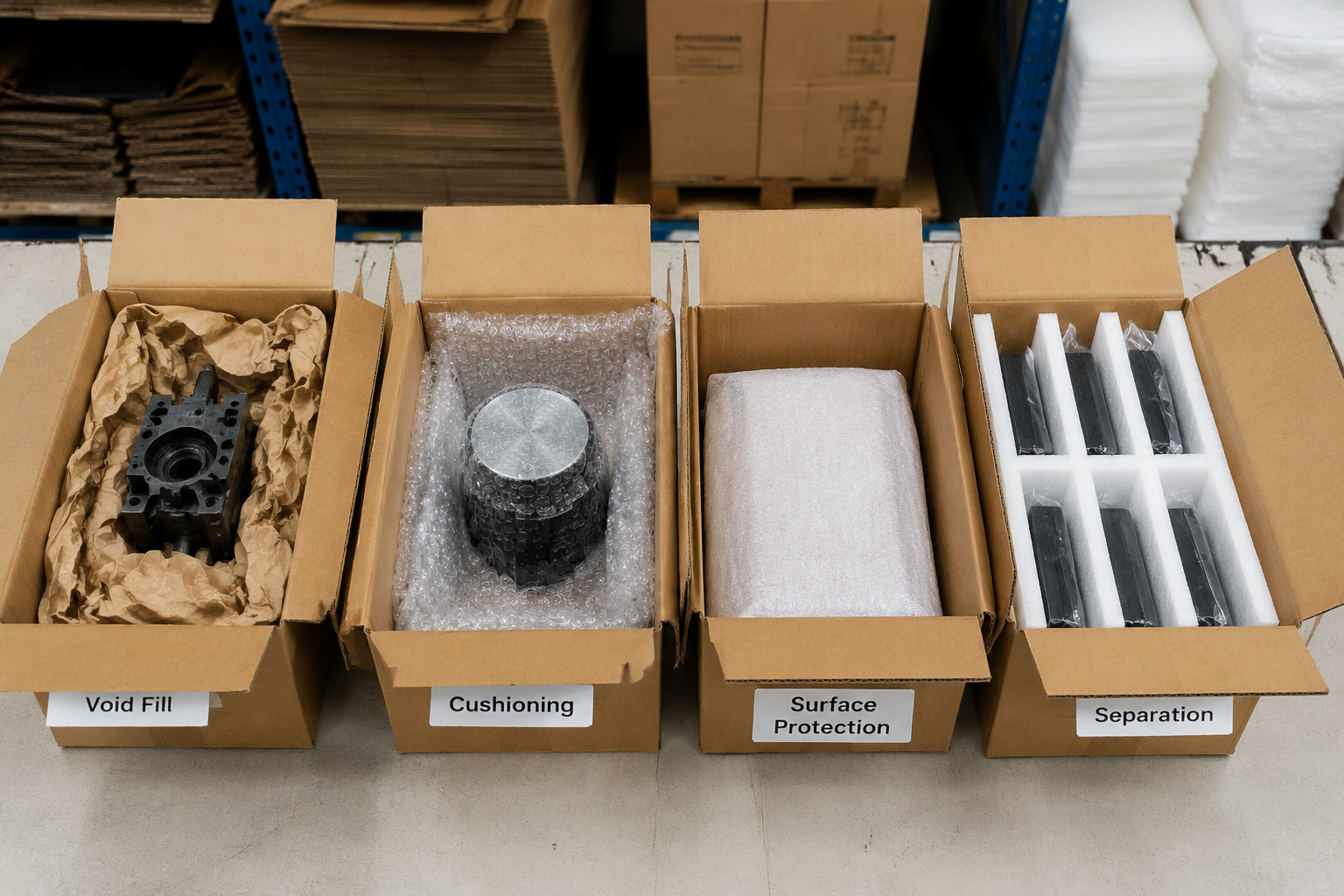
Void fill: when empty space is the main problem
Void fill is used when the carton has unused space and the main risk is movement. During parcel handling, warehouse transfer, or truck vibration, a product can shift from side to side, hit the carton wall, or collide with another item. Void fill reduces that movement by occupying the open space around the product.
Common void fill formats include air pillows, paper dunnage, bubble material, foam pieces, or other space-filling materials. The right choice depends on carton size, product weight, packing speed, and whether the filler must also provide light cushioning. For lightweight e-commerce items, air pillows may be efficient because they fill space without adding much weight. For heavier products, loose void fill alone may compress or move aside, so restraint and structural support may be needed.
The main limitation is that void fill is not automatically cushioning. Filling a gap does not always protect a sharp corner from a drop impact. If the product is fragile, heavy, or has a vulnerable edge, the pack may need dedicated cushioning in addition to space control.
Cushioning: when impact and drop risk matter most
Cushioning is used when the product must be protected from shock. The goal is not only to fill the carton, but to absorb and spread impact forces before they reach the product. This matters for glass items, electronics, ceramic parts, precision components, sharp-edged products, and anything that can crack, dent, or lose function after a drop.
Cushioning usually needs enough thickness, coverage, and placement to protect the most vulnerable areas. Edges and corners often need more attention than flat surfaces because they take concentrated force during impact. EPE foam pads, bubble wrap, foam inserts, molded or cut foam structures, and air column packaging can all be used for cushioning, but their performance depends on the product weight, shape, and pack design.
The trade-off is space and cost. A cushioning layer often takes more carton room than a thin surface wrap. If the carton is already tight, the buyer may need to adjust carton size or use a more precise insert rather than forcing bulky material into a small space. Over-compressing cushioning can reduce its ability to absorb shock.
Surface protection: when scratches, marks, and abrasion are the concern
Surface protection is needed when the product already fits securely but the contact surface must stay clean and undamaged. The product may not be fragile in the breakage sense, yet it can still be rejected if it arrives with scratches, rub marks, dust, printed-surface damage, or coating abrasion.
This function is common for painted metal parts, polished plastic components, acrylic panels, furniture pieces, retail display items, printed boxes, coated products, and finished consumer goods. Thin EPE foam sheets, foam bags, protective film, plastic bags, non-abrasive liners, or soft interleaving layers may be used depending on the surface sensitivity and packing method.
Surface protection should be chosen carefully because the material touches the product directly. Buyers should consider whether the contact layer is clean, soft enough, easy to remove, and suitable for the surface finish. A rough or dusty protective layer can create the same cosmetic problem it was supposed to prevent.
If the protective layer will contact food, cosmetics, medical products, or other regulated items directly, the buyer should confirm the intended contact condition before treating it as an ordinary surface-protection material. Food-contact packaging, for example, may involve specific material and substance requirements depending on market and use, so direct-contact applications should be checked separately before production.[7]
Material Selection Note: Material choice should follow the product risk first. Before selecting EPE foam, bubble wrap, air cushions, plastic film, paper fill, or corrugated dividers, confirm whether the main concern is movement, impact, surface contact, product separation, or carton support rather than choosing by habit or lowest unit price alone.
Separation and structural support: when items must stay apart or stay in shape
Separation is the right function when multiple items are packed together and must not touch each other. Without separation, products can rub, chip, nest incorrectly, tangle, or transfer marks during vibration. Dividers, foam sheets, corrugated partitions, bags, sleeves, and layered inserts can all create controlled spacing between items.
Structural support goes one step further. It helps the product stay in a stable position or helps the carton resist pressure. This is useful for irregular shapes, long parts, assemblies with protruding components, items with weak edges, and products that may deform under stacking or compression. A foam insert, corrugated support, corner block, or shaped pad may hold the product where it belongs instead of simply wrapping it.
The important point is that separation and support are design functions. They often require attention to product dimensions, carton layout, packing quantity, and how workers place the product into the carton. If the insert or divider is hard to use, warehouse teams may pack inconsistently, which can reduce protection even when the material itself is suitable.
Match the Function to Product Weight, Fragility, and Surface Finish
Product characteristics should drive the packaging function. A light product, a heavy machined part, a fragile glass item, and a glossy painted panel may all need protection, but not for the same reason. One may move too easily in the carton. Another may crush weak filler. Another may break from shock. Another may arrive structurally fine but cosmetically unacceptable.
A practical selection process looks at product weight, fragility, and surface finish before choosing the material. These details help the buyer decide whether the pack needs movement control, cushioning, abrasion prevention, compression resistance, or a combination. The more specific the product risk, the easier it is to avoid both underprotection and unnecessary bulk.
How weight changes the packaging job
Product weight changes how packaging behaves inside the carton. A light product may only need modest void fill to stop movement, especially if it is not fragile and has a durable surface. A heavy item creates more force during drops, sliding, and sudden stops. If the material around it compresses too easily, the product may still hit the carton wall or damage nearby items.
For heavier products, restraint and support often matter more than loose fill. The pack may need denser foam pads, corner protection, corrugated supports, shaped inserts, or a tighter carton layout that limits movement from the start. Simply adding more soft filler can create a false sense of protection if the filler collapses under the product weight.
Weight also affects carton performance. A heavy product in an oversized box can shift with enough force to break through the side, weaken the bottom, or damage other cartons on a pallet. For this reason, the inner protection and outer carton should be considered together, especially for bulk shipments or export packing.
How fragility changes the packaging job
Fragility is not one single condition. A glass bottle, an electronic device, a ceramic tile, and a precision plastic part can fail in different ways. Some break from direct impact. Some suffer from vibration. Some have delicate corners. Some have small attached components that bend or snap. The packaging function should match the specific weak point.
For a fragile product, cushioning and controlled spacing usually become more important than basic void fill. The product should not only stay in place; it should have enough protective material in the right areas to reduce shock. Corners, edges, protruding parts, lids, screens, handles, and connection points often need special attention because they are more likely to receive concentrated stress.
Fragile products packed in multiples may also need separation. If two items can hit each other, a cushioned carton wall will not solve the internal collision problem. Dividers, sleeves, foam layers, or individual bags can reduce product-to-product contact and make the pack more predictable during handling.
How finish quality changes the packaging job
Surface finish changes the packaging job even when the product is strong. A metal bracket may not break easily, but a painted or coated version may need scratch protection. A matte plastic part may tolerate light contact, while a glossy panel may show every rub mark. A printed retail surface may need a clean inner layer so the package still looks acceptable when opened.
For high-finish products, the first question is what touches the surface. Thin EPE foam, protective film, plastic bags, foam pouches, or soft interleaving sheets can create a clean contact layer. The material should be suitable for the surface condition and packing process, and buyers should check whether it leaves marks, traps dust, slides too much, or creates pressure lines after stacking.
Finish quality also affects how tightly products can be packed. A tight carton may reduce movement, but if two finished surfaces rub against each other, cosmetic damage can still occur. In that situation, separation and surface protection may be more important than adding bulky cushioning. The best choice depends on whether the main risk is breakage, abrasion, or pressure marking.
Use Carton Space and Packing Method to Decide the Function
Packaging selection is not only a question of how fragile the product is. The available carton space, carton size, and packing method can change the best protection function. A product may need strong cushioning in one carton layout, but only surface protection in another. A pack that looks safe on a desk can also become slow, inconsistent, or expensive when warehouse staff need to repeat it hundreds or thousands of times.
The first practical question is simple: after the product is placed in the carton, what problem remains? If the product moves around, the main job is movement control and void fill. If the product fits tightly but touches the carton wall or another item, the job may be surface protection or thin cushioning. If several pieces are packed together, separation may matter more than adding loose filler. The best function should match the real pack-out, not just the material a buyer is used to ordering.
When extra space makes void fill the first job
Too much empty space inside a carton creates a movement problem. During handling, the product can slide, rotate, hit carton walls, or collide with other products inside the same box. In this situation, void fill is not decoration; it is there to stop movement and keep the product in its intended position during transit.
Oversized cartons often create this issue. A small e-commerce item placed in a standard shipping box may have open space on all sides. A lightweight accessory packed with a larger main product may shift into corners. A spare part with an irregular shape may leave empty pockets that allow movement even when the carton looks full from the top. In these cases, air pillows, bubble wrap, paper fill, foam pieces, or a shaped insert can all be considered, but the real requirement is to control the empty space.
Buyers should also avoid assuming that “more fill” automatically means better protection. Loose fill that compresses, settles, or moves away from the product may not control shifting well. For repeated packing, it helps to define the target fit: how much space remains around the product, where the product should sit, and whether the filler must block movement on the sides, top, bottom, or corners. This makes the packing method easier to repeat and easier to check.
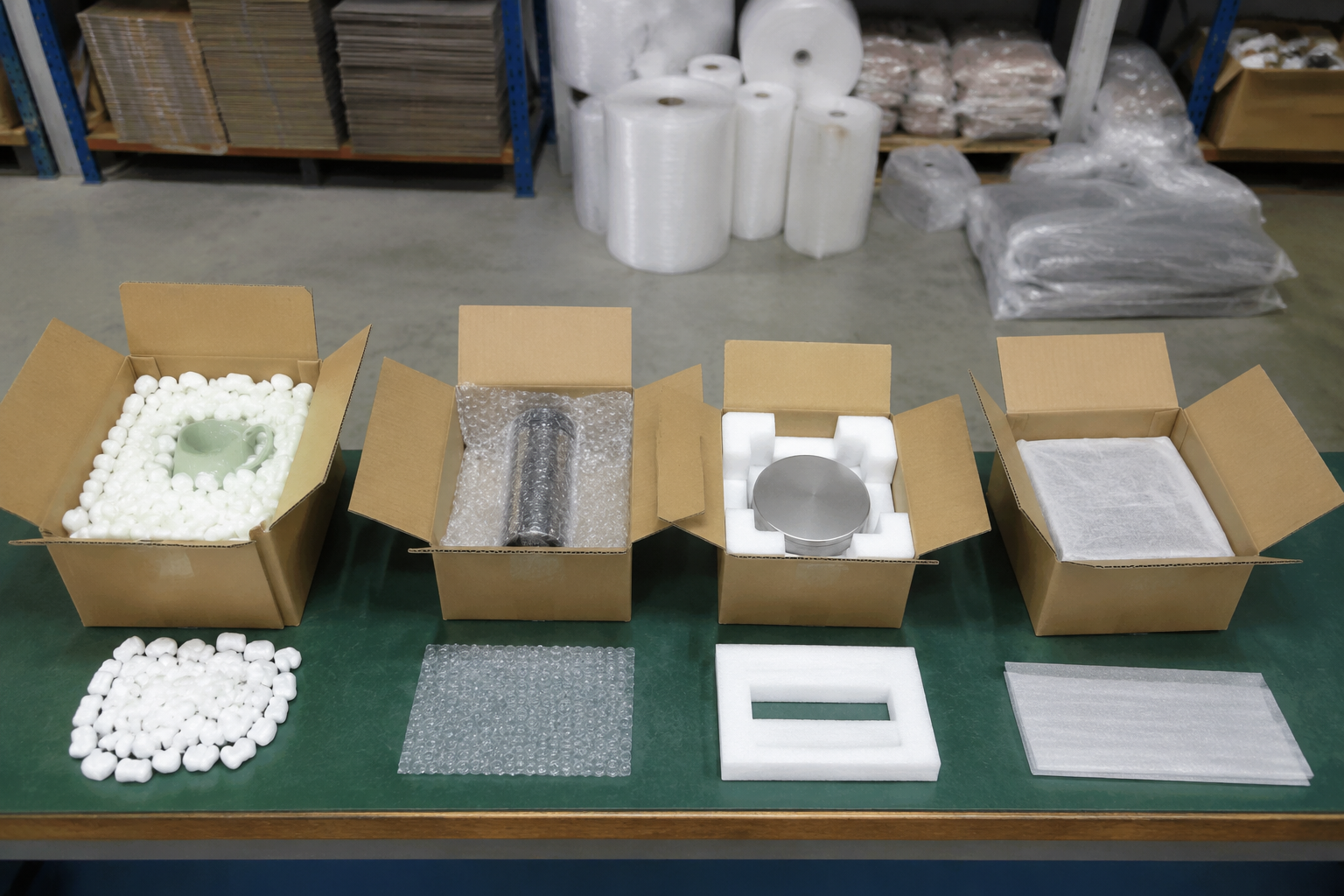
When a tight carton needs thin protection instead of bulk fill
A tight carton creates a different problem. If the product already fits securely, adding bulky filler may make the carton hard to close, distort the product, or create pressure points. In this case, the pack may need a low-profile protective layer rather than more volume. Thin EPE foam sheets, foam bags, bubble bags, protective film, tissue-like wrapping, or poly bags may be more practical than loose void fill.
This is common for products with cosmetic surfaces. A painted metal part, glossy plastic component, printed retail box, coated wood item, or polished accessory may not need much impact absorption if it is already held in place. The bigger risk may be scuffing, rubbing, dust, or contact marks. Surface protection keeps the product clean and separates it from abrasive carton surfaces or nearby items.
Tight cartons can also require slim cushioning in specific areas. A product edge may sit close to the carton wall, or a corner may need a small foam pad to prevent concentrated impact. The goal is not to fill the carton. The goal is to protect the contact points without creating an overpacked carton that bulges, wastes labor, or fails carton closure checks.
How packing speed influences the best function choice
The best packaging function must also fit the speed and skill level of the packing process. A careful hand-wrapped pack may work well for low-volume shipments, but it can become slow or inconsistent in a busy fulfillment line. If each packer wraps the product differently, the protection level may vary from carton to carton, even when the same material is used.
Faster packing often favors formats that are easy to repeat: pre-cut foam sheets, bubble bags, foam pouches, pre-sized air cushions, dividers, inserts, or cartons designed around the product. These formats reduce judgment at the packing table. Instead of asking each worker to decide how much material is enough, the pack design tells them where each item goes and how the protection should be placed.
This does not mean every product needs a custom insert. For simple, low-risk products, a standard roll, sheet, bag, or air pillow system may be enough. But when packing efficiency matters, buyers should compare total pack-out cost, not just material price. A slightly higher material cost can make sense if it reduces packing time, improves fill rate, lowers rework, or makes damage checks more predictable.
When a buyer evaluates labor cost, the easiest comparison is often a small packing trial. Ask the packing team to prepare several cartons using the proposed method, then note how long the process takes, where workers hesitate, whether the material size is convenient, and whether the finished cartons look consistent. This practical check can reveal issues that a material sample alone may not show, such as difficult folding, unclear placement, or excess trimming waste.
For traceable packing decisions, the trial result should be written back into the specification. If workers used one foam sheet per product, two air pillows on each side, a bag before the insert, or a fixed carton orientation, those details should be recorded with the approved sample. This gives production and purchasing the same reference point when the order moves from quotation to bulk packing.
How Shipping Distance, Handling, and Transport Route Change the Decision
The product itself is only one part of the decision. Shipping distance, handling method, and transport route can change the protection mix. A carton moved across a warehouse has a different risk profile from a parcel shipment, a palletized domestic load, or export packing that passes through several transfers before reaching the final destination.
Longer routes usually mean more vibration, more stacking time, more loading and unloading, and more chances for rough handling. The packaging function may need to shift from simple void fill toward a combination of movement control, cushioning, separation, and structural support. A buyer should think about the route before approving a material or carton layout. Random vibration testing standards exist because vibration during distribution can be a meaningful packaging performance factor, especially when products travel through longer or more complex routes.[2]
Why longer routes usually need more than basic void fill
Basic void fill can stop light movement in a short route, but it may not be enough for long-distance shipping. Over time, vibration can cause products to settle, rotate, or work their way into weak points inside the carton. If the filler compresses or shifts away from the item, the product may still hit the carton wall during a drop or transfer.
For longer routes, buyers should ask whether the product needs controlled spacing as well as empty-space filling. A fragile product may need cushioning around corners and edges. A heavy item may need restraint so it does not crush the filler. A product with a delicate finish may need a soft contact layer even if the outer carton is strong. The farther the shipment travels, the more important it becomes to separate these jobs instead of treating all inner packaging as simple filler.
Handling frequency also matters. A carton that moves through several warehouses, parcel hubs, or mixed freight environments may face more drops, compression, and side impacts than a carton moved once by a dedicated truck. The packaging should reflect that route risk, not only the product value. For small-package parcel environments, ISTA Procedure 3A is one example of a packaged-product test procedure used to evaluate parcels under delivery-system conditions rather than judging protection by appearance alone.[3]
Why export packing often needs layered protection
Export packing often requires layered thinking because the shipment may face long transit time, container loading, pallet movement, warehouse transfer, and destination handling. One material rarely solves every risk. The outer carton may provide structure, while the inner packaging controls movement, absorbs impact, separates products, and protects surfaces.
For example, a carton of finished components may use plastic bags or film for dust protection, EPE foam sheets between layers for surface protection, edge pads for corner cushioning, and a corrugated carton for stacking support. A fragile item may use bubble wrap or an air column bag for cushioning, plus a snug carton layout to reduce movement. A heavy part may need foam blocks or a shaped insert instead of loose filler because the packaging must hold position under weight.
For export orders, carton marks, packing quantity, pallet preparation, and destination handling requirements should be confirmed early. Ethan Lee often pays attention to these details during overseas order communication because they can affect not only shipping preparation, but also the inner protection design and quotation details.
Export review should also include the practical packing information that appears on the factory floor: how many pieces go into each carton, whether inner bags or foam pieces are counted per product or per layer, where labels are applied, and whether cartons will be palletized before loading. These details help prevent a common mismatch where the sample protects the product well, but the bulk packing instruction is not specific enough for repeated export preparation.
Shipment preparation is easier to control when the confirmed packing method connects directly to carton quantity, inner packing, labels, carton marks, pallet pattern, and loading information. If a buyer changes the destination, carton mark format, pallet height, or quantity per carton after sample approval, the supplier should usually recheck whether the original void fill, cushioning, or separation design still matches the shipment condition.
If the shipment involves regulated goods, destination-market rules should be checked before the packaging structure is finalized. Hazardous goods and some battery or chemical shipments may require packaging, marks, documents, and transport preparation beyond ordinary protective packing; international model rules and local transport regulations can affect what is acceptable for shipment.[8] A protective packaging supplier can help review fit and material structure, but the buyer and shipping parties should confirm regulated-shipment requirements where applicable.
Why pallet or carton handling changes the protection mix
Manual carton handling and pallet handling create different priorities. A single parcel may face drops and side impacts, so cushioning and movement control become important. A palletized shipment may face compression, stacking pressure, forklift movement, and vibration, so carton strength, layer stability, and product separation can become just as important as cushioning.
If cartons are stacked on pallets, the inner packaging should not collapse in a way that allows products to deform or press into each other. If cartons are mixed with other freight, the outer box and internal support need to work together. If workers frequently lift or rotate cartons by hand, the product should stay in position even when the carton orientation changes.
This is why the same product may need different packaging for different channels. A local warehouse transfer may use simple separators or thin wrapping. A domestic parcel shipment may need cushioning at impact points. An export pallet shipment may need a more structured carton layout with inner separation and support. The right choice depends on the route and handling method as much as the product itself.
Common Selection Mistakes Buyers Make
Many common selection mistakes happen before a sample is even made. The buyer compares material names or unit prices without first deciding what job the packaging must perform. That can lead to a wrong packaging choice: too much filler where thin protection would work, not enough cushioning where impact risk is high, or a pack that protects the product but slows the warehouse team.
The cost of a poor choice is not limited to broken products. It can show up as slow packing, higher freight volume, damaged finishes, customer returns, repacking labor, inconsistent bulk orders, or cartons that are difficult to close. A practical packaging decision should consider protection, pack efficiency, carton space, and repeatability together.
The lowest unit price trap
The lowest unit price can look attractive during purchasing, especially for high-volume packing materials. But a cheaper material is not always the lower-cost pack. If it takes more labor to apply, requires more volume inside the carton, increases freight size, or fails to prevent damage, the total cost can rise quickly.
For example, a low-cost loose filler may seem cheaper than a pre-cut foam pad, but it may take longer to pack and may not hold a heavier product in place. A very thin wrap may reduce material cost, but if it allows scratches on a painted or glossy surface, the buyer may lose more through returns or product downgrading. A larger carton may make packing easier at first, but if it creates too much empty space, the shipment may require more void fill and take up more storage and freight volume.
A better comparison looks at the full pack: material used per carton, packing time, damage risk, carton size, storage space, and repeat-order consistency. The lowest material price only helps if the packaging function is still correct.
The wrong-function trap
A familiar material can still be the wrong choice if it is used for the wrong function. Bubble wrap, foam, air cushions, film, and corrugated inserts can all be useful, but each needs to match the risk. Using void fill when the product needs impact cushioning leaves fragile corners exposed. Using thick cushioning when the product only needs surface protection can waste carton space and slow packing. Using film to hold items together may not protect them from compression or collision.
This mistake often happens when buyers reorder based on habit. A team may say, “We always use bubble wrap,” without asking whether the current product needs wrapping, cushioning, separation, or carton filling. The material name becomes the decision, and the actual protection job is missed.
To avoid this, buyers should describe the packing problem in plain language before asking for a quote. Is the product moving inside the carton? Are the corners breaking? Is the surface getting scratched? Are items rubbing against each other? Is the carton too tight to close? Each answer points to a different function, and often to a different structure.
The overpack and underpack trap
Overpacking and underpacking are opposite problems, but both create cost. Overpacking adds unnecessary material, increases carton size, slows workers, and may make the package harder to recycle or dispose of where local requirements apply. It can also create pressure inside tight cartons, especially when bulky cushioning is forced around products that only need a light protective layer. If a buyer makes recyclability, compostability, degradability, or similar environmental claims about the final pack, those claims should be checked against applicable guidance rather than assumed from the material name alone.[4]
Underpacking creates a different risk. A product may look acceptable when placed in the carton, but still move during transport, rub against another item, or fail under stacking pressure. Underprotection is especially costly for fragile products, finished surfaces, mixed cartons, and export shipments where replacement or return handling is more complicated.
The practical target is not the most material or the least material. It is the right function in the right place. A good pack uses enough protection to control the real risk while keeping carton size, packing labor, and bulk order consistency under control. Packaging optimization standards similarly treat source reduction and performance as linked considerations rather than separate goals.[5]
How to Build a Practical Function-First Packaging Spec
A useful packaging spec does not start with “quote bubble wrap” or “quote foam sheets.” It starts with the product problem: what must the packaging prevent during packing, storage, handling, and transport? Once that is clear, a supplier can recommend the right function, structure, and material instead of guessing from a material name.
For procurement, this matters because a vague request often creates a vague quotation. Two suppliers may quote different thicknesses, densities, bag sizes, carton layouts, or packing quantities while using the same material name. The prices may look comparable, but the protection level and packing result may be very different. A function-first packaging spec gives the buyer and supplier the same reference point before sample confirmation and bulk production.
The spec does not need to be complicated. It should describe the product, the risk, the carton, the route, and the packing method clearly enough for the supplier to judge whether the job is void fill, cushioning, surface protection, separation, structural support, or a combination of these functions.
What product details a factory needs to recommend the right function
A factory-side recommendation is only as good as the product information behind it. Product dimensions tell the supplier how much space is available around the item. Product weight affects whether the packaging needs stronger restraint, higher cushioning performance, or a more stable carton layout. Product shape shows whether there are corners, protruding parts, handles, edges, or fragile points that need local protection.
Buyers should also describe the surface condition. A matte plastic part, a glossy painted panel, a printed retail box, and a polished metal item may not need the same contact layer. Some products can tolerate normal rubbing inside a carton, while others need a clean foam sheet, plastic bag, protective film, or soft pouch to prevent scuffs and marks.
The following details usually help a protective packaging manufacturer make a more practical recommendation:
- Product size and weight: length, width, height, net weight, and whether the item is light, dense, top-heavy, or unevenly shaped.
- Fragile areas: glass parts, thin edges, corners, screens, handles, coatings, printed surfaces, or parts that can bend under pressure.
- Surface requirements: whether the product needs scratch prevention, dust protection, moisture resistance where appropriate, or clean contact during storage.
- Carton information: inner carton size, quantity per carton, product orientation, remaining carton space, and whether items are packed singly or in layers.
- Packing method: hand wrapping, pre-made bags, inserts, sheets between layers, air cushions added at the packing table, or a fixed pack-out process in a warehouse.
- Shipping route: local delivery, parcel shipping, pallet shipment, export freight, warehouse transfer, or mixed handling before final delivery.
Photos or simple drawings are often more useful than long descriptions. A product photo with dimensions marked on it can show where the risk sits. A carton photo can show whether the problem is empty space, tight fit, product-to-product contact, or weak outer packing. If the buyer can send a current packing method, even if it is not working well, the supplier can see what needs to change.
At Daipak, the discussion usually starts with these product and packing details before moving to material names. A bubble wrap bag, EPE foam insert, plastic liner, air cushion, or corrugated structure may all be possible, but the correct choice depends on what the pack must do.
For clearer traceability, each recommendation should be linked to the information that caused it. If product weight leads to a higher foam density, if a glossy finish leads to a softer contact layer, or if export palletizing leads to stronger separation and carton support, those reasons should be visible in the quotation or sample note. This helps the buyer understand why two materials with similar names may have different prices or different production requirements.
What to confirm in a sample before bulk production
Sample confirmation should not only check whether the material looks acceptable. The buyer should test whether the sample performs the intended packaging function in the real pack-out. If the goal is to stop movement, the product should not shift loosely inside the carton after normal handling. If the goal is cushioning, edges and corners should have enough protection for the expected shipping route. If the goal is surface protection, the contact layer should not scratch, stain, press marks into, or leave unwanted residue on the product.
Fit is the first point to check. A foam insert that is too tight can slow packing or put pressure on fragile parts. A bag that is too loose may wrinkle, trap excess air, or fail to protect the surface consistently. A cushioning wrap that is too thick may force the carton to bulge or reduce packing quantity. Small size differences can affect carton closure, pallet loading, and freight volume.
Movement is the second point. After the product is packed, the buyer should check whether empty carton space still allows the item to slide, rotate, or hit the carton wall. Void fill should hold the product in position without crushing it. Cushioning should protect against shock, not simply occupy space. Separation pieces should keep items apart through handling, not only look neat when first packed.
Surface contact is also important. For coated, printed, polished, or painted products, the sample should be checked after removal from the package. Look for rubbing marks, dust transfer, pressure points, trapped particles, or color transfer. The packaging may need a smoother foam surface, a protective film, a clean plastic bag, or a different contact layer if the product finish is sensitive.
Pack efficiency should be reviewed before approval. A good sample should be practical for the people who pack the product every day. If it takes too long to fold, align, tape, insert, or adjust, the lower material price may disappear in labor cost. Buyers should confirm carton closing, packing quantity, label position, carton marks where needed, and whether the packing method can be repeated consistently in bulk production.
After sample approval, the confirmed sample should become the reference for production checks. For foam, this may include size, thickness, density, cutting shape, bonding or lamination position, and bag or sheet format. For bubble, air cushion, film, or plastic bags, it may include sealing size, roll width, print or label position, and packing quantity. Finished product review is easier when inspectors can compare output against the approved sample, drawing, order detail, or confirmed requirement rather than relying on memory.
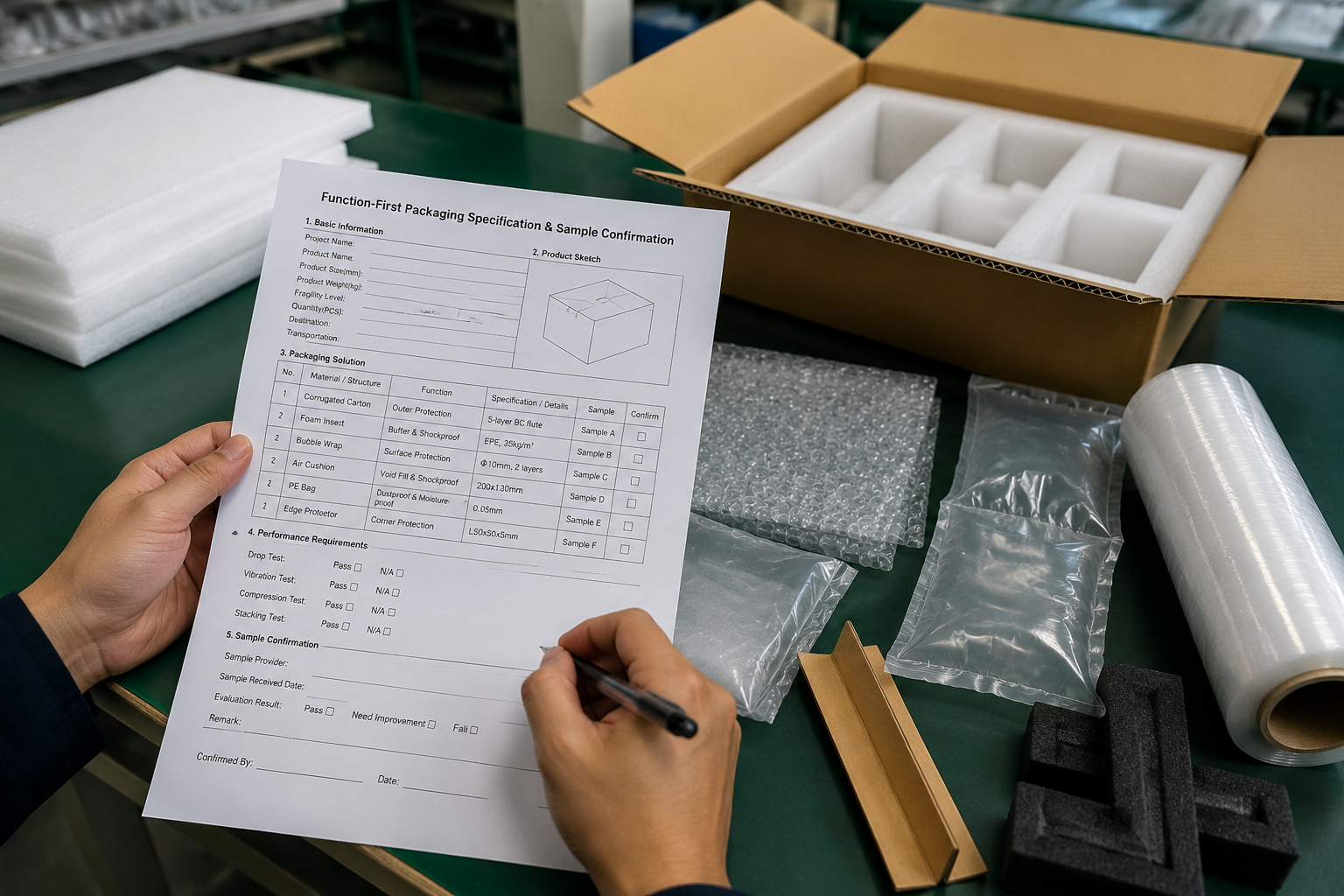
How to describe the packing goal clearly in a quote request
A strong quote request tells the supplier what the packaging must achieve. Instead of asking only for a material and size, describe the protection goal and the current packing challenge. This helps the supplier quote the right structure, not just the closest standard item.
For example, “We need to fill empty carton space” is different from “We need to protect a fragile corner from impact.” “We need to prevent scratches on a glossy surface” is different from “We need to keep four parts separated inside one carton.” Each request points to a different function, and sometimes to a different material combination.
A practical request can be simple:
- Product: include dimensions, weight, photos, surface finish, and fragile points.
- Packing goal: explain whether the priority is void fill, cushioning, surface protection, separation, support, or a combination.
- Carton layout: provide carton size, quantity per carton, product direction, and remaining space if known.
- Shipping condition: describe parcel delivery, warehouse handling, pallet shipping, export route, or storage requirements.
- Quotation need: ask for material, thickness or density where relevant, size, structure, packing quantity, and sample option.
This kind of request gives the supplier room to recommend. A buyer may still have a preferred material, but the supplier can explain if a thinner surface layer, a shaped foam insert, air cushions, bubble wrap, corrugated divider, or combined pack would serve the function better. The final packaging spec should record the agreed size, material, thickness or density, structure, sealing or cutting requirements, carton packing quantity, and any label or carton mark requirements before production starts.
Specification Confirmation Note: Before production, confirm the functional requirement together with size, thickness or density, structure, order quantity, printing or label details, carton packing quantity, and packing method. This gives both buyer and factory a clear reference for sampling, production preparation, and repeat-order checking.
Compliance-Sensitive Details Buyers Should Confirm Early
Some packaging questions are not only about whether the product arrives clean and undamaged. They also involve how the buyer intends to describe, label, ship, or use the packaging. Claims such as recyclable, compostable, moisture resistant, anti-static, food-contact suitable, or suitable for regulated transport should not be assumed from a material family alone. They depend on the exact structure, additives, documentation, destination market, and end use.
For environmental statements, buyers should decide whether the claim is needed on the product, carton, website, or sales document before approving materials. Recyclability and disposal instructions can depend on local collection systems, material combinations, labels, coatings, inks, and consumer instructions, so a claim should be reviewed against the final packaging structure rather than a sample material in isolation. Labeling programs and design guidance can help buyers evaluate how recycling communication should be supported before use.[9]
For moisture-sensitive, electronic, or static-sensitive products, the buyer should describe the actual risk clearly instead of using broad wording. A plastic bag may reduce dust exposure, but that does not automatically make the pack a moisture-barrier system. A foam or film material may reduce contact abrasion, but that does not automatically make it anti-static or suitable for electronics handling. If moisture-barrier or static-control performance is required, the supplier should review the requested specification, and the buyer should confirm whether supporting data or separate testing is needed before production.
For food, medical, cosmetics, hazardous goods, or child-related products, the pack should be reviewed with the intended contact and use condition in mind. Daipak Packaging can discuss material format, fit, cushioning, separation, and production details as a packaging materials supplier, but it should not be treated as a regulator, certification body, or transport authority. Where product-specific rules apply, the buyer should confirm the required documentation, testing route, and market requirements with the appropriate qualified parties before final approval.
How to Check Whether a Packaging Choice Will Hold Up in Real Use
Function-based packaging should be judged in the same way it will be used in production, not only by how it looks in a sample photo. A good pack may fail if the warehouse team packs it differently, if the carton size changes slightly, or if the product weight varies from one batch to the next. That is why buyers should look for signs that the design is repeatable, not just neat.
One useful check is to simulate the handling path. Place the product in the package, close the carton, and move it through the same steps it will face in real use: lifting, shifting, stacking, turning, and short transport. Listen for movement. Check whether corners hit the carton wall. Make sure the surface layer stays in place and does not wrinkle or slip away from the area it is supposed to protect. If possible, have the packing team repeat the process several times to see whether the result stays consistent.
Another useful check is to compare the sample against the actual production conditions. A sample made carefully by hand may look good, but bulk orders need a pack that remains stable at normal line speed. If the pack depends on one worker’s judgment, the result may vary too much. If it depends on difficult folding or exact positioning, it may work in the sample room but not in the warehouse. The strongest packaging choice is the one that survives ordinary packing habits.
For more formal validation, buyers can use recognized distribution test practices when the product value, route risk, customer requirement, or damage history justifies it. ASTM D4169, for example, is a standard practice for performance testing shipping containers and systems under defined distribution cycles, so it is better treated as a structured validation option than as a substitute for understanding the product risk.[6]
For this reason, Ms. Tang usually looks at order coordination and packing repeatability together. If a structure is technically correct but slow to assemble, that can matter as much as the material itself. Buyers should ask not only whether the pack protects the product, but also whether their own team can use it the same way every day.
How a Factory-Side Supplier Can Help Match Function to Material
A factory-side supplier can add value when the buyer has a clear protection goal but is not sure which material or structure should deliver it. This is especially true for custom packaging, export packing, and products that need more than one protection function inside the same carton.
As a China packaging materials supplier and protective packaging manufacturer, Daipak often helps buyers compare foam, bubble wrap, air cushion packaging, plastic bags, film, corrugated boxes, and custom inserts for the same product. The useful part of that discussion is not simply naming more options. It is matching each option to the job it can realistically perform in the pack.
A supplier familiar with multiple packing materials can also notice conflicts early. A cushion may protect the corner but make the carton too tight. A plastic bag may keep dust off the product but do little for impact. A corrugated divider may separate items but still need a soft layer for a finished surface. These details are easier to solve before sampling than after a bulk order has already been packed.
Why direct factory communication matters for function-based packaging
Function-based packaging requires back-and-forth communication. The buyer knows the product, damage complaints, customer expectations, and warehouse process. The supplier understands material behavior, cutting accuracy, sealing method, thickness limits, density options, carton fit, and production repeatability. When both sides discuss the function directly, the recommendation becomes more practical.
Direct communication also reduces the risk of quoting the wrong item. If a buyer asks for “foam,” the factory still needs to know whether the foam is for wrapping, surface protection, cushioning, spacing, an insert, a bag, or edge protection. If a buyer asks for “air cushions,” the factory needs to know whether the goal is void fill, product support, or lightweight cushioning for parcel shipment. The same material family can be made into very different formats.
For custom packaging, the supplier should review the product size, carton space, expected packing speed, order quantity, and shipping destination before giving a final recommendation. This does not make the process slower; it helps avoid unnecessary sample rounds and reduces the chance that the buyer compares prices for different protection levels without realizing it.
Why multi-material packaging often needs coordination, not a single-product quote
Many real packs do not rely on one material alone. A product may need a plastic bag for dust protection, an EPE foam sleeve for surface and edge protection, bubble wrap for flexible cushioning, a corrugated insert for separation, and a carton strong enough for stacking or export handling. Each part has a different job, and those jobs need to fit together.
The main coordination issue is space. If every layer is selected separately, the total pack may become too bulky for the carton. The carton may close poorly, the packing quantity may drop, or the pallet pattern may change. A factory-side review can check whether the combined thickness, product orientation, and carton layout still make sense before the buyer approves the sample.
Coordination also matters for packing labor. A beautiful multi-layer pack may fail in daily use if warehouse workers need too many steps to assemble it. Pre-cut sheets, pre-made bags, shaped foam pieces, corrugated dividers, or simple inserts may improve consistency if they match the packing flow. The best structure is not always the heaviest or most complex one; it is the one that protects the product and can be repeated correctly.
From a production perspective, details such as foam density, sheet thickness, bag sealing, cutting tolerance, bonding method, print position, and carton packing quantity should be confirmed as part of the same specification. If one part changes, the whole pack may need to be checked again.
Why repeat orders benefit from the same function logic
A stable function definition helps repeat orders stay consistent. If the approved spec says only “bubble wrap” or “foam sheet,” future orders may drift in size, thickness, format, or performance. If the spec says the packaging must prevent movement, protect a painted surface, separate two parts, or cushion a fragile corner, the supplier has a clearer standard to maintain.
Repeat-order consistency depends on practical details: confirmed dimensions, material type, thickness or density, sealing size, cutting method, packing quantity, carton labels, and any special marks. These details help the buyer reorder the same structure instead of restarting the discussion each time. They also help the factory check whether production output matches the previously approved sample.
This is useful when products are updated, carton sizes change, or the shipping route becomes longer. The buyer can return to the original function and ask whether the existing structure still works. If the product becomes heavier, the pack may need more support. If the finish changes from matte to glossy, the surface contact layer may need review. If the route changes from domestic warehouse delivery to export freight, the carton and inner protection may need to work harder together.
Feedback from delivered orders should also be connected back to the next purchase. If customers report scuffed corners, loose parts, crushed cartons, slow unpacking, or label confusion, that information can help Daipak and the buyer adjust material thickness, foam density, bag size, divider layout, carton quantity, marks, or pallet preparation for the repeat order. This kind of practical feedback loop does not need to be complicated, but it helps keep future production aligned with real shipment results.
Function-first thinking does not remove the need to compare price. It makes the price comparison fairer. Buyers can compare quotations against the same protection goal, the same sample requirements, and the same packing assumptions. That is a stronger basis for purchasing than choosing the lowest unit price without knowing whether the pack is solving the right problem.
References
[1] ASTM International, “ASTM D642 Standard Test Method for Determining Compressive Resistance of Shipping Containers,” packaging test method reference for evaluating compression resistance of shipping containers, available at ASTM D642 Compression Resistance.
[2] ASTM International, “ASTM D4728 Standard Test Method for Random Vibration Testing of Shipping Containers,” shipping-container vibration test reference supporting vibration as a distribution risk to evaluate in package design, available at ASTM D4728 Random Vibration Testing.
[3] International Safe Transit Association, “ISTA Procedure 3A Overview,” packaged-product test overview for parcel delivery systems and small package shipping contexts, available at ISTA Procedure 3A Overview.
[4] Federal Trade Commission, “FTC Green Guides,” U.S. environmental marketing guidance relevant to recyclable, degradable, compostable, and other environmental claims, available at FTC Green Guides.
[5] International Organization for Standardization, “ISO 18602 Packaging Optimization,” packaging optimization reference for fit-for-purpose packaging and source reduction discussions, available at ISO 18602 Packaging Optimization.
[6] ASTM International, “ASTM D4169 Standard Practice for Performance Testing of Shipping Containers and Systems,” standard practice reference for testing shipping containers and systems under distribution-cycle conditions, available at ASTM D4169 Shipping Container Performance Testing.
[7] U.S. Food and Drug Administration, “Food Packaging and Other Substances That Come into Contact with Food,” consumer-facing reference on food packaging and food contact substances, available at FDA Food Packaging and Food Contact Substances.
[8] United Nations Economic Commission for Europe, “UN Model Regulations Rev. 24,” dangerous goods model regulations reference with packaging-related provisions for regulated shipments, available at UNECE UN Model Regulations Rev. 24.
[9] How2Recycle, “How2Recycle Label Guidance,” recyclability labeling reference for consumer-facing recycling instructions and communication, available at How2Recycle Label Guidance.