
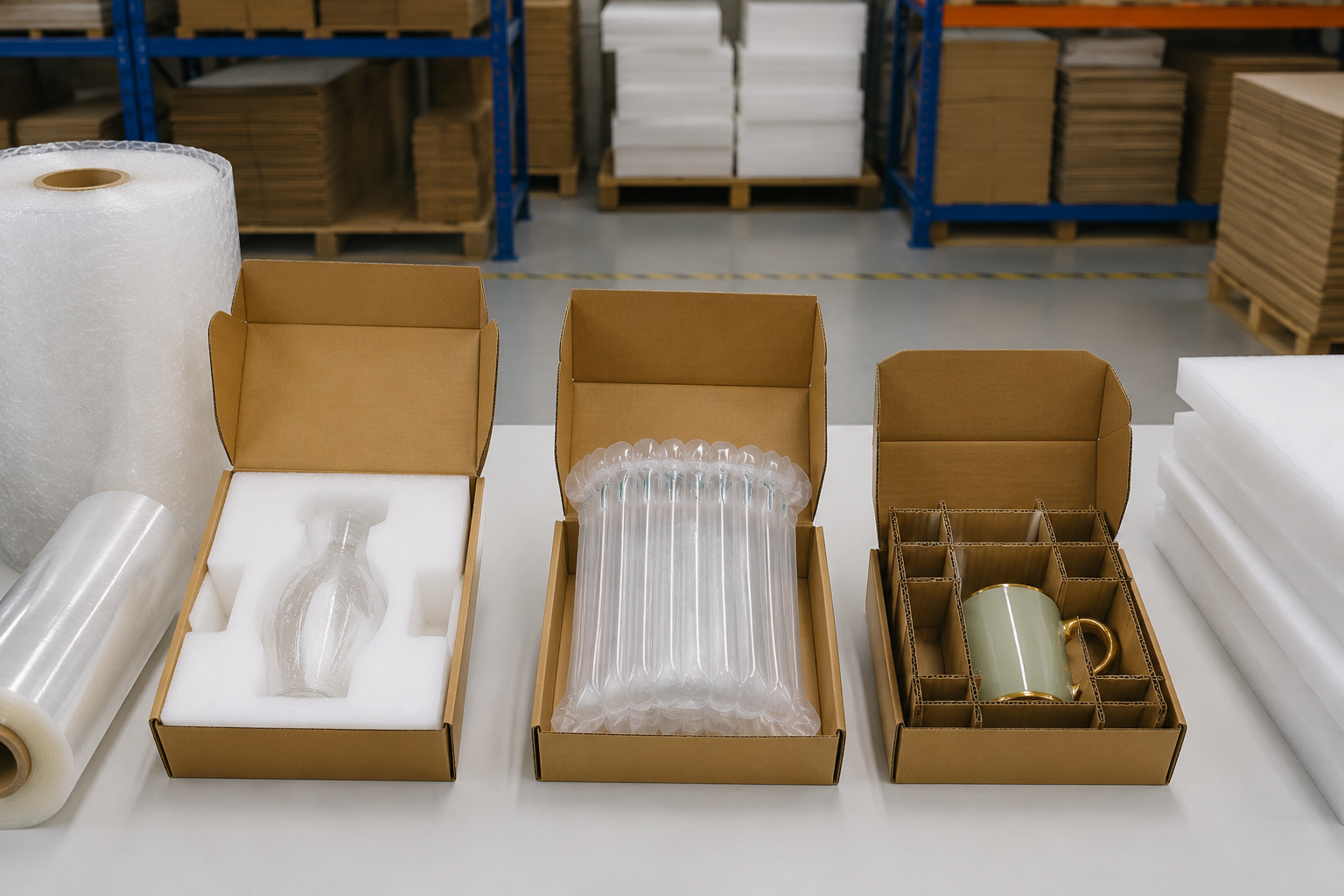
Choosing between custom foam inserts, air column packaging, and corrugated inserts is not just a material decision. The right option depends on what problem the package must solve: stopping movement, absorbing shock, separating parts, protecting surfaces, improving presentation, speeding up packing, or fitting more efficiently inside the carton. A fragile product may need strong fixed-position support, lightweight cushioning, simple separation, or a combination of materials.
This article helps buyers compare these insert types as a complete packing system rather than by unit price alone. Product size, weight, weak points, carton space, shipping route, order quantity, sample testing, and repeat production consistency all affect the final choice. The goal is to avoid both under-protection and unnecessary packaging while selecting an insert structure that works reliably in real packing and transport conditions.
Quick Packaging Decision Guide
| Buyer Question | Practical Reading | What to Check |
|---|---|---|
| Does the product need fixed positioning? | Custom foam is usually stronger for irregular, fragile, or presentation-sensitive items. | Product shape, weak points, movement inside the insert, and carton fit. |
| Is lightweight cushioning more important than precise location? | Air column packaging can work well for regular shapes and fast packing. | Inflation quality, product edges, carton clearance, and shipping route. |
| Is the main need separation and organization? | Corrugated inserts are practical for stable sizes, fixed counts, and simple packing lines. | Part separation, stacking pressure, carton layout, and assembly speed. |
| Will the lowest insert price reduce total cost? | Not always; labor, carton size, tooling, storage, and damage risk can change the result. | Total packed cost, repeat-order consistency, and carton utilization. |
| Should one material or a hybrid design be used? | Hybrid packaging helps when one material cannot solve all protection risks. | Each added layer should solve a clear problem, not add unnecessary bulk. |
| What should be tested before approval? | Samples should be checked as a full packed system, not judged by appearance only. | Fit, movement, surface contact, packing speed, and protection of fragile points. |
Quick Questions Before You Read
Q: Which insert is best for highly fragile or irregular products?
Custom foam is often a more controlled starting point because it can hold the product in a fixed position and support weak areas more precisely.
Q: When does air column packaging make sense?
It works best for regular product shapes where lightweight cushioning, compact storage before use, and fast packing are important.
Q: Are corrugated inserts enough for fragile products?
They can be enough when the main need is separation and carton organization, but they may be weaker for heavy shock or brittle items.
Q: What information should I send before requesting samples?
Send product dimensions, weight, fragile points, surface sensitivity, carton limits, quantity per carton, packing direction, and shipping route.
Start With the Packaging Problem the Insert Must Solve
Before comparing custom foam inserts, air column packaging, and corrugated inserts, the first question is not “which material is best?” The better question is: what problem must the insert solve inside the carton? For fragile product packaging, the insert may need to stop movement, absorb shock, protect a surface finish, separate parts, control the unboxing position, or make packing faster and more consistent.
Custom protective packaging works best when the buyer defines the risk clearly. A glass bottle with a narrow neck does not fail in the same way as a small electronic device with a screen, a precision instrument with protruding knobs, or a cosmetic set that must arrive clean and well presented. One product may need fixed-position packaging so it cannot shift. Another may need soft surface protection to avoid scuffs. A third may need void filling because the outer carton is larger than the product.
More cushioning is not always better packaging. If the insert is too soft, the product may still move during transit. If the structure is too tight, pressure can concentrate on a cap, corner, glass rim, display, or decorative coating. If the insert takes too much carton space, the buyer may pay for a larger shipping carton without improving protection. The goal is not simply to add material; it is to control movement, contact, and impact in a way that fits the product and the shipping route.
At Daipak Packaging, the discussion usually starts with the product details rather than the material name. Product size, weight, shape, fragile points, surface finish, carton space, and shipping destination all affect whether foam, air column structures, corrugated inserts, or a combined system will make the most practical sense.
What makes a product difficult to package safely
A fragile product becomes difficult to protect when it has several risks at the same time. Movement is one of the most common. If the item can slide, rotate, or bounce inside the carton, even a strong outer box may not prevent damage. Repeated vibration during truck, courier, or export handling can slowly move the product toward a carton wall, another item, or a hard contact point.
Pressure points also matter. A bottle shoulder, glass rim, electronic screen edge, instrument dial, or cosmetic pump may be more vulnerable than the main body of the product. If the insert touches only a few small areas, impact force can concentrate there. Good insert packaging spreads contact across safer surfaces and avoids loading delicate features directly.
Surface scratching is a separate issue from breakage. A product can arrive unbroken but still be unacceptable if a glossy coating, printed label, painted metal part, acrylic panel, or retail surface is rubbed during shipment. Foam, film, bubble, paper, or corrugated contact surfaces should be selected with the finish in mind. The buyer should ask whether the insert only reduces breakage risk or also protects appearance.
Carton voids add another layer of risk. Empty space may seem harmless, but it gives the product room to gain momentum during drops and vibration. Void filling can help, but loose fill alone may not create reliable product immobilization. For higher-risk items, the insert must hold the product in a predictable position so operators pack it the same way each time.
Why carton fit matters as much as cushioning
A well-designed insert can perform poorly if the carton fit is wrong. If the carton is too large, the insert may shift as a whole. If the carton is too tight, the insert may compress unevenly and transfer pressure to the product. The outside box and the internal protection need to work together, especially for export packing, e-commerce parcels, and cartons that may be stacked or handled multiple times.
Carton fit also affects shipping efficiency. A thick insert may look protective, but if it forces the buyer into a larger carton size, the total cost can rise through higher material use, more warehouse space, and less efficient pallet loading. On the other hand, reducing the insert too aggressively can leave corners, edges, or fragile parts exposed. The practical balance is to use enough structure to control movement without wasting carton space.
Buyers should compare packed dimensions, not only product dimensions. A product that measures 200 mm may require a much larger carton after foam thickness, air columns, dividers, or clearance space are added. This is why early carton review is important. The insert should answer three plain questions: will it hold the product in place, help protect during shipping, and fit my carton without creating avoidable waste?
Carton fit should also be checked against real loading conditions. A carton that works on a packing table may behave differently after being stacked on a pallet, placed at the bottom of a mixed shipment, or handled by courier networks. Buyers should confirm inner carton dimensions, outer carton board strength, closure method, carton marks, pallet pattern, and whether the cartons will be loaded loose or palletized. These details affect how much compression, vibration, and side impact the insert must help manage.
Evidence-based checks for compression and distribution risk
When cartons will be stacked, palletized, or placed under mixed freight, buyers should avoid judging insert strength by touch alone. Compression resistance depends on the complete shipping container, load pattern, board condition, closure method, and handling environment; standardized compression testing is designed to evaluate shipping containers under controlled loading rather than assuming strength from material name alone.[1]
For parcel and small-package distribution, the buyer should also think beyond a single drop or squeeze check. Packaged-product test procedures for parcel delivery consider a distribution system as a sequence of handling hazards, so a sample that looks good on the table should still be reviewed as a closed carton with the product, insert, outer box, and closure method working together.[2]
Compliance boundaries before choosing a material
Some packaging decisions involve more than cushioning performance. If the insert, bag, film, liner, label, coating, or divider will be used near food, cosmetics, electronics, liquids, batteries, or regulated shipments, buyers should confirm the end use before production. A material that works well as outer protective packaging is not automatically suitable for direct food contact, special transport handling, anti-static protection, moisture barrier use, or environmental labeling.
Claims should match the confirmed specification. For example, “helps reduce movement,” “supports separation,” or “can improve packing consistency” are usually more accurate than broad statements such as “prevents damage” or “works for all shipping conditions.” If the buyer needs a specific claim such as recyclable, compostable, anti-static, moisture barrier, heavy-duty stacking, or direct food-contact suitability, the requirement should be checked separately with the material, structure, destination market, and any required documentation before the claim is used.
When the insert needs to do more than protect
Some inserts must also support presentation. Cosmetics, gift sets, electronics, glassware, and premium retail items often need to open cleanly, show the product in a fixed position, and keep accessories organized. In those cases, protection and presentation cannot be separated. A structure that protects well but looks messy may create problems for the brand or the receiving team.
Set consistency is another practical requirement. If one carton contains a bottle, cap, pump, instruction sheet, cable, or accessory pack, the insert can help operators place each item in the same position every time. This reduces packing errors and makes receiving inspection easier. For repeat orders, a stable insert structure also helps keep material use, packing method, and carton quantity more predictable.
Packing line speed should not be ignored. A highly protective insert that takes too long to assemble may slow the warehouse. A simple insert that operators use incorrectly may create hidden damage risk. The best choice is often the one that operators can pack correctly at normal speed, with limited variation between shifts, order batches, or production sites.
How Custom Foam Inserts Perform for Fragile Products
Custom foam inserts are usually chosen when the product needs a tight fit and controlled support. Unlike loose cushioning or basic void fill, foam inserts for packaging can be cut or shaped to hold the item in a fixed position. This makes foam useful for products that must not move inside the carton, especially when the shape is irregular, the surface is sensitive, or certain edges and corners need extra protection.
EPE foam packaging is often used for protective foam packaging because it can provide cushioning, separation, and surface protection in one structure. Die-cut foam can create cavities for bottles, devices, parts, or accessories. Molded foam or shaped foam structures may be considered when the product form requires more precise support. The right foam design depends on thickness, density, cavity tolerance, product weight, and the expected handling conditions.
Foam is not automatically the best choice for every fragile product. It can provide controlled cushioning and a premium look, but it usually requires more setup effort than simpler inserts. Buyers should consider sample development, cutting accuracy, material density, storage volume, and how the insert will be packed into the carton. Foam is most justified when the added control reduces a real risk that lighter or simpler structures cannot handle well.
Where foam inserts usually deliver the strongest fit
Foam inserts are strongest when geometry matters. A product with a narrow neck, uneven body, delicate corner, protruding switch, curved glass surface, or multiple accessories may need cavities that match its shape. By nesting the product into the foam, the packaging can limit sliding and rotation while keeping fragile areas away from the carton wall.
This fixed-position performance is valuable for products that should not touch each other during shipment. Glassware sets, instrument parts, electronic accessories, and cosmetic bottles may all need separation as much as cushioning. Foam can create individual pockets, top-and-bottom pads, corner blocks, or full trays depending on the product risk. The goal is to support stable areas of the product while avoiding pressure on delicate features.
Foam also helps when repeat packing consistency matters. If the cavity is clear and the product only fits one way, operators are less likely to pack it incorrectly. That matters in bulk orders, warehouse packing, and export cartons where small packing variations can become damage claims later.
What buyers give up when they choose foam
The main trade-off with custom foam inserts is development effort. A foam insert may require drawings, product samples, cavity testing, cutting setup, and sample confirmation before bulk production. If the buyer changes the product size, bottle cap, accessory layout, or carton size, the foam design may also need to change. This can affect timing and cost.
Material choice also matters. Softer foam may cushion well but may not hold a heavier item firmly. Denser foam may support the product better but can transfer more pressure if the contact areas are poorly designed. Thickness, density, cavity clearance, and edge distance should be reviewed together. A lower foam cost is not always a better value if the insert becomes too thin, too loose, or difficult to assemble.
Buyers should also ask how the foam is processed. Cutting, bonding, laminating, grooving, and multi-layer assembly can all affect the final fit. A cavity that looks correct in a drawing may need tolerance adjustment after the real product is placed inside, especially when bottles have slight dimensional variation or electronic housings have raised buttons and ports. For presentation-sensitive goods, buyers should confirm whether the contact surface may leave dust, marks, or rubbing on glossy finishes, and whether an inner bag, film, tissue layer, or softer liner is needed.
Storage is another consideration. Foam inserts usually arrive in their finished shape, so they can take more warehouse space than flat corrugated parts or uninflated air column bags. For large inserts or high-volume orders, buyers should check carton packing quantity, line-side storage space, and how the inserts will be staged near the packing table.
Foam insert fit for bottles, instruments, and electronics
For bottles, foam can support the body, reduce side movement, and protect the shoulder, base, or cap area. This is useful when the bottle is glass, the closure is exposed, or the label surface must stay clean. The insert should not press too strongly against a pump, spray head, thin cap, or decorative coating. A good design supports the stable body of the bottle first.
For instruments, foam is often used because the product may have sensitive measuring surfaces, knobs, screens, lenses, or calibrated parts. The insert needs to prevent movement without loading fragile control points. In many cases, a bottom cavity plus a top pad or cover layer gives better stability than a single flat pad.
For electronics, the value of foam depends on product weight, edge sensitivity, and surface finish. Small devices may need corner and screen protection, while heavier devices may need stronger structural support. Foam can improve packing consistency, but buyers should also consider anti-scratch surfaces, accessory placement, and whether the outer carton can handle stacking pressure.
How Air Column Packaging Performs for Protection and Packing Speed
Air column packaging is often selected when buyers want lightweight cushioning, compact storage before use, and a packing process that can move quickly once the inflation setup is in place. Air cushion packaging can wrap or surround fragile items, creating a buffer between the product and the carton wall. For many shipping operations, this makes it practical for bottles, delicate retail goods, and products that need cushioning without a heavy insert structure.
The main difference is that air column bags usually work as a cushioning surround rather than a precise fixed-position insert. They can absorb shock and distribute impact across inflated chambers, but they may not hold every product geometry as tightly as foam. If the product has sharp edges, heavy weight, or a shape that can shift inside the inflated structure, the buyer should check the packed sample carefully.
Air column packaging is also an operational choice. It can reduce inbound storage volume because the material is stored flat before inflation. It can support pack-on-demand workflows where the warehouse inflates material as needed. The trade-off is that inflation quality, sealing performance, chamber size, and carton fit must be controlled. Poor inflation or an unsuitable carton can reduce the protection that the structure is expected to provide.
Why air column packaging helps with storage and warehouse space
Before inflation, air column bags and related inflatable packaging occupy much less space than many pre-formed inserts. This can be useful for warehouses that handle multiple product sizes, seasonal order volume, or limited line-side storage. Instead of receiving bulky protective structures, the buyer stores flat material and inflates it near the packing operation.
This storage advantage can also reduce internal handling. Flat material is easier to move, count, and stage than large shaped inserts. For e-commerce sellers and distribution teams, that can make air column packaging attractive when the product range changes often or when the same packing area handles different carton sizes during the day.
However, the warehouse needs a practical inflation process. Operators must use the correct air level, seal quality, and packing method. Underinflated columns may not cushion well. Overinflated structures may become harder to fit into the carton or may place too much pressure on the product. The material is compact before use, but the final packed size still needs to match the carton.
Inflation control should be treated as part of the packaging specification, not as a small warehouse detail. Buyers should confirm the film thickness, column width, sealing form, inflation pressure range, and whether the inflated pack still closes cleanly inside the carton. If different operators use different air levels, the same air column design can perform differently from carton to carton. For repeat orders, a short packing instruction with photos can help keep inflation, product placement, and carton closing consistent.
Where air column structures can protect well
Air column structures can perform well when the product benefits from wraparound cushioning. Bottles, jars, small appliances, cosmetics, and delicate retail goods may be suitable if the air chambers surround the product evenly and limit direct contact with the carton wall. The inflated columns help distribute drop energy across a larger area rather than concentrating it at one hard point.
For bottle packaging, air columns can protect the body and reduce side impact, especially when the carton is designed around the inflated size. For delicate retail goods, the lightweight structure can help maintain shipping efficiency while still providing a visible protective layer. This can be useful when the buyer needs a balance between protection, storage convenience, and packing speed.
Air column packaging is usually more effective when the product shape is regular enough for the inflated structure to hold it consistently. A cylindrical bottle, rectangular retail box, or compact device may fit better than a product with many protruding parts. The buyer should test whether the item stays centered after vibration, carton turning, and normal handling.
Where air column packaging is less suitable
Air column packaging is less suitable when the product requires exact positioning. If a fragile item must sit in a precise cavity, avoid contact on a specific feature, or remain aligned for presentation, foam or a corrugated structure may offer better control. Air columns cushion well in many cases, but they do not always create the same immobilization as a custom-shaped insert.
Sharp edges and pointed parts also need attention. A metal corner, exposed tool edge, rough casting, or sharp glass feature may damage the air chamber if the material and layout are not chosen carefully. Buyers should review whether a protective sleeve, film layer, corrugated separator, or foam pad is needed between the product and the inflatable structure.
Heavy products can be another limitation. If the item is too heavy for the selected air column structure, the chambers may compress, shift, or fail to hold the product away from the carton wall. For rigid, heavy, or high-value fragile items, the packaging decision should include carton strength, internal positioning, and sample testing under realistic handling conditions rather than relying on cushioning alone.
Air column limitations for moisture, puncture, and special handling claims
Air column film should not be described as waterproof, puncture-proof, or suitable for every courier route unless the exact material and packed system have been checked for that use. The buyer should confirm whether the product has sharp edges, rough surfaces, caps, valves, corners, or accessories that may abrade the film during movement. Where liquid leakage, humidity exposure, cold-chain handling, or long storage is part of the order, the packaging should be reviewed as a complete system rather than treated as a moisture barrier by default.
If air column packaging is used for electronics, buyers should also avoid assuming anti-static or ESD protection from the material name alone. Sensitive electronics may require separate confirmation of the required protective properties, compatible bags or liners, handling procedures, and documentation before production. In practical sourcing, it is better to state the protection requirement clearly than to rely on a generic “electronics packaging” description.
When Corrugated Inserts Are the Practical Choice
Corrugated inserts are often the practical answer when the main job is to hold products in place, separate them, and keep them organized inside the carton. They are not built to replace every cushioning structure, but they can solve a lot of packaging problems without the added complexity of custom foam or inflatable systems. For buyers comparing corrugated inserts with other protection structures, the key question is whether the product mainly needs positioning and carton control, or whether it also needs stronger impact cushioning and surface isolation.
That is why corrugated packaging inserts work well in packaging structures where the carton layout is already fairly stable. If the product size is consistent, the pack count is fixed, and the shipping route is not extremely harsh, corrugated inserts can give a clean fixed-position carton setup with less development work. In many cases, they also help buyers keep carton organization simple, which matters when the packing team needs repeatable results across many orders.
Where corrugated inserts solve the problem efficiently
Corrugated inserts are strong when the product needs separation more than deep cushioning. A carton divider, paperboard insert, or fixed-position carton insert can keep bottles from touching, prevent small devices from shifting, and organize multiple pieces in one shipper. For grouped products, that separation is often just as important as padding, because product-on-product contact can cause scratches, chipped edges, label damage, or loose packing during transit.
They are also useful when the buyer wants moderate fixed-position support without building a highly customized insert structure. If the product has a steady shape and the carton size is already defined, corrugated inserts can create a repeatable packing layout with a simple setup. That is one reason they are often chosen for standardized retail shipping, inner pack organization, and carton-based product sets where the goal is to keep items aligned and stable.
Where corrugated inserts fall short
Corrugated inserts should not be treated as a substitute for strong cushioning in every case. Their main strength is structural organization, not heavy shock absorption. If the product is brittle, heavy, or highly sensitive to drop impact, a corrugated insert alone may not provide enough protection at the corners, edges, or contact points. In those cases, buyers often need a combined structure or a different insert material.
Corrugated material can also be more sensitive to moisture and crush conditions than some buyers expect, especially if cartons are stored in less controlled environments. It can perform well in normal dry warehouse and shipping conditions, but it is not the best choice when the packaging must also hold up to long damp storage, rough stacking, or very premium presentation requirements. A corrugated insert can look neat, but it usually does not create the same premium, molded feel that some brands want for high-end unboxing.
Sustainability and recycling claims need precise wording
Corrugated packaging is widely discussed as a recyclable packaging material, and industry resources describe corrugated as recyclable within established recovery systems.[3] That does not mean every finished pack can automatically carry a broad environmental claim in every market. Coatings, mixed materials, labels, tapes, contamination, and local recycling access can all affect the correct claim a buyer should make.
For foam, air column films, laminated papers, or hybrid packs, buyers should be especially careful with words such as “eco-friendly,” “recyclable,” “biodegradable,” or “compostable.” Environmental marketing guidance treats these as claims that may need qualification, especially when recycling or composting access is limited or when a claim could overstate the package’s end-of-life performance.[4] A safer purchasing practice is to ask the supplier for material identification, recycled-content details where relevant, and destination-market claim requirements before printing environmental language on the carton or retail pack.
How corrugated inserts support simpler packing lines
One reason buyers choose corrugated inserts is that they can simplify packing operations. The structure is usually easy to source, easy to cut or fold, and easy for operators to understand. That makes them useful when packing teams need a simple setup with fewer steps and less training. In a stable packing line, a corrugated insert can reduce variation because the insert itself guides where each product goes.
They also support standardization. When the carton size, product count, and insert layout stay consistent, buyers can keep packing organization under control across repeat orders. That matters for warehouse teams, e-commerce sellers, and manufacturers that want fast carton assembly without needing a highly engineered custom insert every time. From a factory perspective, corrugated inserts often make sense when the buyer wants good carton organization and moderate protection without adding unnecessary development burden.
Compare the Three Structures by the Factors Buyers Actually Care About
When buyers compare foam inserts vs air column packaging vs corrugated inserts, the right answer usually depends on a few practical questions: How much movement can the product tolerate? How much protection is needed at the surface and corners? How much carton space can the pack use? And how much complexity can the packing line handle?
The table below gives a clear side-by-side view. The useful takeaway is not that one structure wins in every row. It is that each one solves a different part of the packaging problem, and the best choice depends on how the product moves, how it ships, and how the carton is used in real packing.
| Buyer factor | Foam inserts | Air column packaging | Corrugated inserts |
|---|---|---|---|
| Protection control | Strong fixed-position support and surface control | Good lightweight cushioning around the item | Moderate support, best for organization and separation |
| Carton space | Can be thicker, but tightly matched to the product | Compact before inflation, flexible around the carton | Usually efficient for simple internal layouts |
| Storage footprint | Higher than flat paper structures, depending on form | Low before inflation, easy to stage | Typically easy to store and stack flat |
| Setup complexity | Higher development and specification control | Requires inflation logic and puncture awareness | Usually the simplest to deploy |
| Packing speed | Fast once the structure is finalized | Fast for pack-on-demand workflows | Fast for standardized packing lines |
| Customization level | High | Medium to high, depending on structure | Medium, often easier to adapt |
Protection performance: shock, crush, and surface control
Foam inserts usually give the strongest fixed-position control, especially when the product has fragile edges, coated surfaces, or a shape that must not shift inside the carton. Air column packaging can cushion well when the goal is to absorb impact around the item, but it does not always lock the product in place as tightly as a shaped insert. Corrugated inserts are better for separation and moderate support than for deep shock control, so they fit simpler packaging problems more naturally.
The buyer should think about the kind of damage risk first. If the issue is surface scratching or small movement during transit, a corrugated insert may be enough. If the product faces higher drop risk or needs contact-point control, foam often becomes more relevant. If the packing system needs lightweight cushioning with less stored bulk, air column packaging may be the better fit.
Carton space and shipping efficiency
Carton space matters because a tighter package can reduce wasted void and improve carton use. Foam inserts can create a very efficient internal fit when they are designed around the exact product, but the insert thickness still affects the final carton size. Air column packaging can be flexible around the product and is often useful when the buyer wants cushioning without a large amount of stored material. Corrugated inserts usually help most when the carton layout is straightforward and the product count is fixed.
Shipping efficiency is not only about material cost. A carton that is too large for the insert structure may raise freight cost, increase movement in transit, and make pallet loading less stable. Buyers should check how much void is left after the insert is placed, whether the package nests well in outer cartons, and whether the final packed dimensions still suit the shipping method.
Storage volume and warehouse handling
Storage footprint can change the real cost of a packaging choice. Corrugated inserts are usually easy to store flat and move around the warehouse, which helps when line-side space is limited. Air column packaging also has a strong storage advantage before inflation, so it can work well in operations that need compact inbound volume. Foam inserts take more planning because their form and thickness may require more staging space, especially if they are custom-shaped.
Warehouse handling matters too. If the packing area needs quick access and minimal clutter, a simpler insert structure may be easier to manage. If the buyer packs in batches or keeps repeat inventory, the storage and handling difference can be significant over time. This operational detail should be reviewed early, because storage convenience affects the whole packing flow, not just the material line item.
Setup cost and production complexity
Setup cost is not only the quote for the insert itself. Buyers should also think about sampling, structure development, and repeatability. Foam inserts often require the most careful development because the fit must be confirmed precisely. Air column packaging can reduce some storage and shipping burden, but it may bring its own process requirements around inflation and puncture handling. Corrugated inserts are often simpler to start with because the tooling and structural development are usually less demanding.
That does not mean corrugated inserts are only a low-cost fallback. In many cases, they are the most practical choice because they reach the needed result with less design effort. For buyers with standard products and repeat orders, that lower complexity can be a real advantage, especially when the pack structure does not need highly specialized shaping.
Packing speed and operator consistency
Packing speed depends on how much judgment the operator must use at the line. Foam inserts can be very fast once the structure is finalized, because the product has a fixed home and the insert tells the operator exactly where it goes. Air column packaging can also support fast packing, especially in pack-on-demand environments, but the workflow depends on how the inflation step is managed. Corrugated inserts are often the easiest for teams to learn because the layout is straightforward and the packing sequence is visible.
Operator consistency matters just as much as speed. A structure that reduces variation can lower packing mistakes, even if the material itself is simple. If one team member can assemble the pack differently from another, the buyer may see inconsistent protection and inconsistent carton use. That is why simpler insert systems often perform well in high-volume packing lines: they standardize the work, not just the package.
Customization level and product fit
Foam inserts usually offer the highest level of product fit, which makes them useful for irregular shapes, fragile contact points, and products that must not move at all. Air column packaging offers flexible adaptation, but it is more about surround cushioning than exact immobilization. Corrugated inserts sit in the middle: they can be tailored for separation and positioning, but they are usually strongest when the product dimensions are stable and the carton design is already defined.
For buyers, the real question is whether the product needs a custom-shaped home or simply a clean, repeatable packing layout. If the brand cares about fit, consistency, and a structured unboxing, foam may justify the extra development. If the priority is lighter cushioning and compact storage, air column packaging may fit better. If the goal is carton organization with lower complexity, corrugated inserts are often the most practical answer.
Match the Right Structure to the Product Category and Shipping Risk
Product category helps narrow the choice, but it should never be the only factor. The same bottle, device, or glass item may need a different structure depending on weight, finish, carton size, and shipping route. For fragile products packaging, the best match is the one that controls motion, protects contact points, and fits the packing process the buyer actually uses.
Bottles and liquid products
Bottles often need movement control first. If the bottle can shift, tilt, or knock against another bottle, the carton may fail even if the outer box looks strong. Corrugated inserts can work well for bottle separation and grouping, especially when the pack count is fixed and the bottle shape is consistent. Foam inserts become more useful when the bottle has a delicate label, a coated surface, or a shape that needs tighter immobilization. Air column packaging can help when the goal is to cushion around the bottle or protect it inside a larger shipping carton, but it should still be checked for how well it holds the bottle in place.
For liquid products, cap protection and leakage caution matter as much as breakage control. A buyer should confirm whether the packaging needs to prevent bottle-to-bottle contact, brace the neck area, or support the base more strongly. Carton fit is especially important here, because extra void can let the bottles move even if the insert material itself is acceptable.
Food-contact and regulated-use caution
If an insert, bag, liner, or divider will touch food directly, the buyer should treat the material choice as a food-contact question, not only as a cushioning question. In the EU, food contact materials are regulated around safety for materials and articles intended to contact food, while U.S. polymer and paper packaging components may need review under applicable FDA indirect food additive regulations depending on the material and use case.[5][6] For ordinary outer protection that never contacts food, the review may be different, but buyers should still separate “shipping protection” from “direct food-contact suitability.”
For liquids, aerosols, chemicals, batteries, or other goods that may fall under transport controls, the insert choice cannot replace the need to confirm the product’s shipping classification and packaging requirements. Dangerous goods frameworks include packaging-related provisions for regulated shipments, so buyers should not assume that foam, air column packaging, or corrugated inserts alone make a regulated product ready for export or courier movement.[7]
Electronics and small devices
Electronics and small devices usually need immobilization and edge protection. Sensitive corners, finished surfaces, connectors, or screens can all be damaged by repeated movement inside the carton. Foam inserts are often strong in this category because they can create a precise cavity around the product. Corrugated inserts can also work when the product is standardized and the main goal is to keep units separated and stable. Air column packaging is better suited when the device needs lightweight cushioning in transit rather than a highly rigid fixed position.
For these products, packing consistency matters because one loose pack can become a support issue later in the supply chain. Buyers should look not only at the material, but also at whether the structure gives the operator an obvious and repeatable packing method. If the item is packed in volume, the structure should reduce variation from one shift to another.
Instruments, glassware, and highly fragile items
Instruments and glassware usually need the most careful position control. These items are often vulnerable to drop impact, point pressure, and vibration, so the insert must do more than simply fill space. Foam inserts are often the strongest choice when the product must stay centered and protected at specific contact points. Corrugated inserts can still help when the main need is separation, but they are usually not enough by themselves for highly fragile items that can crack or chip from motion. Air column packaging may support the outer protection layer, but it often works best alongside a more precise internal structure.
For this category, the buyer should think about the weakest point on the product. A glass edge, a calibrated surface, or a protruding instrument part may need a very specific cavity or brace. In many cases, the final answer is not “more padding,” but “better fit.” That is the difference between cushioning and real fixed-position packaging.
Cosmetics and presentation-sensitive products
Cosmetics often sit between protection and presentation. The item may not be as fragile as glassware, but buyers still care about clean appearance, carton efficiency, and unboxing consistency. Corrugated inserts can work well when the product set is standardized and the packaging needs neat organization. Foam inserts may be preferred when the brand wants a more premium presentation or a tighter fit around shaped bottles, jars, or sets. Air column packaging can support shipping protection, but it usually makes more sense when the focus is lightweight cushioning rather than presentation inside the carton.
For cosmetics packaging, the structure should support both the product and the brand experience. If the carton is used for retail presentation, the insert should look clean and hold every item in a predictable position. If the product ships in bulk or through e-commerce, the pack may need a simpler structure that balances protection with carton efficiency. The best choice depends on how much the buyer values presentation, pack speed, and shipping stability at the same time.
What Buyers Should Confirm Before Asking for Samples or a Quote
A useful custom quote depends on more than the product name. “Glass bottle,” “small device,” or “cosmetic set” gives a packaging supplier a starting point, but it does not explain how the item breaks, how it moves inside the carton, or how the packing team will assemble the final package. Before requesting samples, buyers should prepare enough product and shipping information for the supplier to compare foam, air column, corrugated, or a combined structure with real constraints in mind.
The most common mistake is separating the insert from the carton too early. Product dimensions tell the supplier the size of the item, but packed dimensions show how much room remains after the insert, cushioning, dividers, bags, or outer carton are included. A foam insert with a tight cavity may need more carton space than expected. An air column bag may require clearance after inflation. Corrugated dividers may organize products well but still need top, bottom, or corner protection. Without carton size and packing method, the quote may look correct on paper but fail during sample confirmation.
At Daipak Packaging, the discussion usually starts with the product details rather than the material name. For custom packaging, the team often needs product size, weight, photos, packing quantity per carton, carton limits, surface protection needs, and shipping destination before making a practical recommendation.
Specification Confirmation Note: Before production, buyers should confirm size, thickness, density, structure, quantity, printing or labels, carton fit, and packing method so the approved sample can be repeated with fewer interpretation gaps.
The minimum product data a supplier needs
The first information to send is the product’s actual dimensions, including length, width, height, diameter, irregular protrusions, caps, handles, screens, buttons, hinges, or fragile corners. If the product has a tapered shape, curved surface, or uneven base, photos from several angles are more useful than a single measurement. For products still in development, a drawing or 3D file can help the supplier plan the cavity, clearance, or divider spacing before a physical sample is available.
Weight matters because cushioning and positioning are not the same problem. A light glass ornament may need surface separation and gentle shock absorption. A heavier electronic device may need stronger edge support and a carton structure that resists compression. A tall bottle may need cap protection and control around the shoulder and base. If the supplier does not know the weight, material thickness, foam density, air column size, and corrugated flute choice can be difficult to judge.
Buyers should also identify breakage points and surface sensitivity. A glossy cosmetic bottle may not break easily but can reject if the surface is scratched. A measuring instrument may have a sensitive display or calibration part that cannot receive direct pressure. A glass jar may need separation between units to prevent side impact. These details help the supplier decide whether the insert should focus on cushioning, surface protection, product immobilization, or carton organization.
Carton constraints should be confirmed early. If the buyer already has a fixed outer carton size, the insert must be designed within that space. If carton size is still open, the supplier can propose a structure that balances protection and carton utilization. Buyers should send the number of pieces per carton, preferred packing direction, retail box size if any, export carton requirements, and whether the carton will be palletized, stacked, or handled through parcel delivery.
- Product size: actual measurements, including protrusions, caps, handles, fragile edges, and irregular shapes.
- Product weight: individual unit weight and total packed weight per carton where possible.
- Fragility points: areas likely to crack, dent, loosen, scratch, leak, or deform under pressure.
- Surface needs: glossy coating, painted finish, glass surface, screen, label, or printed decoration that needs protection.
- Carton limits: inner carton size, pieces per carton, packing direction, stacking needs, and shipping route.
What to ask when comparing samples
Sample confirmation should not be treated as a quick visual approval. A clean-looking insert may still allow product movement, slow down packing, waste carton space, or create pressure in the wrong area. When comparing samples, buyers should place the real product into the insert, close the carton as it will be shipped, and check whether the product remains stable during normal handling. The sample should be judged as a packed system, not as a separate insert sitting on a table.
Fit is the first question. The product should not rattle, rotate, or press hard against a weak point. With foam inserts, check whether the cavity is too tight for easy loading or too loose for reliable immobilization. With air column packaging, confirm inflation level, coverage, and whether the product can shift inside the inflated structure. With corrugated inserts, check divider height, slot fit, folding accuracy, and whether products can contact each other during movement.
Ease of assembly is just as important as protection. A sample that takes too long to fold, inflate, align, or load can create labor cost and inconsistent packing during bulk orders. Buyers should ask how the insert is supplied, how operators will stage it near the packing line, whether extra tools are needed, and whether the packing sequence is simple enough for repeat work. A structure that only one experienced worker can assemble correctly may create risk when order volume increases.
Carton efficiency should also be checked before approval. If a sample protects well but forces a larger carton, the buyer may pay more for outer cartons, freight, warehouse space, and pallet volume. On the other hand, forcing the insert into a carton that is too small can compress the protection and reduce its value. The right sample should provide enough clearance and cushioning while keeping packed dimensions reasonable.
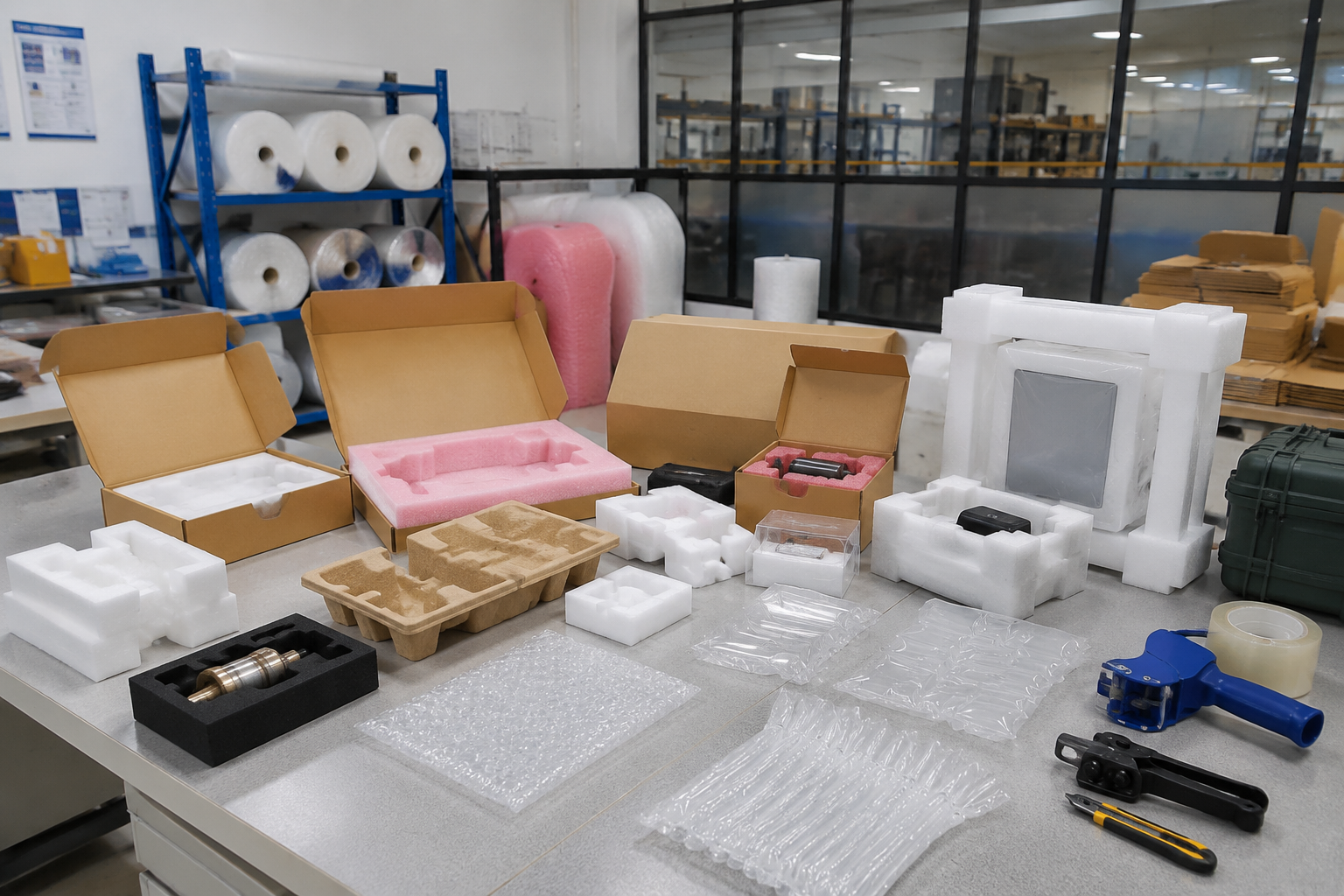
Good sample questions are practical: Does the product move after the carton is closed? Are fragile points protected without direct pressure? Can operators pack it the same way every time? Does the insert fit the carton without bulging? Does the structure support the expected shipping method? These questions often reveal more than a simple material comparison.
When sample testing should be more formal
For high-value fragile products, export shipments, or products with repeated damage claims, buyers may need a more formal test plan instead of relying only on a hand check. ASTM distribution-cycle testing provides a framework for evaluating shipping containers and systems under defined hazards, while random vibration testing is used to study how packed goods respond to vibration in transit.[8][9] These standards do not guarantee a damage-free shipment, but they give buyers and suppliers a more disciplined way to compare foam, air column, corrugated, and hybrid structures under repeatable conditions.
A practical test record should identify the exact product sample, insert material, carton size, closure method, packed weight, test sequence, and acceptance criteria. Without those details, two samples may appear to pass the same “drop test” or “shake test” while actually being prepared in different ways. Keeping the test package, photos, and written result with the approved sample helps the buyer repeat the same structure during bulk production.
Quality checks before bulk production
Once a sample is approved, the buyer should make the approval measurable. A final specification should record material type, foam thickness or density where relevant, air column film and chamber size, corrugated board details, cutting size, cavity clearance, sealing method, packing quantity, carton size, and carton marks. Photos of the approved packing sequence are often useful because they show how the product sits inside the insert and how the carton closes.
Production consistency should be checked against the approved sample, not only against the purchase order name. For foam inserts, the buyer should watch for cavity size, bonding accuracy, dust, surface marks, and whether the product loads smoothly. For air column packaging, seal strength, inflation behavior, and leak risk should be reviewed. For corrugated inserts, slot position, folding line accuracy, board stiffness, and divider height can affect the final packing result. These checks help reduce misunderstandings before the goods reach the warehouse or shipping stage.
Quality Review Note: A practical pre-shipment review should compare finished goods with the approved sample, including dimensions, appearance, cutting, bonding, sealing, printing or labels, packing quantity, carton marks, and whether the carton closes without forced compression.
How to keep the requirement traceable from sample to shipment
To make a packaging recommendation traceable, the buyer should keep the same core details attached to every stage: the original product photos or drawing, the confirmed dimensions and weight, the approved sample, and the final packing method. That gives the supplier a clear basis for repeating the same foam cavity, air inflation level, or corrugated layout without guessing from memory or a new email thread.
Once the sample is approved, the production record should match the sample rather than the first quotation. If the material, thickness, density, carton size, printing, labels, or insert layout changes, the buyer should treat that as a new confirmation point. This is easier to control when the approved sample photos, brief notes, and final drawing are stored with the order detail, because the packing team can then compare the finished goods against the same reference.
For shipment preparation, traceability should extend to packing quantity, inner pack count, carton marks, pallet pattern, and destination. These items tell the warehouse how the approved insert is supposed to be used in real loading conditions. They also make repeat orders more consistent, because the buyer can check whether the next batch still follows the same carton logic instead of rediscovering the structure after boxes arrive.
After delivery, feedback should be recorded in practical terms: any movement in the carton, surface rubbing, crushed corners, inflation loss, loose divider fit, or packing-line difficulty. That feedback gives the next order a clearer starting point and helps the supplier adjust the recommendation only where the real problem appeared. In this way, traceability is not a separate system; it is the link between the buyer’s product information, the approved sample, the production requirement, and the repeat-order result.
How to read a quote beyond the unit price
A lower unit price does not always mean a lower total packaging cost. Buyers should read the quote together with tooling, material use, packing labor, carton size, and repeat-order stability. A foam insert may have a higher development or cutting requirement but can reduce movement and improve presentation for sensitive products. Air column packaging may save storage space before inflation but needs inflation equipment, correct air pressure, and operator control. Corrugated inserts may be simple to source and assemble, but they may need additional cushioning if the product is highly fragile.
Tooling and setup details should be clear before approval. Die-cut foam, shaped cavities, special corrugated layouts, and custom air column structures may require sample development and specification confirmation. Buyers should ask what is included in the quotation, what may change after sample adjustment, and whether the same structure can be repeated consistently in later orders. A quote based on an unfinished sample can change if the product fit, material thickness, or carton size is revised.
Material use should be reviewed in practical terms. Thicker foam, higher density material, wider air columns, or stronger corrugated board can improve protection in some cases, but they can also increase cost and carton space. The goal is not to choose the most material. The goal is to use material where it controls risk: corners, edges, side impact zones, top compression areas, or product-to-product contact points.
Labor should not be ignored. If one structure saves a few cents per insert but adds extra folding, wrapping, taping, inflating, or alignment steps, the total cost may increase at the packing line. For e-commerce or export orders with repeated packing, operator consistency becomes part of the cost calculation. A slightly more stable structure can be worth more if it reduces packing variation and avoids repeated sample revisions.
Repeat-order stability is another important quotation factor. The buyer should confirm the final drawing, dimensions, material thickness, density or board grade where relevant, packing quantity, label requirements, and carton marks before production. Clear specifications help the buyer compare quotes fairly and help the supplier reproduce the approved structure in future orders.
When a Hybrid or Custom System Makes More Sense Than One Material Alone
Some fragile products do not fit neatly into one material choice. A product may need foam for edge control, corrugated for separation, an air cushion for void filling, and a strong outer carton for stacking. In those cases, the better question is not “which material is best?” but “which packaging system controls the main risks without making packing too slow or expensive?”
A hybrid packaging solution can make sense when one material solves only part of the problem. Foam may hold a device securely but leave unused space inside the carton. Corrugated dividers may organize bottles well but offer limited shock absorption at the base. Air column packaging may cushion a retail box during parcel delivery but may not prevent a heavy or irregular product from shifting. Custom insert packaging works best when the product, insert, carton, and packing process are designed together.
This does not mean mixed materials are always better. More components can mean more assembly steps, more specifications to control, and more room for operator error. A hybrid structure is worth considering when the added complexity solves a clear problem: lower breakage risk, better carton utilization, stronger product separation, faster repeat packing, or a more stable presentation for retail or e-commerce delivery.
When mixed materials are worth the extra development work
Mixed materials are most useful when a product has more than one protection need. For example, a glass bottle set may need corrugated dividers to separate units, foam pads at the bottom to reduce impact, and a carton sized tightly enough to limit movement. A sensitive electronic item may need an EPE foam frame to protect corners, an inner plastic bag or film for dust and surface protection, and a corrugated box to handle stacking and shipping. An instrument may need a custom foam cavity for immobilization plus an outer carton structure that helps manage compression during export handling.
The trade-off is development work. Each added layer should have a job. If foam is added, it should protect a specific edge, surface, or shock zone. If corrugated is added, it should improve separation, structure, or carton organization. If air column packaging is added, it should provide cushioning or void control that the insert alone cannot provide efficiently. Without this logic, hybrid packaging can become bulky and costly without improving real protection.
Buyers should also think about the packing line. A foam and corrugated combination may be excellent for a high-value fragile item, but only if operators can load the product quickly and consistently. A layered protection system may reduce damage risk but increase packing time if every unit requires several manual steps. The best hybrid design usually balances protection with a packing sequence that workers can repeat without confusion.
How a custom factory thinks about the full packing system
From a factory-side view, the insert is only one part of the packed result. The supplier should review the product shape, contact points, carton size, material thickness, assembly method, packing quantity, and shipping route together. If the product is heavy, the carton must support the load expected for the chosen handling route. If the product has a polished surface, the inner contact material should be checked for possible scratching. If the shipment goes through parcel handling, drop and vibration risk may matter more than presentation alone.
A custom protective packaging factory will usually look at several layers of decision-making. The first layer is product control: can the product move, rotate, collide, or receive pressure on a weak point? The second layer is cushioning: what part of the structure absorbs shock or keeps impact away from the item? The third layer is carton performance: does the outer box fit properly, close cleanly, stack as intended, and leave no loose voids? The fourth layer is packing reality: can workers assemble the structure at the required speed with stable results?
For this reason, buyers should send the full packing requirement instead of asking for a single insert in isolation. If there is an existing carton, send the inner dimensions and photos. If there is a retail box, send its size and whether it must remain visible or protected from abrasion. If the product ships in sets, confirm the order of placement and whether items can touch. These details allow the supplier to recommend a product-specific packaging structure instead of guessing from a product category.
A custom system may be simple or complex. It might be a corrugated insert with small foam pads. It might be an EPE foam tray inside a printed carton. It might be air column packaging around an inner retail box. The value comes from matching each layer to a real risk, not from adding materials for the sake of looking more protective.
Factory coordination for multi-material packaging
When foam, bubble, film, air column material, and corrugated board are combined in one pack, coordination becomes part of the quality control. The foam cavity may depend on the retail box size, the air column may depend on carton clearance, and the corrugated divider may depend on how many units the buyer wants per carton. If one component changes after approval, the whole packed structure should be reviewed again rather than treated as a simple material substitution.
For buyers, this means the supplier should not only quote each component separately. The more useful review is whether the components can be produced, packed, counted, labeled, and shipped as one repeatable system. Daipak Packaging can help align drawings, sample photos, packing sequence, carton quantity, and export packing details so the production team and the buyer are working from the same confirmed structure.
Export packing and shipment preparation details
For export orders, the insert decision should be connected with carton marking, pallet preparation, loading method, and the expected number of handling steps. A carton that moves from factory to warehouse, then to container loading, port handling, overseas unloading, and final distribution may face more vibration and compression than a domestic warehouse shipment. Buyers should confirm whether cartons will be palletized, how many layers will be stacked, whether corner protection or stretch film is needed, and whether the carton marks clearly show orientation, fragile handling, or product identification where required.
Export packing also makes documentation and repeatability more important. If the first shipment uses one carton size and the next shipment uses another, the same foam insert, air column bag, or corrugated divider may no longer fit correctly. Before production, buyers should align the insert specification with the master carton, packing list quantity, pallet layout, and loading condition. This does not guarantee damage-free transport, but it can help reduce avoidable packaging changes that create risk during long-distance shipping.
Documentation and claims that should be confirmed before shipment
Before bulk production or export shipment, buyers should separate internal packing specifications from external product claims. A specification can say the insert is EPE foam, air column film, corrugated board, or a hybrid structure with confirmed dimensions and packing quantity. A customer-facing or carton-facing claim, however, may need support if it refers to recyclability, compostability, food contact, moisture resistance, anti-static performance, heavy-duty load, or regulated transport use.
Documentation needs vary by product, destination, and end use. For ordinary protective packaging, the buyer may only need drawings, sample photos, material descriptions, packing instructions, and carton details. For food-contact packaging, environmental claims, dangerous goods, electronics requiring special handling, or destination-market labeling requirements, additional review may be required before the packaging is produced or printed. Daipak Packaging can provide packaging material and structure information for buyer review, but the buyer should confirm any market-specific claim or regulated-use requirement with the appropriate responsible parties before use.
Why repeat orders benefit from a stable structure decision
Once a structure is confirmed, repeat orders become easier to control. Operators know the packing sequence. The supplier can prepare material according to the confirmed size, thickness, density, cutting pattern, sealing detail, or corrugated layout. Buyers can plan carton quantity, pallet space, warehouse storage, and packing labor with fewer surprises. This stability is especially important for fragile products because small packing changes can create large differences in transit protection.
A stable structure also helps avoid hidden variation. If the first order uses a foam insert with a specific cavity clearance, the repeat order should not change material thickness or cutting tolerance without review. If an air column structure depends on a certain inflation level, workers need clear handling guidance. If corrugated dividers are used, slot size and board strength should remain consistent enough to hold the product as approved. These details should be documented before bulk production, not rediscovered after damage occurs.
Long-term sourcing reliability depends on more than choosing the cheapest insert. Buyers should keep the approved sample, final drawing or measurement sheet, carton size, packing photos, and any label or carton mark requirements. This helps future orders match the confirmed packaging system and reduces repeated back-and-forth during production coordination. For fragile products, consistency is part of protection.
The practical goal is to make the packaging decision stable enough for procurement, production, warehouse packing, and shipping teams to use repeatedly. One material may not solve everything, but a clear custom structure can give buyers a better balance of protection, carton efficiency, packing speed, and repeat-order control.
References
[1] ASTM International, “ASTM D642 Standard Test Method for Determining Compressive Resistance of Shipping Containers,” packaging test method reference for carton compression resistance discussions, available at ASTM D642 Compression Resistance.
[2] International Safe Transit Association, “ISTA Procedure 3A Overview,” packaged-product test overview for parcel delivery systems and small package shipping contexts, available at ISTA Procedure 3A Overview.
[3] Fibre Box Association, “Corrugated is Recyclable,” industry resource on corrugated packaging recovery and recyclability context, available at Fibre Box Association Corrugated is Recyclable.
[4] Federal Trade Commission, “FTC Green Guides,” U.S. environmental marketing guidance for recyclable, degradable, compostable, and related packaging claims, available at FTC Green Guides.
[5] European Commission, “EU Food Contact Materials,” official food contact materials safety context for packaging articles intended to contact food, available at EU Food Contact Materials.
[6] Electronic Code of Federal Regulations, “21 CFR Part 177 Polymers,” U.S. federal regulations for indirect food additives involving polymers used in food-contact contexts, available at 21 CFR Part 177 Polymers.
[7] United Nations Economic Commission for Europe, “UNECE UN Model Regulations Rev. 24,” dangerous goods model regulations with packaging-related provisions for regulated shipments, available at UNECE UN Model Regulations Rev. 24.
[8] ASTM International, “ASTM D4169 Standard Practice for Performance Testing of Shipping Containers and Systems,” distribution-cycle testing reference for shipping containers and packaging systems, available at ASTM D4169 Shipping Container Performance Testing.
[9] ASTM International, “ASTM D4728 Random Vibration Testing,” random vibration test reference for shipping containers and transit packaging validation, available at ASTM D4728 Random Vibration Testing.