
Choosing protective packaging is not just a choice between foam, bubble wrap, air cushions, film, or corrugated boxes. The real decision is which risks the package must control: impact, scratches, dust, product movement, compression, carton failure, or long-distance export handling. A light item with a polished surface may need different protection from a heavy product with fragile corners, even if both fit in the same carton.
This guide helps buyers match inner protection and outer cartons as one packaging system. It explains where EPE foam, bubble wrap, air pillows, air column bags, plastic film, and corrugated boxes perform well, and where they need support from other materials. Before comparing prices, consider product size, weight, fragility, finish, carton space, packing speed, route, storage conditions, and sample confirmation.
A practical packaging decision also depends on how the goods are handled before they leave the factory or warehouse. Products may be stacked near a packing line, moved between workstations, stored before shipment, repacked for inspection, or combined with accessories and labels. If the packaging choice only considers the final courier or container journey, it may miss damage that happens during daily handling. This is why buyers should review the full packing flow, from product completion to carton sealing and pallet preparation.
Quick Packaging Decision Guide
| Buyer Question | Practical Reading | What to Check |
|---|---|---|
| Is foam better than bubble wrap? | Foam is stronger for stable positioning, edges, spacing, and custom inserts. | Product weight, shape, fragile points, required fit, and storage space. |
| Can air cushion packaging handle export shipping? | It can reduce movement, but puncture and compression risks must be considered. | Shipping route, carton strength, sharp edges, stacking pressure, and handling time. |
| Do plastic bags or film replace cushioning? | No. They mainly protect surfaces, cleanliness, grouping, and pallet stability. | Surface finish, dust control, moisture exposure, and whether impact protection is needed. |
| How important is the corrugated box? | The carton provides structure, stacking support, and containment for inner materials. | Box size, board strength, sealing method, product weight, and void space. |
| Why can a lower material price cost more? | Weak fit, slow packing, excess void, or damage risk can increase total cost. | Material usage, packing labor, freight efficiency, damage rate, and repeatability. |
Quick Questions Before You Read
Q: What information should I prepare before requesting a quote?
Send product dimensions, weight, photos, fragility points, packing method, carton size, order quantity, and shipping route.
Q: When is custom EPE foam worth considering?
Use it when products need fixed positioning, edge protection, separation, or a repeatable packing process.
Q: Can I use bubble wrap for heavy or sharp products?
Sometimes, but it may need corner guards, dividers, foam, or a stronger carton to prevent pressure damage.
Q: Should inner packaging and outer cartons be selected separately?
No. They should be designed together so cushioning, carton strength, void space, and stacking support work as one system.
Start With the Protection Job, Not the Material Name
No single protective material is the right choice for every product. EPE foam, bubble wrap, air cushions, plastic film, bags, and corrugated boxes all protect products during shipping, but they do it in different ways. A material that works well for a lightweight e-commerce item may not be enough for a heavy industrial part. A clear plastic bag may keep a garment clean, but it will not provide the same shock absorption as cushioning packaging. A strong carton can handle stacking pressure, but the product may still break if it moves freely inside.
The better starting point is the protection job. Before choosing protective packaging materials, buyers should define what the package must prevent: impact damage, surface scratches, dust, carton movement, product-to-product contact, compression, or poor handling during export transit. This approach makes packaging material selection more practical because it connects the material to the real risk instead of starting with a familiar product name or the lowest unit price.
For example, a ceramic item may need cushioning and separation. A painted metal part may need surface protection before it needs thick padding. A carton with too much empty space may need void fill to reduce movement. A heavy product may need both internal support and a stronger outer box. Many packaging failures happen not because the buyer chose a “bad” material, but because the material was asked to solve the wrong problem.
In a real procurement discussion, the same product may even need different packaging for different sales channels. A retail-ready item shipped in a master carton may have one protection requirement, while the same item shipped directly to an end customer by parcel may need stronger individual cushioning and better carton fit. Buyers should also consider whether the package will be opened for inspection, relabeled, bundled with other products, or stored for months before shipment. These details can change the best material choice more than the product category alone.
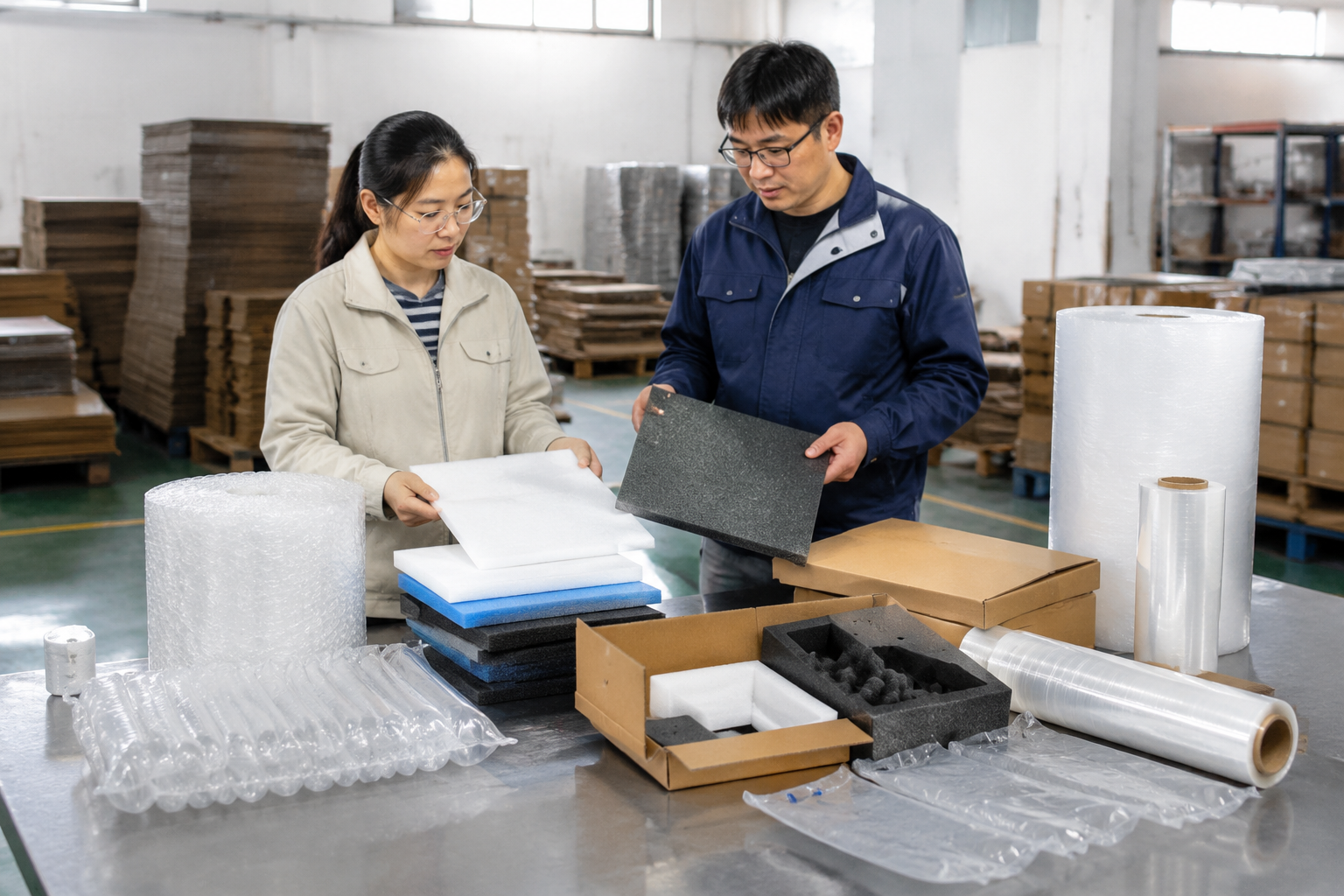
Why product risk comes before material choice
Product risk starts with basic details: size, weight, shape, fragile points, surface finish, and how the item will be packed. A smooth acrylic panel, a glass bottle, a small appliance, and a machined metal component may all need protection, but their risks are different. The acrylic panel may scratch easily. The glass bottle may crack from side impact. The appliance may need corner protection. The metal part may damage nearby products if it is not separated.
Weight distribution is also important. A product may not be very heavy overall, but if the weight is concentrated on one small foot, corner, handle, or edge, that point can cut through weak cushioning or create pressure marks. Products with handles, buttons, screens, thin rims, caps, hinges, or exposed connectors should be reviewed carefully because damage often starts at these raised or unsupported areas. A simple photo from the front is not always enough; side views, bottom views, and close-up images of fragile areas help the supplier judge the real risk.
Shipping route also changes the decision. A product moving from a warehouse to a local retail store may face different handling than an export carton moving through consolidation, pallet loading, container transport, customs handling, and final delivery. Longer routes and more handling points usually make carton fit, inner cushioning, and stacking strength more important. For export packing, the outer carton and inner protection need to work together rather than being selected separately.
Packing speed matters as well. A warehouse packing mixed SKUs may prefer flexible materials that packers can use quickly, such as bubble wrap, air pillows, or pre-cut sheets. A factory shipping the same product in large quantity may benefit from custom foam inserts, formed air column bags, or cartons designed around a repeat packing method. The right choice is not only about protection level; it also affects labor time, packing consistency, storage space, and repeat-order control.
Storage conditions can create another layer of risk. Cartons stored in humid warehouses, packed tightly on pallets, or held for a long time before shipment may lose some strength or show more surface marking from pressure. Film, bags, and foam can help with cleanliness and separation, but they do not correct a weak stacking plan. If goods will be stored before export or moved between warehouses, buyers should mention this early so the supplier can consider carton strength, pallet stability, and internal support.
The five basic jobs of protective packaging
Most protective packaging decisions can be organized around five basic jobs: cushioning, surface protection, void filling, separation, and structural support. These jobs are connected, but they are not the same. Understanding the difference helps buyers choose packing materials with more confidence before asking a supplier for a quote.
Cushioning reduces shock and vibration. EPE foam, bubble wrap, air cushion packaging, and some shaped inserts can absorb impact and reduce direct force on fragile parts. Cushioning is especially important for glass, ceramics, electronics, small appliances, and products with corners or protruding components.
Surface protection helps prevent scratches, scuffs, dust, and light contamination. Foam sheets, soft wraps, plastic bags, garment bags, and protective film are often used when the product finish matters. This is common for painted parts, furniture panels, plastic components, retail goods, and garments.
Void filling controls empty space inside the carton. If a product can slide, bounce, or rotate during transport, the carton may look fine from the outside while the product is damaged inside. Air pillows, bubble wrap, paper fill, foam pads, and carton inserts may all be used to reduce movement depending on the product and carton size.
Separation keeps products or components from touching each other. This matters for multi-item cartons, kits, hardware sets, glassware, bottles, finished parts, and accessories that can scratch or chip during transit. Separation may come from foam sheets, corrugated dividers, bags, partitions, or custom inserts.
Structural support helps the package resist stacking pressure, compression, and handling loads. Corrugated boxes, partitions, corner supports, foam blocks, and internal bracing can help maintain shape and protect products from being crushed or shifted. This is especially important for heavier goods, palletized shipments, and export cartons.
These five jobs should be checked in order rather than assumed. If the product is scratched, adding more void fill may not solve the problem. If the carton collapses, adding a soft bag around the item will not solve the structure issue. If the product breaks at a corner, a general wrap may be less effective than targeted edge or corner protection. A clear diagnosis makes the quote more accurate and helps avoid adding unnecessary material.
How this guide should be used before requesting a quote
Before requesting a quote, buyers should compare materials by function first and price second. A low material price can become expensive if it increases product damage, slows packing, wastes carton space, or creates inconsistent protection between shipments. The more useful question is not “Which material is cheapest?” but “Which material performs the required protection job with acceptable cost, packing speed, and consistency?”
A practical quote request should include the product dimensions, weight, photos or drawings, fragile areas, surface protection needs, current carton size, packing quantity per carton, shipping destination, and whether the order is for e-commerce, retail packing, warehouse storage, or export shipment. With this information, a supplier can compare foam, bubble wrap, air cushion packaging, film, bags, and corrugated options more accurately.
A traceable quotation process is easier when every recommendation can be linked back to a specific product detail. Product size affects carton dimension and foam clearance; product weight affects cushioning density, board strength, and sealing method; photos or drawings help locate fragile corners, raised parts, handles, screens, and accessories. When the buyer provides these details clearly, the supplier has a stronger basis for explaining why a certain thickness, bag size, foam shape, air column layout, carton quantity, label position, or pallet method is being suggested.
For custom packaging, buyers should also confirm tolerance expectations, material thickness, density or strength preference where applicable, printing or labeling requirements, sealing method, and whether samples are required before mass production. If a product has several sizes or versions, each version should be identified clearly. Small differences in product height, corner radius, accessory position, or carton count can change the foam cut, bag size, air column layout, or carton dimension.
At Daipak, the discussion usually starts with the product details rather than the material name. The same material can perform very differently depending on carton space, product weight, handling route, and packing method. Starting with the protection job gives both buyer and supplier a clearer path toward a practical packaging structure.
Compliance-Sensitive Questions to Confirm Early
Some packaging choices require more than a normal size and price discussion. If the package will touch food directly, carry cosmetics, protect medical or electronic products, support hazardous goods, or display environmental claims, buyers should confirm the applicable requirements before production rather than assuming that a familiar material is automatically suitable. The same foam, film, bag, carton, or coating can be acceptable for one use and inappropriate for another depending on material composition, destination market, product contact, label wording, and shipping route.
Daipak Packaging can help buyers compare protective packaging formats and prepare practical specifications, but a packaging supplier should not be treated as a regulator, certification body, or testing laboratory. When compliance evidence is needed, buyers should identify the required documents, test methods, destination-market rules, and product-use conditions in advance. This is especially important when customer-facing claims involve food contact, recyclability, compostability, moisture resistance, anti-static performance, heavy loading, or special transport handling.
For food-contact use, the question is not whether a bag or liner looks clean, but whether the material and intended contact condition match the applicable market requirement. European and U.S. references show that food-contact packaging review depends on the material, substance, intended use, and regulatory context, so direct food-contact applications should be checked separately before production or labeling.[3][4]
For regulated transport, including dangerous goods or lithium battery shipments where applicable, buyers should not rely on ordinary protective packaging descriptions alone. Packaging selection, marking, documentation, and shipment preparation may be subject to transport rules that vary by product, route, and destination, and the responsible shipment parties should review those requirements before confirming the packing plan.[8][9]
Evidence Checks Buyers Should Consider
For routine products, a sample pack, drop observation, carton fit check, and buyer approval may be enough. For high-value, fragile, heavy, or long-route shipments, buyers may want a more formal test plan instead of relying only on visual inspection. ASTM D4169 is a recognized reference for performance testing of shipping containers and systems, and ISTA 3A is commonly used as a packaged-product test overview for parcel delivery environments.[1][2]
Testing should not be treated as a promise that every shipment will arrive without damage. It is better understood as a controlled way to compare a proposed package against defined hazards such as handling, vibration, compression, and distribution conditions. The useful question is not “Is this material protective?” but “Has this complete product-package system been checked against the route and handling risk we expect?”
Buyers should also keep evidence proportional to risk. A commodity item in short-distance warehouse transfer may not need the same documentation as fragile glassware shipped through parcel networks or heavy goods loaded in export cartons. When a buyer asks for stronger proof, the supplier needs the product sample, packed carton, route details, acceptance criteria, and any destination-specific requirements before recommending a practical validation method.
How Cushioning, Surface Protection, Void Fill, Separation, and Support Work Together
Protective packaging functions often overlap in a real carton. A product may need cushioning against drops, surface protection against scratches, void fill to stop movement, separation from nearby items, and structural support for stacking. If only one function is considered, the package may solve one problem while leaving another risk open.
For example, glassware may be wrapped in bubble wrap for cushioning, separated with dividers to prevent contact, and packed in a corrugated carton strong enough for stacking. A painted metal part may need a soft foam sheet or plastic bag for surface protection, plus foam blocks or corrugated supports to keep the part from shifting. An e-commerce parcel may not need a custom insert, but it may need air pillows or paper fill so the product does not move inside an oversized shipping carton.
This is why many packaging systems combine two or three materials. The goal is not to use more packaging than necessary. The goal is to assign each material to the job it does well and avoid asking one material to solve every risk. A flexible wrap, a stable insert, and a correctly sized carton can work together better than a single material used in the wrong way.
Combined packaging should still be kept simple enough for the packing team to repeat. A design that works only when one experienced packer follows many steps may fail during busy seasons or shift changes. If the package needs several materials, the sequence should be clear: for example, surface film first, foam edge protection second, product into carton third, void fill last, then sealing and labeling. Clear packing order reduces variation between cartons and makes later quality checks easier.
Factory Coordination Note: When a package uses foam, bubble wrap, film, air cushions, and corrugated cartons together, Daipak Packaging reviews the packing sequence and material roles so production teams can repeat the same structure more consistently during bulk orders.
Cushioning protects against shock and vibration
Cushioning material helps reduce the force that reaches the product when a carton is dropped, bumped, or vibrated during transport. EPE foam can provide more stable cushioning and shaped protection, especially when cut into pads, blocks, corner pieces, or inserts. Bubble wrap gives flexible cushioning around irregular shapes and is useful for manual wrapping. Air cushion packaging can reduce movement and absorb some handling shock when the product and carton design are suitable.
The right cushioning depends on product weight and fragility. A lightweight retail item may be fine with bubble wrap or air pillows in a snug carton. A heavier electronic device or fragile appliance may need foam corners, pads, or inserts that hold the product in position. If the product has sharp edges, heavy mass, or fragile protruding parts, loose cushioning alone may compress, shift, or fail to protect the most vulnerable points.
Cushioning thickness should not be chosen only by appearance. A thick but soft material may compress too much under a heavy product, while a thinner but more suitable foam structure may hold its shape better. Buyers should also think about where the cushion touches the product. Supporting a strong base or frame is usually safer than placing pressure on a screen, thin panel, cap, or decorative part.
Surface protection prevents scratches, scuffs, and dust
Surface protection is different from impact protection. A product can arrive unbroken but still be rejected if the finish is scratched, dusty, scuffed, or marked by contact with another item. Foam sheets, soft wraps, poly bags, garment bags, protective film, and inner liners are commonly used to keep surfaces clean and separated during storage and shipping.
This matters for retail goods, furniture components, painted parts, plastic panels, metal finishes, garments, and products with visible surfaces. A smooth product may need a soft layer before any stronger cushioning is added. If a hard divider or carton wall touches the product directly, it may create marks during vibration. In that case, a thin surface protection layer can be just as important as the cushioning material.
Surface protection should be checked with the actual product finish when possible. Glossy plastic, matte paint, brushed metal, powder coating, acrylic, and coated paperboard can react differently to pressure, rubbing, adhesive, or trapped dust. If the product has a high-value visible surface, sample packing and unpacking can reveal problems that are not obvious from a material sample alone.
Void filling controls movement inside the carton
Empty space inside a carton creates risk. Even if the outer box is strong, the product can slide into carton walls, collide with accessories, rotate into a weak position, or crush nearby parts. Void fill packaging helps control this movement by filling unused carton space and keeping the product closer to its intended position.
Air pillows, bubble wrap, foam pads, kraft paper, and other carton filling options can all reduce movement, but they should match the carton size and product weight. Too little fill allows shifting. Too much fill can create pressure or make cartons difficult to close consistently. For high-volume packing, the repeatability of the fill method matters because different packers may use different amounts unless the process is clearly defined.
Void fill is most effective when the carton size is already reasonably close to the packed product size. If a product is placed in a much larger carton, packers may need excessive filling material, the carton may bulge, and freight volume may increase. In this situation, changing the carton size may reduce cost and damage risk more effectively than simply adding more fill.
Separation and support reduce contact damage and compression risk
Product separation prevents items from rubbing, chipping, scratching, or hitting each other inside the same carton. This is common for glass sets, bottles, hardware kits, replacement parts, retail bundles, and industrial components. Corrugated partitions, foam sheets, foam inserts, plastic bags, and dividers can all keep products separated, depending on the weight, surface finish, and required packing speed.
Structural support packaging handles a different risk: compression and stacking pressure. A carton may need internal supports, corner blocks, corrugated partitions, or foam blocks to prevent heavy products from collapsing into each other or crushing lighter items. For palletized or export shipments, this support becomes more important because cartons may face stacking pressure during storage, container loading, and transport.
The best result usually comes from matching the inner protection to the outer carton. A strong carton with weak internal separation can still allow damage. A well-cushioned product in a weak carton can still suffer from compression. Buyers should review both parts of the package as one system.
For multi-layer cartons, support should also consider the direction of load. Products stacked vertically may need different protection from products laid flat. If accessories are packed beside the main product, they should not become pressure points against the product surface. A small charger, metal fitting, bottle cap, or tool can cause damage if it is allowed to press into a fragile or finished surface during stacking.
Where EPE Foam Packaging Fits Best
EPE foam packaging is commonly used when a product needs cushioning, spacing, surface protection, or a more stable fit inside the carton. It is lightweight, flexible enough for many product shapes, and can be supplied in sheets, rolls, pads, blocks, bags, corner protectors, or custom foam inserts. For buyers comparing protective foam packaging with bubble wrap or air cushions, the main advantage is usually control: foam can be designed to hold a product, protect edges, separate parts, or create a repeatable packing layout.
Foam is especially useful when the product should not move freely inside the carton. Loose void fill can reduce movement, but it may not lock the product in place. Custom foam packaging can support the product at specific points, protect fragile corners, and keep clearance between the product and carton wall. This can improve consistency for repeat shipments, especially when the same product is packed in bulk.
The trade-off is that foam often needs more specification work than simple wraps or bags. Buyers may need to confirm dimensions, thickness, shape, cutting method, bonding details, packing direction, and sample fit. Foam can also take more storage space than flat bags or film. It is not always the lowest-cost or fastest option, but it can be the more practical choice when product positioning and stronger cushioning matter.
Foam selection should consider density, thickness, resilience, surface softness, and the shape of the contact area. A soft sheet may be suitable for surface separation, while a thicker block may be needed for corner spacing or impact absorption. If foam parts are bonded or assembled, the bonding area and production repeatability should be checked because a weak joint can change the way the insert supports the product.
Best use cases for EPE foam
EPE foam works well for electronics, small appliances, glass, ceramics, furniture edges, lighting products, display items, and industrial parts that need fixed spacing or edge protection. It is also useful for products with fragile corners, polished surfaces, irregular shapes, or parts that should not touch the carton wall directly.
For heavier products, foam blocks or corner pads can help distribute pressure and reduce direct impact. For finished goods, foam sheets or foam bags can provide a softer contact surface before the item is placed into a carton. For multi-component packaging, foam inserts can separate accessories, hold the main product in position, and improve the packing presentation at the same time.
EPE foam is not limited to fragile consumer goods. Industrial buyers may use it to protect machined parts, metal components, tools, hardware, and equipment parts during storage or export handling. In these cases, the goal may be less about retail appearance and more about preventing impact, abrasion, or product-to-product contact during movement.
For export orders, foam can also help make the packing result more predictable across many cartons. If every product sits in the same position, carton sealing, stacking, and pallet loading become easier to control. This does not mean every export product needs a custom foam insert, but it does mean that buyers should consider foam when repeated positioning is more important than packing flexibility.
Common EPE foam formats buyers may compare
Foam sheets and rolls are useful for wrapping, layering, surface protection, and separation. They give packers flexibility and can be cut or folded around different product sizes. They are often suitable when the product shape changes or when the buyer needs a general protective layer rather than a fixed insert.
Foam pads and blocks provide more targeted cushioning. They can protect corners, edges, gaps, or pressure points inside a carton. These formats are useful when the product needs stronger support in certain areas but does not require a fully custom insert.
Corner protectors and edge protection help reduce impact on vulnerable areas, especially for furniture parts, panels, appliances, frames, and products with exposed corners. They are often combined with film, bags, or corrugated cartons to create a complete packing structure.
Custom foam inserts are used when the product needs a more precise fit. Inserts may be cut, assembled, layered, or shaped to hold the product in place. They can improve packing consistency, but they also require clearer specifications and sample confirmation before bulk production.
When comparing foam formats, buyers should also consider how the material will be stored and handled at the packing site. Rolls and sheets may be easier to stock for flexible use, while assembled inserts can occupy more warehouse space but reduce packing decisions on the line. Pre-cut parts can save labor, but they need clear labeling or packing instructions if several similar sizes are used in one order.
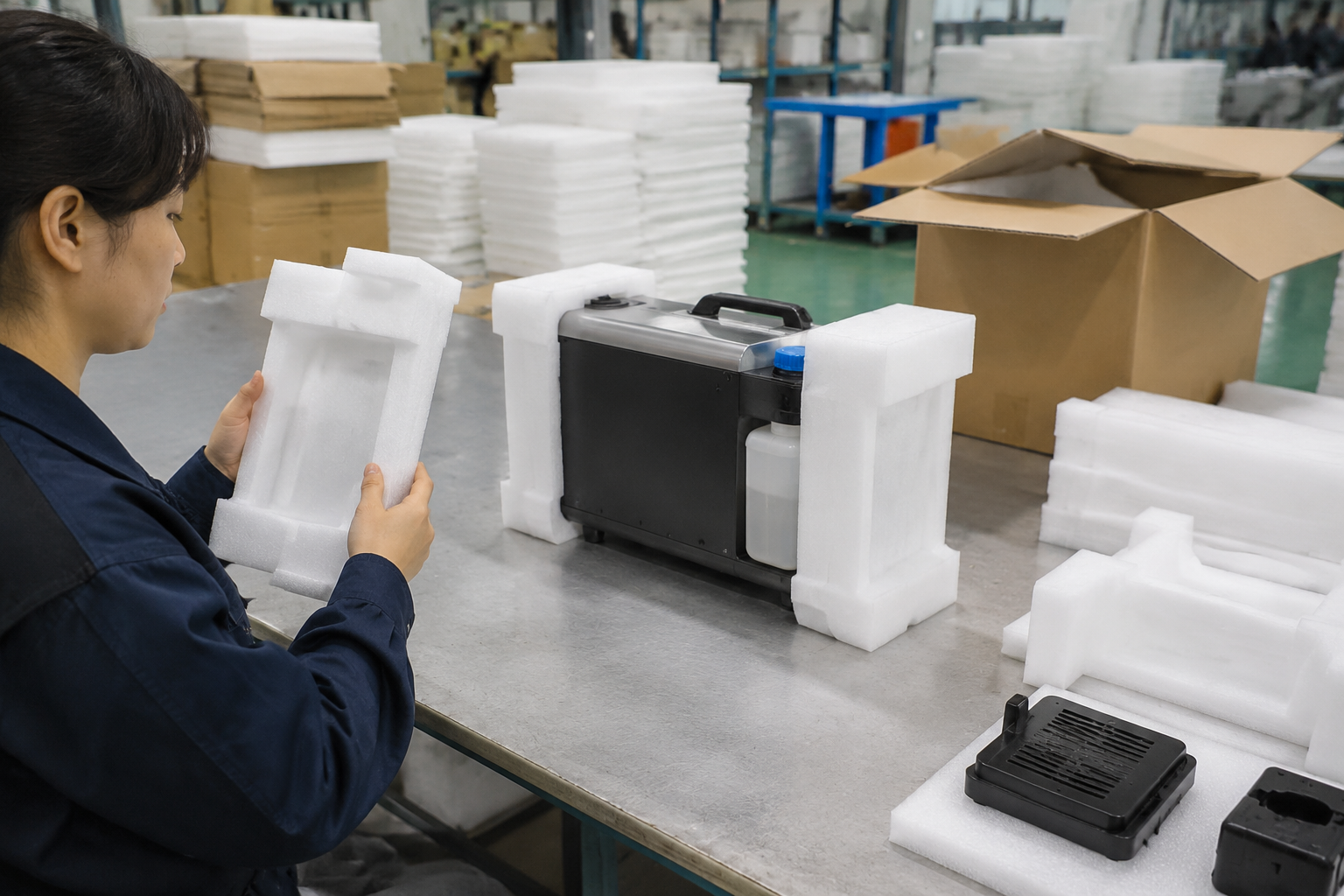
What to confirm before asking for custom foam
For custom foam, buyers should provide more than the product name. Useful details include product length, width, height, weight, photos or drawings, fragile points, surface finish, packing direction, carton size, and quantity per carton. If the product has handles, screens, sharp corners, glass areas, painted surfaces, or protruding parts, those details should be shown clearly.
The desired packing method also matters. A foam insert designed for fast line packing may look different from one designed for maximum product display. A structure used for export cartons may need different support than one used for short-distance warehouse transfer. If the buyer already has a carton size, the foam design must fit that space. If the carton size is still open, the foam and carton can be reviewed together.
Sample confirmation is usually important for custom foam because small changes can affect fit and packing speed. A few millimeters of clearance may decide whether the product slides in smoothly, sits too tightly, or moves during shipping. From a factory perspective, Mr. Wang often checks whether cutting, bonding, and assembled foam details can be repeated consistently during batch production, because a good sample must also be practical for bulk orders.
For made-to-size foam, production checks should follow the confirmed sample, drawing, or written specification rather than memory or a general product name. Cutting size, foam thickness, density, bonding position, hole location, slot depth, packing direction, and carton fit should usually be checked against the confirmed requirement before bulk packing continues. This practical link between the approved sample and the production check helps buyers understand whether the final foam insert is only similar in appearance or actually matches the agreed packing function.
Buyers should keep an approved sample, drawing, or specification record after confirmation. This helps avoid confusion in repeat orders, especially when there are similar products, revised product dimensions, or multiple suppliers involved. If a carton or product is later changed, the foam design should be reviewed again rather than reused automatically.
Specification Confirmation Note: Before custom foam or other made-to-size packaging moves into production, Daipak Packaging encourages buyers to confirm size, thickness, density, structure, quantity, labels, carton fit, and packing method so the approved sample and bulk order follow the same practical standard.
When Bubble Wrap Is the Practical Flexible Cushioning Choice
Bubble wrap packaging is often chosen because it gives packers a flexible way to wrap products with different shapes, sizes, and surface needs. It works especially well in warehouse packing where the same team may handle mixed SKUs, replacement parts, fragile retail goods, or small appliances in the same shift. Instead of needing a separate custom insert for every item, packers can cut or tear the cushioning wrap to length, wrap the product, tape it if needed, and place it into the carton.
The main advantage is adaptability. Bubble wrap can cover corners, curved surfaces, handles, edges, and protruding parts more easily than rigid inserts. It can also reduce scratches and light impact damage when products are handled during picking, packing, storage, or parcel delivery. For many B2B buyers, this makes bubble wrap a practical protective wrap for general fragile product packaging, especially when order profiles change frequently.
That flexibility has limits. Bubble wrap does not usually hold a product in a fixed position as precisely as a foam insert, and it does not add the same stacking strength as corrugated supports. If the carton has too much empty space, the wrapped item can still move. If the product is heavy, sharply edged, or very fragile, bubble wrap may need to work with corner protectors, dividers, stronger cartons, or void fill.
Bubble wrap performance also depends on how it is applied. One loose layer may look protected but leave corners exposed. Too much wrapping can waste material, increase carton size, and slow packing. For repeat warehouse work, it is useful to define wrapping standards such as the number of layers, whether corners need extra coverage, whether tape may touch the product, and how the wrapped product should sit inside the carton.
Best use cases for bubble wrap
Bubble wrap is a strong fit when the packing process requires quick wrapping and moderate cushioning rather than a fully engineered structure. Fragile retail goods, ceramics, glass items, accessories, small appliances, electronic accessories, lighting parts, and replacement components are common examples. It is also useful for products with irregular shapes that are difficult to protect with flat sheets alone.
In mixed warehouse packing, bubble wrap rolls can help teams respond to different order combinations without holding too many custom packaging parts in stock. A picker may pack a ceramic cup, a metal accessory, and a boxed spare part in one order, each needing a slightly different wrapping method. Bubble wrap gives the packer room to adjust the number of layers, corner coverage, and final carton fit.
Bubble wrap can also provide basic surface protection. For products with painted, polished, plated, or glossy surfaces, the wrap can help reduce scuffs during handling. Buyers should still confirm whether the surface is sensitive to pressure marks, static, residue from tape, or rubbing. In some cases, a soft foam sheet, bag, or protective film may be placed against the surface first, with bubble wrap used outside for cushioning.
Bubble size and roll format can affect both protection and speed. Larger bubbles may provide more cushioning space for light or medium products, while smaller bubbles may wrap more closely around detailed shapes and provide a smoother surface layer. Perforated rolls can improve packing efficiency when the same length is used repeatedly, while non-perforated rolls may be more flexible for mixed product sizes.
Where bubble wrap may need support from other materials
The most common mistake is treating bubble wrap as the whole packaging system. A wrapped product still needs a carton that fits correctly and has enough strength for the shipping route. If the carton is oversized, the product can shift during transit. If the carton is weak, stacking pressure may crush the box even if the item inside is wrapped well.
For multi-item cartons, bubble wrap may need dividers or corrugated partitions to prevent contact damage. Two wrapped glass items can still hit each other if they are not separated. Hardware, ceramic sets, and accessories with sharp or hard edges often need product separation as much as cushioning. Foam pads, corrugated inserts, or paperboard dividers can help control that risk.
Bubble wrap may also need help at corners and edges. Products such as framed items, small furniture parts, appliance panels, and boxed electronics can suffer edge impact when cartons are dropped or compressed. In those cases, corner protection, EPE foam blocks, or reinforced corrugated supports may do a better job at absorbing localized pressure. The practical choice is not bubble wrap versus another material; it is often bubble wrap plus the right support where the product is most vulnerable.
Sharp products should be checked carefully before bubble wrap is selected as the main cushion. Metal brackets, pointed accessories, exposed screws, and rigid corners can puncture or flatten bubbles, reducing protection during transit. A paperboard sleeve, foam sheet, or cap over the sharp area may be needed before wrapping.
Quote details that help suppliers recommend bubble wrap
A useful bubble wrap quotation needs more than a request for “one roll price.” Suppliers need to understand how the material will be used. A buyer asking for lining a carton may need a different roll width, bubble size, and perforation style than a buyer wrapping individual ceramic items by hand. The packing method affects both material use and labor speed.
Before requesting a quote, buyers should prepare the basic product and packing details: product type, approximate size and weight, fragility level, surface condition, carton size, units per carton, and whether the wrap is used for individual wrapping, interleaving, carton lining, or void filling. For bubble wrap rolls, width, roll length, bubble size direction, layer preference, and packing speed can also affect the recommendation.
If repeat orders are expected, consistency matters. Roll width, roll length, material thickness, bubble height, perforation, and packing quantity should be confirmed clearly so warehouse teams receive the same usable format each time. A small change in roll width can slow packing or increase waste if it no longer matches the product size or carton layout.
Buyers should also confirm packaging of the rolls themselves, especially for export or warehouse storage. Rolls that are too large for the packing area may be difficult to handle, while rolls that are too short may require frequent replacement. If the bubble wrap is used at multiple packing stations, roll size and dispenser compatibility can affect daily efficiency as much as the material price.
How Air Cushion Packaging and Air Column Bags Reduce Carton Movement
Air cushion packaging is mainly used to control empty space inside cartons while keeping the package lightweight. It includes air pillows, air bubble film, and air column bags, but these formats do not all do the same job. Air pillows and air bubble film are commonly used for void fill packaging, while air column bags provide more shaped inflatable packaging around selected products.
The main benefit is workflow efficiency. Air cushions can often be inflated near the packing line, which saves storage space compared with pre-expanded bulky materials. This is useful for e-commerce operations, fulfillment warehouses, and distributors that pack many cartons per day and need material that can be produced as needed. The packer fills empty carton space, reduces movement, and closes the carton without adding much shipping weight.
Still, air is not a structure by itself. The outer carton, product weight, edge sharpness, compression risk, and shipping route all matter. Air packaging can reduce movement and absorb some handling shock, but it may not be enough for heavy goods, sharp metal parts, products needing fixed positioning, or export cartons exposed to long handling chains.
Air packaging should be evaluated with the actual carton closing process. If pillows are placed only on top of the product while side voids remain open, the item may still shift. If inflated packaging makes the carton difficult to close, workers may press down on the box and damage the product or weaken the seal. The goal is to fill voids without creating uncontrolled pressure.
Air pillows and air bubble film for void filling
Air pillows are often used to fill top, side, or corner voids inside a shipping carton. Their job is to stop items from sliding, bouncing, or hitting carton walls during movement. They are especially practical when products are already packed in retail boxes but still need carton filling for parcel shipping or warehouse dispatch.
Air bubble film can be used more like a lightweight cushioning layer or flexible wrap, depending on the format and packing method. It can help protect boxed goods, small products, or items that need a cleaner, lighter alternative to loose fill. For high-volume packing environments, the ability to inflate on demand can reduce the storage burden that comes with bulky rolls or pre-made void fill.
For repeat orders, buyers should not overlook equipment and process details. Film roll compatibility, inflation settings, sealing quality, and operator handling all affect performance. If pillows are under-inflated, they may collapse too easily. If they are over-inflated, they may be harder to fit around products and can place pressure on lighter cartons. The best setting depends on carton space, product weight, and packing speed.
Quality checks for air packaging should include seal condition, air retention, roll width, perforation, and whether the inflated size matches the carton void. A film that looks similar on a quotation may behave differently during inflation if the roll structure or sealing condition is different. For buyers using machines, the supplier should understand the equipment type or required film compatibility before recommending a roll.
Once an air cushion format is approved, the practical control points should be kept consistent for the next order. Film roll width, inflation level, sealing temperature, perforation length, pillow size, carton void location, and quantity used per carton can all change the packed result. If a buyer reports that cartons arrived with more movement than expected, those details give the supplier a clearer basis for adjusting the carton size, fill amount, machine setting, or supporting material rather than simply replacing one air film with another.
Air column bags for more shaped protection
Air column bags are more structured than loose air pillows. They use inflated chambers to surround or partially surround a product, creating a cushion around bottles, electronics, cosmetics, glass containers, and other fragile items. Because the chambers are connected in a shaped format, they can provide more consistent coverage than simply placing air pillows around the item.
This format is useful when a product needs both cushioning and positioning. A bottle, for example, may need side protection, bottom protection, and reduced movement inside the carton. An air column bag can help create a protective sleeve or chamber around it. For certain products, this can reduce packing steps compared with wrapping, taping, and adding separate void fill.
Buyers should still check the product shape carefully. Tall bottles, square electronics, irregular parts, and products with caps, corners, or accessories may require different air column structures. The supplier will usually need product dimensions, photos, carton size, packing orientation, and the intended number of units per carton before recommending a practical structure.
Air column bags also need enough carton clearance to perform properly. If the carton is too tight, the inflated chambers may be compressed before shipment begins. If the carton is too large, the protected product may still move as a unit. A sample fit can show whether the inflated bag, product, and outer box are working together rather than only looking acceptable separately.
When inflatable packaging is not enough by itself
Inflatable packaging can lose effectiveness when the product has sharp edges, concentrated weight, or high compression risk. A metal component may puncture the film. A heavy item may compress the air chambers. A product with a delicate corner may still need a foam block, corrugated corner, or molded insert to control the impact point.
Long export routes can also change the decision. Cartons may face stacking pressure, pallet movement, container loading, unloading, and multiple handling points. Air pillows may be useful for carton voids, but they should not be expected to replace carton strength or internal support where compression is a real concern. For export packing, the inner cushion and outer carton need to be reviewed together.
Air cushion packaging is usually strongest when the product already has a stable primary pack or when the main risk is movement inside the carton. If the product must stay in an exact position, if the surface must avoid rubbing, or if the product is heavy enough to deform the cushion, foam, corrugated inserts, or a combined packaging design may be safer.
For buyers comparing inflatable packaging with foam or bubble wrap, total cost should include machine use, film roll yield, operator training, storage, and carton size. Air packaging may reduce warehouse space and shipping weight, but it still needs a controlled process. If operators use too many pillows to compensate for a poor carton size, the expected cost advantage can disappear.
How Plastic Bags, Film Packaging, and Stretch Film Protect Surfaces and Improve Handling
Not all protective packaging is cushioning. Film packaging, plastic bags, garment bags, protective film, and stretch film often protect products by keeping them clean, grouped, separated, and easier to handle. They may not absorb major shock by themselves, but they play an important role in preventing dust exposure, scratches, loose accessories, and unstable pallet loads.
These materials often work with foam, bubble wrap, air cushions, or corrugated boxes. A garment may need a clear bag before going into a mailer or carton. A furniture panel may need surface protection film before edge foam is added. A pallet of cartons may need stretch film to keep the shipment unit stable during warehouse movement. The protection is practical because it supports the full packing process, not because the film replaces cushioning.
For buyers, the main decision is the job the film or bag must perform. Is it for clean individual packing, product grouping, surface protection, retail presentation, shipping closure, pallet stability, or warehouse handling? Once that is clear, size, thickness, sealing style, printing, perforation, roll width, and packing method become easier to specify.
Film and bag specifications should be checked against the packing environment. A bag used for manual packing may need an easy opening and suitable slip, while a bag used with sealing equipment may need more attention to material thickness and sealing temperature. Printed bags or labeled bags should be reviewed for barcode readability, warning text where required, and alignment with the buyer’s packing process.
If the bag, liner, film, or coated paperboard will touch food directly, buyers should separate ordinary protective packaging discussion from food-contact compliance review. European food-contact material rules and U.S. polymer food-contact regulations show that food-contact suitability depends on the material, substance, intended use, and applicable market requirements, so it should be confirmed with the supplier and destination market before the packaging is used for direct food contact.[3][4]
Plastic and poly bags for clean individual packing
Plastic bags and poly bags are commonly used to keep products clean and separated before they go into cartons. Garments, accessories, hardware kits, spare parts, instruction manuals, and small components often need individual bagging so they do not collect dust, mix with other items, or scratch neighboring products. For many products, the bag is part of basic packing discipline.
Garment bags are a good example. They do not cushion the garment, but they help keep it clean, folded, and ready for handling through storage, picking, and shipment. For hardware or accessory kits, a bag can keep small parts together so the end customer receives a complete set. For products with light surface sensitivity, a bag can reduce direct rubbing inside the carton, although highly scratch-prone finishes may still need softer surface protection.
Specification details affect daily packing. Buyers should confirm bag size, opening direction, thickness, closure style, sealing requirements, vent holes or perforation if needed, and any printing or labeling needs. If workers need to pack quickly, a bag that is too tight can slow the line. If the bag is too large, it may wrinkle, waste material, or create a less tidy presentation.
For small components, bag strength and sealing consistency can be more important than thickness alone. A heavy hardware kit in a weak side-sealed bag may tear during handling, while a sharp accessory may require a stronger bag or an additional wrap. If bags are used to group parts for assembly or after-sales kits, labels should match the product code clearly to reduce picking and packing errors.
Protective film for finished surfaces
Surface protection film is used when the product finish is part of the product value. Panels, furniture parts, metal sheets, plastic components, appliance surfaces, and glossy parts may need protection against scratches, scuffs, dust, and handling marks before final assembly or shipment. The film helps protect the face of the product while other materials handle cushioning or structural support.
The buyer should check how the film interacts with the surface. A smooth painted panel, brushed metal part, acrylic sheet, and textured plastic surface may not behave the same way. Adhesion level, film thickness, roll width, application method, and removal condition should be reviewed before production. If the product surface is sensitive, sample confirmation is especially important.
Protective film also affects the packing sequence. If the film is applied before cutting, assembly, or carton packing, the supplier and buyer need to understand where the surface may be touched, stacked, or rubbed. Film can reduce surface risk, but it does not protect edges from impact. Finished panels often still need corner protection, foam sheets, or corrugated support inside the carton.
Removal condition should not be ignored. A film that protects well during transport may still create a problem if it leaves residue, lifts a coating, or is difficult for workers or customers to remove. Buyers should confirm whether the film is temporary process protection, shipping protection, or customer-facing protection, because each use may require a different balance of adhesion and clarity.
Stretch film for pallet stability and warehouse movement
Stretch film protects shipment units by keeping cartons or goods stable as they move through storage, loading, and transport. It is commonly used around palletized cartons, bundled products, or larger warehouse loads. The goal is not to cushion each product, but to reduce shifting, leaning, dust exposure, and loose cartons during handling.
Pallet stability matters because damage can happen before the carton is opened. If cartons shift on a pallet, edges can crush, labels can become unreadable, or the load can become unsafe to move. Stretch film helps hold the load together, especially when combined with proper stacking pattern, corner boards where needed, straps, labels, and pallet preparation.
Buyers should confirm roll width, film thickness, stretch requirement, hand-use or machine-use format, pallet size, load height, carton weight, and storage conditions. A lighter load of uniform cartons may need a different wrapping method than a tall export pallet with mixed carton sizes. For export preparation, carton marks and pallet handling requirements should be considered early so the final packed load is stable and easy to identify.
Stretch film should be treated as part of the outbound packing plan, not just a warehouse consumable. If labels, carton marks, or inspection documents must remain visible, the wrapping method should not cover them in a way that creates handling confusion. For taller pallets, corner boards or strapping may be needed in addition to film, especially when the load has uneven carton sizes or will be moved several times before shipment.
Before shipment preparation, packing information should usually be checked against the confirmed order details: pieces per inner bag, pieces per carton, carton dimensions, gross weight, label content, carton marks, pallet quantity, and loading destination. These details do not change the protective material itself, but they affect whether the finished goods can be identified, counted, palletized, and loaded without confusion. For repeat export orders, keeping the same carton quantity and mark format can help the buyer compare deliveries and notice changes before the shipment leaves the factory.
Environmental or recycling claims for plastic films, bags, and mixed-material protective packaging should be worded carefully. U.S. FTC Green Guides caution marketers to qualify environmental claims such as recyclable, degradable, or compostable where needed, so buyers should confirm the actual material structure, local recycling access, label language, and destination-market rules before making customer-facing sustainability claims.[5]
Why Corrugated Boxes Provide the Structural Side of Protection
Corrugated boxes do a different job from foam, bubble wrap, air cushions, or film. Inner materials help cushion, separate, wrap, or keep products clean, but the outer box provides the structure that holds the whole packing system together. If the shipping carton is too weak, too large, poorly fitted, or not closed properly, even good inner protection can fail during handling, stacking, or long-distance transport.
This is why carton strength and carton size should be reviewed early, not treated as a final purchasing detail. A lightweight e-commerce parcel, a retail postal box, a heavy export carton, and a moving box for warehouse transfer face different pressure and handling conditions. The right corrugated packaging depends on product weight, carton dimensions, stacking height, shipping route, storage conditions, and how much internal support the product already has.
Compression strength should be checked against the packed carton, loading pattern, storage condition, and handling route rather than assumed from the board name alone. ASTM D642 provides a standard test method for determining the compressive resistance of shipping containers, which makes it relevant when buyers need documented support for stacking or compression discussions.[6]
The most common mistake is focusing only on the cushioning material inside the box. A buyer may choose thicker foam or more bubble wrap, but still use an oversized carton that lets the product shift, or a weak outer box that crushes under pallet stacking. For export packing, the carton and the inner protection need to work together: the box resists outside pressure, while the internal material controls movement and impact around the product.
Carton quality is not only about board grade on paper. Creasing, slotting, flap alignment, printing position, glue or stitching condition, and sealing compatibility can all affect the final packed result. A carton that is difficult to fold or seal may slow the packing line and create weak closures. If carton marks are required for export, they should be confirmed together with orientation, gross weight, net weight, product code, and handling symbols where needed.
Corrugated boxes contain, stack, and resist handling pressure
A corrugated box is not just a container. It sets the package shape, carries the product weight, allows cartons to be stacked, and protects against routine pressure during transport. During warehouse movement, cartons may be pushed, lifted, stacked, palletized, or loaded with other goods. A box that looks acceptable at the packing table may perform differently after compression, humidity exposure, vibration, or repeated handling.
Carton strength matters most when products are heavy, cartons are stacked high, or goods travel through multiple handling points. For example, a small but dense metal part may need a stronger carton than a larger but lighter plastic item. A fragile retail product may need a postal box with a clean presentation, but if it ships inside a master carton, the master carton still needs enough strength for bulk transport.
Buyers should also consider how the box will be closed. Weak sealing, poor flap fit, or an overfilled carton can reduce the protective value of the structure. If the box bulges after packing, the issue may not be only carton strength; it may also mean the inner packaging layout, product count, or carton size needs adjustment.
For heavier shipments, the bottom closure deserves special attention. Tape width, tape quality, stapling, glue, or strapping may need to match the carton weight and handling route. If a carton is lifted manually, carried by conveyors, or moved on pallets, the sealing method should be strong enough to keep the product contained without relying only on the inner packaging.
Carton size affects protection, freight, and packing efficiency
Carton size is one of the most practical decisions in corrugated packaging. If the box is too tight, there may not be enough space for foam, bubble wrap, air cushions, partitions, or corner protection. If the box is too large, the product can move inside, and the buyer may pay for unnecessary carton volume, extra void fill, and less efficient pallet loading.
A good carton fit leaves enough room for the right internal protection without creating uncontrolled empty space. For a single fragile product, this may mean room for cushioning around all sides. For multiple items in one carton, it may mean dividers, foam pads, corrugated partitions, or product separation to stop items from hitting each other. For e-commerce orders, it may mean choosing a shipping box size that reduces excess void while still allowing fast packing.
Before requesting a quote, buyers should share both the product dimensions and the intended packed dimensions if available. Product photos, drawings, unit weight, quantity per carton, and whether the goods ship individually or in bulk all help the supplier recommend a practical carton size. At Daipak, the discussion often starts with the full packing layout rather than the box style alone, because a small carton size change can affect material use, protection level, packing speed, and pallet arrangement.
Freight efficiency should be reviewed together with protection, not after the carton is finalized. A carton that is only slightly larger may increase pallet height, reduce container loading efficiency, or create more empty space in parcel shipping. On the other hand, reducing carton size too aggressively can remove the clearance needed for cushioning. The better decision is the carton size that protects the product while supporting reasonable packing speed and loading efficiency.
Outer cartons and inner protection should be designed as one system
Corrugated boxes rarely solve every protection problem by themselves. A strong shipping box can resist outside pressure, but it does not automatically stop a fragile product from moving inside. In the same way, soft cushioning can reduce impact, but it cannot replace the stacking strength of a properly selected outer carton. The package works best when the inner and outer parts are matched to the same product risk.
For light products, a postal box with simple internal wrap may be enough. For glass, ceramics, electronics, or coated parts, the carton may need foam inserts, bubble wrap, partitions, or surface protection film. For heavy industrial goods, the buyer may need stronger cartons, internal blocks, edge protection, or a more controlled packing layout to reduce compression and shifting. The goal is not to add more material everywhere, but to place the right support where the damage risk is highest.
When the inner and outer packaging are reviewed together, quality control also becomes easier. The supplier can check whether the material size matches the carton, whether the packed product moves when the carton is handled, whether the carton closes without bulging, and whether carton marks and labels remain readable. These checks are practical and simple, but they can prevent many misunderstandings before bulk shipment.
Finished product review should compare the packed carton with the confirmed requirement, not only with a general appearance standard. For example, the reviewer should be able to check whether the foam or bubble wrap is placed in the agreed position, whether the bag or film size matches the product, whether the carton quantity follows the order, whether labels and carton marks are readable, and whether the pallet preparation matches the shipping destination. If the buyer later gives feedback about damage, slow unpacking, carton deformation, or label confusion, those comments can be connected back to the sample, drawing, packing method, and shipment preparation for the next repeat order.
Corrugated packaging is also often discussed in sustainability reviews, but buyers should keep the claim specific. Corrugated boxes are widely positioned as recyclable in industry recovery guidance, while any buyer-facing claim should still consider local collection, contamination, coatings, labels, and market rules rather than using a broad “eco-friendly” statement.[7]
| Packaging Need | Corrugated Box Role | Common Inner Support |
|---|---|---|
| E-commerce delivery | Provides a shipping-ready outer box and protects against normal parcel handling | Bubble wrap, air pillows, paper fill, or light foam protection |
| Fragile product shipment | Contains the product and resists outside pressure during transit | Foam inserts, dividers, bubble wrap, or air column bags |
| Bulk export packing | Supports stacking, carton marking, pallet preparation, and handling through longer routes | Foam pads, corrugated partitions, liners, corner protection, or stretch-wrapped pallets |
| Warehouse storage or moving | Keeps goods organized and easier to handle between locations | Plastic liners, separators, simple cushioning, or product grouping bags |
The main takeaway is that corrugated boxes provide the structural side of protection, but they should not be selected in isolation. Buyers should confirm the product weight, carton size, packing quantity, stacking requirement, shipping destination, and inner packaging method together. This reduces the risk of choosing a box that looks economical on paper but creates damage, slow packing, wasted void fill, or unstable pallets later.
A careful packaging review does not need to be complicated, but it should be specific. Buyers can start with a product sample, a proposed carton size, photos of fragile or finished areas, the expected shipping route, and the required packing quantity. From there, a protective packaging manufacturer such as Daipak Packaging can help compare whether foam, bubble wrap, air cushions, film, corrugated cartons, or a combined structure is the more practical direction. The strongest packaging decision is usually the one that reduces real damage risk while keeping packing, storage, purchasing, and shipment control manageable.
References
[1] ASTM International, “ASTM D4169 Shipping Container Performance Testing,” standard practice reference for performance testing shipping containers and systems, available at ASTM D4169 Shipping Container Performance Testing.
[2] International Safe Transit Association, “ISTA Procedure 3A Overview,” packaged-product test overview for parcel delivery systems and small package shipping contexts, available at ISTA Procedure 3A Overview.
[3] European Commission, “EU Food Contact Materials,” official food-contact materials safety and regulatory context for packaging articles in the European Union, available at EU Food Contact Materials.
[4] Electronic Code of Federal Regulations, “21 CFR Part 177 Polymers,” U.S. federal regulations for polymers used in indirect food-contact contexts, available at 21 CFR Part 177 Polymers.
[5] Federal Trade Commission, “FTC Green Guides,” U.S. environmental marketing guidance for recyclable, degradable, compostable, and other green claims, available at FTC Green Guides.
[6] ASTM International, “ASTM D642 Standard Test Method for Determining Compressive Resistance of Shipping Containers,” packaging test method reference for compression resistance discussions, available at ASTM D642 Compression Resistance.
[7] Fibre Box Association, “Corrugated is Recyclable,” industry resource on corrugated packaging recyclability and recovery context, available at Fibre Box Association Corrugated is Recyclable.
[8] United Nations Economic Commission for Europe, “UNECE UN Model Regulations Rev. 24,” dangerous goods model regulations with packaging-related provisions for regulated shipments, available at UNECE UN Model Regulations Rev. 24.
[9] Pipeline and Hazardous Materials Safety Administration, “PHMSA Hazardous Materials Regulations,” U.S. hazardous materials transport regulations relevant to regulated packaging and shipping preparation, available at PHMSA Hazardous Materials Regulations.