
This article is for buyers who need custom packaging that actually fits the product, not just a cheaper material name. The real decision starts with size, weight, shape, fragile points, and surface condition, then moves to how the order will be packed, stacked, shipped, and received. A foam insert, bubble wrap, air cushion, plastic film, or corrugated carton can each solve a different problem, but the wrong mix can add cost, slow packing, or still leave movement and surface damage risk.
You will also see why sample approval matters before bulk production. Clear photos, dimensions, weight, carton goals, shipping route, and quantity help a supplier estimate the right structure and avoid quote gaps. For buyers sourcing from China, including Daipak or another factory-side partner, the useful question is not only what material is used, but how the full packaging system performs from fit and protection to carton space, repeatability, and export handling.
Quick Packaging Decision Guide
| Buyer Question | Practical Reading | What to Check |
|---|---|---|
| Does this product need a rigid insert or a cushion? | Use inserts for positioning and edge control; use cushioning for void fill and impact reduction. | Product movement, weak corners, and how tightly the item must sit in the carton. |
| Will the surface scratch during packing or transit? | Film or bags help with dust and rub marks; layered protection may be needed for finished surfaces. | Gloss, coating, paint, polish, and contact points inside the pack. |
| Is the carton strong enough for the route? | Carton strength must match weight, stacking, and long-distance handling. | Carton size, wall structure, pallet load, and shipping mode. |
| Can the line pack this quickly and consistently? | Simple, repeatable packaging often works better for high-volume packing. | Packing steps, labor time, tape use, and setup complexity. |
| Is the quote really comparable to another supplier’s? | Unit price only makes sense when material, size, structure, and packing count match. | Thickness, density, print, carton count, and export preparation. |
| What should be locked before bulk production? | Approved samples and written specifications prevent drift in repeat orders. | Fit, sealing, appearance, marks, counts, and final pack method. |
Quick Questions Before You Read
Q: Do I need custom packaging if standard cartons already fit?
If the product shifts, scratches, or needs better stacking control, a custom structure may still be the safer choice.
Q: What product details should I send first?
Send photos, dimensions, weight, weak points, current packing method, quantity, and destination details.
Q: Is the cheapest material usually the best option?
Not if it causes damage, slows packing, or uses more carton space than necessary.
Q: Why does export packing need extra review?
Long transit, stacking, storage, and destination handling can change the right carton strength and inner protection.
Why Custom Packaging Starts with Product Requirements, Not Material Names
Buyers often begin an inquiry by asking for foam, bubble wrap, plastic bags, or custom cartons. That is understandable, but custom packaging materials from China are usually developed more effectively when the discussion starts with the product instead of the material name. A packaging material is only useful if it matches the product’s size, weight, shape, surface condition, weak points, packing method, and shipping route.
A supplier cannot recommend the right structure or prepare a reliable quotation from a material request alone. For example, two products may have the same outside dimensions, but one may be a light plastic retail item with a glossy surface while the other is a heavy metal part with sharp corners. They may both fit in the same carton, but they do not need the same cushioning, separation, or surface protection. The real packaging question is not only “Which material should we use?” but “What does this product need protection from?”
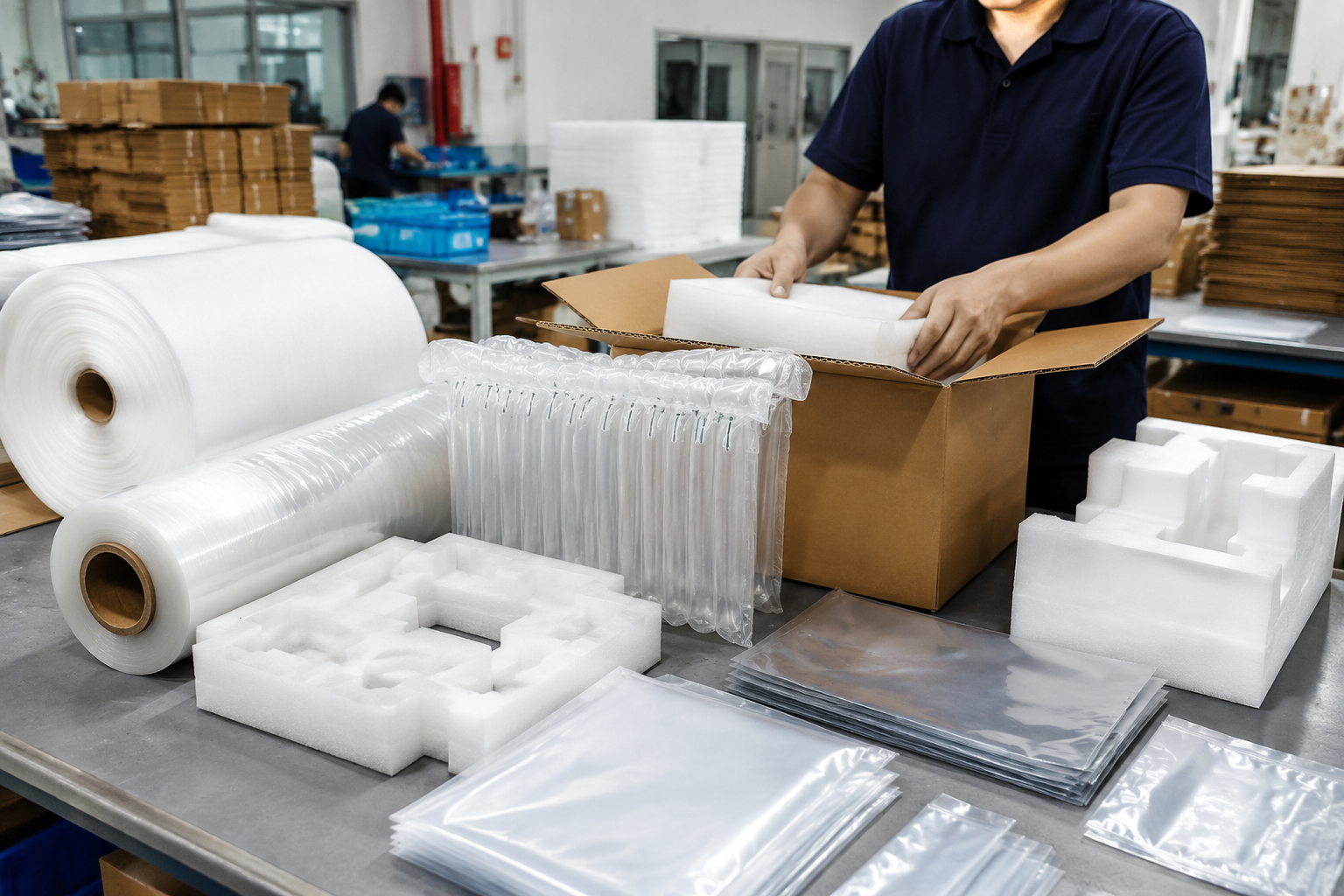
At Daipak, the discussion usually starts with the product details rather than the packaging category. As a packaging materials supplier in China and protective packaging manufacturer, Daipak often helps buyers compare EPE foam, bubble wrap, air cushion packaging, plastic film, and corrugated cartons as possible parts of one custom protective packaging plan. The goal is not to push one material, but to find a practical balance between protection, cost, and packing efficiency before a bulk packaging order is placed.
Product information gives the supplier the design boundary
Product information defines the first design boundary. Dimensions tell the supplier how much space is available for cushioning, wrapping, inserts, bags, or carton filling. Weight affects whether the packaging needs stronger support, thicker foam, reinforced corrugated structure, or better bottom protection. Shape matters because round, flat, sharp, long, or uneven products all behave differently inside a carton during handling.
Surface condition is just as important as size. A painted part, polished metal item, coated plastic housing, or retail-finished product may need scratch protection before impact protection is even considered. In that case, a plastic bag, foam sheet, protective film, or soft wrap may be needed as the first layer, while foam, bubble wrap, or corrugated packaging may provide the outer cushioning and structure.
Weak points should be identified early. Glass edges, electronic screens, protruding handles, thin corners, connection ports, and decorative surfaces may need targeted protection rather than general wrapping. If the supplier knows where the product is most likely to fail, the packaging can be designed around those areas instead of simply adding more material everywhere.
A practical trace path starts at this point. When the buyer sends product size, weight, photos, drawings, current packing method, order quantity, and destination, those details give the supplier a clearer basis for recommending material thickness, foam density, bag size, carton structure, and packing quantity. If any of these inputs later change, the recommendation should usually be checked again because the original material choice was based on the earlier product and shipment information.
Shipping and handling risks change the packaging decision
Packaging that works for short warehouse transfer may not be enough for long-distance shipping. Courier delivery, export cartons, pallet loading, container movement, and repeated handling can introduce impact, compression, vibration, rubbing, and carton movement. These risks affect whether the product needs tight-fit foam inserts, air column protection, corrugated dividers, void fill, corner guards, or stronger outer cartons.
For e-commerce parcels, the product may face individual drops, conveyor handling, and mixed carton orientations. For export packing, the concern may shift toward carton compression, pallet stability, container loading, and long transit time. For warehouse assembly, the packaging may need to be easy to open, easy to count, and simple for workers to use repeatedly without slowing the line.
This is why shipping damage is not only a material problem. It can come from empty carton space, poor fit, weak outer cartons, insufficient separation between parts, loose pallet loading, or unclear packing instructions. A good packaging review looks at the whole movement path from packing table to destination warehouse, not only the material roll or carton sample.
Custom packaging should balance protection, cost, and packing efficiency
Custom packaging should protect the product, but overpacking can create its own problems. Too much material may increase unit cost, carton size, storage space, and shipping volume. A foam insert that is too tight may slow workers down or make product removal difficult. A carton that is too large may require more void fill and still allow movement if the internal structure is not controlled.
The better approach is to compare protection, cost, and packing efficiency together. A slightly more accurate foam insert may reduce wrapping labor. A properly sized corrugated box may reduce the need for extra air pillows. A plastic bag may prevent surface scratches, but it should not be treated as impact cushioning. Bubble wrap may be flexible and fast, but for some products it needs to be paired with dividers, cartons, or corner protection.
Before choosing a material, buyers should be clear about the packaging job: prevent breakage, reduce scratches, separate parts, fill empty carton space, improve packing speed, support export handling, or make receiving easier. Once that purpose is clear, the supplier can recommend a material and structure that fit the real operating conditions.
Evidence checkpoints for buyer claims
Some packaging claims need a higher level of confirmation than ordinary purchasing advice. If a supplier or buyer describes a package as recyclable, compostable, food-contact suitable, export-compliant, or tested for a specific distribution environment, that claim should be tied to the exact material, market, test method, or regulation involved. For example, plastic packaging recyclability is not determined by the word “plastic” alone; design choices such as material combination, labels, adhesives, color, and closures can affect how the item fits recycling guidance.[1]
The same caution applies to performance language. A custom insert or carton can help reduce damage risk, but it should not be described as guaranteed protection unless the actual packed product has been validated under the relevant handling conditions. Package performance is affected by the product, inner material, carton, closure, stacking, route, and handling method, so evidence should support the specific claim being made rather than a broad promise.
Compliance boundaries should be set before wording is used outside purchasing
Packaging descriptions used in a quotation, product label, marketplace listing, or customer instruction should match what has actually been confirmed. Words such as recyclable, compostable, food-contact suitable, moisture barrier, anti-static, heavy-duty, or export-compliant can mean different things depending on the material, structure, destination, and end use. Buyers should separate internal sourcing descriptions from customer-facing claims and ask what documentation, test method, or market requirement supports the wording before using it in public materials.
Daipak Packaging can help organize material information, samples, dimensions, packing details, and supplier-side production records, but it should not be treated as a regulator, certification body, or testing laboratory. When a claim depends on destination-market rules or a specialized application, the buyer should confirm the requirement separately before production and before applying that claim to finished goods, labels, cartons, or sales materials.
What Buyers Should Prepare Before Asking for a Custom Packaging Quote
A useful custom packaging quote depends on clear product and order information. If the inquiry only says “Please quote foam insert” or “Need custom carton,” the supplier can only estimate based on assumptions. Those assumptions may later change after the product size, weight, material thickness, packing quantity, or shipping destination is confirmed.
A strong quotation request does not need to be complicated. Buyers do not need professional packaging drawings before starting the discussion. However, they should provide enough information for the custom packaging supplier to understand the product, the protection goal, the expected order scale, and the logistics situation. This helps avoid vague pricing, sample delays, wrong material choices, and price changes after details are clarified.
Product details the supplier needs first
The first information to prepare is the product itself. Product photos are often the fastest way to show shape, surface finish, edges, and fragile areas. Dimensions should include length, width, height, and any important protruding parts. Weight should be provided per unit and, where relevant, per set or per carton.
Buyers should also explain whether the product is sold as a single item, a kit, or a multi-piece set. A single electronic accessory may only need one bag and a small insert, while a product set may need separation between parts to prevent rubbing. Industrial parts with sharp edges may need thicker protection at contact points, while retail goods may need cleaner appearance and surface protection.
For a more accurate packaging quotation, it helps to prepare the following basic details:
- Product dimensions, including any tolerance or tight-fit requirements.
- Product weight and whether the item is light, dense, fragile, or unevenly balanced.
- Photos showing the full product, weak points, sharp edges, and finished surfaces.
- Surface protection needs, such as scratch prevention, dust protection, or separation from other parts.
- Expected packing style, such as wrapped individually, packed as a set, placed in an insert, or loaded into an export carton.
These details help the supplier narrow the packaging direction before discussing exact material thickness, foam density, bag size, carton structure, or sample requirements.
Order and logistics details that affect price
Product data explains what the package must protect. Order and logistics data explain how the package will be produced, packed, stored, and shipped. Estimated order quantity affects material planning, production setup, cutting efficiency, printing preparation, and unit price. A one-time trial order and a repeat bulk packaging order may require different quotation assumptions.
The shipping destination also matters. A carton used for domestic warehouse transfer may not need the same outer strength as a carton prepared for export handling. If the goods will be palletized, the supplier should know the preferred carton size, pallet loading direction, and whether carton marks are required. If the packaging will support e-commerce fulfillment, ease of picking and packing may matter as much as material cost.
Buyers should confirm the packing method as early as possible. This includes how many product units go into one inner pack, how many inner packs go into one carton, whether cartons need labels or printed marks, and whether the packaging materials themselves need to be packed in bundles, rolls, bags, or export cartons. These details can change the real cost even when the unit material price looks similar.
For traceable quotation preparation, the supplier should be able to connect each price assumption to a confirmed input. Bag size should come from the product dimensions and folding method; foam density should follow product weight and cushioning need; carton quantity should follow the buyer’s packing plan; carton marks should follow the destination warehouse or purchase order requirement. This makes it easier for the buyer to see why a quotation changes when the material thickness, printing, label, carton count, or shipment preparation changes.
Reference samples, drawings, or photos can reduce misunderstanding
Visual references help suppliers understand the buyer’s expectation faster. A current package, competitor-style reference, simple sketch, product drawing, or marked photo can show where the product should be supported, how much clearance is acceptable, and which surfaces must not be scratched. Even a basic phone photo with measured dimensions can reduce back-and-forth communication.
Reference materials are especially useful when the product has an irregular shape, delicate finish, or set-packing requirement. For example, a foam insert for a tool set needs to match several cavities, while a bag for a garment must consider fold size, opening direction, thickness, and packing appearance. A custom carton may need to fit both the product and the buyer’s shelf, warehouse, or shipping carton system.
Still, buyers should not delay an inquiry just because they do not have finished drawings. A supplier can often begin with photos, approximate dimensions, weight, order quantity, and destination. The design can then become more specific through material samples, drawings, revised measurements, and sample confirmation.

How Product Risk Guides the Choice of Packaging Materials
Custom protective packaging works best when material selection follows product risk. A fragile item needs impact absorption and movement control. A glossy or coated item may need scratch protection. A heavy product may need structural support. A carton with empty space may need void fill. A fast packing line may need materials that workers can apply consistently without special handling.
No single material solves every risk. EPE foam packaging can provide cushioning, separation, pads, bags, and shaped inserts. Bubble wrap is flexible for wrapping and light-to-medium cushioning. Air cushion packaging and air column bags can reduce weight and fill space in selected shipping applications. Plastic film packaging, poly bags, liners, and protective film help with dust, limited moisture exposure where suitable, grouping, and surface protection. Corrugated boxes provide the outer shipping structure. Many practical solutions combine several of these materials.
Fragile products need impact absorption and movement control
Glassware, ceramics, electronics, instruments, and delicate components need more than a soft layer around the product. They need controlled contact points and limited movement inside the carton. If the product can shift, hit another item, or strike the carton wall during handling, damage can occur even when cushioning material is present.
For fragile products, the supplier usually looks at the impact path. Corners, edges, screens, handles, lenses, and thin sections may need extra clearance or dedicated support. EPE foam inserts can hold a product in place and create a cushion zone. Bubble wrap can wrap irregular shapes, but it may need carton filling to stop movement. Air column bags can protect suitable product shapes with inflated chambers, but the product and carton size must match the air structure.
The outer carton should also support the inner protection. If the carton is too weak or too large, the inner material may not perform as intended. For export or courier handling, fragile products often need a combined system: surface layer, cushioning layer, movement control, and a carton sized to the packed product.
Finished surfaces need scratch and dust protection
Some products are not easily broken but are easy to damage visually. Painted metal, polished plastic, coated parts, acrylic panels, retail goods, and decorative surfaces can lose value from rubbing, dust, fingerprints, or contact marks. In these cases, the first packaging layer should protect the surface before the supplier thinks about carton strength or impact cushioning.
Plastic bags, foam sheets, protective film, self-adhesive foam pouches, and soft wrapping materials are common choices for surface protection. A clear plastic bag can keep dust away and organize the product. A foam sheet can separate two finished parts in one carton. Protective film can help reduce scratching on flat surfaces where suitable. These materials help prevent abrasion, but they do not replace cushioning for fragile or heavy products.
The risk is often found at repeated contact points. If two coated parts rub during transport, a small movement repeated over many hours can create visible damage. Product separation, snug carton fit, and soft contact surfaces can be more effective than simply adding thicker outer packing.
Heavy or irregular products need structure, not only soft cushioning
Heavy or irregular products can crush weak cushioning, deform cartons, or shift during lifting and pallet movement. A soft wrap alone may look protective during packing but fail when the carton is stacked, dropped, or moved across a warehouse. For dense parts, the package needs structure as well as cushioning.
Corrugated boxes, foam blocks, edge protection, corner pads, partitions, and reinforced inserts can help control load and movement. The right choice depends on the product’s weight distribution. A heavy item with small contact points may need stronger pads under those areas. A long item may need end protection. A product with sharp corners may require edge protection so it does not cut through bags, film, or thinner foam.
For heavier goods, carton size and internal layout matter. A tight, well-supported package can reduce movement, but it should still allow workers to pack and remove the product without force. A package that is too tight can slow packing and may create surface marks; a package that is too loose can create impact risk inside the carton.
Fast packing lines may need simpler, repeatable materials
Packaging is not only a design issue; it is also a labor and consistency issue. A material that protects well in a sample may be difficult to use repeatedly if it requires too many wrapping steps, careful alignment, or skilled handling. For warehouse teams and factory packing lines, repeatability can be just as important as material performance.
Simple bags, pre-cut foam pads, shaped inserts, bubble bags, air pillows, and standardized cartons can help workers pack faster and with fewer mistakes. If the packing process is too complicated, different workers may apply the material differently, creating inconsistent protection. That can be a hidden risk in bulk production and daily fulfillment.
The table below shows how common packaging materials often match different product risks. The best choice still depends on the actual product, carton space, shipping route, and packing method.
| Product Risk | Common Material Direction | Practical Limitation to Check |
|---|---|---|
| Impact from drops or rough handling | EPE foam inserts, bubble wrap, air column bags, cushioning pads | Material must fit the product and limit movement inside the carton. |
| Scratches, dust, or surface rubbing | Plastic bags, foam sheets, protective film, soft wrapping | Surface layers usually need support from cushioning or separation materials. |
| Empty carton space and product movement | Air pillows, bubble wrap, corrugated dividers, foam blocks | Void fill should prevent shifting without creating excessive carton volume. |
| Compression during stacking or export handling | Corrugated boxes, partitions, reinforced corners, structured inserts | Outer carton strength and internal support must work together. |
| High-volume packing work | Pre-cut sheets, bags, inserts, standardized cartons, simple fill materials | Workers need a repeatable method that does not slow the line. |
A practical packaging plan usually combines risk control with ease of use. If the product is fragile and finished, it may need both a plastic bag for surface protection and foam or air packaging for impact protection. If the product is heavy, it may need corrugated structure and edge protection instead of only thick wrapping. Matching the risk first helps buyers avoid both under-protection and unnecessary material use.
Special product categories need an early suitability check
Some products require more than a normal fit-and-cushioning review. If the packaging will be used for direct food contact, cosmetics, pharmaceuticals, medical supplies, lithium batteries, electronics sensitive to static, or hazardous goods, buyers should identify that use before samples are made. The packaging material, additive, printing ink, adhesive, closure, and carton format may need separate review depending on the product and destination market.
For electronics, buyers should not assume that an ordinary plastic bag, foam sheet, or bubble wrap has anti-static or electrostatic discharge properties unless that material has been specified and documented for that purpose. For moisture-sensitive goods, buyers should also distinguish between basic dust or splash protection and a verified moisture-barrier requirement. These details should be checked before production because the required material structure may be different from standard protective packaging.
Material Selection Note: For custom packaging projects, material choice should follow the product’s real risk profile rather than habit or the lowest unit price. Daipak’s discussion normally compares foam, bubble, film, air cushion, and corrugated options by fit, movement control, surface protection, carton space, and packing workflow before a sample or quotation is finalized.
When to Use Foam Inserts, Air Packaging, Plastic Bags, or Custom Cartons
Most custom packaging materials can be understood by the job they perform inside the package. Some materials hold the product in a fixed position. Some absorb shock. Some reduce scratches or dust. Some create the outer shipping format. A good packaging decision usually starts by asking which job is missing in the current pack, not which material sounds most familiar.
For many products, one material family is not enough. A painted metal part may need a plastic bag to reduce surface rubbing, EPE foam to protect corners, and a corrugated carton to give the shipment structure. A small e-commerce item may need bubble wrap or air pillows only if the shipping carton already has enough strength. A fragile item may need air column packaging or foam inserts if movement inside the box is the main problem.
EPE foam inserts for fitted cushioning and product separation
EPE foam inserts are useful when the product needs a fixed position, shaped cushioning, or separation between parts. They can be cut or formed into pads, blocks, trays, dividers, sleeves, or corner protectors. This makes them practical for product sets, electronic components, glass items, hardware kits, and products with areas that should not touch each other during transport.
The main advantage of foam inserts is control. Instead of wrapping the product loosely, the insert can hold key contact points and protect corners, edges, or protruding parts. This helps make packing more repeatable for warehouse teams because each product has a clear place inside the packaging. For bulk packing, repeatability matters: if workers pack the same way each time, the risk of loose movement or uneven protection is lower.
The trade-off is that fitted foam needs accurate product dimensions and a clear understanding of the carton space. If the insert is too loose, the product may still shift. If it is too tight, packing can slow down or the foam may press against a delicate surface. Buyers should provide product size, photos, weight, and any weak points before asking a supplier to design foam inserts.
Air column and air cushion packaging for lightweight impact protection
Air column packaging uses inflated chambers to cushion fragile goods such as bottles, jars, small appliances, electronics, and selected e-commerce products. It can provide impact absorption while keeping the package relatively light. Air cushion film and air pillows are often used to fill empty space in cartons so products do not move during courier handling or warehouse transfer.
Air packaging works best when the product shape and packing method fit the inflated structure. A regular bottle, box-shaped item, or product with a predictable outline is often easier to match than a heavy, sharp, or highly irregular part. Buyers should also consider where inflation happens. If packaging is supplied flat and inflated at the packing site, the warehouse needs suitable equipment, space, and workers trained to inflate and pack consistently.
Air cushions and air column bags are not a direct replacement for every foam or carton solution. They may not be ideal for products with sharp edges, very heavy items, or goods that need rigid separation between multiple parts. They are strongest when used for lightweight cushioning, void fill, and certain fragile products where the inflated chambers can surround the item properly.
Plastic bags and film packaging for surface protection and product grouping
Plastic bags and film packaging are often used to protect the product surface, keep parts together, reduce dust exposure, and support clean inner packing. Poly bags, garment bags, liner bags, courier bags, stretch film, and protective film each serve different roles. For example, a garment bag helps keep apparel organized and clean, while a clear poly bag can separate accessories inside a retail or shipping carton.
Film packaging is especially useful for products with polished, painted, coated, or easily scratched surfaces. A bag, sleeve, or soft film layer can reduce direct rubbing between the product and the carton, foam, or other parts in the same pack. It also helps warehouse teams identify, count, and handle components more easily when products are packed in sets.
The limitation is clear: plastic bags and film do not provide enough impact protection by themselves. A thin bag may keep dust away, but it will not protect a fragile corner from a drop. For products with both surface and impact risks, film packaging often works as an inner layer together with foam, bubble wrap, air cushioning, or a corrugated outer box.
Custom corrugated cartons for shipping structure and outer protection
Custom corrugated cartons provide the shipping shape and outer structure for the full packaging system. They may be used as postal boxes, zipper corrugated boxes, moving boxes, printed boxes, export cartons, or product-specific shipping cartons. The carton is not only a container; it affects stacking, carton compression, pallet loading, courier handling, and how much inner protection is needed.
A carton that fits the product and inner packaging well can reduce excess void fill and improve packing speed. A carton that is too large may require more air pillows, bubble wrap, or paper fill to control movement. A carton that is too weak for the product weight or shipping route may deform during storage or transit, even if the inner cushioning is acceptable.
Buyers should confirm carton size, board strength expectations, packing quantity, product weight per carton, printing or label needs, and whether the carton will be used for e-commerce delivery, warehouse storage, export packing, or retail distribution. Custom cartons perform best when they are designed together with the inner protection, not selected after the product has already been wrapped.
Corrugated packaging is often discussed as a practical option partly because corrugated recovery and recycling systems are well established in many markets, but buyers should still confirm local recovery rules, coatings, inks, labels, and contamination limits before making a recyclability claim on finished packaging.[2]
How Custom Size, Thickness, Density, and Structure Affect Performance and Cost
Custom packaging specifications do more than define the outside size of a package. They affect how well the product fits, how much material is used, how fast workers can pack, how much space the packaging occupies in storage, and how the finished cartons ship. A small change in thickness, foam density, carton size, or packaging structure can change both protection and total cost.
Where buyers often go wrong is focusing only on the unit price of one material. A thinner bag, lighter foam, smaller bubble, or lower-strength carton may reduce the material cost, but it can create other costs through tearing, poor fit, slow packing, extra void fill, or shipping damage risk. On the other side, overpacking with excessive material can increase carton volume, storage space, and freight cost without solving the real problem.
Size accuracy affects fit, protection, and packing speed
Accurate size information is one of the most important inputs for custom packaging. The supplier needs product length, width, height, weight, shape, and any protruding or fragile areas. If the product is irregular, photos or simple drawings can help clarify where the packaging should touch the product and where it should leave clearance.
A foam insert that is too loose may allow the product to move inside the carton. A foam insert that is too tight may slow down packing or press against a coated surface. A plastic bag that is too small can tear during insertion, while a bag that is too large may look messy or create extra folding. A carton that is slightly oversized can increase void fill needs across every shipment.
Size accuracy also affects packing speed. Warehouse workers should be able to insert, wrap, seal, and carton the product without forcing it into place. For bulk orders, even a few extra seconds per unit can become a real labor issue. The goal is not only a good fit on the drawing, but a fit that works repeatedly on a packing table.
Material thickness or density changes both protection and cost
Material thickness and density should match the product’s actual handling needs. Higher foam density or thicker foam may improve support for certain products, but it can also increase material use and package volume. Lower-density foam may work for lightweight surface protection, but may not be enough for heavier items or products with concentrated pressure points.
Bubble size and bubble wrap thickness also affect performance. Smaller bubbles can wrap easily around light products and surfaces, while larger bubbles may offer more cushioning space for certain items. Film thickness matters for bags, liners, courier bags, and stretch film. A thin film may save material, but if it tears during packing or transport, the saving disappears quickly.
Corrugated cartons have similar trade-offs. A stronger carton may be needed for heavier products, stacking, export handling, or pallet preparation. But increasing carton strength without checking the inner packaging may not solve movement inside the box. The carton, cushioning, and product fit should be reviewed as one packaging system.
Packaging structure can reduce waste better than simply adding more material
Better protection does not always mean adding more material. A smarter packaging structure can reduce waste while improving performance. Examples include using foam only at key contact points, adding partitions to separate parts, using a fitted insert instead of loose wrapping, or choosing a carton size that reduces empty space around the product.
Layering can also be more effective than relying on one thick material. A product with a fine finish may use a soft plastic bag or film first, then foam pads for cushioning, then a corrugated carton for structure. This approach places each material where it does the most useful work. It avoids using expensive or bulky material in areas where it does not add much protection.
From a factory perspective, structure also affects production consistency. Simple, repeatable shapes are usually easier to cut, seal, fold, pack, and inspect. A design that looks protective but is difficult for workers to assemble can create variation in bulk production. Buyers should ask whether the proposed structure is practical for the packing line, not only whether it looks strong in a sample.
Sample Confirmation Before Bulk Production
A custom packaging sample is a checkpoint before committing to bulk production. It gives the buyer and supplier a shared reference for fit, material, structure, appearance, and packing method. Sample confirmation should not be treated as a formality, especially when the packaging is cut to size, shaped around the product, printed, sealed, or designed to fit a specific carton.
Some samples are simple material samples, such as foam sheets, bubble wrap, film, or carton board references. Others are custom-formed, cut, sealed, printed, or assembled to match the intended production design. The time and cost can vary depending on the structure, tooling, cutting, printing, bonding, or special material requirements. Buyers do not need to know every production detail at the beginning, but they should understand what the sample is meant to prove.
What a sample should prove before production
A useful sample should confirm that the packaging matches the product and the order requirements. For foam inserts, this means checking whether the product fits correctly, whether the support points are in the right place, and whether fragile areas are protected without excessive pressure. For bags or film, it means confirming size, thickness, sealing, opening direction, clarity, and handling feel. For cartons, it means checking size, folding, strength expectations, printing if included, and compatibility with the inner packaging.
The sample should also prove the protection logic. If the package is meant to prevent movement, the buyer should see whether the product stays stable inside the carton. If it is meant to reduce scratches, the buyer should check contact between the product surface and the packaging material. If it is meant to improve packing speed, the packing team should be able to use it without extra trimming, forcing, or complicated handling.
Appearance matters as well, especially for retail, e-commerce, or branded packaging. Color, print placement, label area, bag finish, carton folding, and visible cutting quality should be reviewed before production. A pre-production sample becomes much more useful when the buyer evaluates both protection and presentation.
What buyers should test with their own product
Buyers should test the sample with the real product whenever possible. Product drawings are helpful, but the actual item reveals details that are easy to miss: a sharp edge, a glossy surface, a raised button, a weak corner, or a small accessory that needs separate placement. Insert the product, remove it, repack it, and check whether the packaging still works after normal handling.
For fitted packaging, check whether the product moves when the carton is gently shaken. For surface-sensitive products, check whether rubbing marks appear after insertion and removal. For bags, check whether the opening is convenient and whether the seal or film thickness feels suitable for the product weight. For cartons, confirm that the inner packaging fits without bulging, crushing, or leaving too much empty space.
It is also useful to involve the warehouse or assembly team before approval. A packaging sample may look correct on a desk but slow down packing on a production line. If workers need to pack many units per hour, the sample should be easy to identify, open, fold, insert, seal, and place into the shipping carton.
How sample feedback should be communicated
Sample feedback should be clear, visual, and specific. Instead of saying the foam is “not suitable,” mark where it is too tight, too loose, too thin, or not supporting the correct area. Photos with arrows, measured dimensions, short videos of the packing process, and comments from the warehouse team can help the supplier understand the issue quickly.
If a dimension needs to change, the buyer should state the revised size or the desired clearance rather than only describing the problem. If the material feels too thin, too stiff, too soft, or too bulky, explain what happened during packing or handling. This helps the supplier adjust the design based on a real packaging problem, not a guess.
After revisions, the confirmed version should be recorded carefully. The final sample, material specification, size, color, printing, carton packing, and any buyer-specific notes should match before bulk production begins. Clear sample confirmation reduces misunderstandings and gives both sides a practical reference for production review.
Good sample feedback also creates a practical trace from problem to revision. If the first foam slot is too narrow, the revised slot size should be connected to the marked photo or measured product point. If a bag tears during packing, the revised film thickness or sealing method should be connected to the packing test that revealed the issue. This kind of simple record helps the supplier understand whether a change is solving fit, protection, appearance, or packing-speed concerns.
Trial packing should reflect real line conditions
A sample is more reliable when it is tested the way the actual packing team will use it. Buyers should not only place the product into the packaging once on a clean desk. They should try a small trial run with the real workflow: opening materials, placing inserts, sealing bags, loading cartons, marking cartons, and stacking packed goods the way they will be handled in daily operation.
This is where practical problems often appear. A foam insert may fit well but slow down production if workers need to rotate the product during insertion. A bag may look correct but wrinkle badly if the product is packed in a different sequence. A carton may look strong but become awkward to fold or tape when the packing line is busy. Testing the full process helps the buyer see whether the design is only sample-friendly or truly production-friendly.
For export buyers, it is also useful to simulate how finished cartons are loaded and moved. If cartons will be palletized, the stack should be checked for stability. If cartons will be shipped loose, the outer surfaces and labels should still remain clear and intact. A trial packing review often saves more money than trying to fix a problem after bulk goods are already made.
When formal transit testing is worth discussing
For higher-value, fragile, heavy, or new-to-market products, sample approval may need more than a desk check. Buyers can discuss whether the packed product should be evaluated against a recognized distribution or parcel-delivery test approach, especially when the package will face courier networks, mixed handling, or export movement. ASTM D4169 is a standard practice for performance testing shipping containers and systems, while ISTA Procedure 3A is commonly referenced for packaged products moving through parcel delivery systems.[3][4]
Formal testing is not necessary for every simple bag, foam sheet, or carton order, and it does not remove the need for practical packing-line review. It is most useful when the buyer needs a repeatable way to compare designs, document a packaging decision, or reduce uncertainty before a large production run. The test plan should match the actual product, carton, route, and risk level rather than being used as a generic label.
How Suppliers Build a Quotation for Custom Packaging Materials
A custom packaging quotation is built from more than a material name and an order quantity. For the same product, one supplier may quote a thin plastic bag, another may quote an EPE foam insert with an outer carton, and another may include printing, export cartons, and packing details. The numbers will not be comparable unless the specifications behind the quote are comparable.
For buyers, the goal is not only to collect a low unit price. The better question is what the price includes, what protection level it assumes, and whether the quoted packaging can be produced consistently for the intended packing method. A lower bulk packaging price can become expensive if the material is downgraded, the carton size increases shipping volume, or the packaging slows the packing line.
Material specification is the base of the quote
The material specification usually sets the starting point for cost. For EPE foam packaging, size, thickness, density, cut shape, lamination, adhesive, and the number of pieces per set can all change material use and production time. For bubble wrap or air cushion packaging, bubble size, film thickness, roll width, bag style, or perforation details may affect the quote. For plastic bags and film packaging, bag size, film thickness, sealing method, printing, handle style, and adhesive closure all matter. For corrugated boxes, board grade, flute type, carton size, printing, die-cutting, and structure affect both cost and performance.
This is why a packaging materials supplier may ask for product dimensions, carton space, product weight, and photos before quoting. Without those details, the supplier may only give a rough estimate based on assumptions. If the buyer later requests thicker foam, a tighter insert, printed carton marks, or a different packing quantity per carton, the quotation may need to change.
Structure can be just as important as material. A flat foam sheet, a simple foam pad, and a multi-part fitted insert may use the same material family but require different cutting work and packing time. A plain poly bag and a printed courier bag may look similar in a product list, but printing setup, film strength, sealing quality, and packing format can create different pricing. Buyers should ask suppliers to describe the quoted specification clearly, not only state the unit price.
Order quantity affects setup efficiency and unit price
Order quantity influences how efficiently a factory can prepare materials, arrange cutting or sealing, set up printing, and pack finished goods. In general, larger bulk orders spread setup work across more units. Smaller orders may still be possible, but the unit price may carry more of the setup, handling, and material preparation cost.
This does not mean buyers should order more than they need. Packaging materials also take storage space, and some products or designs may change over time. A practical quotation discussion should balance current demand, repeat-order expectations, warehouse space, and how stable the product design is. If the buyer expects repeat orders, it helps to confirm whether the same specification can be used again and whether the supplier can keep clear production references for future batches.
Quotation discussions usually work best when buyers separate trial needs from bulk order expectations. A sample or pilot quantity may be used to confirm fit and packing method, while the bulk quantity gives the factory a clearer basis for material planning and production coordination.
Packing and export preparation can change the real landed cost
The quoted unit price is only one part of the real cost. Carton packing, carton size, packing quantity, and shipping volume can change the final landed cost for overseas buyers. A packaging item that is light but bulky may look inexpensive per piece but take more container or air freight space. A carton that is too large may require more void fill and may also increase handling risk during transport.
Buyers should confirm whether a quote includes only the packaging product itself or also export cartons, inner packing, labels, carton marks, pallet preparation, or other shipping support. For example, foam inserts may need to be stacked without deformation. Air column bags may need packing that protects them from puncture before use. Printed corrugated boxes need to be packed in a way that reduces edge damage and keeps cartons clean for warehouse receiving.
| Quote Factor | Why It Matters | Buyer Question to Ask |
|---|---|---|
| Material thickness or density | Affects cushioning, strength, material use, and unit cost. | Is the quoted material the same as the approved sample? |
| Custom size and structure | Changes cutting, sealing, tooling, waste, and packing speed. | Does the price include the final custom shape or only a standard size? |
| Printing or labels | Adds setup work and requires artwork or marking confirmation. | Are printing, carton marks, and label details included? |
| Carton packing | Influences shipping volume, warehouse receiving, and product condition. | How many pieces are packed per carton, and what is the carton size? |
| Export preparation | May affect handling, pallet loading, and delivery preparation. | Does the quote cover export cartons or only loose product packing? |
The main takeaway is simple: buyers should compare the full quotation basis, not only the number in the unit price column. A clear quotation should make the material, size, structure, packing method, and export preparation easy to understand before the buyer approves a bulk packaging order.
Total packaging cost goes beyond the material unit price
Experienced buyers often look past the unit price and ask what the packaging costs in real use. The cheapest material on paper may increase labor time, damage risk, or freight volume. A slightly more expensive insert may reduce repacking, while a better-fitted carton may save space and cut filler usage. That is why packaging cost should be measured from the packing table to the destination warehouse, not only at the factory gate.
Other cost factors are easy to miss. More complicated structures can require more setup or slower packing. Extra printing can increase approval time. Unclear size information can create remake cost. Large cartons may increase shipping expense even if the material itself is inexpensive. For this reason, a good quote should help the buyer see where the cost is coming from and what trade-offs are included.
Buyers should compare quote sheets by specification first, not by total number alone. That is especially useful when one supplier includes a fitted structure, carton, and labels while another quotes only a loose protective material. The unit price can look lower in the second case even though the total packing result is not the same.
Lead time should be treated as a planning estimate, not a guarantee
Custom packaging schedules can change with material availability, sample revision, printing approval, tooling or cutting setup, production queue, packing method, and export preparation. Buyers should ask what the quoted schedule assumes and which details must be confirmed before the supplier can plan production. A fast estimate is useful for planning, but it should not be treated as a fixed delivery promise until specifications, sample approval, quantity, packing, and shipment arrangement are aligned.
If a project has a launch date or a factory packing window, the buyer should share that timing early. The supplier can then explain which steps are likely to affect the schedule, such as artwork confirmation, sample feedback, bulk material preparation, carton mark approval, or shipment booking. Clear timing discussion helps both sides avoid rushing into bulk production before the packaging has been properly checked.
From Approved Sample to Bulk Production
Bulk production custom packaging begins when the approved sample becomes a working production reference. At that stage, the supplier should not rely on memory or informal discussion. The final sample, drawings, dimensions, material specification, packing method, and order details need to be turned into a clear production file that factory teams can follow.
This step matters because custom packaging often has small details that affect performance. A foam insert may need a specific slot width so the product does not move. A plastic bag may need a certain seal strength or opening direction. A carton may need accurate creases and printed marks so the warehouse team can use it correctly. If those details are not locked before production, the finished goods may look close to the sample but fail in actual packing work.
Final specifications should be locked before production starts
Before production begins, the buyer and supplier should confirm the approved sample version, final dimensions, material type, thickness or density, color, printing details, size tolerance where relevant, order quantity, packing quantity, carton marks, and shipment arrangement. If the product is packed as a set, the supplier should also understand the order of placement and any separation requirements between parts.
For custom protective packaging, even small changes should be reviewed. A slightly thicker foam may improve cushioning but reduce the number of pieces per carton. A tighter insert may hold the product more securely but slow down packing or create surface rubbing. A different carton size may save material but create less space for corner protection. Specification confirmation is not paperwork for its own sake; it prevents avoidable changes after material has already been prepared.
In order discussions, sampling, specifications, and production preparation should stay connected because a small design update can affect material planning, packing quantity, and delivery preparation. For overseas buyers, this kind of coordination helps reduce confusion between the sample stage and the production stage.
Specification Confirmation Note: Before bulk production, the buyer and factory should confirm size, thickness, density, structure, quantity, printing, labels, carton marks, and packing method in writing. This gives the production team a practical reference and helps reduce mismatch between the approved sample, quotation basis, and finished packaging.

Production coordination depends on the material family
Different packaging materials follow different production workflows. EPE foam may involve sheet preparation, cutting, slotting, bonding, lamination, or shaping. Bubble wrap and air cushion products may involve film converting, cutting, bag making, or roll packing. Plastic bags may require film selection, printing, sealing, punching, folding, or packing by bundle. Corrugated cartons may involve board selection, printing, slotting, die-cutting, folding, gluing, and carton packing.
Because each material family has its own process, production coordination should match the product being made. A foam insert needs attention to cutting accuracy and fit. A bag order needs attention to film thickness, sealing quality, and opening direction. A printed carton needs attention to structure, print position, crease accuracy, and packing condition. A supplier that handles multiple packaging categories should still treat each one according to its own production logic.
For combined packaging, coordination becomes even more important. A product may use a plastic bag for surface protection, foam pads for cushioning, and a corrugated carton for outer shipping structure. If one part changes, the whole packing system may need to be checked again. A thicker inner wrap, for example, may affect how well the foam insert fits inside the carton.
During production, traceability is most useful when each process check is tied back to the confirmed requirement. Cutting should be checked against the approved size or drawing, sealing against the confirmed bag style, bonding or lamination against the sample structure, printing against the approved artwork or carton mark, and carton packing against the agreed quantity. This keeps factory checks practical: workers are not only looking for “good appearance,” but comparing the finished packaging with the buyer-approved reference.
Finished packaging should be checked before shipment
Finished goods should be reviewed before shipment against the confirmed production file. The check should include size, material appearance, thickness or density where applicable, structure, cutting or sealing quality, printing or label accuracy, packing quantity, carton condition, and buyer-specific requirements. This review does not replace the buyer’s own product testing, but it helps reduce mistakes before the goods leave the factory.
Carton labels and carton marks are especially important for overseas orders. Warehouse teams need to know what is inside each carton, how many pieces are packed, and whether the packaging belongs to a certain product model, purchase order, or destination. Incorrect marks can create receiving delays even when the packaging itself is correct.
Shipment preparation should also consider whether the packaging can tolerate its own transport before being used. Foam pieces should not be crushed in poor cartons. Plastic bags should stay clean and organized. Corrugated boxes should be bundled or packed to reduce edge damage. Air packaging products should be packed to avoid puncture or deformation before the buyer uses them in their own packing operation.
Quality Control Points Buyers Should Not Skip
Custom packaging quality control is not only a final appearance check. The real purpose is to confirm that the packaging matches the approved specification and can be used smoothly in the buyer’s packing process. Wrong size, weak cushioning, poor sealing, damaged cartons, incorrect labels, or wrong packing quantity can all create downstream problems even if the finished packaging looks acceptable at first glance.
A practical packaging inspection should connect each check point to a real buyer risk. If the foam is too loose, products may move during shipping. If the bag seal is weak, products may fall out or collect dust. If carton marks are wrong, the receiving warehouse may sort goods incorrectly. If repeat orders are not tied to the same confirmed sample, the buyer may see packaging variation between shipments.
Specification checks protect against wrong-size packaging
The first control point is comparison with the approved sample or confirmed specification. For foam, this may include length, width, thickness, density, slot size, cut shape, bonding position, and surface condition. For plastic bags, it may include bag size, film thickness, sealing width, opening direction, printing, and packing count. For corrugated boxes, it may include internal size, board structure, printing position, folding accuracy, and carton strength for the intended use.
Fit is especially important for custom protective packaging. A package that is only a few millimeters off may still look close in photos but fail during packing. It may be too tight for fast insertion, too loose to control movement, or too large for the shipping carton. Buyers should ask suppliers how the finished goods will be checked against the approved sample, especially when the order involves inserts, shaped foam, printed cartons, or packaging that must match a product set.
Color and appearance may also matter, but they should not distract from function. A clean surface and neat cutting are useful, but the packaging must first meet the required dimensions, material specification, and protection logic. For export packaging, functional consistency usually matters more than cosmetic perfection.
Packing quantity and carton marks matter for receiving and warehouse use
Packing quantity errors are easy to overlook during production but costly during receiving. If cartons contain inconsistent counts, the buyer’s warehouse may spend extra time recounting, relabeling, or sorting. If one carton contains mixed items without clear labels, the wrong packaging may be sent to a packing line or fulfillment station.
Carton marks should be confirmed before shipment when buyers need purchase order numbers, item codes, product names, quantities, destination marks, or handling notes. These details are not only for shipping. They also help warehouse teams identify materials quickly after arrival, especially when several packaging types look similar, such as different foam insert sizes or poly bags for related product models.
Carton condition should also be part of the review. Damaged export cartons, weak sealing, poor stacking, or unclear labels can create problems before the packaging is even used. A good packing review should check whether finished packaging is arranged in a clean, countable, and practical way for storage, unloading, and internal distribution.
Repeat orders need consistent production references
Repeat orders are easier and safer when the buyer and supplier keep the same confirmed references. These may include approved samples, drawings, material records, production photos, packing quantity, carton marks, and any change history. Without these references, a repeat order may drift from the original specification, especially if the buyer only sends a product name or old purchase order number.
For custom packaging, repeat-order consistency depends on more than using the same material category. The foam density, film thickness, bag sealing method, carton size, printing position, or packing count may all need to match the previous batch. If the buyer changes product dimensions, carton arrangement, or shipping method, the supplier should review whether the old packaging specification still fits the new requirement.
Clear records help both sides. Buyers can reorder with fewer explanations, and the supplier can prepare materials and production instructions with less risk of misunderstanding. This is especially useful for overseas B2B buyers managing several product lines, seasonal orders, or packaging materials for different warehouse locations.
Repeat-order feedback should be connected to the next production instruction. If the buyer reports that cartons arrived with unclear marks, the next order should confirm mark size, position, and wording before printing or labeling. If the warehouse says the packing count is inconvenient, the next quote and carton plan should reflect the revised count. If a product finish changes, the supplier should check whether the old bag, film, foam, or carton contact surface still protects the product properly.
Watch the first bulk run for pattern errors
The first bulk run often reveals issues that were hard to see in the sample stage. Sometimes the product is packed slightly differently by different workers. Sometimes labels are placed too low or too high. Sometimes the carton closes well in the sample but becomes difficult when packed at speed. These are not dramatic failures, but they can affect daily production and receiving.
Buyers should ask for a small internal review of the first production batch if the packaging is new or the structure is complex. A few cartons from the first run can be checked for fit, count, label accuracy, packing cleanliness, and whether the product can be opened or removed correctly after arrival. That review is especially useful when the packaging will be used for export or for repeat warehouse operations.
Once the first bulk batch has been checked, the buyer can keep the confirmed result as a reference for future orders. This reduces the chance that a later order slowly drifts away from the approved pack without anyone noticing until the products are already in use.
How Export Shipping and Destination Requirements Change the Packaging Plan
Packaging that works for a short domestic warehouse transfer may not be enough for export packing. International shipments can involve longer transit time, more loading and unloading, container movement, pallet stacking, warehouse storage, and sometimes courier handling after arrival. The packaging plan should account for this full chain, not only the moment the product leaves the factory.
Export packaging support is usually about matching the inner protection, outer carton, packing format, and shipment preparation to the way the goods will actually move. A lightweight retail item shipped by courier may need different cushioning and carton control than heavy industrial parts loaded on pallets. A product going directly to an assembly line may need packaging that is easy to open and sort, while an e-commerce product may need stronger individual parcel protection.
The supplier does not control every part of the logistics chain, so no packaging design should be treated as a guarantee against all handling damage. Still, good planning can reduce common risks such as carton compression, product movement inside the shipping carton, surface abrasion, moisture exposure during storage, and confusion at destination warehouses.
Export routes may require stronger outer packing and better movement control
Long-distance shipping adds repeated vibration, stacking pressure, and handling changes. A carton may be loaded into a container, moved through ports, stored in a warehouse, and then broken down for local distribution. During that process, weak outer cartons can crush, oversized cartons can collapse into empty space, and loose products can rub against each other even if the material itself looks acceptable.
For export routes, the shipping carton and the inner protection should work as one system. Corrugated cartons provide structure, but they need the right size, board strength, and packing quantity. EPE foam, bubble wrap, air column bags, partitions, plastic liners, or corner protection may be used inside the carton depending on product risk. The goal is not simply to add more material, but to keep the product stable and protected from impact, compression, and surface contact.
Pallet loading also changes the decision. If cartons will be stacked high, the lower cartons need enough compression resistance for the expected load. If the product is fragile or heavy, the packaging may need tighter internal support so the product weight does not shift during transport. For goods exposed to humid storage or variable warehouse conditions, buyers should discuss whether liner bags, film wrapping, or other moisture-control measures are appropriate for the product and route. Compression resistance should be checked against the actual carton, load pattern, and handling condition rather than assumed from the carton material name alone.[5]
Warehouse and fulfillment use affects packaging format
After arrival, packaging often needs to serve warehouse teams, not only protect the product during transit. If workers need to pick, scan, open, repack, or assemble products quickly, the format should be practical. A package that is very protective but difficult to open may slow fulfillment. A foam insert that fits too tightly may protect well in theory but create handling problems when workers remove the product repeatedly.
Warehouse packing also depends on how the product is stored. Products kept in bulk cartons may need separators, bags, or foam sheets to prevent rubbing during storage. Products prepared for e-commerce fulfillment may need individual inner packaging that can move directly into a courier bag, postal box, or shipping carton. Products used in factory assembly may need packaging that keeps sets organized and easy to identify at the workstation.
Buyers should think about who will handle the packaging after delivery. A distributor may care about carton labels and packing counts. A fulfillment center may care about barcode space, carton size, opening method, and picking efficiency. A manufacturer may care about part separation, dust protection, and repeatable unpacking. These practical details can affect whether foam inserts, poly bags, bubble wrap, air cushions, corrugated dividers, or custom cartons make the most sense.
Destination information helps the supplier recommend practical packing details
A China protective packaging supplier can make a better recommendation when the destination and shipping method are clear. The same product may require different preparation if it ships by sea freight in palletized export cartons, by air freight in smaller cartons, or by courier as individual parcels. Destination warehouses may also have requirements for carton marks, packing quantity, carton weight, pallet format, or receiving labels.
Useful destination details include the country or region, expected shipping mode, whether the goods will be palletized, whether cartons will be opened for retail distribution or e-commerce fulfillment, and whether the buyer has preferred carton sizes or label formats. If the packaging will be used by a warehouse or assembly team, that should be shared early as well. It can affect carton layout, product grouping, bag opening direction, and the way parts are separated.
For export orders, buyers should confirm carton marks, packing quantity, destination, and delivery preparation details early. Those details do not only affect shipment paperwork; they can also affect carton selection, packing arrangement, and the way finished packaging materials are organized before dispatch.
Recheck the specification when the shipping route changes
Buyers sometimes keep the same packaging but change the route, such as moving from domestic delivery to export, from sea freight to courier, or from carton shipment to palletized shipment. When that happens, the packaging should be reviewed again instead of assuming the old specification still works. A carton that was acceptable for local distribution may be too light for export stacking. A bag that worked for short handling may not be enough if the goods are stored longer before use.
Even a small logistics change can affect the packing logic. More transit time may increase the need for cleaner surface protection. More handling points may increase the need for tighter carton fit. Pallet loading may change carton dimensions or stacking direction. This is why route information belongs in the packaging review from the start, not only after production has begun.
Special compliance topics should be separated from ordinary export packing
Not every export order has the same regulatory risk. Ordinary protective packaging for consumer goods is different from packaging that directly contacts food, carries hazardous goods, or includes wood packaging material. If packaging will touch food directly, U.S. buyers may need to review applicable FDA food-contact substance requirements for polymers, paper, paperboard, or related materials; EU buyers should also confirm requirements under EU food contact material rules.[6][7]
Hazardous goods and regulated transport should not be handled as a normal carton-strength discussion. Dangerous goods packaging may need to follow transport rules that are separate from ordinary protective packaging selection, including international model regulations or destination-specific hazardous materials rules.[8] If wooden pallets, crates, or other wood packaging material are used for international trade, buyers should also confirm whether ISPM 15 treatment and marking requirements apply.[9]
Working with Daipak on Custom Packaging Projects
Daipak Packaging, operated by Zhejiang Daipak Packaging Materials Co., Ltd., works as a China packaging materials supplier and protective packaging manufacturer for overseas B2B buyers. The useful starting point is not a catalog item alone, but the product, its handling risk, the packing process, and the expected shipment route. From there, the packaging discussion can move toward EPE foam packaging, bubble wrap and air cushion packaging, plastic bags and film packaging, corrugated boxes, or a combined custom protective packaging structure.
For many buyers, the main value of working with a custom packaging supplier is having one discussion that connects material selection, sample confirmation, quotation basis, production coordination, packing review, and export preparation. A product may need a foam insert for positioning, a plastic bag for dust protection, a corrugated carton for outer structure, and carton marks for warehouse receiving. Treating those items separately can create gaps; treating them as one packaging plan helps reduce mismatch before bulk orders begin.
What Daipak can help confirm before production
Before production, the packaging details should be clear enough that both buyer and supplier are working from the same reference. This normally includes material type, size, thickness or density, color if relevant, structure, cutting or sealing requirements, printing or label details, sample approval status, packing quantity, carton packing, and shipment preparation needs.
Daipak can help buyers compare material options based on the product and application. For example, EPE foam inserts may be suitable when products need fitted cushioning or separation. Bubble wrap may be practical for flexible wrapping and light-to-medium cushioning. Air column packaging may suit certain fragile products if the shape and inflation process are appropriate. Plastic bags and film can support dust protection, product grouping, or surface protection, while corrugated cartons provide the outer shipping format.
From a factory-side view, the confirmed sample and written specifications should stay connected. If a buyer approves a sample but later changes the carton size, product quantity per carton, or material thickness, the packaging plan may need review again. Small changes can affect fit, material use, packing labor, carton volume, and final quotation.
What buyers can send to start a packaging review
Buyers do not need to prepare professional packaging drawings before the first discussion. Clear product and order information is usually enough to begin a practical review. The more specific the information, the easier it is to avoid rough assumptions and repeated revisions.
- Product photos: show the full product, fragile areas, corners, surface finish, accessories, and any current packaging problem.
- Product dimensions and weight: include length, width, height, approximate tolerance needs, and whether the product is packed alone or as a set.
- Protection concerns: explain if the main risk is impact, scratches, dust, limited moisture exposure, compression, movement inside cartons, or courier handling.
- Current or target packing method: describe whether products are wrapped, inserted into foam, placed in bags, packed into cartons, palletized, or prepared for fulfillment.
- Order and shipment details: provide estimated quantity, destination, shipping mode if known, carton requirements, pallet needs, and any label or carton mark expectations.
If the buyer already has an old package, reference sample, drawing, or damaged shipment photo, it can help the supplier understand the goal faster. The reference does not need to be perfect. It simply gives the packaging team a clearer starting point for material comparison, sample planning, and quotation.
How repeat orders benefit from clear specifications
Repeat-order support is much easier when the first order has clear records. Custom packaging depends on confirmed dimensions, material references, cutting details, sealing quality, carton packing, labels, and approved samples. If those references are not controlled, a repeat order can drift from the original version even when the product name is the same.
For buyers, clear specifications reduce the need to re-explain the same packaging requirements every time. They also help purchasing, warehouse, and quality teams communicate using the same information. If a product changes weight, finish, carton quantity, or shipping route, the existing specification can be reviewed and adjusted instead of starting the discussion from zero.
For Daipak, stable records also help production coordination across foam, bubble, film, and corrugated packaging. The supplier can check the previous material, size, packing method, and shipment preparation before quoting or producing again. That consistency is especially useful for overseas buyers managing multiple product models, seasonal replenishment, or regular bulk packaging orders.
Responsible Claims for Sustainability and Material Selection
Buyers increasingly ask whether a packaging option is recyclable, compostable, biodegradable, or eco-friendly. These words should be used carefully because the correct answer depends on material composition, additives, coatings, labels, local collection systems, and destination-market rules. The FTC Green Guides are a useful reminder that environmental marketing claims should be clear, qualified, and not misleading in the U.S. market context.[10]
For compostable packaging, buyers should not treat “biodegradable” and “compostable” as interchangeable terms. Compostability claims normally need to be connected to a specific standard, certification path, and composting environment. ASTM D6400 covers plastics designed to be aerobically composted in municipal or industrial facilities, while ASTM D6868 addresses biodegradable plastic coatings or additives on paper and other compostable substrates.[11][12]
For practical sourcing, the safest approach is to request the exact material description, recycled-content claim if any, recyclability or compostability documentation if needed, and the intended destination market before using environmental language on product pages, cartons, labels, or customer-facing instructions. A supplier can help prepare material information, but the buyer should confirm whether the claim is acceptable for the selling market and disposal route.
Claim wording should follow the weakest confirmed detail
A packaging system may include several materials, and a claim should not be based on only one favorable component. For example, a corrugated carton, plastic window, tape, label, coating, ink, foam insert, or adhesive can each affect the final claim. If only the paperboard portion has been reviewed, the buyer should avoid implying that the entire finished package has the same recyclability or environmental profile unless the complete structure has been checked for the relevant market.
The same principle applies to performance claims. A carton may pass a supplier’s internal size and appearance check, but that does not automatically prove a packed product is suitable for every courier, pallet, warehouse, or export route. Buyers should keep claim wording close to the confirmed evidence: the material can help reduce a defined risk under a stated packing method, rather than guaranteeing a result across all shipping conditions.
References
[1] Association of Plastic Recyclers, “APR Design Guide Overview,” design guidance for plastic packaging recyclability and material compatibility considerations, available at APR Design Guide Overview.
[2] Fibre Box Association, “Corrugated is Recyclable,” industry resource on corrugated packaging recovery and recyclability context, available at Fibre Box Association Corrugated is Recyclable.
[3] ASTM International, “ASTM D4169 Standard Practice for Performance Testing of Shipping Containers and Systems,” shipping container performance testing reference for distribution-cycle evaluation, available at ASTM D4169 Shipping Container Performance Testing.
[4] International Safe Transit Association, “ISTA Procedure 3A Overview,” packaged-product test overview for parcel delivery systems and small package shipping contexts, available at ISTA Procedure 3A Overview.
[5] ASTM International, “ASTM D642 Standard Test Method for Determining Compressive Resistance of Shipping Containers,” packaging test method reference for compression resistance discussions, available at ASTM D642 Compression Resistance.
[6] U.S. Electronic Code of Federal Regulations, “21 CFR Part 177 Polymers,” U.S. federal regulations for indirect food additives involving polymers used in food-contact contexts, available at 21 CFR Part 177 Polymers.
[7] European Commission, “EU Food Contact Materials,” European Union food contact materials rules and safety context for packaging articles, available at EU Food Contact Materials.
[8] United Nations Economic Commission for Europe, “UNECE UN Model Regulations Rev. 24,” dangerous goods model regulations with packaging-related provisions for regulated shipments, available at UNECE UN Model Regulations Rev. 24.
[9] International Plant Protection Convention, “ISPM 15 Wood Packaging,” international phytosanitary standard for wood packaging material used in international trade, available at IPPC ISPM 15 Wood Packaging.
[10] Federal Trade Commission, “FTC Green Guides,” U.S. environmental marketing guidance for recyclable, degradable, compostable, and other green claims, available at FTC Green Guides.
[11] ASTM International, “ASTM D6400 Compostable Plastics,” standard specification for labeling plastics designed to be aerobically composted in municipal or industrial facilities, available at ASTM D6400 Compostable Plastics.
[12] ASTM International, “ASTM D6868 Compostable Coated Packaging,” ASTM compostability reference for biodegradable plastic coatings on paper and other compostable substrates, available at ASTM D6868 Compostable Coated Packaging.