
Packaging quality problems often start before production, when the order details are not specific enough to guide the supplier’s work. Size, material, thickness, density, sealing method, print position, carton marks, packing quantity, and inner versus outer dimensions all need to be confirmed before bulk production begins. This article helps buyers understand how clear specifications, approved samples, and first-piece checks reduce the risk of repeated defects and shipment disputes.
To make the whole order easier to trace, each decision should connect back to one confirmed source: product photos, drawings, an approved sample, or a written specification. When those references stay linked through material selection, production checks, packing, and shipment review, the supplier has a clearer basis for each step and the buyer can more easily see where a change or defect began.
The guide is especially useful when ordering protective packaging, custom foam, bubble wrap, air cushion packaging, plastic bags, films, or corrugated cartons for domestic or export use. It explains how to check the material based on its real job: cushioning fragile products, protecting surfaces, saving carton space, supporting packing speed, or surviving longer shipping routes. It also shows why labels, carton marks, packing lists, photos, and repeat-order records are part of quality control, not just paperwork.
Quick Packaging Decision Guide
| Buyer Question | Practical Reading | What to Check |
|---|---|---|
| Are my specifications detailed enough? | Quality control starts before production, not only at final inspection. | Dimensions, tolerances, material grade, thickness, density, sealing, printing, labels, and packing quantity. |
| Is the approved sample reliable? | A sample should match real production needs, not just look acceptable. | Fit with the actual product, material feel, print position, seal strength, carton performance, and packing method. |
| Which checks matter for my material? | Foam, films, bags, bubble wrap, air cushions, and cartons fail in different ways. | Foam density and cutting, film thickness, bag seals, air retention, carton creasing, board strength, and print accuracy. |
| How do I avoid repeated production errors? | First-piece confirmation and in-process checks catch setup issues early. | Cutting position, bonding, folding, openings, roll consistency, carton marks, and consistency with the approved sample. |
| What matters before shipment? | Finished goods review should include packing structure and receiving information. | Carton condition, labels, SKU separation, carton counts, packing list accuracy, pallet arrangement, and loading photos. |
| How should repeat orders be controlled? | Old approvals must stay connected to current production details. | Reference samples, written specifications, artwork, carton marks, and any confirmed changes. |
Quick Questions Before You Read
Q: Is final inspection enough for packaging quality control?
No. Final inspection can find problems, but clear specifications, sample approval, and first-piece checks help prevent the same defect from being produced in bulk.
Q: What should I send before requesting a packaging quote?
Send product size and weight, protection needs, material preference, drawings or photos, packing quantity, carton requirements, labels, shipping route, and any approved reference sample.
Q: Why do carton marks and packing lists affect quality?
They help the warehouse identify SKUs, quantities, destinations, and mixed items without opening every carton, reducing receiving delays and sorting errors.
Q: How does export packing change the review?
Export orders need closer checks on carton strength, pallet arrangement, moisture exposure risk, compression risk, label accuracy, shipment photos, and consistency across variants.
Why Packaging Quality Control Starts Before Production
Good packaging quality control does not begin at the end of the line. It begins when the order is still being defined. Most packaging problems show up later as the wrong size, the wrong material, weak sealing, print mismatch, or cartons that do not fit the warehouse process. Those issues usually come from unclear packaging specifications, not only from poor factory work.
For a custom packaging supplier, the first checkpoint is agreement on the basic order details: dimensions, material type, thickness, density, sealing method, printing, packing quantity, and carton marks. Once those points are fixed early, production has a standard to follow. Without that standard, even a careful factory can end up making a product that looks acceptable but does not fit the buyer’s use.
A traceable order is easier to control when the same information keeps moving forward with the job. The product photo, drawing, confirmed sample, and written spec should all point to the same version so the factory is not guessing which detail matters most. That kind of record does not need to be complicated; it simply needs to stay consistent from inquiry to shipment.
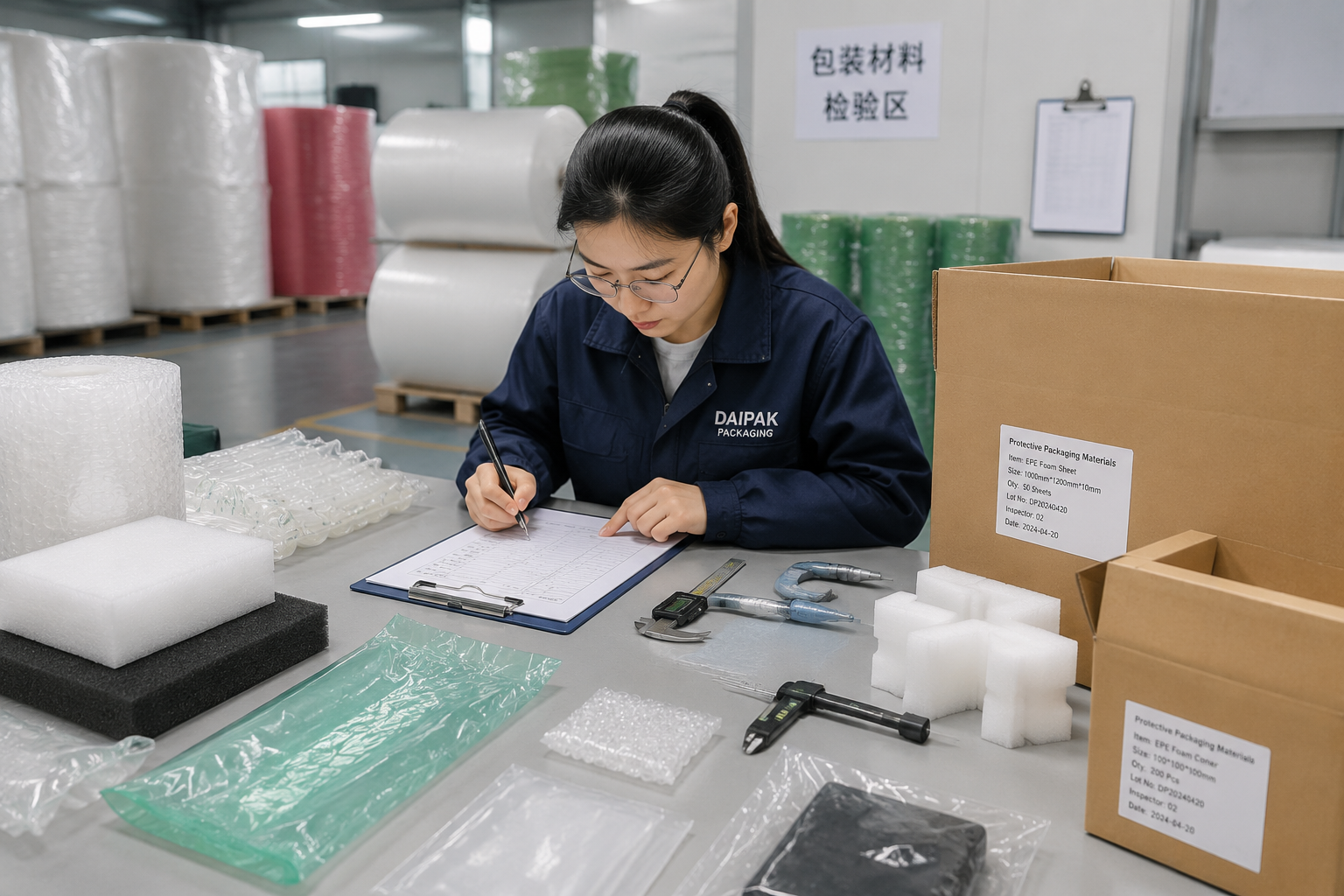
Quality Problems Often Begin With Unclear Requirements
Many avoidable problems start with missing information. A poly mailer may be strong enough for light items, but if the buyer needed a thicker film for sharp edges or heavier contents, the bag can feel too thin in use. EPE foam may look correct at first glance, but if the density is too low, it may not support the product well enough during transport. A carton can also be the wrong size if the inner dimensions were never confirmed clearly, which creates wasted space or packing difficulty.
Labels and carton marks cause the same kind of trouble. If the receiving team expects one product code and the supplier prints another, the goods may arrive physically intact but still create confusion at the warehouse. For repeat orders, this becomes even more sensitive because buyers expect the new batch to match the previous one. Clear requirements are what make repeat order consistency possible.
Inspection Works Best When the Standard Is Already Defined
Inspection is useful only when there is something measurable to compare against. A finished box, bag, or foam insert cannot be judged well by vague comments like “looks okay” or “should fit better.” The factory needs a reference point: the confirmed size, the approved material, the sealed edge, the print position, the carton quantity, and the packing method. That turns inspection into comparison, not guesswork.
When the standard is already defined, the buyer and supplier can check practical questions instead of debating opinions. Is the opening direction correct? Is the sealing line strong enough? Is the print centered where it should be? Does the carton still close properly after product loading? These are the kinds of checks that actually protect an order before it becomes a shipment problem.
How Daipak Uses Order Details to Reduce Misunderstanding
At Daipak, the discussion usually starts with the product details rather than the material name. The same packaging material can perform very differently depending on the product size, weight, shape, surface finish, packing purpose, and shipping route. That is why order clarification matters before production begins.
In practice, this means confirming drawings, photos, dimensions, packing method, quantity, and any special warehouse or export marking needs before the order moves forward. Ms. Tang often keeps this stage focused on specification confirmation so the production team does not have to interpret missing details later. That kind of communication does not remove every risk, but it does reduce misunderstanding and makes the next steps more controlled.
For repeat purchasing, it also helps to keep one confirmed version of the order record. If the buyer later changes a size, label, carton mark, or print layout, the supplier can compare the new request against the earlier approval instead of relying on memory. That makes later production checks and shipment review much easier to explain.
What Buyers Should Confirm in the Packaging Specification
A reliable specification should describe both the packaging product and how it will be used. Buyers often ask for custom packaging based on a product name alone, but a practical order needs more detail than that. The right packaging specifications should cover size, thickness, density, color, structure, sealing or adhesive style, printing artwork, label needs, packing method, carton quantity, and export carton marks.
The exact items depend on the product family. EPE foam may need density, thickness, and shape. Bubble wrap may need bubble size and roll width. Poly mailers may need film thickness, adhesive strip quality, opening direction, and print placement. Corrugated boxes may need flute type, board grade, size, print layout, and a realistic view of carton strength for shipping and stacking.
For traceability, the most useful specification is the one that can be checked again later. That usually means keeping the final dimensions, the approved artwork file, the agreed packing quantity, and any carton mark wording in one place. If a question comes up during production or after delivery, that record gives both sides a practical comparison point.
Dimensions, Tolerances, and Usable Fit
Size is one of the first things to confirm, but the useful question is not just length and width. Buyers also need to know whether the number refers to inner size or outer size. That difference matters because inner size determines product fit, while outer size affects carton loading, pallet space, and shipping cost.
Tolerance also matters. A packaging product that is slightly over or under the target size may still function, but only if the buyer has allowed for that variation in the packing process. If the tolerance is too loose, a carton may become difficult to close, a foam insert may shift, or a bag may not seal cleanly. Clear size expectations help the supplier judge whether the order can be packed efficiently and consistently.
Material Type, Thickness, Density, and Structure
Material choice affects both protection and cost. Film thickness influences how much a bag, mailer, or wrap can handle during packing and shipping. Foam density affects how well an insert cushions a product and resists compression. Bubble size changes how flexible or protective a bubble wrap layer feels. Corrugated structure affects stacking strength, folding behavior, and the way a carton performs in transit.
These details are not just technical labels. They change how the packaging behaves on the packing table and in the warehouse. A thicker material is not automatically better if it makes packing slower, increases waste, or creates a carton that is harder to close. The better choice is the one that matches the product risk, the handling condition, and the shipping distance.
Buyers should also consider whether one material can solve the whole packing problem or whether a combined structure is safer. For example, a glossy appliance part may need a clean plastic bag or film sleeve to reduce dust and abrasion, EPE foam pads to control impact at the corners, and a corrugated carton sized closely enough to reduce movement. Looking only at the unit price of one layer can be misleading if the final pack uses more labor, more carton space, or creates higher damage risk during export handling.
When buyers need formal validation rather than only a supplier-side judgment, the specification can identify which distribution test or handling simulation is relevant to the order. ASTM D4169 is a standard practice for performance testing shipping containers and systems, while ISTA Procedure 3A is commonly referenced for packaged products moving through parcel delivery systems; these references help buyers discuss testing scope without assuming that a material name alone guarantees transit performance.[1][2]
Printing, Color, Labels, and Carton Marks
Visual details need to be confirmed just as carefully as physical ones. Printing artwork should show the correct logo, text, and placement. Color should be described in a way the supplier can actually follow, especially when the buyer expects a specific branded look. Labels also need attention because they support receiving, sorting, and inventory control.
Carton marks are part of the same conversation. For export orders, a warehouse may need product code, size, quantity, destination, or batch identification on the carton. If those marks are missing or inconsistent, receiving becomes slower even if the packaging product itself is correct. Ethan Lee often reminds overseas buyers to treat carton marks as part of the order, not as a minor finishing detail.
Packing Quantity and Carton Configuration
Packing quantity affects more than the final count. Pieces per carton, rolls per carton, bundles, and pallet arrangement all influence how the order is handled from factory to warehouse. If the quantity per carton is not fixed early, the supplier may pack in a way that looks efficient locally but is awkward for the buyer’s storage or distribution system.
Carton labels should match that packing logic. A carton marked with the wrong quantity or wrong SKU can create inventory errors at receiving. For larger orders, palletization also needs to be considered so the shipment arrives in a form that can be counted, stored, and moved without extra rework.
Specification Confirmation Note: Before production, buyers should confirm size, thickness, density, material structure, quantity, printing, labels, carton marks, and packing method in writing so the factory can check the order against the same practical standard during sampling, production, and shipment review.
How Sample Approval Reduces Risk Before Bulk Production
Packaging sample approval is the bridge between a quotation and bulk production. A sample gives both sides a chance to confirm whether the size, structure, material feel, printing position, bonding, sealing, cutting, and packing fit are all on the right track. It is a practical checkpoint, not a formality.
Depending on the product and the level of customization, the sample may be handmade, machine-made, or based on an existing material reference. What matters is not the form of the sample itself, but whether it helps the buyer and supplier make the right decision before a bulk packaging order moves into full production.
To keep sample approval traceable, it helps to note exactly what version was approved, what changed from the earlier sample, and whether approval covers appearance only or also fit, sealing, and packing method. That way the sample becomes a clear reference for later production instead of a loose memory of what was once acceptable.
What a Sample Should Confirm
A sample should confirm the points that are easiest to get wrong in production. That includes dimensions, structure, material feel, sealing or bonding quality, cutting accuracy, and print position. For a corrugated box, the sample should also show whether the fold lines behave correctly and whether the product fits as expected. For foam or protective inserts, the sample should show whether the shape holds the product in place without damaging it.
Buyers should look at the sample as a working reference, not a finished promise. If the sample is approved, it becomes a shared standard for the next step. If it is not approved, it gives the buyer a chance to correct the order before material and labor are committed to a full run.
What Buyers Should Test With Their Own Product
When possible, the buyer should test the sample with the real product. That is the fastest way to confirm fit, cushioning, handling, packing speed, and carton loading. A packaging piece may look correct on the table but still be awkward when the product is inserted, closed, stacked, or shipped.
This matters especially for protective packaging. A fragile product with sharp corners, a coated surface, or a heavy body can create different demands on the same material. The buyer should check whether the sample absorbs pressure well enough, stays in place during handling, and protects the product surface without leaving marks. For printed packaging, the buyer should also confirm artwork placement, logo position, color expectation, barcode readability if relevant, and label placement.
Surface finish is often overlooked during sample review. Polished metal, painted parts, acrylic panels, coated electronics, and retail-facing products may need separation from rough carton surfaces, dust, loose foam particles, or abrasive movement inside the pack. A buyer should rub, insert, remove, and repack the product during testing to see whether the packaging protects the surface as well as the shape. If scratch risk is high, a film sleeve, soft foam layer, tissue layer, or cleaner inner bag may be more important than adding more cushioning thickness.
When a Reference Sample Is Not Enough
A reference sample is useful, but it does not always represent production exactly. A material reference may only show the base material. A printed proof may only confirm artwork. A handmade prototype may show shape but not the final machine result. A production sample is closer to the real order because it reflects the intended process more closely.
Buyers should not assume that a reference sample automatically covers every production detail. If the final order will be made on different equipment, with different bonding, sealing, or cutting methods, that difference should be recognized early. Sample approval reduces risk, but it does not eliminate the need to confirm the production method that will be used for the bulk run.
Material Checks That Matter for Protective Packaging Performance
Protective packaging quality control has to match the material to the job it is expected to do. A foam insert, a poly mailer, a bubble wrap roll, and a corrugated carton all protect products in different ways, so the checks cannot be identical. The useful question is not simply whether the material looks acceptable, but whether it supports the product’s weight, surface finish, handling method, carton space, and shipping route.
The right material is not always the thickest or most expensive option. A heavy but non-fragile metal part may need separation and scratch prevention more than soft cushioning. A glossy consumer product may need clean surface protection and controlled fit. A lightweight e-commerce item may benefit from bubble wrap or air cushions, while a heavier export item may need foam and corrugated structure working together. Material checks help confirm that the chosen packaging is practical for the real risk, not just acceptable on paper.

EPE Foam: Density, Thickness, Cutting, and Bonding
EPE foam is often used for cushioning, surface protection, product separation, edge protection, foam bags, sheets, pads, and custom inserts. For these applications, EPE foam density matters because it affects how the foam compresses and recovers under product weight. Foam that is too soft may flatten during transport, leaving corners or surfaces exposed. Foam that is unnecessarily dense may increase cost and carton space without improving protection for a lighter product.
Thickness should be checked against the approved specification and the product’s actual fit. A few millimeters can matter when a foam insert must hold a product in place inside a carton, or when foam sheets are used between stacked parts. Cutting accuracy is also important. Uneven edges, oversized slots, or misaligned holes can slow packing, create loose fit, or make the package look inconsistent when used for retail or branded goods.
For laminated or bonded foam structures, the bond area should be reviewed for alignment and strength appropriate to the application. Weak bonding can separate during packing or transport, especially around corners, handles, or shaped inserts. From the factory side, Mr. Wang often checks whether cutting, bonding, and thickness details can be repeated consistently during batch production, because a good prototype is only useful if the structure can be produced steadily in bulk.
Plastic Film and Bags: Thickness, Sealing, Adhesive, and Printing Surface
Plastic film and bag products include poly mailers, garment bags, clear packaging bags, inner liner bags, courier bags, stretch film, and protective film. Their quality risks are different from foam. Film thickness affects puncture resistance, tearing behavior, feel, and sometimes opacity. A thin mailer may reduce material cost but fail when packed with sharp-edged items. A thicker film may improve strength but can be unnecessary for soft garments or light inner packing.
Sealing quality is one of the most practical checks for bags and mailers. Weak side seals, uneven heat sealing, or poor bottom sealing can open during packing, warehouse handling, or delivery. For self-adhesive bags and poly mailers, the adhesive strip should be checked for placement, tack, release liner function, and closing consistency. If the adhesive is difficult to remove or does not close securely, packing speed and shipping reliability both suffer.
For printed film or printed bags, the surface needs to support the expected print appearance. Buyers should review whether the print position, color expectation, barcode readability where required, and logo clarity match the approved reference. For transparent bags, clarity and cleanliness may matter more than heavy strength. For garment bags, the opening direction, vent holes, hanger holes, and warning print placement can be just as important as the basic film itself.
Bubble Wrap and Air Cushion Packaging: Air Retention and Roll Consistency
Bubble wrap quality depends on air retention, bubble height, film consistency, and roll dimensions. If bubbles collapse too easily or lose air before use, the packaging may still look like bubble wrap but provide much less cushioning. This matters for fragile items, coated surfaces, small electronics, ceramics, glassware, and mixed warehouse packing where packers rely on the material to absorb light impacts and fill space.
Roll consistency also affects packing efficiency. A roll that is shorter than expected, unevenly wound, or inconsistent in width can disrupt packing stations and create quantity disputes. Bubble size should match the application. Smaller bubbles may be better for surface protection and wrapping smaller items, while larger bubbles can help with void filling or light cushioning. The choice depends on product size, fragility, carton space, and whether the bubble wrap is used alone or with a corrugated outer carton.
Air cushion packaging and air column bags need checks related to inflation, sealing, and air chamber performance. Air pillows used for void filling should inflate evenly and hold enough air for the intended packing period. Air column bags should fit the product correctly and protect the sides or corners that face the highest handling risk. If the product is heavy, sharp, or highly fragile, buyers should confirm whether air packaging alone is suitable or whether foam, corrugated partitions, or other inner protection should be added.
Corrugated Boxes: Board, Creasing, Slotting, and Folding Accuracy
Corrugated packaging is not only an outer container. It affects stacking, carton loading, warehouse storage, e-commerce delivery, and export handling. Corrugated board should be reviewed for structure, surface condition, flatness, and suitability for the product weight and shipping method. A carton that looks acceptable when empty may still fail if the board is too weak for stacking, if the product load is concentrated, or if the inner packaging does not support the carton walls.
Creasing, slotting, and folding accuracy affect how easily a box forms and closes. Poor creasing can cause cracking, uneven folding, or slow packing. Inaccurate slotting can create misaligned flaps, gaps, or weak corners. For postal boxes, zipper boxes, printed corrugated boxes, and custom cartons, these details also influence the opening experience and the final appearance of the packed product.
Print and carton mark review should not be left until the last moment. Smudged printing, wrong item codes, incorrect size marks, or unclear handling marks can create warehouse receiving problems even if the carton structure is correct. For export packing, the corrugated box and inner protective material need to work as one system: the foam, bubble, film, or air cushion protects the product inside, while the carton supports handling, stacking, labeling, and shipment preparation.
If a carton must carry stacking load, buyers should avoid treating “strong board” as a complete specification. Compression resistance can be tested on shipping containers under a defined method, but the useful result still depends on the actual carton design, loading pattern, storage condition, and handling route.[3] Corrugated packaging also has a strong recyclability context in many recovery systems, but recyclability claims should still be matched to the specific material combination, coatings, labels, and destination market requirements.[4]
Compliance, Food Contact, and Environmental Claims Need Separate Confirmation
Some packaging quality topics are not solved by appearance inspection alone. If a bag, film, paperboard, liner, or coated structure will directly touch food, the buyer should confirm the intended food-contact use, material composition, migration or regulatory documentation needs, and destination market before production. European food-contact rules and U.S. polymer food-contact regulations show why “plastic bag” or “paper box” is not enough detail when the package will touch food directly.[5][6]
The same caution applies to environmental claims. Words such as recyclable, compostable, biodegradable, recycled content, or eco-friendly should not be used only because a material looks paper-based, lightweight, or reusable. Buyers should confirm the exact material structure, local collection or processing conditions, labeling requirements, and claim wording before using environmental messages on packaging or sales materials; the FTC Green Guides are a useful reference for keeping environmental marketing claims from becoming too broad or misleading.[7]
For regulated or safety-sensitive shipments, such as hazardous goods, medical-related packing, child-safety applications, or special transport conditions, buyers should treat quality control as a documentation and compliance discussion as well as a factory inspection. Daipak can help review packaging structure and production details, but the buyer should identify destination-market rules, product-specific restrictions, and any required third-party testing before assuming that a general protective packaging solution is sufficient.
Documentation Boundaries for Sensitive Packaging Uses
Quality control documents should describe what was actually checked: material name, size, thickness, density reference, sealing style, print content, carton mark, sample version, inspection date, and shipment packing condition. They should not turn a normal production record into a broad compliance statement unless the buyer has separately confirmed the required standard, testing scope, and supporting evidence for the destination market.
For food-contact, pharmaceutical, medical-related, anti-static, moisture-barrier, lithium battery, or hazardous goods applications, buyers should confirm the required documentation before production rather than after the shipment is ready. Dangerous goods transport rules include packaging-related provisions, but the correct requirement depends on the product classification, route, transport mode, and jurisdiction.[8] A packaging supplier can support the packing design discussion, but product classification and transport compliance should be checked by the buyer and qualified logistics or compliance parties where applicable.
Wood pallets, wooden crates, or wood packing accessories need a separate export review when they are used. International wood packaging requirements may apply to wood packaging material moving in international trade, so buyers should confirm whether treated and marked wood packaging is required for the destination before shipment preparation is finalized.[9] If the order uses only paper, foam, film, plastic bags, or corrugated cartons without wood packaging, that should also be made clear in the shipment record.
In-Process Production Checks Prevent Small Errors From Becoming Bulk Problems
Production quality control for packaging is most useful when it catches mistakes early. Once a machine setup, cutting die, sealing temperature, print plate, or bonding position is wrong, the same error can repeat across a large batch. Waiting until all goods are finished may turn a small setup issue into a bulk order problem involving rework, sorting, delay, or difficult buyer-supplier discussions.
In-process checks are especially important for custom packaging production because the supplier is not simply pulling a standard stock item from a warehouse. Custom sizes, printed artwork, shaped foam, special bag openings, handle positions, adhesive strips, hole punching, and carton structures all depend on correct setup before volume production continues. The goal is not to inspect every piece in every order. The goal is to monitor the points where mistakes are most likely to repeat.
First-Piece Confirmation Before Full Production Continues
First-piece confirmation means checking the initial output against the approved specification, sample, drawing, or order record before production proceeds at full speed. This early check can include size, thickness, material, color, sealing, cutting, bonding, printing position, bag opening direction, carton folding, or roll width depending on the product. It is a practical checkpoint between production setup and bulk output.
For example, a poly mailer may need confirmation of width, length, flap size, adhesive strip position, print orientation, and film thickness. An EPE foam insert may need checking for slot size, edge cut, laminated layer alignment, and product fit. A corrugated box may need review of inner dimensions, crease line position, print placement, and flap closure. If the first pieces are wrong, the issue can often be corrected before too much material is used.
Buyers can support this step by making sure the approved sample or final specification is clear before production begins. If there are several versions of artwork, several sizes, or a revised carton mark, the supplier needs the final confirmed version. Ambiguity during setup is one of the easiest ways for an avoidable error to enter production.
Monitoring Size, Thickness, Sealing, Cutting, and Printing During Production
After first-piece approval, production still needs monitoring because material rolls, machine settings, cutting tools, sealing temperature, and print alignment can shift during the run. For film and bags, checks may focus on film thickness, seal strength, side sealing, bottom sealing, adhesive placement, bag opening direction, perforation, hole punching, and handle position. A small change in sealing temperature can affect whether the bag holds during packing or opens under pressure.
For foam products, production checks may include sheet thickness, density reference, cutting accuracy, bonding alignment, lamination quality, and whether shaped parts match the intended product position. For bubble wrap and air cushion materials, roll width, roll length, bubble consistency, inflation condition, and sealing condition may need attention. For corrugated products, size, slotting, creasing, folding, print clarity, and glue or locking structure should be reviewed as production continues.
These checks are not only about product protection. They also affect packing speed. If a bag opening is on the wrong side, workers may need to rotate each piece during packing. If foam slots are too tight, products may be forced into place and damaged. If cartons fold poorly, warehouse teams lose time during assembly. A material defect can become a labor problem long before it becomes a visible shipping claim.
Why Custom Packaging Needs Extra Attention During Setup
Custom packaging has more setup risk than standard packaging because more details are made specifically for one buyer’s product. A custom die may need to match a fragile corner. A printed bag may need the logo centered after sealing and folding. A foam insert may need a cavity deep enough to protect a surface without making removal difficult. A corrugated mailer may need locking tabs that close smoothly while still holding the product securely.
The more customized the structure, the more important it is to connect the approved sample with the production setup. If a buyer approves a handmade foam prototype but bulk production uses machine cutting, some edge finish, tolerance, or assembly detail may need confirmation. If artwork is adjusted after sampling, print placement should be checked again during setup. If carton quantity changes, carton size and packing arrangement may also change.
For a packaging manufacturer in China working with overseas buyers, clear production checks help reduce the distance between buyer expectations and factory output. Remote buyers cannot stand beside the machine, so specifications, approved samples, photos when useful, and timely communication become part of the control process. This is where practical production monitoring protects both order quality and delivery preparation.
Finished Product Review Before Packing Into Export Cartons
Finished packaging inspection takes place after production but before shipment packing is finalized. At this stage, the supplier should compare the actual goods with the approved specifications, samples, artwork, and order requirements. The review is not only looking for obvious defects. It also checks whether the goods are ready to be counted, packed, marked, and shipped in a way that matches the buyer’s purchase order.
A practical packaging quality review may cover appearance, dimensions, sealing, cutting, bonding, folding, print, labels, contamination, deformation, quantity per bundle, quantity per carton, and inner packing protection. The exact items depend on the packaging type. Uneven foam cuts, weak bag seals, print smudging, damaged rolls, crushed boxes, wrong labels, or incorrect carton quantities can all create problems after the goods arrive at the buyer’s warehouse.
Visual and Functional Review
Visual review starts with the details a buyer or warehouse team will notice quickly: surface cleanliness, color consistency, print clarity, shape, folding quality, and general workmanship. For foam packaging, this may include checking for rough cuts, uneven bonding, crushed areas, dust, deformation, or parts that do not match the intended shape. For film and bags, the review may include wrinkles, weak seals, blocked openings, poor adhesive strip placement, print defects, or contamination inside clear bags.
Functional review looks at whether the packaging can do its job during packing and handling. A poly mailer should close securely. A garment bag should open in the correct direction and fit the product. A foam insert should hold the item without forcing it. A bubble wrap roll should unwind normally and provide consistent cushioning. A corrugated box should fold, close, and stack as expected for the packing method.
This review is also useful for catching issues that may not look serious at first. A slightly misaligned cut can make foam inserts difficult to use. A weak side seal can fail only after the bag is packed. A smudged barcode or unclear printed code can cause receiving delays. The risk is not only product damage; it is also slow packing, wrong identification, and avoidable disputes after delivery.
Quality Review Note: A useful finished-goods review should check dimensions, appearance, sealing, cutting, bonding, printing, label content, packing quantity, and carton marks together, because small mismatches can affect warehouse receiving even when the packaging material itself looks acceptable.
Quantity Checks at Piece, Bundle, Carton, and Pallet Level
Quantity control should be checked at more than one level. For small packaging items, the supplier may need to confirm pieces per bundle, bundles per carton, and total cartons. For rolls, the review may include roll length, roll count, carton count, and whether each roll is packed as agreed. For corrugated boxes, quantity may be counted by bundle, carton, pallet, or flat-packed stack depending on the packing method.
Miscounts create practical problems for buyers. If a carton label says 500 bags but the carton contains 450, the issue may not be discovered until warehouse receiving or production line use. If mixed sizes are packed without clear separation, the buyer may spend extra labor sorting goods. If pallet count does not match the packing list, receiving teams may hold the shipment for investigation even when the physical products are acceptable.
Quantity review should connect with carton labels and packing records. The carton quantity, item code, size, color, and order reference should be consistent where the buyer requires them. For bulk order inspection, this step helps avoid shortages, overages, mixed cartons, and warehouse confusion after the shipment arrives.
Comparing Finished Goods With the Approved Sample
The approved sample is a practical reference point for finished goods review. It helps the supplier and buyer compare size, material feel, structure, print position, sealing style, cutting finish, and overall appearance. Written specifications are necessary, but a physical or visual reference often makes differences easier to recognize, especially for foam density feel, film softness, print position, or carton folding behavior.
Finished goods do not need to be judged only by whether they are usable in a general sense. They should be judged against what was approved for that order. If the approved sample had a certain foam thickness, bag opening direction, adhesive strip position, or printed logo location, the bulk goods should follow that confirmed standard within the agreed production tolerance.
This comparison is also important for repeat orders. If each order is reviewed against the previous approved reference, changes are easier to notice and discuss before shipment. If a material, print, size, or packing method needs to change, both sides should confirm it instead of allowing silent variation. That approach protects the buyer’s warehouse process and helps the supplier maintain more consistent bulk production over time.
Labels, Carton Marks, and Packing Details Are Part of Quality Control
A packaging shipment review should not stop at the packaging product itself. A bubble wrap roll, EPE foam insert, poly mailer, or corrugated box may be made correctly, but the shipment can still create problems if the labels, carton marks, quantity markings, or carton organization do not match the buyer’s receiving process. For overseas B2B orders, these details affect how quickly a warehouse can identify, count, store, and allocate the goods after arrival.
This is especially important for buyers managing multiple SKUs, destination warehouses, online order fulfillment, or repeat replenishment. A wrong label or unclear carton mark can delay receiving even when the goods inside are physically acceptable. In some cases, warehouse staff may need to open cartons one by one to confirm size, color, product code, or quantity, which adds labor and increases the chance of handling mistakes.
Carton Marks Should Match the Buyer’s Receiving Process
Carton marks are more than printed text on an export carton. They are a working reference for warehouse receiving, inventory control, and order allocation. Depending on the buyer’s system, carton marks may need to show a purchase order number, item code, SKU, product name, size, color, quantity per carton, gross or net weight, destination warehouse, or batch reference. The right format depends on how the buyer identifies goods after import.
For example, a distributor receiving several sizes of poly mailer bags may need each carton to show the bag size, thickness, color, and quantity. A warehouse receiving custom EPE foam inserts may need item codes that match the finished product they protect. An e-commerce packaging buyer may need carton labels that align with internal SKU numbers so the goods can move directly into storage without re-labeling.
The risk is not only a receiving delay. If cartons with similar products are marked poorly, the wrong packaging material may be sent to a packing line or customer location. A small marking issue can become a picking error, a stock mismatch, or a repeat-order confusion. Buyers should therefore confirm carton mark content and placement before production packing is finalized, especially when the order includes several sizes or material types.
Inner Packing Protects the Packaging Materials Themselves
Protective packaging materials also need protection during storage and transit. Bubble wrap rolls can be dented or compressed if cartons are weak or overloaded. Plastic bags and poly mailers can collect dust, moisture, or edge damage if inner packing is loose. EPE foam parts can deform if they are packed under heavy pressure. Corrugated boxes can arrive with crushed corners or dirty surfaces if the bundles are not wrapped or arranged properly.
Inner packing should match the product form. Rolls may need tight wrapping or stable carton placement so they do not shift during handling. Bag products may need bundles with clear counts and protective liners where appropriate. Foam inserts and shaped pads may need separation or controlled stacking to avoid compression marks. Flat corrugated boxes or postal boxes should be bundled in a way that protects edges, creases, and printed surfaces.
A lower carton cost can become expensive if the packaging materials arrive hard to use. Warehouse teams care about clean bundles, readable labels, correct counts, and goods that can be moved into storage without sorting or repacking. For export packing, the outer carton, inner packing, and product arrangement should work together rather than being treated as separate details.
Buyers should review packing cost as a complete system, not only as the price of the bag, foam sheet, roll, or carton. A cheaper carton may increase crushed goods, a loose pack may require more void fill, and an oversized carton may raise freight volume while giving the product more room to move. In many export orders, the better choice is the pack that balances material cost, packing labor, warehouse handling, freight space, and damage reduction rather than the lowest single material quotation.
Mixed Orders Need Clear Separation and Identification
Mixed orders need extra care because several similar products may travel in the same shipment. A buyer may order bubble wrap rolls in different widths, foam sheets in different thicknesses, printed mailers in several sizes, or corrugated boxes with different artwork. If these items are not separated and identified clearly, the receiving team may spend unnecessary time opening cartons and comparing contents against the packing list.
Clear separation can be handled through carton marks, item labels, pallet grouping, or a carton-by-carton packing list, depending on the order. The goal is simple: each carton should be easy to connect with the buyer’s purchase order and inventory record. If one carton contains a mixed assortment, the outside label should make that clear so warehouse staff do not assume it contains only one item.
For repeat purchasing, mixed-order control also helps both buyer and supplier compare current shipments with previous orders. If carton quantity, label format, or pallet arrangement changes without notice, the buyer may think the order is wrong even when the total quantity is correct. Good marking and separation reduce these avoidable questions.
Shipment Review Connects Factory Quality With Import Readiness
A pre-shipment packaging inspection is the final checkpoint before goods leave the factory or warehouse. At this stage, the focus is not only whether the packaging was produced correctly. The supplier should also confirm that the finished goods are packed, marked, counted, and organized in a way that matches the buyer’s order and receiving expectations.
For overseas buyers, this step matters because they usually cannot stand beside the shipment before dispatch. A practical shipment review can reduce confusion about carton count, packing quantity, label content, carton condition, and loading readiness. It does not control every risk after the goods enter the freight network, but it does help confirm that the order is ready to ship from the supplier side.
Final Carton Count and Packing List Alignment
The carton count should match the order quantity and packing list before dispatch. This sounds basic, but misalignment can happen when orders include multiple materials, partial cartons, sample cartons, accessories, printed items, or mixed SKUs. A final count helps confirm how many cartons are shipping, what each carton contains, and whether the quantity per carton is consistent with the buyer’s records.
For example, if a buyer orders custom corrugated boxes packed flat, the packing list should reflect the number of bundles or cartons and the quantity inside each one. If a buyer orders poly mailer bags in several sizes, the carton marks should match the item list so the receiving team can confirm the shipment without opening every carton. If bubble wrap rolls or EPE foam sheets are packed by roll, bundle, or carton, the unit description should be clear.
This review also supports communication between the supplier, freight forwarder, and buyer. When carton count and packing list information are consistent, it is easier to confirm loading, arrange warehouse space, and investigate any shortage claim later. The review should be done before the goods move out, not after the shipment is already in transit.
Carton Condition, Pallet Preparation, and Loading Readiness
Carton condition is part of quality control because damaged outer cartons can affect both protection and receiving confidence. Before dispatch, cartons should be checked for obvious crushing, torn seams, weak tape, poor sealing, unreadable marks, or visible moisture exposure where relevant. If cartons are already damaged before shipment, it becomes harder to judge where a later problem occurred.
Pallet preparation, when used, should also match the buyer’s handling needs. Cartons should be stacked in a stable pattern, with weight distributed sensibly and labels or carton marks visible where possible. Stretch film, strapping, corner boards, or top protection may be considered depending on the product type, carton strength, loading method, and shipping route. Heavy corrugated boxes, foam cartons, and roll products may need different pallet arrangements because they react differently to pressure and movement.
Loading readiness also includes practical details such as whether cartons are grouped by item, whether mixed pallets are clearly identified, and whether fragile or easily compressed materials are placed in a suitable position. As a China packaging materials supplier, Daipak often treats shipment preparation as part of the quality discussion because export buyers need goods that are not only produced correctly, but also organized clearly before they leave the factory side.

Photo Confirmation for Remote B2B Buyers
Shipment photos can be useful for buyers who are not present during final review. Photos may show finished cartons, carton marks, labels, pallet arrangement, carton condition, and overall loading preparation. They give the buyer a visual reference before dispatch and can help confirm that the shipment matches the agreed packing method.
Photo confirmation is not a replacement for clear specifications or proper inspection, but it is a practical communication tool. A buyer may request photos of carton labels, pallet sides, mixed-order separation, or opened cartons showing inner packing. These images can reduce uncertainty and help the buyer prepare receiving instructions for the destination warehouse.
The most useful photos are specific rather than decorative. A close image of a carton mark, a wider image of pallet grouping, and a view of inner packing can answer real receiving questions. If the buyer has special concerns, such as label placement or carton quantity by SKU, those photo requirements should be discussed before the shipment is packed.
How Buyers Can Work With a Supplier to Improve Repeat-Order Consistency
Repeat order packaging quality depends on keeping the first approved order connected to future production. If specifications, approved samples, artwork files, carton marks, and packing methods are not preserved or reviewed, a repeat order may slowly drift from what the buyer expected. The change may be small at first: a slightly different film thickness, a different bag opening direction, a new carton quantity, or a revised label format. But for a warehouse or packing line, those changes can matter.
A long-term packaging supplier relationship works best when both sides treat quality control as an ongoing process. The supplier should keep practical production references, and the buyer should report product changes, new warehouse requirements, route changes, or complaints from the previous shipment. This cooperation helps avoid silent substitutions and makes each repeat order easier to confirm.
After delivery, the most useful feedback is the feedback that can be tied back to the same order reference. If a carton crushed, a bag seal opened, or a foam insert fit loosely, the supplier can review the confirmed specification, the approved sample, and the shipment photos together and adjust the next order more accurately. That loop is simple, but it is often the clearest form of traceability in real packaging work.
Approved Samples and Specifications Should Stay Connected
An approved sample is useful only when it remains connected to written specifications. The sample shows look, feel, structure, and fit, while the specification records measurable details such as size, thickness, density, color, printing position, sealing style, carton quantity, and carton marks. If one side relies only on memory or a physical sample, important production details can be missed.
For custom protective packaging, this connection is especially important. An EPE foam insert may need the same density, cut shape, bonding position, and product fit as the previous order. A printed poly mailer may need the same film thickness, adhesive strip style, artwork position, and bag opening direction. A corrugated box may need the same inner size, flute structure, printing layout, and folding accuracy. Written records help turn the approved sample into repeatable production instructions.
Buyers should also confirm which version of a sample or artwork file is the approved one. If several trial samples were made during development, the final approved version should be clearly identified. This avoids confusion when a new purchasing manager, warehouse contact, or supplier coordinator handles the next order.
Buyer Feedback Helps Improve the Next Order
Useful feedback does not need to be complicated. Buyers can report whether the packaging fit the product well, whether workers packed it quickly, whether cartons arrived easy to identify, or whether any damage pattern appeared during transit. A photo of crushed carton corners, torn bag seals, foam deformation, label confusion, or warehouse receiving comments can help the supplier understand what needs to be reviewed.
Feedback should be specific enough to guide action. “The foam was not good” is hard to solve. “The foam corner pad compressed on the heavy side of the product after pallet stacking” gives the supplier a real problem to review. “The label was wrong” is less useful than “The carton mark did not include our SKU, so the receiving team had to open cartons to identify sizes.”
Supplier communication also works better when buyers share changes early. A new product weight, a sharper product edge, a different surface finish, a longer shipping route, or a new destination warehouse can all change the packaging requirement. For repeat orders, the safest assumption is not that everything is unchanged, but that both sides should confirm whether anything has changed before production begins.
Any Specification Change Should Be Confirmed Before Production
Specification changes should be controlled, even when they seem minor. A change in plastic film thickness can affect bag strength, feel, sealing, and cost. A change in foam density can affect cushioning and compression resistance. A small size change can affect product fit, carton quantity, and packing speed. A new carton mark can affect receiving and inventory allocation.
Buyers should approve changes before production starts, not after the goods are finished. This includes changes requested by the buyer and changes suggested by the supplier due to material availability, production setup, packing improvement, or cost adjustment. If the change affects size, material, printing, quantity per carton, inner packing, or carton marks, it should be written clearly and matched with the latest sample or specification.
Repeat orders become more reliable when both sides avoid assumptions. The buyer should not assume the supplier knows about a product update unless it has been communicated. The supplier should not assume a substitute material, label format, or packing method is acceptable without confirmation. Good repeat-order control is not about making every order identical at all costs; it is about making every change visible, reviewed, and approved before production.
What a Practical Packaging Quality Control Process Looks Like With Daipak
At Daipak, quality control is usually handled as a connected process rather than a single final check. For overseas B2B buyers, that means the order is reviewed from the first specification discussion through sample confirmation, production coordination, finished goods review, and shipment preparation. As a China packaging materials supplier and protective packaging manufacturer, Daipak often starts with the product details, then works backward to confirm whether the packaging structure, material choice, size, and packing method fit the order.
This approach matters across foam, bubble wrap, air cushion packaging, plastic bags and film, and corrugated boxes because each material can fail in a different way if the order is not clearly defined. A foam insert may fit poorly, a poly bag may seal inconsistently, a carton may fold incorrectly, or a printed mark may not match the buyer’s receiving process. Practical quality control helps reduce those problems before they become shipment disputes.
For buyers comparing suppliers, the useful question is not only whether a factory can quote a price quickly. It is whether the supplier asks enough practical questions to understand the product, packing process, order quantity, destination, and receiving requirements before production starts. A supplier who confirms these points early is easier to evaluate because the quotation, sample, inspection standard, and export packing approach are based on the same order logic.
Specification and Sample Confirmation Before Production
For custom packaging, Daipak usually helps buyers turn a general need into a usable production specification. That starts with the product itself: size, weight, shape, surface condition, fragility, and shipping route. A buyer may know they need protection, but the factory still needs clear details before preparing a sample. Without that step, the first version may be the wrong thickness, the wrong fit, or the wrong structure for packing.
Sample confirmation is useful because it gives both sides something concrete to review. The buyer can check fit, appearance, sealing, cutting, printing, or inner protection. The factory can confirm whether the design is practical to produce in bulk without changing the order intent. For example, a custom EPE foam insert may look correct on paper but still need adjustment if the product has sharp corners or a surface finish that scratches easily. A printed corrugated box may also need a sample review to confirm logo position, panel layout, and carton marks before mass production begins.
For a more accurate quotation and sample, buyers should provide real product photos, drawings if available, product weight, fragile points, surface concerns, and the expected packing sequence. If the goods will be packed by a fast warehouse line, the opening direction, sealing style, and carton loading method should be discussed early. If the goods will be exported in mixed SKUs or palletized cartons, the quote should also consider carton size, pieces per carton, label needs, and loading condition instead of treating the packaging item as an isolated product.
Ms. Tang often treats this stage as part of order coordination, not as a separate formality. The goal is to keep the approved sample and the written specification aligned so later production does not drift from what the buyer expected.
Production and Finished Goods Review Across Multiple Packaging Materials
Once production starts, Daipak’s quality control focus shifts to whether the finished goods match the confirmed requirements in a repeatable way. From the factory side, Mr. Wang usually looks for practical consistency: is the foam cut cleanly, is the bubble film uniform, does the bag seal hold properly, does the roll width stay steady, and do the cartons fold without distortion. These are small details, but they are the details that decide whether packing runs smoothly at the buyer’s warehouse.
The checks vary by material. EPE foam may need closer attention to density, cutting accuracy, and bonding. Bubble wrap and air cushion products need visual checks for film consistency, roll size, and cushioning stability. Plastic bags and film products need sealing quality, thickness consistency, and printing surface review. Corrugated cartons need board condition, creasing, slotting, folding accuracy, and print placement. None of these materials should be judged only by appearance; they need to be checked against the packing job they are expected to do.
When an order combines several materials, production coordination becomes more important than checking each item separately. A foam insert may change the carton size, a film sleeve may affect the way a product slides into the foam, and a carton mark may need to match several inner packaging versions. Daipak’s coordination should therefore connect foam, bubble, film, bag, and corrugated details before final packing so one material does not create a problem for another part of the pack.
Finished goods review is also where quantity and packing condition matter. A product can look acceptable but still create problems if pieces are short, bundles are uneven, or cartons are damaged before shipment. A practical review helps catch those issues while there is still time to correct them.
At this stage, the question is not whether one material is better than another in general. It is whether the specific product, packing method, and shipping condition have been matched well enough to support the order.
Shipment Preparation for Overseas B2B Orders
For overseas buyers, shipment preparation is part of quality control because the goods must arrive in a condition that supports easy receiving. That means carton marks, packing quantity, export carton review, and packing list alignment all need to be checked before the shipment leaves the factory. Even when the packaging product itself is acceptable, unclear labels or mixed carton details can slow down warehouse receiving and create avoidable questions on arrival.
Daipak usually coordinates this final stage by confirming carton counts, checking whether marks match the buyer’s order reference, and reviewing how the goods are packed for export handling. If the shipment includes multiple sizes, colors, or product types, the separation needs to be clear enough that the buyer can identify each carton quickly. For remote buyers who cannot be at the factory, photo confirmation is often a practical way to reduce uncertainty before dispatch.
For repeat orders, this final check also helps preserve consistency. If the same product is packed differently from one shipment to the next, the buyer’s warehouse may need extra time to sort and receive it. A practical shipment review keeps the order details, packing method, and carton identification tied together so the next order can be handled with less friction.
References
[1] ASTM International, “ASTM D4169 Shipping Container Performance Testing,” standard practice reference for performance testing shipping containers and systems, available at ASTM D4169 Shipping Container Performance Testing.
[2] International Safe Transit Association, “ISTA Procedure 3A Overview,” packaged-product test overview for parcel delivery systems and small package shipping contexts, available at ISTA Procedure 3A Overview.
[3] ASTM International, “ASTM D642 Standard Test Method for Determining Compressive Resistance of Shipping Containers,” packaging test method reference for carton compression resistance discussions, available at ASTM D642 Compression Resistance.
[4] Fibre Box Association, “Corrugated is Recyclable,” industry resource on corrugated packaging recyclability and recovery context, available at Fibre Box Association Corrugated is Recyclable.
[5] European Commission, “EU Food Contact Materials,” regulatory framework reference for materials and articles intended to come into contact with food in the European Union, available at EU Food Contact Materials.
[6] U.S. Electronic Code of Federal Regulations, “21 CFR Part 177 Polymers,” U.S. federal regulation reference for polymers used in food-contact indirect additive contexts, available at 21 CFR Part 177 Polymers.
[7] Federal Trade Commission, “FTC Green Guides,” U.S. environmental marketing guidance reference for claims such as recyclable, compostable, degradable, and other green claims, available at FTC Green Guides.
[8] United Nations Economic Commission for Europe, “UNECE UN Model Regulations Rev. 24,” dangerous goods model regulations reference with packaging-related provisions for regulated transport discussions, available at UNECE UN Model Regulations Rev. 24.
[9] International Plant Protection Convention, “IPPC ISPM 15 Wood Packaging,” international phytosanitary standard reference for wood packaging material used in international trade, available at IPPC ISPM 15 Wood Packaging.