
An accurate packaging quote from a China packaging supplier depends on much more than a product name or photo. Size, weight, shape, fragility, surface finish, material thickness, foam density, bubble size, carton strength, printing, closures, packing method, quantity, and shipping basis can all change the final price. If these details are missing, different suppliers may quote different assumptions, making the prices difficult to compare.
This article helps buyers prepare a clearer inquiry before asking for prices. It explains what information to send, when samples or drawings are useful, how export packing and shipping route affect the decision, and why the cheapest material line may not produce the lowest total packaging cost. The goal is to compare suppliers on the same basis and choose packaging that fits the product, handling risk, and order plan.
Quick Packaging Decision Guide
| Buyer Question | Practical Reading | What to Check |
|---|---|---|
| Why are supplier quotes so different? | Each supplier may assume a different material grade, thickness, structure, packing method, or trade term. | Confirm size, material, thickness or density, printing, carton packing, quantity, and delivery basis. |
| What should I send before requesting a quote? | Product data helps the supplier price the real packing problem instead of guessing from a name or photo. | Send dimensions, weight, photos, drawings, fragility level, surface protection needs, and packing process. |
| When are samples or drawings necessary? | They are important when fit, sealing, strength, print position, or protection performance cannot be judged clearly. | Show openings, folds, cavities, contact points, loading direction, closures, and print areas. |
| How does export packing affect the quote? | Long-distance shipping, courier handling, container loading, and warehouse movement may require stronger outer packing. | Check carton strength, inner protection, pallet or carton quantities, destination, and trade terms. |
| Is a lower material price always cheaper? | Not if it increases breakage risk, slow assembly, repacking, carton waste, or customer complaints. | Compare total packaging cost, including labor, damage risk, carton space, and repeat-order consistency. |
Quick Questions Before You Read
Q: Can I get an accurate quote from photos only?
Usually not. Photos help, but suppliers still need measurements, material expectations, quantity, packing method, and shipping details.
Q: What is the most common cause of inaccurate packaging quotes?
Missing specifications. If thickness, density, structure, printing, carton packing, or delivery terms are unclear, prices may not be comparable.
Q: Should I ask for the lowest price first?
It is better to define the product risk and packaging requirements first, then compare prices on the same specification.
Q: How can I compare China packaging suppliers fairly?
Use the same material, size, structure, quantity, packing details, sample requirements, destination, and trade terms for each quote.
Why Packaging Quotes Vary More Than Buyers Expect
A packaging quote from a China packaging supplier is rarely based on the product name alone. A request such as “Please quote bubble bags” or “I need a foam insert” gives a starting point, but it does not define the material thickness, size, structure, packing quantity, printing, export carton arrangement, or protection target. Without those details, the supplier can only make assumptions, and assumptions create price differences.
This is why buyers sometimes receive very different prices for what appears to be the same packaging item. One packaging materials supplier in China may quote a thinner poly mailer, while another assumes a heavier film. One supplier may price a bubble wrap roll with a different roll length or bubble size. A protective packaging manufacturer may quote an EPE foam insert based on die-cut cavities, while another supplier assumes simple foam sheets cut to size. Both quotes may be “correct” based on their own assumptions, but they are not necessarily comparable.
An accurate packaging price needs to reflect the real packaging job. The supplier needs to understand what is being packed, how the package will be assembled, how many units go into each carton, whether the packaging needs printing, and what kind of shipping or warehouse handling the product will face. A lower unit price can become expensive if the material is too thin, the carton is oversized, the packing process is slow, or the product arrives scratched or damaged.
For higher-risk products, buyers should separate a supplier recommendation from a verified shipping-performance result. Packaging standards such as ASTM D4169 and ISTA Procedure 3A are used as references for distribution-cycle or parcel-delivery packaged-product testing, so a quote can identify the proposed material and structure, while a test plan can be used later when the buyer needs formal validation for a specific product and route.[1][2]
A Product Name Is Not Enough for Accurate Pricing
Common packaging names can hide many cost levels. A “bubble bag” could be a simple open-end bag, a self-seal bubble pouch, a laminated mailer, or a custom-size bag with thicker film. A “foam insert” could mean a flat EPE foam pad, a layered insert, a die-cut structure with product cavities, or a bonded assembly that protects corners and fragile parts. A “mailer bag” could vary by film thickness, adhesive strip quality, printing coverage, and bag size. A “carton box” could be a light postal box, a stronger shipping carton, a printed retail-style box, or a custom export carton.
Each specification affects material use, production process, and packing volume. For example, increasing a corrugated box by a few centimeters may seem minor, but it can change board consumption, carton strength, pallet fit, and freight volume. A thicker bubble wrap roll may offer better cushioning, but it also changes roll diameter, storage space, and carton packing. A foam insert with precise cavities takes more production planning than a basic foam pad, even if both use EPE foam.
At Daipak, the discussion usually starts with the product details rather than the material name. This helps avoid quoting packaging that looks correct in a message but does not match the product’s weight, surface finish, or shipping risk.
Different Assumptions Create Different Quotes
When an inquiry is incomplete, each supplier fills in the blanks differently. One supplier may assume a standard size; another may include trimming waste. One may quote without printing; another may include a one-color logo. One may pack the goods loosely into export cartons; another may compress, bundle, or stack them to reduce volume. These choices can all change the final price.
Quantity is another common reason quotes vary. A custom packaging quote for 2,000 pieces may carry a higher unit cost than a quote for 50,000 pieces because setup, material preparation, printing, and carton packing are spread across fewer units. The same applies to printed poly mailers, custom corrugated boxes, foam inserts, and bubble bags. If one quote is based on trial quantity and another is based on bulk quantity, the comparison is not fair.
Shipping terms can also create confusion. A product-only price, a factory pickup price, a port-based price, and a delivered price may all look like unit prices, but they include different cost responsibilities. For export orders, buyers should confirm whether the quote includes only packaging goods, export cartons, pallet preparation, freight coordination, or other shipment-related items.
Another practical difference is how suppliers treat allowance and tolerance. Foam sheets, plastic bags, printed film, and corrugated boxes all have normal production variation, and tight-fit packaging may need more careful review than loose protective wrapping. If a buyer needs a foam cavity to hold a product firmly, a bag to fit a fixed retail box, or a carton to match a warehouse shelf size, the inquiry should state whether the size is approximate or critical. Otherwise, one quote may include extra clearance and another may quote a very tight size that looks cheaper but is harder to use in daily packing.
Buyers can reduce this uncertainty by asking each supplier to repeat the quote basis in writing before comparing prices. A short written basis may include material name, thickness or density, finished size, tolerance if important, print details, pieces per carton, carton size if available, sample status, and trade term. This is not extra paperwork for its own sake; it is a practical way to confirm whether the prices are describing the same packaging item.
The Best Quote Starts with the Packing Problem
Packaging is not only a purchased material. It is part of the product’s handling system. The useful question is not simply “How much is this bag?” but “What does this packaging need to do?” It may need to prevent scratches, cushion against drops, separate parts inside a carton, fill empty space, resist compression, improve packing speed, or support export handling.
For example, a fragile glass product may need a combination of bubble wrap, EPE foam, and a corrugated outer box. A polished metal part may need surface protection first, then cushioning. A garment may only need dust protection and a clear bag, while an e-commerce shipment may need a stronger mailer or carton. A heavy hardware item may not need soft wrapping as much as corner protection and carton strength.
When buyers describe the packing problem clearly, the supplier can recommend a realistic structure and quote the right cost factors. That may lead to a slightly higher material price in some cases, but it can reduce hidden costs such as repacking, carton damage, customer complaints, and repeated sample revisions.
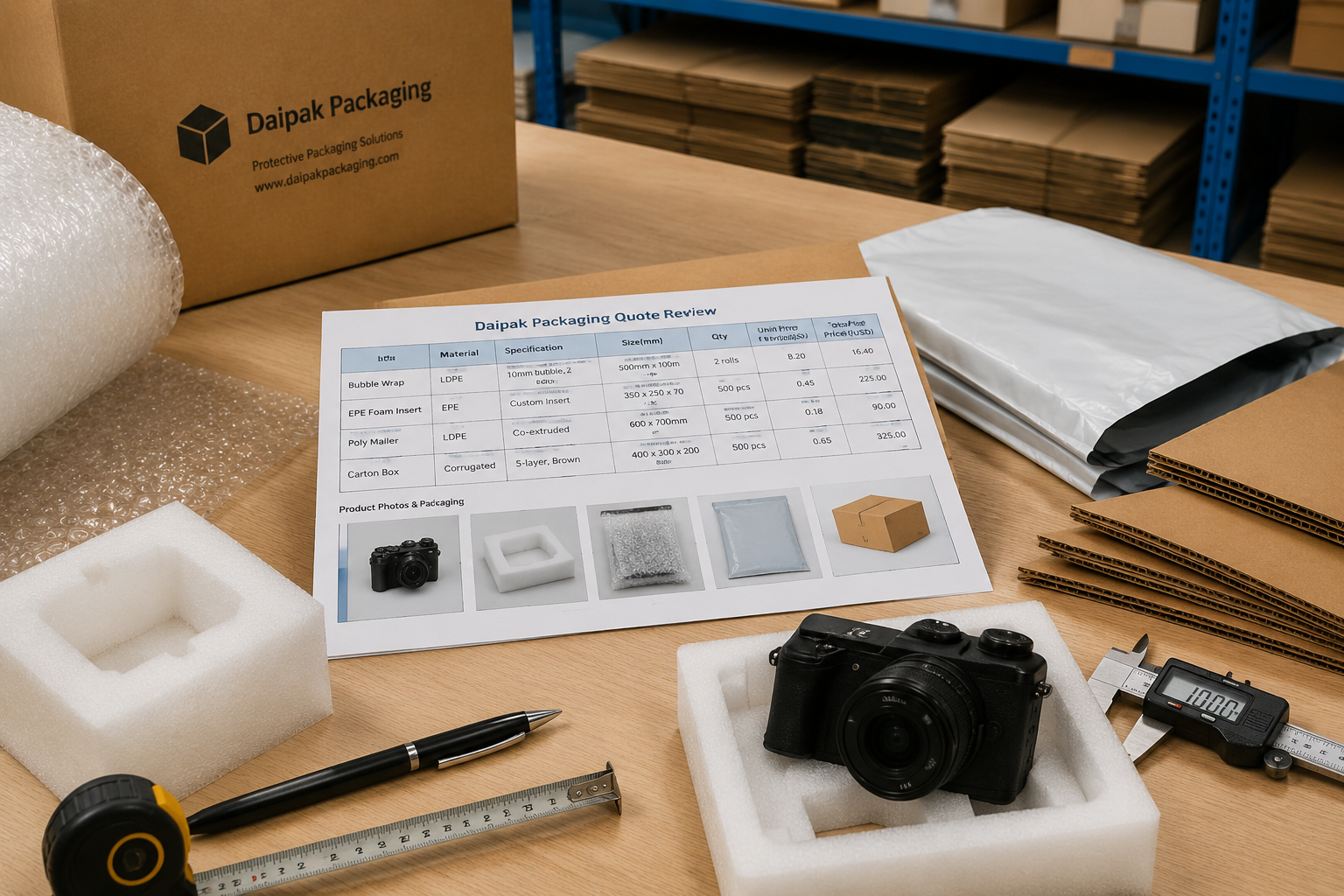
Product Details Buyers Should Send First
Before asking a China packaging supplier for a firm price, buyers should send the basic product details that affect material selection. Product size, product weight, shape, fragility, surface finish, and packing quantity are not small details. They determine whether the packaging should be foam, bubble wrap, air cushion packaging, plastic film, corrugated board, or a combination of materials.
The same outer dimensions can lead to very different packaging recommendations. A glass bottle, an electronic device, a furniture panel, a painted metal part, a garment, and a hardware component may share a similar size but face different risks. Some products break easily. Some scratch easily. Some are heavy enough to crush weak inner packaging. Some have corners, handles, screens, coatings, or protruding parts that need targeted protection.
Buyers do not need to prepare a full engineering file at the first inquiry. Clear measurements, weight, product photos, packing purpose, and order quantity are often enough for an initial review. If existing packaging is already being used, photos or samples can also help the supplier understand what works, what fails, and what should be improved.
For Daipak, these first details become the practical starting record for the recommendation. Product size, weight, photos, drawings, packing method, quantity, and destination give the supplier a clearer basis for choosing material, estimating carton packing, and deciding whether a sample check is needed. If any of these points changes later, the quote basis should be updated as well, because a small change in product weight, bag size, foam thickness, or carton quantity can affect both production and export preparation.
Size, Weight, and Shape
Length, width, and height are the first numbers a supplier needs, but they should not be treated as the only product information. Net weight matters because a light cosmetic box, a heavy metal casting, and a ceramic part create different pressure on the packaging. A heavy product may need stronger cushioning, thicker foam, reinforced cartons, or better separation inside the master carton.
Shape can be just as important as size. Irregular products with handles, sharp corners, raised buttons, curved surfaces, or thin edges may need special protection points. Oversized products may require larger sheet material, wider film, stronger cartons, or different packing methods. If the product cannot lie flat, or if it has a preferred loading direction, that should be explained early.
A practical inquiry should include the finished product dimensions, the product weight, and any shape details that affect packing. If the product has a fragile corner, an exposed screen, a polished surface, or a part that cannot bear pressure, that information should be stated instead of left for the supplier to discover later.
Photos, Drawings, or Existing Packaging Samples
Product photos help the supplier see details that dimensions cannot show. A front, side, top, and close-up view can reveal corners, handles, openings, sharp edges, polished areas, and pressure-sensitive parts. For many standard packaging discussions, clear photos plus dimensions are enough to begin a recommendation.
Drawings become more useful when the packaging has to fit closely around the product. Foam inserts, air column bags, die-cut pads, dividers, and custom boxes often need more accurate dimensional information. A simple drawing showing length, width, height, loading direction, and key protection areas can prevent misunderstanding. For corrugated boxes or printed mailers, a dieline or artwork file may be needed before final sampling or production.
Physical samples are helpful when the buyer wants to match an existing material feel, thickness, sealing style, printing effect, or cushioning structure. A sample can show stiffness, flexibility, surface texture, bag opening style, and carton folding details better than a photo. However, buyers should still confirm measurements and quantity, because a sample alone does not define the full quote.
Fragility and Surface Protection Needs
Fragile products need more context than size and weight. Glass, ceramics, electronics, lighting parts, instruments, and retail display items may need cushioning against vibration, carton drops, or pressure from other goods. A quote for these products should consider not only the material cost but also the risk of breakage during parcel handling, warehouse movement, or export shipment.
Surface-sensitive products create a different problem. Painted parts, polished metal, furniture surfaces, acrylic panels, coated components, and glossy retail goods may arrive unbroken but still be unacceptable if they are scratched, dented, or rubbed during transport. For these products, the first protective layer may be foam sheet, foam pouch, plastic film, soft liner bag, or another anti-scratch material before the cushioning layer is added.
Buyers should describe what kind of damage they are trying to prevent. “Fragile” is useful, but “glass surface scratches easily,” “painted corner dents under pressure,” or “screen must not touch the carton wall” gives the supplier a clearer basis for packaging design and pricing.
How the Product Will Be Packed
The packing stage also affects the quote. Packaging for one individual unit is different from packaging for inner boxes, retail kits, master cartons, warehouse storage, or export shipment. A foam pouch may work for unit protection, while a foam insert may be better for a gift set or multiple parts. Bubble wrap may protect products inside a carton, but an outer corrugated box still needs the right size and strength.
Buyers should explain whether the product will be packed by hand, on a packing line, in a warehouse, or at a supplier’s factory before export. Packing speed matters because a structure that protects well but takes too long to assemble may not fit the buyer’s operation. For high-volume packing, bag opening, adhesive closure, carton loading direction, stacking method, and labeling can all affect labor and consistency.
It also helps to confirm how many pieces go into each inner box or master carton. A product packed one piece per box needs different protection than products stacked in layers or separated by dividers. If the goods will be palletized, stored for a long period, or shipped in containers, the packaging should be reviewed as part of the full carton and shipment plan.
Packaging Material Specifications That Change the Quote
A custom packaging quote becomes more reliable when material specifications are clear. Buyers do not need to know every technical term before contacting a supplier, but they should share any known size, thickness, density, board type, film type, printing detail, or reference sample. If those details are unknown, the supplier can recommend options based on product risk, quantity, packing method, and target cost.
The main point is simple: two packages that look similar in a photo may not cost the same or perform the same. A thicker film, denser foam, larger bubble size, stronger corrugated board, or more complex closure can change both price and function. Buyers should avoid comparing supplier prices unless the material, size, structure, quantity, printing, packing method, and shipping basis are close enough to compare.
As a protective packaging manufacturer, Daipak often helps buyers compare foam, bubble wrap, air cushion packaging, plastic bags, film packaging, and corrugated boxes for the same product. The right choice depends on the protection target and the practical packing process, not only on the lowest material cost.
Once the buyer and supplier agree on a material direction, the confirmed specification should be treated as the working reference for production. Material name, thickness, density, structure, color, printing, labels, carton marks, and packing method usually need to be checked together, because production teams will follow those details when cutting foam, sealing bags, bonding layers, laminating film, printing artwork, or forming cartons. This connection between the quote basis and the production requirement is what makes a later finished-product review more meaningful.
Material Selection Note: For a useful quote, material choice should follow the product’s risk, weight, surface sensitivity, packing method, and shipping route rather than habit or the lowest unit price. Daipak’s material discussion is most practical when the buyer shares both the product details and the handling condition.
Foam Packaging: Density, Thickness, Shape, and Cutting Method
EPE foam packaging can be quoted in many forms, including foam rolls, sheets, bags, pads, corner protectors, self-adhesive pouches, and custom inserts. The quote changes according to foam density, thickness, sheet size, cutting accuracy, bonding requirements, and whether the structure is simple or shaped around the product.
Foam density affects cushioning and material use. Thicker or denser foam may be useful for heavier products, sharp corners, or repeated handling, but it also increases cost and packing volume. A simple rectangular foam sheet is usually easier to price and produce than a die-cut insert with cavities, slots, or layered protection. If the insert must hold the product tightly, the supplier may need more exact product dimensions or a sample for confirmation.
Cutting method also matters. Straight-cut foam pads, die-cut shapes, laminated layers, and bonded assemblies require different preparation. For products with fragile corners or polished surfaces, the supplier may recommend targeted foam protection rather than covering the entire product with unnecessary material. This can help balance protection, packing space, and cost.
Buyers should also think about how foam will be stored and used before it reaches the packing table. Soft foam parts can deform if they are packed too tightly, while bulky foam inserts may increase carton volume and warehouse space. If workers need to pick several foam pieces for one product, the supplier may suggest packing them as sets, adding simple separation, or adjusting the structure so assembly is easier. These details may not change the material name, but they can change the real cost of using the foam in production.
Bubble Wrap and Air Cushion Packaging: Film, Bubble Size, and Roll or Bag Format
Bubble wrap pricing depends on roll width, roll length, film thickness, bubble size, layer structure, and whether the material is supplied as rolls, sheets, or finished bags. A buyer asking for “one roll of bubble wrap” should confirm the roll dimensions and bubble type, because a narrow roll and a wide roll are not the same product. Larger bubbles may provide more cushioning space, while smaller bubbles may be better for surface wrapping and flexibility.
Finished bubble bags add more variables. Bag size, opening direction, sealing quality, adhesive closure, and packing quantity per carton all affect cost. If the bag will be used for e-commerce packing, the buyer should also confirm whether the bubble layer is only for inner protection or whether the bag itself serves as the shipping mailer.
Air cushion packaging and air column bags have their own quote factors. Film thickness, column structure, inflation method, finished size, and product fit can all change the price. Air cushions are often useful for void filling and lightweight cushioning, but they should be matched to the carton size and product weight. For fragile or high-value items, air column packaging may need a closer fit and more careful structure confirmation.
Plastic Bags and Film Packaging: Material, Thickness, Closure, and Printing
Plastic bags and film packaging cover many products, including poly mailers, courier bags, garment bags, PE bags, inner liner bags, clear packing bags, stretch film, and protective film. The quote depends on material type, film thickness, bag size, closure style, printing, color, and packing method. A small change in thickness can significantly affect material consumption, especially for bulk packaging orders.
Closure details should be confirmed early. A plain open bag, self-adhesive bag, zipper bag, handle bag, vented garment bag, and tamper-style mailer are not priced the same way. Adhesive strips, perforation, air holes, hanging holes, and easy-open features can all add production steps. For printed packaging, the number of colors, printing area, one-sided or two-sided printing, and artwork quality also affect pricing and sample preparation.
For film rolls and stretch film, buyers should confirm roll width, roll length, thickness, core size if relevant, and packing quantity. A quote based only on “stretch film roll” may not reflect the buyer’s actual warehouse wrapping process or pallet requirements.
Corrugated Boxes: Size, Board Strength, Flute, Printing, and Structure
Corrugated box quotes are strongly affected by size. Length, width, height, board area, waste allowance, and box structure all influence material use. A small increase in carton dimensions can increase both the box cost and the shipping volume. This is especially important for e-commerce cartons, postal boxes, moving boxes, export cartons, and custom printed boxes.
Board strength and corrugated box flute should match the product weight, stacking requirement, and shipping method. A light postal box for small retail goods has a different purpose than a master carton used for export handling. If the product is heavy, stackable, or shipped over long distances, the carton may need stronger board or a more suitable structure. If the carton is mainly for retail presentation, printing and appearance may become more important.
Box style also changes production and pricing. Regular shipping cartons, zipper corrugated boxes, postal boxes, display-style boxes, dividers, and custom inserts all require different structures. Printing adds another layer of specification, including logo size, print position, color requirements, and carton marks. For a fair quote, buyers should confirm whether they need a plain outer carton, a printed shipping box, or a custom box that also supports product presentation.
When carton stacking or compression resistance is important, buyers should avoid relying only on the word “strong.” ASTM D642 identifies a standard method for determining the compressive resistance of shipping containers, so compression requirements should be tied to the actual carton, load, stacking time, and handling condition rather than assumed from material name alone.[3]
Custom Structure, Printing, and Finishing Details Buyers Should Confirm
Custom packaging is not only a matter of changing the size. A printed poly mailer, an EPE foam insert with cavities, a corrugated postal box with a logo, or a garment bag with an adhesive strip all have structure and production details that affect the quote. If these details are unclear, a supplier may estimate based on a simpler design than the buyer actually needs, which can lead to price changes during sampling or before bulk production.
For a custom packaging supplier, the important question is how the package will be used in real packing work. Does the product slide in from the top or load from the side? Does the package need to protect a polished surface, hold several parts apart, seal quickly on a packing line, or display a logo in a certain position? These details influence material use, cutting method, sealing method, printing setup, and sample confirmation.
As a custom protective packaging factory, Daipak usually needs both the desired appearance and the practical packing function before confirming a structure. A custom size can be simple, but a special shape, insert, divider, handle, or closure detail may require review for production feasibility and repeat-order consistency.
Before a buyer approves a custom packaging quote, it is useful to ask the supplier to identify which details are fixed and which details are still estimates. For example, the size and quantity may be fixed, while carton packing, sample tolerance, print position, or foam bonding method may still need confirmation. This small step makes the quotation more transparent and helps both sides avoid treating a preliminary estimate as a final production instruction.

Custom Size Is Only One Part of Custom Packaging
Buyers often begin with length, width, and height, which is a good starting point. But custom packaging structure also includes how the product sits inside the package, where the pressure points are, how the package closes, and how workers will load the product during daily packing. A foam insert for a glass item may need cavities, finger notches, corner clearance, or layered support. A corrugated postal box may need locking tabs, a tuck-in flap, or extra space for inner cushioning.
The loading direction is easy to overlook. If the product is inserted vertically, the packaging may need different support than if the product is laid flat. For long parts, heavy tools, fragile electronics, or furniture accessories, the structure must consider bending, compression, and movement inside the carton. A design that looks correct on a drawing may still slow down the packing line if workers need too much time to align the product.
Buyers should also confirm whether the packaging is for one product, a set of parts, a retail kit, or a master carton arrangement. Dividers, foam pads, corner protectors, and inner bags may all be part of the same packaging structure. If the supplier quotes only the outer piece without knowing the full packing method, the quoted price may not reflect the real package needed for shipment.
Printing Information That Affects Cost
Printed packaging needs clear artwork information before a reliable quote can be prepared. The cost can change depending on logo size, number of print colors, printing position, one-sided or two-sided printing, and whether the artwork requires close color matching. A small black logo on one side of a poly mailer is not the same cost situation as a full-area printed bag with multiple colors.
Buyers should send artwork files if available, along with a simple note showing the desired print size and placement. For corrugated boxes, this may mean confirming whether the logo appears on the top panel, side panel, or multiple sides. For plastic bags, it may mean confirming whether printing is on the front only, back only, or both sides. For garment bags or courier bags, the adhesive strip position can also affect where printing can be placed.
Color expectations should be discussed early. If a buyer needs a brand color to be close to a reference, the supplier should know this before sampling. Without clear artwork or color direction, the first quote may only cover a general printing assumption, and the actual sample cost or production cost may change after the file is reviewed.
Functional Details That Should Not Be Missed
Small functional details can have a large impact on both usability and price. Adhesive strips, zipper closures, handles, hanging holes, vents, tear lines, easy-open features, anti-scratch layers, and product dividers all add production steps or material requirements. These details should be included in the first inquiry instead of added after the first quotation, especially for custom bags, garment packaging, foam inserts, and printed cartons.
For protective packaging, functional details are not decorative extras. A vent hole may help air escape when packing soft goods. A divider may stop metal parts from rubbing together. A surface film or soft foam layer may reduce scratch risk on painted or polished products. A handle may improve warehouse handling but may also require stronger material or a different structure.
Carton marks should also be considered when the packaging is used for export or warehouse distribution. Buyers may need product codes, quantity marks, handling symbols, destination information, or customer-specific labeling. These details do not always change the product structure, but they can affect printing, labels, packing review, and shipment preparation.
Order Quantity, Packing Method, and Shipping Destination
Order quantity is one of the main reasons packaging quotes change. For bulk packaging orders, unit cost is affected by material purchasing, machine setup, printing preparation, cutting or sealing arrangements, and packing efficiency. A quote for 5,000 printed bags may not use the same cost structure as a quote for 50,000 bags, even if the bag size and material are the same.
Buyers should separate the quantity of their products from the quantity of packaging they need. For example, 10,000 products may require 10,000 individual bags, 2,000 inner cartons, 500 master cartons, or a combination of foam pieces and outer boxes. If the inquiry only says “packaging for 10,000 units,” the supplier may need to ask several follow-up questions before preparing a useful quote.
Packing method and shipping destination also matter because packaging is bulky. Foam, bubble wrap, air cushions, plastic bags, and corrugated boxes do not occupy warehouse or container space in the same way. A wholesale packaging materials supplier may quote the product cost first, but export packing, carton count, pallet arrangement, and freight volume can affect the buyer’s total landed cost.
Why Quantity Changes Unit Price
Many packaging products require setup before production begins. Printing plates or setup work, machine adjustment, material preparation, cutting size confirmation, sealing settings, and carton packing plans all take time. When the order quantity is small, these fixed costs are spread over fewer pieces. When the quantity is larger, the same setup cost may be divided across more units, which can reduce the unit price.
Material purchasing also changes with quantity. Large orders may allow more efficient use of rolls, sheets, board, or film. Smaller custom runs may create more trim waste or require more manual handling. For printed packaging, the number of colors and artwork setup can make quantity especially important because preparation cost does not always increase in direct proportion to the number of pieces.
Buyers should provide a realistic order quantity and, if possible, a forecast for repeat orders. The supplier does not need a guaranteed long-term commitment to quote the first order, but knowing whether the project is a trial order, seasonal purchase, or repeat packaging item can help frame the quotation more practically.
How Supplier Packing Affects Export Cost
Supplier packing affects export cost because packaging products may be light but high in volume. Bubble wrap rolls, EPE foam parts, air column bags, poly mailers, and corrugated boxes all require different carton packing methods. Some materials can be compressed or stacked efficiently, while others must keep their shape to avoid deformation before use.
For example, flat poly mailers can usually be packed tightly in cartons, while shaped foam inserts may need more carton space to avoid crushing. Corrugated boxes may ship flat-packed, but the board size, bundle quantity, and pallet arrangement affect freight volume. Bubble wrap rolls may be packed by roll size and outer film, while air cushion products may be supplied flat before inflation depending on the product format.
Buyers should ask how the supplier plans to pack the goods for export. Carton size, pieces per carton, gross weight, carton marks, pallet use, and loading method can all influence shipment planning. A low unit price can become less attractive if the export cartons are inefficient or the freight volume is much higher than expected.
For export shipments, carton information should be checked before the buyer approves the order, not only after production is finished. Carton dimensions, carton weight, bundle quantity, pallet height, and loading condition can affect freight quotation, warehouse receiving, and container planning. Daipak may ask buyers to confirm whether goods will move by courier, LCL, full container, or warehouse delivery because the same packaging item may need different carton marks, pallet preparation, or loading notes under different routes.
Export packing is easier to control when the order confirmation connects the finished product review with the outer packing plan. After production, the supplier can usually check finished size, sealing, bonding, printing, color, and structure against the confirmed sample or drawing, then review carton quantity, inner packing, labels, carton marks, pallet preparation, and loading information against the agreed shipping details. This does not replace the buyer’s final receiving check, but it helps prevent a correct product from being packed in a way that creates warehouse or delivery problems.
Export Packing Note: Before export production is released, carton packing should be reviewed against destination, carton space, handling route, labels, pallet needs, and shipment details. This helps the buyer compare the packaging price together with the practical receiving and freight plan.
Destination Details Buyers Should Provide
A packaging quote may cover only product cost, or it may include export and freight-related support depending on the buyer’s request. To avoid confusion, buyers should state whether they need EXW, FOB, CIF, DDP, or another trade basis if they already know their preference. If they are not sure, they can still provide the destination country and ask what information is needed for a more complete quote.
Useful destination details include the country, destination port, warehouse address if delivery support is being discussed, preferred shipping method, and any special receiving requirements. For warehouse delivery, carton labels, pallet height, or packing quantity per carton may matter. For a destination port quote, carton volume and estimated shipment weight may be more important at the early stage.
An export packaging supplier cannot make good freight-related assumptions from product size alone. The same packaging order may ship differently if it goes by courier, air freight, LCL sea shipment, full container, or to a third-party warehouse. Sharing the destination early helps the supplier prepare carton packing details that fit the buyer’s purchasing and logistics plan.
Protection Requirements and Shipping Conditions Behind the Quote
An accurate quote depends not only on what the packaging is made from, but also on what the package must survive. E-commerce parcels, palletized export shipments, warehouse storage, courier handling, container loading, and retail distribution all create different risks. A product that looks simple on a table may need stronger cushioning packaging if it will face long-distance shipping, repeated handling, carton drops, or compression in storage.
As a protective packaging manufacturer, Daipak looks at protection as a combination of product risk, handling environment, and packing efficiency. A stronger structure may cost more per piece, but it can help reduce repacking work, visible scratches, broken parts, customer complaints, and replacement cost when matched to the product and route. The goal is not to overpack every item; the goal is to match the protection level to the real risk.
Buyers should describe the shipping condition as clearly as they describe the material. If the product is fragile, heavy, high-value, scratch-sensitive, or shipped over a long distance, those details should be included in the quote request. Otherwise, the supplier may quote a material that fits the size but not the handling risk.
Fragile, Heavy, or High-Value Products Need More Context
Fragile items need more than a general note saying “handle with care.” Glass, ceramics, electronics, lighting parts, instruments, and assembled retail goods may require cushioning around corners, edges, screens, handles, or protruding components. The supplier needs to know which part is most likely to crack, dent, bend, or scratch.
Heavy products create another issue. Weight increases compression and impact force during handling. A thin bag or light foam sheet may protect against dust or minor surface contact, but it may not control movement inside a carton. Heavy metal parts, machinery accessories, hardware, and dense components often need separation, stronger outer cartons, or shaped support to prevent product-to-product damage.
Product value also affects acceptable risk. A low-cost item and a high-value finished product may have the same dimensions, but the buyer may not accept the same damage rate or appearance risk. For polished metal, painted surfaces, furniture panels, and consumer electronics, scratch protection can be as important as breakage protection.
Courier, Container, and Warehouse Handling Are Different
Courier parcels face repeated sorting, drops, vibration, and mixed handling with many other packages. For this type of shipment, the inner protection and outer carton need to work together. Bubble wrap plus a mailer may be enough for some light items, while air column packaging plus an outer box may be more suitable for selected fragile products.
Container shipment has different pressure points. Goods may be packed in export cartons, stacked on pallets, or loaded in bulk. The risk is often compression, carton collapse, vibration, and long storage time rather than only a single drop. Corrugated carton strength, inner foam, dividers, and carton packing quantity can all affect how well the shipment holds up during transport.
Warehouse handling adds another layer. Products may be moved by hand, pallet jack, forklift, or conveyor. Cartons may be stacked, opened, repacked, or stored for weeks before final delivery. If packaging is difficult to identify, too weak for stacking, or inefficient to open and reclose, the buyer may face handling problems even if the product arrived without visible damage.
If the shipment will move through a parcel network, a written “fragile” note should not be treated as a substitute for package design. ISTA Procedure 3A is specifically framed around packaged products for parcel delivery systems, which reinforces why buyers should share the parcel route, product weight, carton size, and protection target before expecting a firm quote for e-commerce or courier packaging.[2]
When Material Combinations Make the Quote More Realistic
Many products need a packaging system rather than one material. Foam can cushion and separate parts, bubble wrap can provide flexible wrapping, air cushion packaging can help fill voids, plastic film can reduce dust or surface contact, and corrugated boxes can provide outer structure. The right combination depends on the product and the shipping route.
For example, a painted metal part may use a protective film or foam pouch to reduce scratches, then a divider or carton to prevent contact with other parts. A fragile glass item may need an EPE foam insert or air column bag inside a corrugated box. A lightweight e-commerce item may use a poly mailer with bubble protection, while a heavier export item may need foam corner protection and a stronger master carton.
Material combinations can make the quote more realistic because they show the supplier the full protection requirement. If a buyer asks only for bubble wrap, the price may look low, but the package may still need cartons, labels, dividers, or surface protection to work in real shipment. A complete protection description helps the supplier quote the packaging that will actually be used, not just one isolated material.
When several materials are used together, the quote should also clarify how those materials are supplied and packed. Foam pads may arrive as loose pieces, matched sets, or bonded assemblies; bags may be bundled by quantity; cartons may be supplied flat; and labels or carton marks may be handled separately. Confirming this workflow helps the buyer understand not only the material cost, but also how the packaging will move from Daipak’s production side to the buyer’s packing table.
Compliance, Food Contact, and Sustainability Claims to Confirm Separately
Some packaging inquiries need more than normal size and price information. If the package will touch food directly, the buyer should identify the food type, contact condition, temperature, destination market, and whether the material is paper, paperboard, plastic, coating, liner, or another component. U.S. food-contact packaging discussions may involve FDA food packaging and food contact substance requirements, while EU projects should be checked against European food contact material rules before a supplier or buyer makes a compliance statement.[4][5]
Environmental wording should also be handled carefully in a quote request. Claims such as recyclable, compostable, biodegradable, recycled content, or eco-friendly should be tied to the exact material, construction, label requirement, and destination market rather than treated as a general description. The FTC Green Guides are a useful reminder that environmental marketing claims need qualification when limits or conditions affect how consumers may understand the claim.[6]
For paper-based or corrugated packaging, buyers can ask whether the selected structure is intended for a recycling stream, but they should still confirm coatings, laminations, tapes, labels, inks, and destination-market instructions. Corrugated packaging has a strong recyclability and recovery context in industry guidance, but the final recyclability message depends on the complete package design and local collection system.[7]
A practical way to avoid confusion is to separate “quote specification” from “claim approval.” The quote can list the material, size, thickness, printing, carton packing, and any requested documentation. Any food-contact, recycling, compostability, or environmental claim should then be reviewed with the buyer’s compliance team, target market requirements, and final packaging construction before it appears on product pages, cartons, or consumer-facing labels.
If a product involves lithium batteries, chemicals, aerosols, flammable goods, or other regulated contents, the packaging quote should not be treated as transport approval. Dangerous-goods packaging and shipping requirements may vary by product classification, transport mode, route, and destination, and frameworks such as the UN Model Regulations and U.S. hazardous materials regulations show why documentation and packaging responsibilities should be checked before production or shipment planning.[8][9]
Anti-static, moisture-barrier, or special protective functions should also be confirmed as separate requirements instead of assumed from a common product name. For example, a plastic bag, foam pouch, or film wrap should not be described as ESD protective, moisture-proof, or waterproof unless the buyer and supplier have confirmed the material structure, intended use, handling condition, and any documentation needed for the buyer’s market.
For consumer-facing recycling instructions, buyers should check whether the finished package construction, labels, inks, laminations, and local collection systems support the message they want to print. Labeling programs and recycling guidance are often based on the complete package, not only the main material, so a claim that works for one structure may not apply after coatings, windows, mixed materials, or adhesive labels are added.[10]
Sample, Drawing, and Reference Quote Information That Speeds Up Confirmation
A clear sample, drawing, or reference package can shorten the path from inquiry to quotation because it reduces guessing. A supplier can see the intended material feel, size, structure, sealing method, printing position, and packing use much faster than through written description alone. This is especially helpful for custom foam inserts, printed mailer bags, corrugated boxes, garment bags, air column packaging, and other items where small specification changes affect both price and production method.
A packaging sample request does not always mean the buyer must send a physical product immediately. In many early quote discussions, photos, product dimensions, and a simple packaging drawing may be enough to prepare an initial estimate. For more exact sample confirmation, however, a reference sample or existing packaging can help the supplier confirm details that are difficult to judge from photos, such as film stiffness, foam resilience, bubble size, carton board strength, surface texture, print coverage, and seal quality.
If a buyer already has a previous quote from another supplier, the most useful information is not the supplier’s commercial details. The useful part is the specification basis: material, size, thickness or density, quantity, printing, packing method, and trade terms. Sharing those details helps avoid a price comparison based on different assumptions.
Sample and drawing review also helps connect the buyer’s requirement to Daipak’s later checks. The approved sample, drawing, artwork file, or written specification should show what production needs to follow, such as cut size, seal position, foam cavity, lamination structure, print placement, carton mark, or packing quantity. When finished goods are reviewed, the check is more useful if it compares the actual packaging against those confirmed details rather than against a general description like “same as sample.”
When a Physical Sample Is Useful
A physical sample is most useful when the packaging has performance or feel requirements that are hard to describe. For example, two EPE foam pouches may have the same size but different thickness, density, surface softness, or sealing strength. Two poly mailer bags may look similar in a photo but feel very different because of film thickness, material blend, adhesive strip quality, or printing coverage. A corrugated postal box may have the same outer dimensions but use a different flute, board grade, fold structure, or locking style.
Samples also help when the buyer wants the new packaging to match existing packaging used by a factory, warehouse, retailer, or e-commerce operation. If the current packaging already works well, the supplier can use it as a practical reference for material and structure. If the current packaging has problems, such as cracked corners, scratched surfaces, weak seals, oversized cartons, or slow packing speed, the sample can show what needs to change.
For protective packaging, a sample can clarify how the product sits inside the package. A foam insert may need to hold a glass item away from the carton wall. A bubble bag may need enough opening space for fast packing. An air column bag may need the correct chamber layout for side and corner protection. These details affect the quote because they influence material use, cutting method, sealing work, and packing quantity.
What Drawings or Dielines Should Show
A packaging drawing does not need to be overly complicated, but it should remove the most common sources of misunderstanding. For simple bags, sheets, or pads, the drawing should show length, width, thickness, opening direction, seal position, and tolerance if the fit is tight. For foam inserts, it should show product cavities, wall thickness, corner clearance, slot depth, and the direction from which the product is loaded. For boxes, it should show inner size, outer size if available, fold lines, flap style, locking structure, and any special holes, handles, or inserts.
Dielines are especially useful for printed bags, mailers, and corrugated boxes because they show where artwork, folds, cuts, seals, and openings will sit on the finished package. A logo that looks centered on a flat artwork file may shift visually after the bag is sealed or the box is folded. Clear print area, color requirements, one-sided or two-sided printing, and orientation marks help the supplier check production feasibility before preparing a sample.
Buyers should also mark loading direction and product contact points when the packaging protects a specific shape. A fragile corner, polished metal face, display screen, painted surface, handle, hinge, or protruding part may need extra spacing or a softer contact layer. These small details can change the recommended structure and prevent a sample that looks correct on paper but does not work at the packing table.
How to Compare Quotes Without Misreading Price
Quote comparison is only useful when the basis is the same. A lower unit price may come from thinner film, lower foam density, smaller dimensions, fewer print colors, lighter corrugated board, looser carton packing, or a different shipping term. The price may be technically correct, but not comparable to another quote based on stronger material or more complete export packing.
Before comparing supplier prices, buyers should confirm that each quote uses the same material, size, thickness or density, structure, printing, order quantity, packing quantity per carton, and trade term. For example, a quote for 50,000 printed poly mailers packed loose in export cartons is not the same as a quote for the same mailers bundled in fixed quantities with carton labels and special marks. A foam insert quote based on simple sheet cutting is not the same as one based on shaped cavities, bonding, or die-cut parts.
A practical way to compare is to make a short specification summary and ask each supplier to quote against that same basis. If one supplier recommends a different specification, the buyer can then compare it as an alternate option rather than treating it as the same item. This keeps the discussion focused on value, protection, and total cost instead of only the lowest number.
Why Specification Confirmation Matters Before Production
Once a quote moves toward sampling or bulk production, the buyer and supplier should confirm the specification in writing. This does not need to be complicated, but it should include the final size, material, thickness or density, structure, printing, quantity, packing method, carton information, and any tolerance or appearance requirement that matters. A short confirmation sheet can prevent a situation where the buyer approves a price based on one assumption while the factory prepares material based on another.
For custom packaging, production consistency starts before the material is cut, sealed, bonded, or printed. The supplier may need to check whether the chosen thickness runs well on the intended machine, whether the foam structure can be repeated in bulk, whether the print position fits the sealing area, and whether cartons can hold the finished goods without crushing or deformation. These checks are part of practical order control, and they are easier to handle before production starts than after goods are packed.
Buyers should also keep the approved sample, artwork, drawing, and quote basis together for repeat orders. If a later reorder changes only the quantity but not the specification, the process is usually smoother. If the product, carton size, printing, or shipping route changes, the packaging should be reviewed again instead of assuming the previous quote still fits.
Common Inquiry Mistakes That Lead to Slow or Inaccurate Quotes
Most slow quotation discussions come from missing information, not from a complicated product. A packaging inquiry may start with a clear need, but if the supplier does not know the size, quantity, material, printing, packing method, or destination, the first response can only be a rough estimate. That estimate may later change after the real custom packaging specifications are confirmed.
The goal is not to make the buyer prepare perfect engineering documents before contacting a supplier. The goal is to give enough information for an accurate packaging quote and a useful recommendation. A small amount of detail at the beginning can prevent wrong size assumptions, mismatched material choices, incorrect printing cost, unrealistic freight volume, and repeated sample revisions.
Asking for the Lowest Price Before Confirming Specs
Price-first inquiries often lead to unreliable comparisons because the supplier has to make assumptions. If a buyer asks for “the cheapest foam insert” or “lowest price bubble bag” without product dimensions, thickness, density, quantity, or packing use, different suppliers may quote completely different items. One may assume light-duty material. Another may assume stronger protection. A third may quote a standard size that does not fit the product well.
A better approach is to define the packaging need first, then ask for cost options. For example, instead of writing, “I need foam for glass, lowest price,” the buyer can write, “Please quote an EPE foam insert for a 200 x 100 x 50 mm glass product, 0.8 kg, one piece per inner box, packed into export cartons. Please suggest a cost-effective protection option.” This gives the supplier room to recommend practical material without guessing the application.
A low material price can become expensive if the packaging fails during handling, slows down packing, uses too much carton space, or requires repeat sampling. The more useful question is not only “What is the lowest price?” but “Which specification is suitable for this product and shipping condition?”
Sending Only a Product Photo Without Dimensions
Photos are helpful, but they cannot replace measurements. A photo can show product shape, finish, corners, handles, or fragile areas, but it usually does not confirm length, width, height, weight, carton space, or clearance requirements. Without those details, the supplier may quote a bag that is too tight, a foam insert with insufficient wall thickness, or a carton size that leaves too much unused space.
For a faster response, buyers should send product photos together with basic measurements and weight. If the product has an irregular shape, it helps to mark the widest, tallest, and most sensitive points. If the packaging must fit into an existing carton or retail box, the available inner space should also be provided. This is especially important for foam inserts, air column bags, custom corrugated boxes, and fitted protective bags.
A clear photo plus dimensions gives the supplier enough context to see both the product risk and the packing limitation. The supplier can then decide whether the quote should be based on a standard material format, a custom cut part, a shaped insert, or a combined packaging structure.
Forgetting Printing, Quantity, or Packing Details
Printing details can change both price and preparation work. A plain poly mailer is not quoted the same way as a printed poly mailer with a large logo, two-sided printing, multiple colors, or a specific color matching expectation. A corrugated box with no printing is different from a printed carton with marks, handling symbols, or brand artwork. If artwork, print size, print position, and color count are missing, the supplier may need to pause the quote or provide only a temporary estimate.
Quantity also affects the unit price because setup work, material purchasing, printing preparation, and carton packing are spread across the order. Buyers should separate the product quantity from the packaging quantity. For example, “10,000 products” does not always mean “10,000 bags” if each set uses more than one bag, foam pad, divider, or carton insert.
Packing details matter because they affect export cartons, warehouse handling, shipment volume, and receiving work. A quote should make clear whether goods are supplied loose, bundled, flat-packed, palletized, labeled, or packed by fixed quantity per carton. These details may not change the finished package itself, but they can change how easy the order is to receive, store, count, and use.
A Practical Quote Request Checklist
Buyers can prepare a stronger quote request by organizing the inquiry around the product, the packaging function, and the delivery plan. The request does not need to be long, but it should give the supplier enough detail to avoid guessing. A clear inquiry often includes product size, weight, photos, quantity, material preference if known, protection target, printing needs, packing method, destination, and trade term.
For protective packaging, buyers should add the risk details that matter most. This may include fragile corners, scratch-sensitive surfaces, heavy product weight, preferred loading direction, carton stacking, parcel delivery, warehouse handling, export container shipment, or existing packaging problems. If a buyer is replacing a previous package, it is helpful to explain whether the goal is lower cost, better fit, faster packing, less carton volume, improved appearance, or fewer shipment issues.
For custom printed packaging, the inquiry should include artwork status, print colors, print area, one-sided or two-sided printing, logo placement, color expectations, and any carton marks or labels. If a claim will appear on the package, such as a recycling instruction or material statement, the buyer should confirm the wording separately before production so that the printed information matches the final material and destination-market requirements.
How Daipak Uses Complete Inquiry Information
Daipak Packaging can review foam, bubble, film, corrugated, and custom protective packaging options more efficiently when the inquiry includes the real packing condition. Complete information helps the team estimate material use, choose a practical structure, check whether sampling is needed, and prepare a quote basis that the buyer can compare with other suppliers.
A complete inquiry also makes later communication easier. If the buyer approves a sample, changes the quantity, adjusts the shipping route, or requests new printing, both sides can see which part of the quote needs to be updated. This reduces the chance of comparing an old price with a new specification or treating an early estimate as a final production instruction.
The most useful supplier discussion is not only about getting a price quickly. It is about confirming the specification, protection target, packing method, export packing, and claim boundaries before production begins. When these points are clear, the quote becomes a more reliable purchasing tool and the finished packaging is more likely to match the buyer’s real operation.
References
[1] ASTM International, “ASTM D4169 Standard Practice for Performance Testing of Shipping Containers and Systems,” distribution-cycle performance testing reference for shipping containers and packaging systems, available at ASTM D4169 Shipping Container Performance Testing.
[2] International Safe Transit Association, “ISTA Procedure 3A Overview,” packaged-product test overview for parcel delivery systems and small package shipping contexts, available at ISTA Procedure 3A Overview.
[3] ASTM International, “ASTM D642 Standard Test Method for Determining Compressive Resistance of Shipping Containers,” packaging test method reference for compression resistance discussions, available at ASTM D642 Compression Resistance.
[4] U.S. Food and Drug Administration, “Food Packaging and Food Contact Substances,” consumer-facing reference for food packaging and substances that come into contact with food, available at FDA Food Packaging and Food Contact Substances.
[5] European Commission, “Food Contact Materials,” European food contact materials rules and safety context for packaging articles, available at EU Food Contact Materials.
[6] Federal Trade Commission, “Green Guides,” U.S. environmental marketing guidance for recyclable, degradable, compostable, and other environmental claims, available at FTC Green Guides.
[7] Fibre Box Association, “Corrugated is Recyclable,” industry resource on corrugated recovery and recyclability context, available at Fibre Box Association Corrugated is Recyclable.
[8] United Nations Economic Commission for Europe, “UN Model Regulations Rev. 24,” dangerous goods model regulations with packaging-related provisions for regulated shipments, available at UNECE UN Model Regulations Rev. 24.
[9] Pipeline and Hazardous Materials Safety Administration, “Hazardous Materials Regulations,” U.S. hazardous materials transport regulations relevant to regulated packaging and shipping preparation, available at PHMSA Hazardous Materials Regulations.
[10] How2Recycle, “How2Recycle Label Guidance,” labeling reference for recyclability communication and consumer-facing recycling instructions, available at How2Recycle Label Guidance.