
When you are sourcing packaging from China, the main decision is not just who gives the quote. It is whether the supplier can handle your product’s size, weight, fragility, surface protection, and packing method without creating avoidable errors in production or shipping. A trading company can simplify mixed sourcing, while a direct factory is often better when you need tighter control over thickness, fit, sealing, printing, carton counts, and repeat orders. For custom packaging or export packing, the real risk is usually a mismatch between what was approved in samples and what arrives in bulk.
This article helps overseas buyers judge which supplier type fits the job, what to verify before placing an order, and how to reduce rework when multiple materials must work together. It is especially useful if you are comparing packaging manufacturers and trading companies, trying to balance convenience with control, or preparing product details for a quotation. The key question is whether the supplier can support your packing system, not just sell individual items.
For higher-risk shipments, buyers should separate ordinary sample approval from performance validation. A visual sample can confirm size, printing, and fit, but transit performance may require a documented test plan that reflects the actual distribution route, handling risk, and package format; ASTM D4169 is one recognized framework for performance testing of shipping containers and systems, while ISTA Procedure 3A is commonly referenced for packaged products moving through parcel delivery environments.[1][2]
Build One Requirement File Before Requesting Quotes
The easiest way to make a packaging order traceable is to put the inquiry, sample, drawing, and production notes into one requirement file. That file should connect the product’s size, weight, surface condition, and fragile points with the material choice, so the supplier can see why a certain foam, bag, carton, or print method was selected. When this information stays together, the quotation is based on confirmed product details instead of a general product name.
For Daipak-style orders, a practical requirement file usually includes photos, drawings, confirmed dimensions, target packing quantity, carton marks, shipping destination, and any sample reference already approved. This gives the supplier a clearer basis for recommending thickness, density, sealing method, or carton structure, and it helps both sides compare the bulk order against the same confirmed standard later.
Set Claim Boundaries Before Comparing Suppliers
Before choosing between a manufacturer, trading company, or single-material factory, buyers should define which statements are simple product descriptions and which statements need supporting documents. Size, color, thickness, packing quantity, and sample photos can usually be checked directly. Claims about recyclability, compostability, food contact, moisture barrier performance, anti-static performance, heavy-load stacking, or regulated transport need more careful review because they depend on material composition, destination rules, test method, and final use.
This does not mean buyers should avoid these topics. It means they should ask the supplier to separate ordinary packaging advice from claims that require confirmation before production. For example, a supplier may suggest a poly bag for dust protection, but if the buyer wants to describe it as suitable for direct food contact, that requirement should be reviewed separately. A supplier may recommend a stronger carton for a heavy item, but the buyer should not treat that recommendation as a universal load-bearing promise unless the carton, product weight, stacking method, and handling condition have been checked together.
A practical supplier will be comfortable using careful wording. Instead of saying one material “guarantees safe delivery,” the better discussion is whether the chosen foam, bubble wrap, bag, carton, and packing method can help reduce specific damage risks under the buyer’s expected handling conditions. This keeps the conversation useful without turning the supplier into a regulator, laboratory, or insurer of the shipment.
Quick Packaging Decision Guide
| Buyer Question | Practical Reading | What to Check |
|---|---|---|
| Do I need a factory or a trading company? | Choose based on order type, not label alone. | Product complexity, communication speed, and revision control. |
| Is this a simple material order or a full packaging system? | Simple orders can fit one-material suppliers; system orders need broader coordination. | Foam, bags, cartons, labels, and void fill working together. |
| How much sample confirmation is enough? | Appearance is not enough for protective packaging. | Real product dimensions, sealing, fit, density, and handling tests. |
| What matters most for repeat orders? | Documented specifications matter more than supplier memory. | Version control, approved artwork, packing quantities, and tolerances. |
| What should I send before asking for a quote? | Clear product data speeds practical recommendations. | Size, weight, fragile points, shipping route, carton needs, and volume. |
| When does lower unit price become a false saving? | When the package does not match packing, storage, or transport needs. | Damage risk, labor time, carton space, and rework cost. |
Quick Questions Before You Read
Q: Is a trading company always better for small orders?
Not always. It can help with mixed sourcing, but you still need clear answers on factory source, samples, and quality checks.
Q: When should I prefer a direct packaging manufacturer?
Choose a factory when the order needs tight control over fit, material thickness, sealing, printing, or repeat-order consistency.
Q: What should I prepare before requesting a quote?
Send product dimensions, weight, fragile areas, packing method, carton requirements, shipping route, and expected quantity.
Q: Why do samples matter so much in protective packaging?
Because the sample should prove fit and function, not just appearance. Real product testing helps avoid bulk errors.
Why Supplier Type Matters More Than the Label on the Quotation
For overseas buyers, the first question is not only “Who gives the lowest unit price?” A better question is: “Who can understand the packaging requirement, confirm the correct specification, control production details, reduce mistakes, and support the next order without starting from zero?” This is why the discussion around a packaging manufacturer vs trading company in China matters. The supplier type affects much more than the name printed on the quotation.
A packaging quote may look simple: size, material, quantity, price, and packing. In real sourcing work, those lines connect to many decisions. Is the bubble wrap suitable for the product weight and movement risk? Will the EPE foam insert fit the product after cutting tolerance is considered? Can the poly mailer adhesive strip support the intended packing and shipping process? Is the carton structure suitable for expected stacking or export handling? If the supplier cannot answer these questions clearly, a lower price may not stay low after sample revisions, delays, repacking, or product damage.
No supplier type is automatically the best choice. A trading company can be useful when a buyer needs several unrelated products in small quantities or wants sourcing convenience. A single-material factory can be a strong fit when the buyer already knows the exact material, size, and specification needed. A multi-category China packaging materials supplier can be valuable when the buyer needs foam, bubble packaging, film, bags, cartons, and other protective packaging to work together as one packing system.
The right decision depends on the product and the order. A simple reorder of standard stretch film does not need the same supplier support as a custom protective packaging project for fragile electronics, coated parts, glass items, or export cartons with multiple inner packing components. Buyers should look beyond “factory direct” or “middleman” language and ask what role the supplier actually plays in communication, specification control, production follow-up, quality checks, and repeat-order support.
It also helps to compare the full packaging cost, not only the material unit price. A cheaper bag, thinner foam, or smaller carton may look attractive on the quotation, but the real cost includes packing labor, damage reports, warehouse sorting, carton replacement, shipment volume, and the time spent fixing misunderstandings. For export buyers, one avoidable packaging error can cost more than the small saving gained from choosing the lowest line item.
Manufacturer, Trading Company, and Single-Material Factory Are Not the Same
A direct packaging manufacturer usually has production-side access to at least part of the packaging being supplied. This can make communication more practical when the buyer needs custom sizes, material changes, sample revisions, or production feedback. For example, if a buyer asks whether an EPE foam pad should be thicker or denser, a manufacturer-side team can usually review the product size, weight, carton space, and cutting method before giving a recommendation.
A trading company usually focuses on sourcing, order coordination, and export communication. Some trading companies are very organized and useful, especially for buyers who need mixed products and do not want to manage several factories directly. The trade-off is that technical questions may need to pass through another production source. If the product is standard, this may not be a problem. If the packaging requires tight tolerances, special sealing, custom printing, or coordinated materials, the extra communication layer can increase the chance of delay or misunderstanding.
A single-material factory is different from both. It may focus deeply on one product family, such as EPE foam, bubble wrap, plastic bags, stretch film, or corrugated boxes. This can be efficient for clear, higher-volume orders. The limitation is product range. If the buyer needs a foam insert, outer carton, poly bag, label, and void fill together, a specialist factory may only solve one part of the project.
The Best Choice Depends on Packaging Complexity
Simple packaging purchases often benefit from a narrow and efficient supplier setup. If the buyer needs standard bubble wrap rolls, clear plastic bags, or regular cartons with known specifications, the decision may focus on stable production, price, packing quantity, and shipping arrangement. In that case, a single-material factory or a trading company with reliable sourcing may be enough.
Complex packaging projects need a different evaluation. A fragile product may need surface protection, cushioning, product separation, carton fit, and export packing support at the same time. A glossy painted part may need a soft inner bag before foam or bubble wrap to reduce scratch risk. A heavy product may require stronger corrugated cartons and shaped foam rather than loose void fill. An e-commerce shipment may need a mailer bag, bubble layer, label space, and packing speed that fits the warehouse process.
As product risk increases, the supplier’s ability to coordinate details becomes more important. Buyers should consider how many materials are involved, whether samples are needed, whether the packaging will be packed by hand or on a line, and whether the goods will be shipped domestically, by air, by sea, or through export pallets. The more the packaging depends on several materials working together, the more important it is to choose a supplier that can discuss the full packing method rather than only quote one item.
Environmental language should also be handled with care during supplier comparison. Corrugated packaging has established recycling and recovery context in many markets, but a buyer should still confirm the destination market’s collection system, contamination limits, inks, coatings, tapes, and labels before making broad recyclability claims.[3] For U.S.-facing marketing, recyclable, compostable, degradable, and similar environmental claims should be qualified so they do not overstate what the package or local recovery system can actually support.[4]
When Supplier Claims Need Extra Confirmation
Some packaging requests should be treated as special-use requirements rather than ordinary product features. If the buyer is sourcing packaging for food contact, cosmetics, pharmaceuticals, lithium batteries, electronics, hazardous goods, child-sensitive products, or products that need moisture or static-related controls, the supplier should review the intended use before quoting or sampling. The same product name can refer to very different requirements depending on whether the package only protects goods during transport or directly supports a regulated end use.
Buyers should ask for the right evidence before relying on a claim in their own sales materials or import documents. A material sample, catalog photo, or casual message is not the same as a test report, specification sheet, declaration, or market-specific review. Where documents are required, the buyer should confirm the document scope, product model, material composition, issuing party, test method, date, and destination-market relevance before production. If the supplier cannot support a special claim, the safer approach is to describe the package by material and function instead of using unsupported terms.

How Direct Factory Communication Changes Packaging Decisions
Packaging specifications are often built through back-and-forth discussion. A buyer may start with a general request such as “foam insert for glass product” or “custom mailer bag for e-commerce shipping,” but the supplier still needs to confirm size, weight, product shape, fragile points, surface finish, packing quantity, carton space, and shipping conditions. Direct factory communication can make those decisions faster and more accurate because the discussion is closer to the people who understand material preparation, cutting, sealing, printing, and packing limits.
A direct packaging manufacturer in China can often help buyers move from a rough idea to a workable specification. That does not mean every factory salesperson has full technical knowledge, and it does not mean every trading company lacks packaging experience. The practical difference is the communication chain. When a technical question must move from buyer to sales contact, then to another factory, then back through the same path, small details can be lost or simplified. For custom packaging, those small details may affect fit, protection, and production cost.
For example, an EPE foam insert may need a product drawing, a physical sample, or clear photos from several angles before the supplier can suggest thickness, slot size, or edge protection. A poly mailer may require confirmation of film thickness, bag opening direction, adhesive strip type, printing area, and carton packing quantity. A corrugated box may need discussion of flute type, board strength, inner product weight, stacking condition, and whether the box is for e-commerce delivery, warehouse storage, or export shipment.
For overseas buyers, the most useful first message is often not “please quote this packaging” but a small information pack. Product photos from multiple angles, exact dimensions, weight, fragile areas, surface finish notes, current packing method, target carton quantity, and shipment route can change the recommendation. Ethan Lee often asks for these details early in export communication because they help separate a standard material purchase from a packaging design problem that needs sample confirmation.
Shorter Communication Chains Reduce Specification Errors
Many packaging problems begin as small specification errors. A foam sheet is quoted at the right length and width but the wrong thickness. A printed bag has the correct artwork but the opening direction is inconvenient for packing. A carton fits the product but leaves no space for bubble wrap or corner protection. These mistakes are not always caused by poor intention. Often, they happen because the original packaging need was not translated into production details clearly enough.
Shorter communication chains help buyers confirm the practical points before production starts. The supplier can ask whether the stated dimensions are product size or required inner packing size. They can check if the tolerance is acceptable for a foam insert, plastic bag, or printed carton. They can point out when a material change will affect carton quantity, packing speed, or unit weight. This type of feedback is especially useful when the buyer is sourcing packaging from China and cannot easily visit the factory in person.
Clear specs should include more than the product name. Buyers should try to confirm material type, thickness or density where relevant, finished size, tolerance, printing details, sealing method, packing quantity per carton, carton marks, and any sample reference. If the packaging must work with another material, such as foam inside a corrugated box or bubble wrap inside a mailer bag, those connected dimensions should be reviewed together.
Specification Confirmation Note: Before production, Daipak recommends confirming size, thickness, density, structure, quantity, printing, labels, carton marks, and packing method in one written order file so the sample reference and bulk production standard are aligned.
Technical Questions Need Production-Side Answers
Some questions cannot be answered well from a catalog image. If a buyer asks whether a foam insert can hold a heavy part without deformation, the supplier needs to understand foam density, product weight, contact area, and carton pressure. If a buyer asks whether a bag seal will hold, the answer depends on film material, thickness, sealing width, product weight, and packing process. If a buyer asks whether printed cartons can keep a consistent appearance, the supplier needs to review print method, board surface, color expectation, and artwork files.
Technical questions also come up during sample changes. A buyer may approve the general shape of a foam insert but request a tighter fit. That change may affect cutting accuracy, ease of packing, and whether workers can remove the product without tearing the foam. A buyer may ask for a thinner bag to reduce cost, but the supplier should explain the possible effect on puncture resistance, sealing quality, or hand feel. A buyer may want a smaller carton, but the supplier should check whether the inner cushioning still has enough space to work.
A good custom packaging supplier should not only say yes or no. The better answer explains the trade-off: what can be produced, what needs a sample, what may change in bulk production, and what information the buyer should provide next. Product drawings, photos, weight, packing method, and shipping destination often help the supplier give a more practical recommendation than a material name alone.
Trace the Approval From Sample to Production
Once the sample is approved, the confirmed size, material, thickness or density, print file, carton count, and packing method should be carried into the production file. That helps the bulk order stay aligned with the sample instead of depending on memory or a short email summary. If the buyer later changes a detail, the revised version should be saved in the same order record so the next quotation, sample, and production run all point to the same standard.
This also makes finished goods review easier. The supplier can compare the packed cartons, labels, bundle counts, and outer marks against the confirmed order file before shipment, which gives the buyer a clearer basis for receiving and warehouse checks. It is a practical traceability trail, not a formal digital system, but it makes the path from recommendation to sample, production, packing, and reorder much easier to control.
When a Single-Material Factory Is the Right Choice—and When It Is Too Narrow
A single-material packaging factory can be the right choice when the buyer has a clear requirement for one product line. If the order is large, repeatable, and technically straightforward, a specialist factory may offer focused production experience and efficient communication around that material. A buyer who regularly purchases one size of bubble wrap roll, one type of plastic bag, or one specification of corrugated carton may not need a broader supplier for every order.
This type of supplier can also be useful when the packaging material itself requires focused know-how. An EPE foam factory may be stronger at foam thickness, lamination, cutting, and shaped inserts. A bubble wrap supplier may be better suited for roll width, perforation, bag conversion, and cushioning formats. A corrugated box manufacturer may be the right partner for carton structure, flute selection, printing, and board strength. The value comes from specialization.
The limit appears when the packaging need is not limited to one material. Most real protective packaging works as a system. A foam insert may protect the product but require a larger carton. Bubble wrap may cushion the product but not protect a delicate surface from rubbing. A poly bag may keep dust away but will not absorb impact. A strong outer carton may still create trouble if the inner protection allows the product to move during vibration. If the buyer must coordinate every part separately, the sourcing work can become heavier than expected.
Best Fit: Large, Clear Orders for One Packaging Material
A specialist factory is often efficient for bulk orders with stable specifications. This may include standard foam sheets for product separation, bubble wrap rolls for warehouse packing, stretch film for pallet wrapping, clear bags for inner packing, or regular corrugated boxes for a known product. If the buyer already has confirmed size, thickness, material grade, packing quantity, and carton requirements, the discussion can stay focused and practical.
This arrangement works especially well when the buyer has internal packaging experience. A warehouse team or procurement manager may already know the exact film thickness, foam density, bag format, or carton size that works for their operation. In that case, the factory’s role is to produce consistently, confirm details before production, pack the goods correctly, and support repeat orders without unnecessary redesign.
The main decision point is whether the buyer truly knows the complete requirement. If the order is “same as last time” and the approved sample or specification file is clear, a single-material supplier can be a strong fit. If the buyer is still testing packaging performance, comparing materials, or changing the product design, a narrow supplier may not provide enough support across the full packing structure.
Main Limitation: The Buyer Must Coordinate the Whole Packaging System
When foam, bags, film, cartons, and labels come from separate suppliers, the buyer becomes the coordinator. That means checking whether the foam insert fits the carton, whether the bag size allows easy packing, whether the label position works on the outer carton, and whether all materials arrive in time for the same production or shipping schedule. For overseas buyers, this coordination can be difficult because each supplier may only see one part of the job.
The hidden workload is not only communication. It includes sample matching, specification control, carton quantity planning, shipment consolidation, and quality follow-up. A small change from one supplier can affect another material. If the foam becomes thicker, the carton may need to be larger. If the carton size changes, pallet loading may change. If the bag count per carton is different from the packing list, the warehouse may spend extra time checking quantities after arrival.
This does not mean buyers should avoid specialist factories. It means they should use them where the order fits. For one-material, high-volume, stable orders, a specialist factory can be practical. For multi-material protective packaging, buyers should consider whether they have enough internal time and packaging knowledge to coordinate separate suppliers, or whether a broader packaging materials supplier would reduce mistakes before bulk production.
Where Trading Companies Can Help—and What Buyers Must Verify
A packaging trading company in China can be a practical option when the buyer needs convenience more than deep production involvement. Many overseas buyers do not want to contact five separate factories for bubble wrap, plastic bags, cartons, labels, and stretch film. A trading company or sourcing agent may help combine these items, reduce the number of conversations, and make a small or mixed order easier to manage.
That convenience has value, especially for buyers who are testing a new product line, preparing a small launch, or purchasing standard packaging materials with limited customization. The decision should not be framed as “factory good, trader bad.” A well-organized trading company can be useful. The buyer’s job is to confirm how much control the supplier has over specifications, samples, production follow-up, and finished goods review.
Trading Companies May Be Useful for Small or Mixed Purchases
Trading companies often work best when the order includes many standard items and the buyer does not need detailed engineering support. For example, an e-commerce seller may need poly mailer bags, tape, stretch film, bubble rolls, and a few standard shipping cartons. If the sizes are common and the protection risk is moderate, one contact who can source and consolidate those items may save time.
This can also help smaller buyers who do not yet have enough volume for separate direct factory relationships. A wholesale packaging materials supplier may offer a broader catalog, flexible product matching, and simpler communication. For a buyer who is still testing demand, this can be more practical than opening several factory discussions for low-volume items.
The trade-off is that mixed sourcing can make technical control less direct. If a buyer needs a special EPE foam insert, a printed courier bag with confirmed film thickness, or a carton designed around a heavy product, the trading company must be able to explain how the factory will make it and how changes will be controlled. If every answer is delayed or vague, the convenience may turn into extra risk.
Verification Questions Buyers Should Ask Before Ordering
Before placing an order, buyers should verify whether the trading company is managing the order actively or only forwarding messages between the buyer and the factory. The difference often appears during sampling, specification changes, and quality follow-up. A supplier that understands the product should be able to explain material choices, tolerance limits, packing quantities, labeling requirements, and what will be checked before shipment.
Useful questions include:
- Which factory will produce this item, and is the sample made by the same production source?
- Can you confirm material thickness, foam density, carton grade, sealing method, print method, or other key specifications in writing?
- If the sample needs a size or material change, who confirms the revision with production?
- What finished goods checks will be done before shipment, and can photos or inspection notes be provided?
- How will repeat orders be controlled so the size, material, printing, packing quantity, and carton marks stay consistent?
These questions are not meant to pressure the supplier. They help the buyer understand the supplier’s working method. A capable trading company should welcome clear specifications because they reduce disputes later. If the supplier cannot identify the sample source, cannot explain basic material details, or cannot describe the inspection process, the buyer should slow down before approving bulk production.
Buyers should also be realistic about responsibility. If a trading company is combining several products from different production sources, carton marks, SKU separation, packing lists, and delivery timing need careful confirmation. The buyer should ask who will check the final order as a whole, not only each individual item. This matters when goods arrive at an overseas warehouse and the team must unload, count, and use the packaging quickly.
A practical way to reduce uncertainty is to request a short pre-production confirmation summary before paying the balance or approving mass production. This summary can list the approved sample date, final dimensions, material specification, print file version, packing quantity, carton label format, and any pending buyer decisions. It does not need to be complicated; its value is that both sides can see the same order standard before the factory starts producing or packing the goods.
Why Multi-Category Packaging Suppliers Can Reduce Coordination Work
Many packaging decisions are not about one material alone. A product may need cushioning, surface protection, void filling, carton strength, and warehouse handling support at the same time. If each part is sourced separately, the buyer must make sure the foam fits the carton, the bag does not affect packing speed, the void fill does not create too much pressure, and the outer carton can support the expected storage and transport conditions.
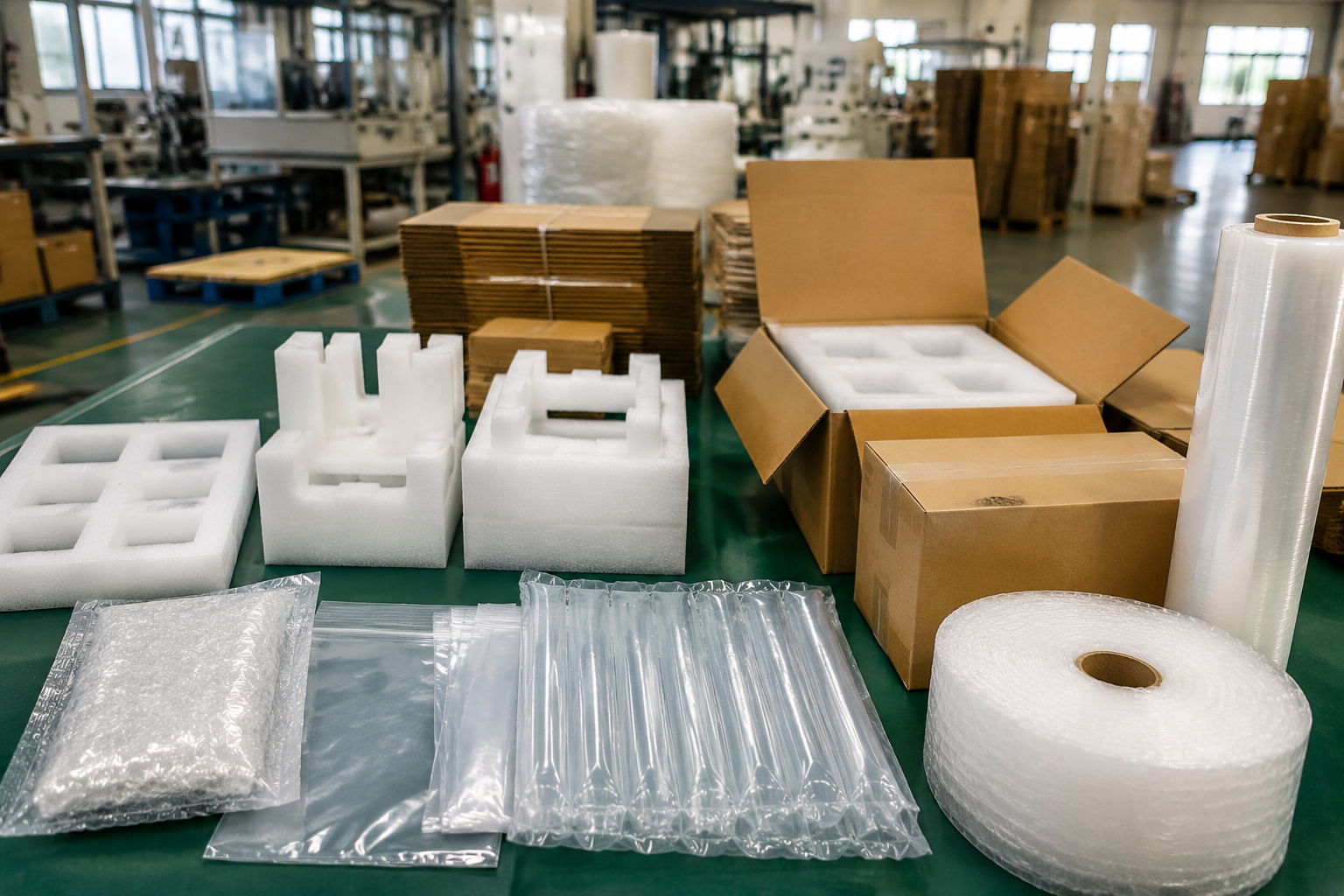
This is where a multi-category packaging supplier can reduce coordination work. Instead of comparing foam, bubble wrap, air cushions, plastic bags, film, and corrugated boxes as separate purchases, the buyer can review them as one packaging structure. As a China packaging materials supplier, Daipak often looks at the product details first—size, weight, fragility, surface finish, carton space, packing method, and shipping route—before discussing which material combination makes sense.
Packaging Materials Need to Work Together, Not Separately
A carton may look strong on paper but still create problems if the inner protection lets the product move during transit. Foam may provide useful cushioning but increase the required carton size and freight volume. A poly bag may protect a polished surface from dust and scratches but will not absorb impact. Bubble wrap may work well for flexible wrapping, while an EPE foam insert may be better when the product must stay in a fixed position.
The best structure depends on the product risk. A fragile glass item may need bubble wrap or air column packaging plus a properly sized outer carton. A coated metal part may need a plastic bag or foam pouch to reduce scratch risk, then separation inside a carton. A garment order may need inner garment bags, outer cartons, carton marks, and possibly stretch film for pallet handling. None of these choices is automatically better; each material has a job.
A combined packaging plan also affects packing workflow. If a foam insert is too tight, workers may slow down or damage the product during packing. If air cushions overfill the carton, compression can bend lightweight items. If a carton is oversized, the buyer pays for extra void fill and freight space. A practical supplier should help the buyer compare protection, carton fit, material use, and packing speed together.
Material Choice Should Follow the Failure Risk
Buyers sometimes begin with a material name because that is what they used before, but the better starting point is the likely failure risk. If the product scratches easily, the first layer may need a soft bag, film, or foam sheet before any stronger cushioning is added. If the product breaks from impact, cushioning thickness, compression space, and carton support matter more than the appearance of the wrapping. If the product is heavy, loose void fill may not be enough because the item can still shift and crush the inner protection.
This is why two products of similar size may need different packaging. A matte plastic part, a polished metal part, and a glass item can all fit in the same carton size but require different surface separation and cushioning. A supplier that asks about surface finish, sharp edges, fragile points, stacking direction, and warehouse handling is usually trying to prevent the wrong material from being selected only because it is familiar or low-cost.
Material Selection Note: For multi-material packaging, Daipak reviews material choice against product risk, carton space, packing workflow, and shipment handling instead of choosing foam, bubble wrap, film, or corrugated cartons only by habit or lowest unit price.
Coordination Can Save Time Before Bulk Orders
Before a bulk order, coordination often takes more time than buyers expect. A small change in product size can affect foam cutting, bag dimensions, carton size, packing quantity, and pallet arrangement. If these items come from separate suppliers, the buyer may need to update several quotations and samples. That creates more chances for old drawings, mismatched dimensions, or unclear packing instructions to remain in the order file.
Working with one supplier for several materials can simplify this process. The buyer can ask for a quotation revision based on the whole packing method rather than one material at a time. Samples can be reviewed together: the product inside the foam, the foam inside the carton, the bag around the product, and the void fill around the set. This makes it easier to see whether the packaging actually works before production begins.
Coordination also matters for repeat orders. If the same supplier helps manage the foam size, printed bag details, carton quantity, and carton marks, the reorder file is easier to keep aligned. The buyer still needs clear specifications and approved samples, but there are fewer handoffs. For overseas procurement teams, fewer handoffs usually mean fewer emails, fewer version mistakes, and a clearer path from sample approval to bulk production.
Sample Support Shows How Much Control the Supplier Really Has
Samples are not only a way to see what the packaging looks like. They show whether the supplier understands the product, the material, the tolerance, and the packing method. A good custom packaging sample should answer practical questions: Does the foam hold the product securely? Does the printed bag match the confirmed size and sealing style? Does the carton fit the inner protection without wasting space? Can workers pack the product efficiently?
Packaging sample confirmation is especially important for overseas buyers because they cannot stand beside the production line every day. A catalog photo or verbal description is not enough for custom protective packaging. The approved sample, written specification, photos, drawing, and revision notes should all support the same production standard before the buyer approves a bulk order.
When the package is intended for direct food contact, sample approval should not be treated as compliance approval. Buyers should confirm the intended food type, contact time, temperature, and destination market requirements separately, because the European Commission treats food contact materials as articles that must be safe under their intended conditions of use, and U.S. polymer and paper or paperboard food-contact materials are addressed through specific federal regulatory parts.[5][6][7]
Good Samples Confirm More Than Appearance
A useful sample confirms the details that affect production and performance. For EPE foam, the buyer should check thickness, density, cutting accuracy, bonding where used, product fit, and whether the foam protects fragile points without adding unnecessary carton size. For a printed bag, the buyer should check film thickness, dimensions, print position, color expectations, sealing quality, adhesive strip if used, and packing quantity. For a carton sample, size, board strength, folding accuracy, print or label position, and inner fit all matter.
Buyers should also test the sample against their real packing process. A foam insert that looks clean may still be too slow to use on a packing line. A bubble bag may provide flexible cushioning but may not protect sharp corners. A carton may close properly with one product but bulge when the full inner pack is added. The sample should be checked with the actual product, or at least with accurate product dimensions and weight.
A sample does not remove every production risk. Bulk production can still be affected by material variation, cutting tolerance, printing setup, sealing consistency, or packing method. The value of the sample is that it gives both sides a confirmed reference. Buyers should keep one approved sample, clear photos, and a written specification file so there is less room for interpretation later.
Revision Handling Reveals Communication Quality
The way a supplier handles sample revisions often reveals more than the first sample itself. Many custom packaging projects require adjustment. A foam insert may need a deeper slot, a bag may need a stronger seal, a carton may need a tighter fit, or a printed mark may need repositioning. The key question is whether the supplier records the change clearly and connects it to the next sample or production file.
Good revision handling should be specific. Instead of saying “we will improve it,” the supplier should confirm what will change: size, thickness, density, print position, sealing width, adhesive style, carton dimension, packing count, or material structure. If the buyer sends a revised drawing or marked photo, the supplier should confirm which version is being used. This prevents an old file from entering production by mistake.
Fast replies are helpful, but speed alone is not enough. Clear documentation matters more. A supplier that can summarize the approved changes, update the quotation if material use changes, and explain whether another sample is needed is showing real control over the order. For bulk packaging orders, that control is often what prevents small sample-stage confusion from becoming expensive production-stage mistakes.
Do Not Treat Special-Use Samples as General Approvals
A sample made for one product, one packing method, and one shipment route should not automatically be used as proof for another application. A foam insert that works for a lightweight item may not be suitable for a heavier product with the same outer size. A bag used as inner dust protection may not meet the needs of direct product contact, high-temperature exposure, liquid exposure, or long storage. A carton that performs acceptably in palletized handling may not perform the same way in parcel delivery.
When buyers plan to use the same packaging across several products or markets, they should ask the supplier to review the changed conditions before approving repeat production. The review should cover product weight, contact surface, packing pressure, transit route, storage condition, labels, and any market-specific requirements. This is especially important when the buyer intends to make product-facing claims, because packaging language should follow the confirmed use rather than the most optimistic interpretation of one sample.
Quality Control Should Cover Specifications, Production, Packing, and Shipment Preparation
Packaging quality control in China should not mean only checking a few cartons at the end of production. By that point, many problems are already expensive to correct. If the wrong foam density was used, the bag thickness is lower than approved, the carton size does not match the packing plan, or the print color was misunderstood, a final inspection may only confirm that the mistake has already been made.
A more useful approach starts before production begins. The supplier should understand which details are critical for the buyer’s product and which details have normal tolerance. For a bubble wrap roll, the buyer may care about roll width, length, bubble height, and packing quantity. For an EPE foam insert, the key points may be cutting accuracy, product fit, thickness, bonding, and compression behavior. For poly mailer bags, film thickness, adhesive strip quality, sealing strength, print position, and carton packing can all affect how the bags perform in the buyer’s warehouse.
Different orders need different checking levels. A standard stock-size bag may not require the same review as a custom foam insert for a fragile product. But even simple packaging orders should have a clear control point: what specification was approved, what will be measured, how defects will be handled, and what proof the buyer can receive before shipment. Photos, measurement records, packing photos, or a finished goods review can help overseas buyers avoid surprises when the shipment arrives.
Specification Control Comes Before Final Inspection
The first quality control question is simple: what is the supplier checking against? The approved quotation, drawing, sample, print file, material description, packing quantity, and production standard should all tell the same story. If one document says 50-micron film and another says 60 microns, or if the sample was changed but the quotation was not updated, the production team may follow the wrong reference.
This is why specification confirmation matters more than a general promise of “good quality.” Buyers should ask the supplier to confirm the final size, material, thickness, density, color, print details, sealing method, carton quantity, and carton marks before bulk production starts. For custom protective packaging, product photos or drawings should also be linked to the approved sample, so the factory understands the real fit and protection requirement.
From the factory side, Mr. Wang usually checks whether details such as cutting, sealing, bonding, or packing can be repeated consistently during batch production. That kind of review is practical because many packaging failures are not dramatic. They are small differences that create trouble later: a foam slot is slightly too tight, a bag opening is difficult to use, a carton is packed with the wrong quantity, or a label does not match the SKU.
Finished Goods Checks Should Match the Packaging Risk
Finished goods checks should focus on the risks that matter for the order. For foam sheets and inserts, the supplier may check dimensions, thickness, cutting edges, bonding areas, and carton packing. For bubble wrap or air cushion products, the review may include roll size, inflation condition, sealing, packing count, and carton protection. For plastic bags, useful checks include film feel, thickness, bag size, side sealing, adhesive strip, printing, and whether the bags are easy to separate and pack.
For corrugated boxes, the finished goods review should not stop at appearance. Buyers should confirm board type where relevant, size, printing, slotting, folding, gluing or stitching condition, packing bundle quantity, and whether the cartons are protected from crushing during storage and loading. If cartons are weak or packed poorly, the packaging materials may be damaged before the buyer ever uses them.
Overseas buyers should also ask about packing quantity checks and carton marks. Wrong counts and mixed quantities create warehouse problems even if the material itself is acceptable. A carton marked as 500 pieces but packed with 450 pieces forces the buyer’s team to recount, delay production, or explain inventory differences. Clear labels, SKU separation, and stable carton packing are part of quality control, not just shipping paperwork.
For custom or mixed packaging orders, buyers can ask the supplier to separate quality review into two levels: item-level checks and order-level checks. Item-level checks confirm whether each foam insert, bag, film roll, bubble product, or carton follows its approved specification. Order-level checks confirm whether the full shipment is packed in the right carton quantities, marked by the correct SKU, separated clearly, and prepared according to the buyer’s receiving process. This distinction is useful because a shipment can contain acceptable products but still create warehouse trouble if the packing list, labels, and carton organization are not controlled.
Export Packing Support Can Reduce Problems After Production Is Finished
A packaging order is not finished when the material comes off the production line. It still needs to pass through storage, carton packing, loading, freight movement, unloading, and warehouse handling at the destination. This is especially important for overseas buyers because damaged or disorganized packaging materials can slow down their own packing operation even if the products were made correctly.
Export packing support should match the type of packaging being shipped. Bubble wrap rolls may need enough outer protection to reduce puncture and crushed-edge risk. Foam sheets can deform if heavy cartons are stacked on top. Poly mailer bags and garment bags need clean, dry, countable carton packing. Stretch film rolls should be packed so roll edges are not damaged. Corrugated boxes may need bundling, strapping, or carton protection depending on the order and loading method.
A practical export packaging supplier should ask how the goods will be received and used. Will the buyer’s warehouse receive full pallets or loose cartons? Are there multiple SKUs? Does each carton need a barcode label, item code, purchase order number, or destination mark? Will the buyer’s team need to count units quickly on arrival? These details do not always change the product itself, but they can affect the packing plan and the buyer’s receiving efficiency.
If the export packing plan uses wooden pallets, crates, dunnage, or other wood packaging material, buyers should confirm treatment and marking requirements before shipment. ISPM 15 provides the international phytosanitary framework for wood packaging material in trade, and USDA APHIS guidance explains how wood packaging material is handled for U.S. import contexts.[8][9] If the goods themselves are classified as dangerous goods or hazardous materials, packaging selection and shipping preparation should be reviewed under the relevant transport rules rather than treated as an ordinary packaging purchase.[10][11]
Outer Cartons and Labels Affect Warehouse Efficiency
Outer cartons do more than hold the goods. They help the buyer’s warehouse identify, count, store, and issue packaging materials to the right packing line. If carton marks are unclear, missing, or inconsistent, warehouse staff may need to open cartons just to identify the contents. That creates extra labor and increases the chance that different sizes or SKUs are mixed.
For mixed orders, SKU separation is especially important. A shipment may include bubble wrap bags in several sizes, custom foam inserts for different products, printed mailer bags, and cartons for separate packing lines. If the supplier packs similar items together without clear labels, the buyer may lose time sorting them after arrival. A packing list should match the physical shipment, and carton labels should be easy to read from the outside.
Buyers should confirm the required carton marks before production packing begins, not after the goods are already sealed. Useful carton information may include product name, size, quantity, SKU, purchase order number, carton number, gross weight, net weight, and destination where needed. The exact format depends on the buyer’s receiving process, but the supplier should be able to follow a clear label instruction.
Export Handling Can Damage Packaging Materials Before They Are Used
Packaging materials can be surprisingly easy to damage during export handling. Foam can be compressed out of shape. Bubble rolls can be punctured or flattened. Corrugated boxes can arrive with crushed corners. Printed bags can become dirty if cartons split. Air cushion products may lose performance if they are packed or stored in unsuitable conditions. These issues may not look like product failure at the factory, but they create real problems for the buyer.
Pallet packing can reduce some risks when it is suitable for the order. Stable stacking, proper wrapping, clear pallet labels, and reasonable carton weight can make unloading and storage easier. But pallet preparation should fit the shipment plan. Some buyers need compact loading to control freight cost, while others prioritize easy warehouse receiving. The supplier should understand the trade-off instead of using the same packing method for every order.
Export handling also affects how quickly the buyer can use the packaging after arrival. If cartons are crushed, wet, mixed, or difficult to identify, the buyer may need to inspect and sort materials before production can continue. For overseas orders, that delay can be more costly than the original packing material difference. The better question is not only “Can you make the product?” but also “Can you pack it so our team can receive and use it efficiently?”
Repeat Orders Depend on Documentation, Not Memory
Many packaging problems appear on the second or third order, not the first. The first order may have careful sample review, many emails, and detailed confirmation. Later, the buyer may simply say, “Please repeat the same size as last time.” If the supplier relies on memory instead of a clear reorder file, small changes can enter production without anyone noticing.
Repeat packaging orders need stable records. The supplier should be able to refer back to the approved size, material, thickness, density, color, print file, carton packing quantity, label format, carton marks, and any special packing instruction. For custom protective packaging, saved sample photos, drawings, and revision notes are especially useful because the shape and fit may matter more than the product name.
Documentation also helps both sides work faster. A well-maintained reorder file can shorten quotation confirmation, reduce repeated sampling, support more stable bulk packaging orders, and lower the buyer’s internal workload. At Daipak, repeat-order communication usually starts by checking whether the previous specification still matches the buyer’s current product, packing method, and shipping route. That check is important because reorder consistency does not mean ignoring real changes.
Good Suppliers Keep Clear Reorder Files
A useful reorder file should be specific enough that a new production or purchasing contact can understand the order without guessing. It should include the item description, confirmed dimensions, material type, thickness or density where relevant, approved sample reference, print artwork, color requirement, packing quantity per inner pack or carton, carton size, carton marks, and any pallet or shipment preparation notes.
For printed bags and cartons, the latest artwork file should be clearly identified. For foam inserts, the drawing or product reference should match the approved version. For bubble wrap rolls or sheets, the roll size, sheet size, perforation, and packing count should be written clearly. For corrugated boxes, board specification, structure, print, bundle quantity, and carton packing requirements should be recorded.
Good documentation is not only for the supplier’s convenience. It protects the buyer from internal turnover, seasonal reorders, and rushed purchasing decisions. If a buyer changes staff or restarts an item after several months, a clear reorder file helps prevent confusion about what was approved last time.
Version Control Prevents “Almost the Same” Mistakes
“Almost the same” is often not good enough in packaging. A foam insert that is 2 mm tighter may make packing slower. A thinner poly bag may feel weaker to the buyer’s customer. A different adhesive strip may affect warehouse packing speed. A slight print color change may be acceptable for an inner bag but unacceptable for a retail-facing carton. A carton packed with a different quantity may disrupt inventory counting.
Version control is the habit of recording what changed, when it changed, and which version should be used for the next order. This matters when the buyer updates product dimensions, changes the shipping carton, adjusts the packing quantity, modifies artwork, or switches from domestic shipping to export handling. Without revision control, the supplier may produce an old version or combine details from two different orders.
Buyers should ask suppliers how they manage specification records before placing repeat orders. A dependable supplier should be able to confirm the latest approved version, identify any changed detail, and ask for approval when something differs from the previous order. That is a stronger sign of long-term reliability than a fast answer that skips the details.
Write Down What Changed After the First Shipment
After the first shipment, buyers should note any packing issues, carton damage, label confusion, or material concerns so the supplier can update the next order. Feedback such as “foam was too tight,” “carton marks were hard to read,” or “outer cartons needed stronger stacking review” gives the supplier a clearer basis for the reorder.
This small feedback loop makes future orders easier to control. It connects what happened in production and shipping to what should be improved next time, without turning the sourcing process into something formal or bureaucratic. Over time, that written feedback helps the supplier keep the same size, material, packing method, and shipment preparation closer to the buyer’s real use case.
How Buyers Should Choose Between a Manufacturer, Trading Company, and Multi-Category Supplier
The right supplier type is not only a pricing decision. It depends on how much packaging risk the buyer needs to control, how many materials must work together, and how much internal time the buyer can spend coordinating details. A simple order for one standard bag or one standard carton may not need the same supplier structure as a custom protective packaging project with foam inserts, printed bags, shipping boxes, carton labels, and export pallet preparation.
To choose a packaging supplier in China, buyers should first define the job the supplier must perform. If the supplier only needs to produce one confirmed material to a stable specification, a specialized factory may be the best fit. If the buyer needs many unrelated items and values convenience over technical customization, a trading company may be practical. If the order requires coordinated protective packaging, custom sizing, sample revisions, quality checks, packing review, and repeat-order consistency, a multi-category packaging supplier may reduce handoffs and make the buying decision easier to manage.
Choose Based on Packaging Risk and Coordination Need
A single-material factory is usually a strong option when the buyer already knows the exact product, specification, and usage. For example, a distributor ordering repeat volumes of one bubble wrap roll size, one stretch film specification, or one corrugated box style may benefit from working with a focused production source. The buyer should still confirm size tolerance, thickness, packing quantity, carton marks, and repeat-order records, but the overall coordination load is lower because the packaging requirement is narrow.
A trading company can be useful when the buyer needs sourcing flexibility. This may include small mixed orders, many product categories, or early-stage product testing where the buyer does not yet know which packaging materials will become long-term items. The trade-off is that the buyer should verify how well the company controls specifications, samples, factory communication, inspection, and repeat orders. Convenience has value, but it should not replace clear documentation.
A multi-category packaging supplier is often a better fit when the packaging must work as a system. A fragile product may need EPE foam for cushioning, a poly bag for surface protection, a corrugated carton for outer packing, and air cushion or paper void fill to control movement inside the box. If these items are sourced separately, the buyer must check whether each material fits the product dimensions, carton space, packing speed, and export handling conditions. A coordinated supplier can help compare these choices before the buyer commits to bulk production.
| Supplier Type | Best Fit | Main Point to Verify |
|---|---|---|
| Single-material factory | Clear, repeat, higher-volume orders for one packaging category | Stable specification control, production consistency, and packing details |
| Trading company | Mixed purchases where convenience and broad sourcing matter | Factory access, sample source, inspection method, and repeat-order records |
| Multi-category packaging supplier | Custom or protective packaging that needs several materials to work together | Coordination across samples, material selection, quality checks, export packing, and reorders |
Product risk should guide the final choice. A low-risk, non-fragile item may only need dust protection or simple carton packing. A coated, breakable, sharp-edged, heavy, or high-value product may need more careful cushioning, separation, compression resistance, and surface protection. Export handling also changes the decision. Goods that move through long-distance shipping, pallet transfers, warehouse storage, or multiple unloading points need packaging that remains organized and usable after transit, not only attractive at the packing table.
Compare Total Cost Before Choosing the Supplier Type
When two quotations are close, buyers should compare the cost of the whole packing system. A direct factory may reduce technical misunderstanding for custom materials, but it may not cover every packaging item the buyer needs. A trading company may save sourcing time, but the buyer should check whether that convenience creates extra sample rounds or weaker specification control. A multi-category supplier may not always show the lowest price for every single item, but it may reduce coordination work when the materials must fit together.
Total cost also includes carton utilization, labor time, product damage risk, inventory accuracy, and freight volume. For example, a foam insert that reduces damage risk but increases carton size may still be worthwhile for fragile goods, while the same change may be unnecessary for a low-risk item. A thinner bag may be acceptable for dust protection but unsuitable for sharp-edged products. The supplier choice should support the buyer’s real operating cost, not only the first number on the quotation.
Information Buyers Should Prepare Before Contacting Suppliers
A supplier can give better advice when the buyer sends practical product and shipping details at the beginning. Without this information, quotations may look simple but leave important risks unresolved. The same product may need different packaging if it ships by courier, sea freight, palletized container loading, or domestic warehouse transfer after arrival.
Before requesting a quotation or sample, buyers should prepare the details that affect material choice, size, and packing method:
- Product size and weight: Include length, width, height, net weight, and any parts that may press against the packaging.
- Product shape and fragile points: Show corners, edges, handles, coatings, glass areas, screens, or parts that can bend, scratch, or crack.
- Surface protection needs: Confirm whether the product needs dust protection, scratch prevention, anti-rub separation, or moisture-related protection where applicable.
- Packing quantity and method: Explain whether products are packed one piece per bag, several pieces per carton, separated by foam, wrapped by hand, or packed on a line.
- Shipping method and destination: Share whether the goods move by courier, air, sea, truck, warehouse transfer, or export pallet handling.
- Carton and label requirements: Provide target carton size, weight limit, SKU separation, carton marks, barcode labels, or warehouse receiving requirements.
- Material preference or current problem: Mention if the buyer already uses bubble wrap, EPE foam, poly bags, stretch film, or corrugated boxes, and what is not working well.
- Drawings, photos, and target order volume: Send product images, technical drawings if available, sample photos, expected order quantity, and repeat-order plans.
These details help the supplier compare more than unit price. A thicker foam may improve cushioning but increase carton size. A lower-cost bag may protect against dust but not impact. A stronger carton may be necessary if the inner protection is light or the product weight is high. A practical China protective packaging supplier should help buyers understand these trade-offs before production starts.
For custom packaging, Daipak usually starts with the product details, packing method, quantity, and shipping destination before recommending a structure. That discussion may lead to one material or a combined plan using foam, bubble packaging, plastic film, air cushion packaging, and corrugated cartons. The goal is not to make the packaging complicated; it is to match the supplier type and material structure to the real risk of the order.
Final Supplier Review Checklist
Before confirming an order, buyers can make a final check against four questions. First, is the supplier describing what it can actually control, such as size, thickness, packing quantity, sample revision, and carton marks? Second, are any special claims clearly supported or separated for later confirmation? Third, does the approved sample match the written production file? Fourth, does the export packing plan match the buyer’s receiving process and shipment route?
If the answer to any of these questions is unclear, the buyer does not always need to change suppliers immediately. Often, the better step is to pause and ask for a written confirmation summary, revised drawing, updated quotation line, or sample photo set before bulk production. This keeps the order moving while reducing the chance that a convenient quote becomes a difficult shipment.
References
[1] ASTM International, “ASTM D4169 Standard Practice for Performance Testing of Shipping Containers and Systems,” distribution-cycle test reference for evaluating shipping containers and packaging systems, available at ASTM D4169 Shipping Container Performance Testing.
[2] International Safe Transit Association, “ISTA Procedure 3A Overview,” packaged-product test overview for parcel delivery systems and small package shipping contexts, available at ISTA Procedure 3A Overview.
[3] Fibre Box Association, “Corrugated is Recyclable,” industry resource on corrugated packaging recyclability and recovery context, available at Fibre Box Association Corrugated is Recyclable.
[4] Federal Trade Commission, “FTC Green Guides,” U.S. environmental marketing guidance for recyclable, degradable, compostable, and other green claims, available at FTC Green Guides.
[5] European Commission, “EU Food Contact Materials,” official food safety reference on materials and articles intended to come into contact with food, available at EU Food Contact Materials.
[6] U.S. Electronic Code of Federal Regulations, “21 CFR Part 177 Polymers,” U.S. federal regulatory reference for polymers used in indirect food-additive and food-contact contexts, available at 21 CFR Part 177 Polymers.
[7] U.S. Electronic Code of Federal Regulations, “21 CFR Part 176 Paper and Paperboard,” U.S. federal regulatory reference for paper and paperboard components used in food-contact contexts, available at 21 CFR Part 176 Paper and Paperboard.
[8] International Plant Protection Convention, “ISPM 15 Wood Packaging,” international phytosanitary standard for wood packaging material used in international trade, available at IPPC ISPM 15 Wood Packaging.
[9] USDA Animal and Plant Health Inspection Service, “Wood Packaging Material,” operational guidance for wood packaging material and ISPM 15 import/export compliance, available at USDA APHIS Wood Packaging Material.
[10] United Nations Economic Commission for Europe, “UN Model Regulations Rev. 24,” dangerous goods model regulations with packaging-related provisions for regulated shipments, available at UNECE UN Model Regulations Rev. 24.
[11] Pipeline and Hazardous Materials Safety Administration, “Hazardous Materials Regulations,” U.S. hazardous materials transport regulations relevant to regulated packaging and shipping preparation, available at PHMSA Hazardous Materials Regulations.