
Export packaging from China is not just a carton selection issue. The right setup depends on how the goods will move, how often they will be handled, and what can go wrong during sea freight, air freight, courier delivery, or consolidated cargo. Product size, weight, fragility, surface finish, carton quantity, pallet handling, label accuracy, and destination warehouse requirements all affect the final packing method.
This article helps buyers judge whether their export packing is strong enough, clear enough, and repeatable enough before goods leave the factory. It covers carton strength, inner protection, palletizing, carton marks, shipping labels, sample approval, loading checks, and after-arrival feedback so future orders can be packed with fewer surprises and better receiving results.
Quick Packaging Decision Guide
| Buyer Question | Practical Reading | What to Check |
|---|---|---|
| Is a single-wall carton enough? | It may suit lighter, lower-risk shipments with limited handling. | Product weight, stacking pressure, route length, and carton size. |
| How much inner protection is needed? | Protection should reduce movement, scratches, compression, and impact risk. | Fragility, surface sensitivity, void space, and units per carton. |
| Do labels and marks need approval? | Yes, unclear or wrong marks can delay receiving and sorting. | SKU data, barcode format, carton marks, placement, and pallet labels. |
| Should goods be palletized? | Palletizing can improve handling when cartons are heavy or warehouse rules require it. | Carton strength, pallet size, wrap, corner protection, and forwarder requirements. |
| Is lower packing cost actually cheaper? | Not always; weak or oversized packing can raise freight, labor, and damage-related costs. | Total carton volume, protection level, packing speed, and receiving efficiency. |
| What should be checked before dispatch? | Factory-side checks help reduce label, count, pallet, and loading mistakes. | Packing list, carton counts, sealing, marks, pallet condition, and loading photos. |
Quick Questions Before You Read
Q: What information should I send before requesting export packing advice?
Send product dimensions, weight, fragility, surface concerns, order quantity, shipping route, carton quantity target, label requirements, and pallet or warehouse instructions.
Q: When is double-wall carton packing worth considering?
Consider it for heavier products, long-distance export routes, stacked cartons, consolidated cargo, or shipments with repeated transfers.
Q: Why is sample approval important before bulk packing?
It confirms fit, protection, label placement, carton structure, and worker assembly before the full order is packed.
Q: How can arrival feedback improve the next shipment?
Photos and warehouse notes show whether to adjust cushioning, carton strength, pallet wrapping, label position, or units per carton.
How Export Packaging Decisions Start with the Shipping Route and Product Risk
Packaging that works well for a domestic warehouse shipment may not be strong enough for international movement. Export packaging from China has to consider more than the carton itself. The product may pass through factory packing, warehouse storage, truck transfer, port handling, container stacking, customs-related inspection points, destination warehouse receiving, and sometimes last-mile delivery before it reaches the final user.
Each shipping route creates different pressure on the package. Sea freight often means longer transit time, higher stacking compression, container vibration, and possible changes in humidity. Air freight may reduce transit time but still involves sorting, handling, and dimensional weight pressure. Courier shipments can face repeated drops, automated sorting, and mixed parcel handling. Consolidated cargo may be moved several times before final dispatch. In each case, carton damage, product breakage, label confusion, and loading risk can come from different causes.
The first step is not choosing a carton size or asking for the cheapest cushioning material. A buyer should first understand the product risk and the handling path. A fragile glass item, a painted furniture component, a metal industrial part, a garment carton, and an e-commerce parcel all need different protection logic. Some products mainly need cushioning. Others need surface protection, corner protection, separation, moisture control where applicable, or stronger carton stacking support.
A practical way to start is to list the three most likely failure points before choosing materials. For example, a glossy plastic housing may mainly fail through abrasion and scuffing, while a ceramic item may fail through impact, and a heavy metal component may fail by breaking through weak carton corners. Once the likely failure mode is clear, the buyer can decide whether the package needs soft wrapping, shaped foam, corner blocks, dividers, a tighter carton, stronger board, pallet support, or a combination of these measures.
For this reason, international shipping packaging should be planned as a system. Inner cushioning protects the product. The outer carton carries stacking pressure and shipping marks. Labels support identification. Pallet preparation improves forklift handling and warehouse storage. Shipment preparation confirms that carton counts, packing lists, and loading arrangements match the order. A practical export packaging supplier should help buyers connect these details rather than treating each material as a separate purchase.
At Daipak Packaging, the discussion usually starts with product details rather than a material name. Product dimensions, weight, shape, surface finish, fragile points, packing method, order quantity, shipping route, and destination handling conditions all affect the recommendation. This approach helps buyers compare protective packaging materials in a practical way and avoid selecting a material that looks acceptable on price but does not match the real export risk.
Why Domestic Packing Often Needs Upgrading for Export Shipping
Domestic packing often assumes shorter transit time, fewer transfers, and more predictable handling. Export shipping adds more variables. Cartons may sit in a warehouse before loading, move by truck to a port or airport, be stacked with other cargo, and then move again through destination handling. Even if the product is not extremely fragile, repeated vibration and compression can expose weak points in the packaging.
Container stacking is a common reason domestic cartons fail during export. A carton that looks fine when handled one by one may deform when stacked for long periods. If the inner packing leaves too much empty space, the product may shift and push against the carton walls. If the carton board is too weak for the gross weight, the bottom layers can crush. If sealing is poor, dust, minor moisture exposure, or handling pressure can open carton flaps during transit.
Port and warehouse handling also create identification risks. Carton marks that are too small, labels placed where they are hidden by stretch film, or mixed SKU cartons without clear marks can slow receiving and create inventory errors. For export shipments, protection and identification should be considered together. A strong carton is still a problem if the warehouse cannot confirm what is inside it.
Using Test Standards as a Practical Risk Filter
For high-value, fragile, heavy, or repeat export shipments, buyers may want a packaging test plan instead of relying only on visual sample approval. ASTM D4169 is a standard practice for performance testing shipping containers and systems, which makes it useful as a reference when buyers want to discuss distribution-cycle style validation with a supplier or third-party lab.[1] This does not mean every export carton needs formal laboratory testing, but it gives buyers a clearer way to separate “looks strong” from “has been checked against defined handling conditions.”
Vibration and compression should be considered separately because they create different failures. Random vibration can expose movement inside a carton, rubbing between products, loose inserts, and weak void filling, while compression checks focus more on how a packed shipping container resists stacking load.[2] [3] A carton may pass a short handling check but still need adjustment if the product shifts during vibration or if lower cartons deform under stacked weight.
For parcel-style export shipments, ISTA Procedure 3A is relevant because it is designed around packaged products moving through parcel delivery systems.[4] Buyers shipping by courier can use this kind of standard as a discussion reference when deciding whether the package should be reviewed for drops, vibration, compression, and mixed handling instead of treating courier packing as only a carton-size issue.
Compliance Boundaries for Sensitive Export Products
Some export orders need more than ordinary carton and cushioning review. If the packaged item is food, a cosmetic product, a medical or pharmaceutical item, a lithium battery product, an electronic component, a chemical product, or any goods that may fall under destination-market rules, the buyer should confirm the applicable packaging and documentation requirements before production. A packaging materials supplier can help prepare materials and structures, but it should not be treated as a regulator, testing laboratory, or certification body.
If packaging will directly contact food, food-contact requirements should be confirmed separately for the actual material, coating, ink, adhesive, and destination market. U.S. polymer food-contact references are found in 21 CFR Part 177, while paper and paperboard components are addressed in 21 CFR Part 176; the European Commission also maintains a food-contact materials framework for the EU market.[13] [14] [15] These references are useful for buyer-side review, but the correct route depends on the exact product, contact condition, and market where the goods will be sold.
For hazardous goods or regulated transport items, buyers should not assume that ordinary export cartons, foam inserts, or pallets are enough. Dangerous goods shipments may require specific classification, packaging selection, marking, labeling, and documentation steps, and the relevant rules can vary by route and destination. The UN Model Regulations and U.S. hazardous materials transport rules are useful references for understanding why regulated shipments need separate review before packing and dispatch.[16] [17]
Moisture, Electronics, and Special Performance Claims
Moisture-related wording should be handled carefully. A PE bag, liner, stretch film, or coated material may help reduce exposure in some handling situations, but that is different from saying a package is waterproof or moisture-proof in all conditions. If moisture control is important, buyers should confirm the target risk, storage environment, sealing method, material structure, and whether desiccants, barrier materials, or separate testing are needed before production.
Electronics and components may need cushioning, surface protection, or separation, but anti-static or ESD performance should not be assumed from a material name. If ESD control is required, the buyer should state the requirement clearly and request suitable material details or supporting documentation before bulk packing. For lithium batteries or battery-powered products, packaging and transport rules should be reviewed separately with the forwarder or qualified compliance resource because ordinary protective packing is not the same as regulated transport preparation.
What Buyers Should Clarify Before Choosing Materials
Before choosing foam, bubble wrap, air cushions, film, or corrugated boxes, buyers should prepare the information that affects packaging performance. The supplier needs enough detail to understand the product and the route. Without this information, the recommendation may be based on assumptions, and small mistakes can become expensive after bulk packing.
- Product size and weight: Length, width, height, net weight, and any uneven weight distribution help determine carton size, cushioning thickness, and handling limits.
- Fragility and weak points: Glass, electronics, sharp corners, protruding parts, hinges, displays, coatings, and assembled components may need targeted protection.
- Surface sensitivity: Polished, painted, printed, plated, or glossy surfaces may need soft wrapping, foam sheets, PE bags, paper interleaving, or surface protection film to reduce rubbing.
- Quantity per carton: The number of pieces affects product separation, gross weight, carton strength, packing speed, and warehouse receiving.
- Shipping method and route: Sea freight, air freight, courier, truck transfer, and consolidated cargo have different compression, vibration, and handling conditions.
- Warehouse and destination requirements: Buyers may need specific carton marks, barcode labels, pallet dimensions, height limits, or receiving instructions.
- Special-use requirements: Food contact, hazardous goods, electronics handling, moisture control, recycled content, or environmental claims should be checked before materials are finalized.
These details help narrow the choice before samples are made. For example, a lightweight retail product may only need bubble wrap and a fitted carton, while a heavy machined part may need dense foam positioning and a stronger outer carton. A garment shipment may focus more on dust protection, carton size, and warehouse labeling. The right decision depends on how the product will be packed, stacked, moved, and received.
Building a Confirmed Specification Before Bulk Packing
Traceability in export packaging starts when the buyer’s product details are turned into a confirmed packing specification. A useful file usually includes product photos or drawings, size, weight, fragile points, material choice, carton dimensions, quantity per carton, label layout, carton mark wording, pallet notes, and shipping destination. This gives the supplier a clearer basis for material selection and helps later checks compare the finished package against the same approved information.
When the first sample or drawing is reviewed, the buyer should confirm not only whether the product fits, but whether the packing logic matches the order. If the carton is being changed for better protection or lower freight volume, that change should be recorded together with the approved sample, so the next production run does not depend on memory or chat messages. This is especially useful when the same order is repeated many times.
Inner Packing: Protecting the Product Before It Reaches the Carton
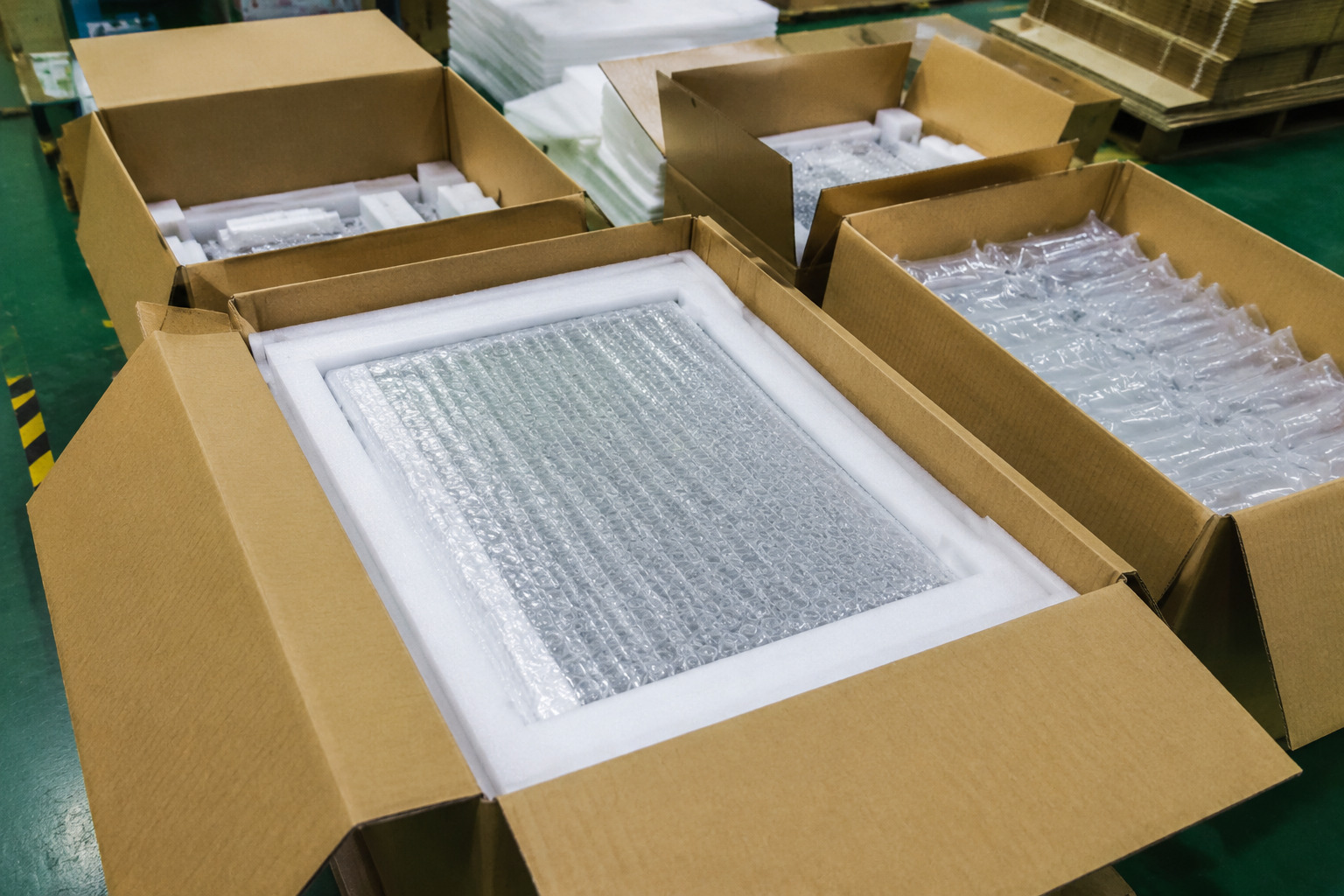
Inner packing is the first layer of long-distance transport protection. It handles the product before the outer carton can do its job. If the product moves freely inside the box, even a strong carton cannot prevent rubbing, corner impact, or damage caused by vibration. Good inner packing cushions the product, separates pieces, protects surfaces, fills empty space, and keeps the product positioned during handling.
Protective packaging materials serve different roles. EPE foam packaging is often used for cushioning, surface protection, pads, sheets, bags, corner pieces, and custom foam inserts. Bubble wrap is useful for flexible wrapping and light-to-medium cushioning around irregular shapes. Air cushion packaging can help fill void space and reduce movement in suitable carton designs. PE bags, liners, and surface protection film can help reduce dust, limited moisture exposure where appropriate, and scratch risk. Dividers and inserts help separate multiple items inside the same carton.
Many export packages work best when these materials are combined instead of selected one by one. A painted metal part may use a PE bag for dust and surface protection, EPE foam pads for separation, and a double-wall carton for stacking support. A light retail product may use bubble wrap for wrapping, air cushions for void filling, and a printed carton label for warehouse sorting. The buyer should check whether each layer has a clear job, because extra material without a clear function can add cost without improving protection.
The key is to match the material to the risk. A soft material may protect a smooth surface but fail to hold a heavy product in place. A strong insert may position a product well but still require a soft layer to reduce abrasion. A carton filled with loose void fill may pass a quick visual check but still allow heavy items to shift during vibration. For export packing, buyers should think about what the product needs inside the carton before discussing the outer box.
Material Selection Note: For export orders, material choice should follow product risk rather than habit or the lowest unit price. Daipak Packaging usually reviews product weight, fragile points, surface finish, carton fit, and shipping route before recommending foam, bubble wrap, film, air cushions, corrugated cartons, or a combined structure.
Choosing Cushioning Based on Fragility and Weight
Lightweight fragile products often need cushioning that absorbs shock without adding too much weight or bulk. Bubble wrap, foam sheets, air column bags, or a fitted carton system may be suitable depending on shape and value. Glass items, ceramic products, small electronics, and retail goods usually need both cushioning and separation because one damaged unit can also damage nearby units inside the same carton.
Dense industrial parts require a different approach. Their weight can compress soft materials quickly, especially during stacking or vibration. These products may need thicker foam pads, cut EPE foam inserts, corner protection, or a structure that locks the part in position. For metal parts, the risk may include impact damage, scratches, oil residue, or edge abrasion rather than classic breakage. The cushioning should support the weight without letting the product sink or slide.
Electronics often combine several risks. They may need cushioning for impact, surface protection for screens or housings, and separation for accessories, cables, or manuals. Retail products may need protection that also keeps the presentation clean when the carton is opened. For export packaging, cushioning should be judged by the product’s weak points, not only by whether the material feels soft.
Separating Products to Prevent Scratches and Impact
When multiple pieces are packed in one carton, separation becomes as important as cushioning. Products that touch during vibration can scratch, chip, dent, or transfer surface marks. This is common with painted metal parts, polished plastic housings, glass panels, furniture components, and retail goods with printed surfaces.
Buyers can use different methods depending on the product. Foam sheets or bubble wrap can create a soft barrier between pieces. PE bags can help protect against dust and light surface contact. Paper interleaving may work for some flat items, while corrugated dividers can separate rows or layers. Custom foam inserts are useful when products have fixed positions or fragile edges. The choice depends on product shape, packing quantity, scratch sensitivity, and packing speed.
Mixed SKUs need extra care. If different models, colors, or sizes are packed together, separation should support both protection and identification. Clear inner labels, separated compartments, or bagged sets can reduce warehouse confusion. Without this control, a carton may arrive physically intact but still create problems during receiving, sorting, or customer-side distribution.
Controlling Movement Inside the Carton
Many export packing problems start with movement inside the carton. Empty space allows the product to shift during vibration, drops, turns, or forklift movement. Once the product moves, it can hit carton walls, rub against other units, damage corners, or weaken the carton from the inside. Void filling is not only about making the box look full; it is about reducing movement in a way that matches the product weight and carton structure.
A snug carton fit can reduce material waste and improve protection, but the fit should not be so tight that the product presses directly against the carton wall. There should be enough room for the protective layer to work. For fragile products, a small clearance with proper cushioning is usually safer than direct contact. For heavy items, inserts or blocks may be needed to hold the product in place instead of relying only on loose fill.
Carton fit also affects stacking performance. If inner packing supports the carton evenly, the outer carton can better handle compression. If products are unevenly positioned or there are large unsupported gaps, the carton may deform under load. This is why inner packing, carton size, and packing quantity should be confirmed together rather than separately.
Outer Cartons: Matching Box Strength, Size, and Packing Quantity
Export cartons do more than cover the product. They carry the weight of the packed goods, protect the inner packing, support stacking, provide space for carton marks and labels, and fit into pallets, containers, or warehouse storage systems. Corrugated boxes for shipping should be selected after the product and inner packing are understood, not before.
The buyer should look at several connected details: carton size, carton weight, gross weight, board structure, flute choice, sealing method, quantity per carton, and expected stacking conditions. A carton that is too weak may collapse during storage or transport. A carton that is too large requires more void fill and may increase freight cost. A carton that is too heavy can slow warehouse handling or create safety concerns. A carton that is too small may compress the product or reduce the effectiveness of the inner protection.
Custom corrugated boxes can be useful when standard cartons create too much empty space or do not match the product shape. For repeated export orders, a consistent carton structure also helps stabilize packing labor, pallet layout, carton marks, and receiving records. The goal is not simply to choose the strongest possible box, but to choose a carton that matches the product risk, packing method, shipping route, and handling process.
For custom cartons, buyers should confirm the inside dimensions, outside dimensions, board structure, printing position, flap closure, and label area before production. A carton drawing or confirmed sample helps avoid small but costly misunderstandings, such as a box that fits the product but leaves no space for foam, or a printed mark that is correct but covered when cartons are palletized. If the carton will be used repeatedly, keeping the approved drawing and packing photos as a reference can make future orders easier to control.
Single-Wall and Double-Wall Cartons for Different Shipping Conditions
Single-wall cartons may be suitable for lighter products, shorter routes, courier parcels, or goods with strong inner packing and lower stacking pressure. They can reduce material cost and carton weight when the product does not require heavy compression support. For many light retail goods, garments, accessories, and lower-risk products, single-wall cartons can be practical if the carton size and gross weight are controlled.
Double-wall cartons are often considered when shipments involve heavier contents, longer storage, sea freight, pallet stacking, or higher compression risk. They can provide more structural support than single-wall cartons, but they also cost more and may add weight and thickness. For export shipments, the decision should be based on actual carton load, stacking height, inner packing support, and handling conditions rather than habit.
The carton structure should also match sealing requirements. A stronger carton with poor tape application or weak flap closure can still fail. Buyers should confirm sealing method, tape width or adhesive performance where relevant, carton orientation, and whether additional strapping is needed for heavy or high-value shipments.
Why Carton Size Affects Both Protection and Freight Cost
Carton size directly affects protection. Oversized cartons create empty space, and empty space allows movement unless enough void fill is used. More void fill adds cost, packing time, and sometimes inconsistent protection if workers do not apply it the same way each time. Oversized cartons are also more likely to deform because the product may not support the carton walls evenly.
Carton size also affects freight cost. Larger cartons take more warehouse space, reduce pallet efficiency, and may increase dimensional weight for air freight or courier shipments. For sea freight, poor carton sizing can reduce container loading efficiency. Even a small size difference can matter across hundreds or thousands of cartons in a bulk order.
Very small cartons have their own trade-offs. They may improve product fit and reduce movement, but they can increase packing labor, labeling work, carton handling, and warehouse receiving time. Buyers should compare carton size not only by material cost, but by how the carton fits the product, pallet, container, packing line, and destination warehouse process.
Confirming Carton Quantity and Gross Weight
Quantity per carton is one of the most practical export packing decisions. More units per carton may reduce carton count and labeling work, but it can increase gross weight and raise the risk of crushed cartons or unsafe manual handling. Fewer units per carton may protect products better and make handling easier, but it can increase carton cost, packing time, and warehouse receiving volume.
Buyers should confirm the number of units per carton together with inner packing thickness, carton dimensions, net weight, gross weight, and stacking requirements. If each unit needs foam, bubble wrap, a PE bag, or a divider, the final carton size may be larger than expected. If the product is heavy, the carton may reach a handling limit before it reaches an ideal packing quantity.
Destination warehouse requirements also matter. Some warehouses prefer cartons within certain weight ranges, clear carton marks, consistent quantities, and predictable dimensions for storage. If carton quantities vary without clear labels, receiving teams may need extra counting or repacking. For export packaging, a stable carton quantity helps connect production packing, documentation, palletizing, loading, and warehouse receiving into one controlled process.
Carton Marks and Product Labels That Keep Shipments Identifiable
Labeling is not decoration. For export shipments, carton marks and product labels are part of the control system that keeps goods moving through production, packing, warehouse receiving, and final distribution without confusion. A clear marking setup helps the buyer know what is inside each carton, where it should go, and how it should be handled. When labels are missing or unclear, the problem is rarely cosmetic. It usually shows up later as delayed receiving, mixed cartons, inventory mismatches, or repacking work at the destination.
The practical goal is simple: each carton should tell a warehouse team enough to identify it quickly, scan it if required, and place it in the right location. That is why carton marks, shipping marks, SKU labels, barcode labels, handling labels, pallet labels, and product labels each serve a different job. They may all sit on the same shipment, but they are not interchangeable.
For overseas buyers, the marking format also needs to fit the receiving process on their side. A distributor may want fast SKU identification. A warehouse may want scan-ready barcodes and carton numbers. A retail buyer may need product descriptions and quantity notes. Export carton marks should support the actual working process, not just look neat on paper.
Product Labels, Carton Marks, and Shipping Marks Are Not the Same
Product labels identify the item itself. They are usually used on the product, inner bag, insert card, or inner package so workers can recognize the SKU, size, style, color, or other item-level information during packing and receiving. If a shipment includes several variants, product labels help reduce mix-ups before the cartons are sealed.
Carton marks sit at the outer box level. They usually show the item number, product name, quantity, carton number, gross or net weight if needed, dimensions, and any handling notes. These marks help receiving teams sort cartons, check counts, and match the physical shipment to the paperwork. If cartons are mixed, damaged, or split across pallets, the carton mark becomes the quickest reference point.
Shipping marks are more focused on logistics identification. They may include destination, consignee reference, purchase order number, shipment number, or other buyer-specific details. In many export projects, shipping marks need to be readable from a distance and consistent across every carton in the same lot. That consistency matters when cartons are stacked, wrapped, or moved several times before final delivery.
Barcode labels and SKU labels add another layer of control. They are useful when the buyer’s warehouse scans items into inventory, sorts by route, or checks receiving against a system record. Handling labels, such as “this side up,” “fragile,” or “keep dry,” are not there for decoration either. They support safer movement and help reduce careless stacking or wrong orientation during warehouse work.
Information Buyers Should Confirm Before Label Printing
Before printing starts, buyers should confirm the exact data that needs to appear on each label type. That includes the item number, SKU, product name, carton quantity, carton number sequence, purchase order number, destination, gross weight, net weight if required, carton dimensions, and any handling symbols. Even a small mismatch, such as a wrong SKU code or carton count, can create receiving delays later.
If barcode labels are required, the buyer should send the barcode format, readable code content, and any scan placement requirements. Some buyers need the barcode on one side only. Others want it on more than one face of the carton for faster scanning after pallet wrapping. If the buyer already uses a label template, that artwork should be shared early so the supplier can match the format instead of guessing.
Artwork files matter just as much as the text. Buyers should provide the logo files, label dimensions, font preferences if any, and placement instructions for each box type. If the shipment has multiple SKUs or mixed cartons, the supplier should also know how the labels change by item, color, or set quantity. Clear instructions prevent wrong label use when packing work becomes repetitive.
For export projects, label confirmation should happen before production or final packing begins. That gives the supplier time to check placement, print legibility, and carton compatibility. At Daipak Packaging, the most useful label discussions usually start with the buyer’s packaging method and receiving flow, not with the label art alone.
Where Label Placement Can Affect Warehouse Handling
Label placement affects how fast cartons can be identified, scanned, and sorted. A label placed too low may be hidden by pallet wrap. A label placed on the wrong face may be blocked by stacking. If a carton has more than one label, the layout should still make it obvious which side is the main scan side and which markings are only secondary information.
Warehouse teams also need labels that remain visible after palletizing. If the pallet is fully wrapped and the barcode ends up under the film, workers may need to unwrap cartons or rotate pallets just to receive them. That creates wasted time and increases the chance of errors. In busy receiving areas, label visibility is part of operating speed.
Carton stacking also changes placement decisions. A mark that is easy to read on a loose carton may disappear once another carton is placed on top. For that reason, buyers often need to tell the supplier whether cartons will ship loose, on pallets, or inside mixed loads. The label layout should fit the real handling method, not a generic carton picture.
If the destination warehouse uses a specific scan direction, the label should be placed consistently across the shipment. The same applies to cartons that will be wrapped and moved by forklift. When one carton face is expected to remain visible, that face should carry the most important shipment marks. This small detail often saves more time at receiving than a larger label ever could.
Palletizing: Preparing Cartons for Forklift Handling and Warehouse Storage
Palletizing for export shipping is about stability, handling safety, and warehouse efficiency. A well-built pallet load helps cartons withstand forklift movement, short-term storage, and container loading with less shifting or crushing. A poor pallet load, on the other hand, can become unstable before it even leaves the warehouse. Once a pallet starts leaning or spreading, the risk of collapsed cartons and forklift damage rises quickly.
The first decisions are practical: pallet size, carton stacking pattern, load height, and weight distribution. Cartons should sit squarely on the pallet surface, with enough support under the edges to avoid sagging. Heavy cartons belong lower in the stack, especially when the cartons carry compressible contents or have weaker top panels. If the stack is too tall for the carton strength or the warehouse handling path, the load becomes harder to move and easier to damage.
Stretch film, corner protectors, strapping, and pallet labels all help the pallet work as a unit. The goal is not to wrap the load until it cannot breathe; the goal is to keep cartons together so they do not slide, tip, or separate during movement. A pallet that looks tight from one side may still be loose at the corners if the wrap is not applied evenly or if the load has uneven edges.
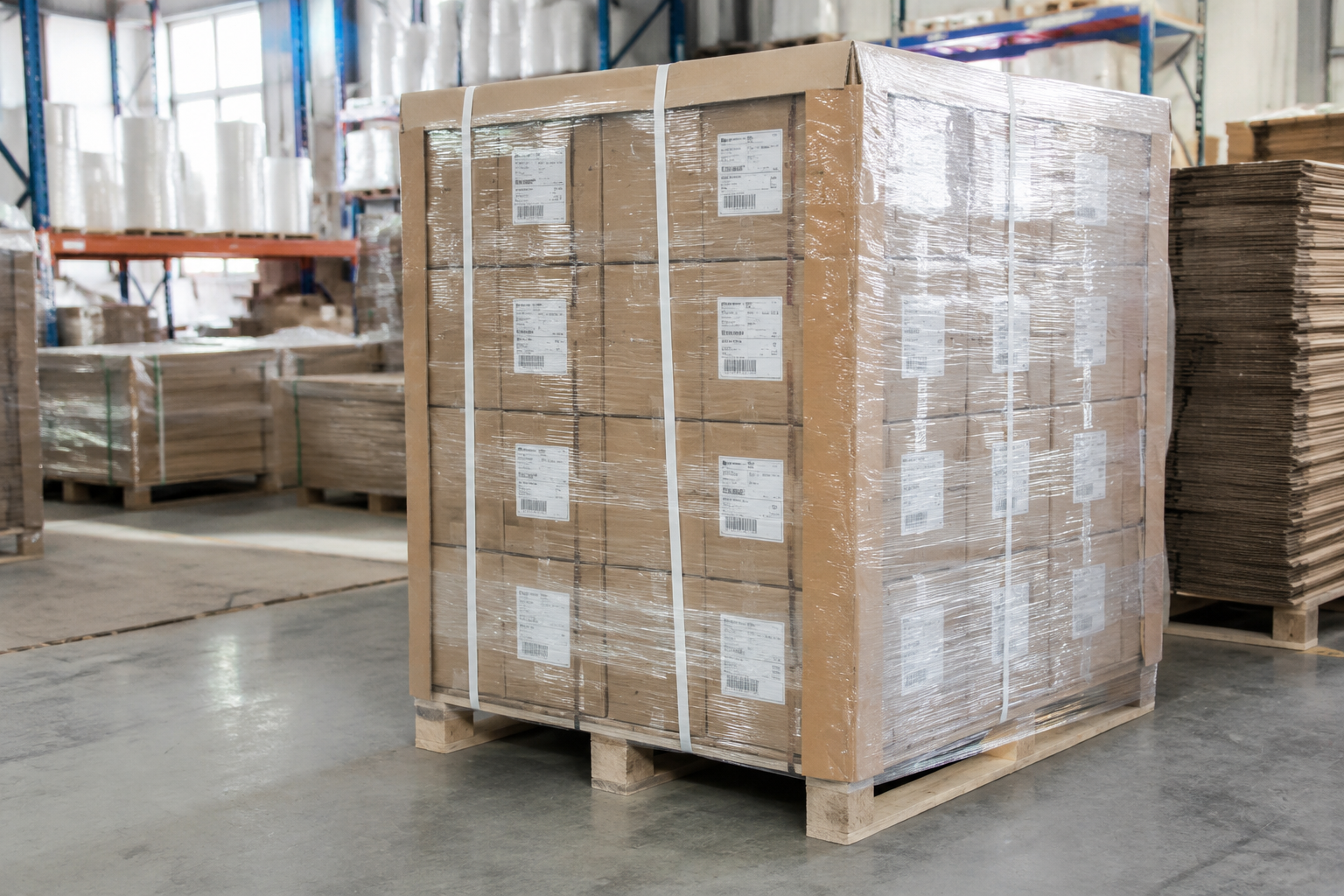
Because export shipments vary, pallet requirements also vary. Some buyers need a specific pallet size to fit racking or warehouse lanes. Others care more about height limits, freight efficiency, or container space. In some cases, loose cartons are acceptable and palletizing is not needed. In other cases, the buyer’s warehouse process makes pallet packing the safer and faster choice. The right answer depends on the route and the receiving method, not on one fixed rule.
Stacking Patterns That Reduce Carton Collapse and Movement
Stacking pattern matters because cartons do not all carry the same level of compression resistance. When the cartons are strong and the content is stable, aligned stacking usually gives cleaner vertical support. It keeps edges lined up and helps the weight travel straight down through the load. That is useful when the cartons will be stored, stacked, or transported for a long distance.
Interlocking patterns can help in some cases, especially when the pallet needs better lateral stability. But interlocking is not automatically better. If the cartons are soft, weak, or sensitive to compression, a pattern that shifts carton edges away from direct support can create more risk instead of less. The buyer should think about both side-to-side stability and top-to-bottom load transfer.
Weight distribution should also stay even across the pallet face. A pallet that is heavy on one side can lean during forklift movement or tilt when the truck brakes. Edge support matters too. Cartons placed too close to the pallet edge may get caught, crushed, or torn during handling. A clean, square load is easier to move and less likely to deform.
For cartons with mixed weight levels, the safest method is usually to place the densest cartons at the bottom and build upward with lighter cartons. That keeps the center of gravity lower and reduces the chance of collapse. When the product or box structure is unusual, the supplier and buyer should review a sample load before the full shipment is packed.
Stretch Film, Corner Protection, and Strapping Decisions
Stretch film helps hold the load together and keeps cartons from shifting during short moves inside the warehouse or during loading. It is especially useful when cartons do not fit tightly enough to lock into place on their own. The film should support the stack, not crush it. Too little wrap leaves the pallet loose; too much tension can distort the cartons or make them difficult to separate later.
Corner protectors are useful when the load needs extra edge support. They help the wrap or strap pressure spread more evenly across the carton corners, which can reduce local crushing. This matters when the cartons are tall, the load is heavy, or the boxes need to stay neat for warehouse storage. Corner support is often a small addition that can reduce a larger handling problem later.
Strapping may be useful when the shipment is heavy, the load is tall, or the buyer wants additional restraint. It is not always required, and it should not be added just for appearance. The question is whether the pallet will benefit from extra mechanical hold during movement or container loading. If strapping is used, the carton strength and pallet structure need to be considered together so the strap does not create pressure damage.
Clear pallet labels should remain visible after wrapping. That means the label position should be planned before the film goes on. If the receiver cannot identify the pallet, the load may need to be opened or rechecked, which slows the receiving process. In export handling, the easiest pallet is the one that can be recognized quickly and moved without second guessing.
Confirming Pallet Requirements with the Buyer or Forwarder
Before pallet packing starts, the supplier should confirm the pallet size, preferred load height, maximum weight if any, and whether the destination warehouse uses a specific pallet layout. Some buyers care about rack compatibility, while others focus on container loading efficiency. Those details can change how cartons are stacked and how much wrap or reinforcement is needed.
The loading method also matters. If cartons will be stored first, the pallet may need to be sturdier and more stable. If the goods will move quickly into a container, the load may prioritize tightness and easy handling. If a buyer wants pallet labels in a certain position, that should be stated early so the label does not get hidden by wrap or corner protection.
When the forwarder is involved, the pallet details should be shared clearly so the pickup process does not stall. A mismatch in pallet height, pallet count, or load arrangement can lead to rework at the warehouse door. The more the supplier understands the destination handling method, the less guesswork there is in final packing.
Wood Pallet Compliance for International Export Routes
When export packing uses wood pallets, crates, or other wood packaging material, buyers should confirm destination requirements before shipment rather than assuming any pallet is acceptable. IPPC ISPM 15 is the international phytosanitary standard for wood packaging material used in international trade, and USDA APHIS also provides guidance on wood packaging material for import and export compliance.[5] [6] This point is separate from carton strength: a pallet can be physically strong but still create a compliance problem if wood packaging rules are not handled correctly.
For practical purchasing, the buyer should tell the supplier whether fumigated, heat-treated, stamped, or non-wood pallet options are required by the destination market or forwarder. If the shipment uses plywood, molded pallets, plastic pallets, or paper pallets instead of solid wood, the buyer should still confirm the rule with the forwarder because requirements can depend on the actual material, route, and receiving country. Keeping pallet photos and treatment marks in the shipment record can also help if the forwarder or destination warehouse asks for clarification.
Loading Preparation: From Packed Cartons to Container or Truck Dispatch
Export delivery preparation does not end when the cartons are sealed. The last stage is checking whether the packed goods, carton marks, pallet condition, and paperwork all match the shipment plan before the truck or container leaves. This is the point where small packing mistakes become logistics problems. A missing carton, a wrong label, or an unclear packing list can turn into a delay that is much harder to correct after dispatch.
Good loading preparation starts with the physical goods, not the paperwork alone. The supplier should confirm the carton count, carton condition, mark consistency, pallet readiness, and loading sequence. Then the records should be matched against the packing list and shipment instructions. If mixed orders are involved, each SKU and carton group should be checked carefully before loading begins.
The loading stage is also where communication matters. The warehouse team, the forwarder, and the buyer should all know the expected pickup time, warehouse address, contact details, and any special handling notes. If the load contains fragile cartons, heavy cartons, or palletized goods with a specific stacking direction, that information should be passed on before the truck arrives, not after.
Before dispatch, buyers should ask for confirmation that the packed shipment matches the agreed packaging specification, not only the order quantity. Useful checks include whether the same carton type was used across the batch, whether carton marks follow the approved sequence, whether labels remain visible after wrapping, whether pallets are stable, and whether any damaged cartons were replaced before loading. These small confirmations are especially valuable for export buyers who cannot inspect the warehouse in person.
Export Packing Note: Before export dispatch, packaging should be reviewed against the destination, carton space, handling method, label visibility, pallet condition, and shipment details. This kind of factory-side confirmation helps buyers reduce avoidable receiving questions without relying on broad promises.

From a factory-side perspective, the most useful loading preparation is the one that leaves fewer open questions. When carton count, marks, pallet condition, and pickup details are all confirmed in advance, the dispatch process becomes smoother and the chance of shipment confusion drops. That is especially important for overseas buyers who rely on accurate packed goods to support receiving and distribution on arrival.
Checking Carton Quantity Against the Packing List
Carton count should be matched to the packing list before loading starts. That sounds basic, but it is one of the most common points where a shipment can go wrong. The warehouse should confirm how many cartons belong to each SKU, how many units are in each carton, and whether the total carton count matches the order record. If the count is off, the issue should be found before the truck departs.
Gross weight and carton dimensions also need to match the actual shipment. Even when the product itself is correct, a mismatch in weight or size can affect loading plans, freight records, and warehouse receiving. When cartons are large, mixed, or palletized, these physical details become even more important because they affect container space and handling.
If the shipment includes more than one item, the carton count should be checked by item and by pallet where relevant. That helps prevent mixed cartons from being loaded in the wrong sequence. A clean count process is not just about paperwork accuracy. It is about making sure the right goods move out under the right shipment reference.
Preparing Loading Photos and Shipment Records
Loading photos are useful because they give the buyer a simple record of what was packed and how it was arranged. Good photo records usually show the cartons, the pallet labels, the wrapped load, the container or truck loading sequence, and the final sealed condition where applicable. These images help the buyer verify that the goods seen in the warehouse match the shipment that left the factory.
Photos can also help when there is a later question about carton marks, pallet wrapping, or loading sequence. If the shipment includes mixed SKUs, photo records make it easier to check whether the cartons were loaded in the expected order. That reduces confusion when the buyer receives goods in stages or through different warehouse lanes.
Records do not need to be complicated to be useful. A few clear images, combined with carton count notes and packing details, often give the buyer enough confidence to confirm dispatch. When the goods are high value or the shipment has special handling instructions, the records become even more important as a practical reference.
Coordinating Pickup Details with the Forwarder
Pickup coordination should cover timing, address, contact person, loading method, and any special handling notes. If the forwarder arrives before the cartons are ready, the loading plan can slip. If the warehouse address or contact details are wrong, the truck may lose time before it can even begin loading. Clear coordination saves more trouble than hurried problem-solving at the dock.
The loading method should also be clear. Some shipments move as loose cartons, while others are palletized and require forklift handling. If the forwarder expects one method and the warehouse prepares another, the process slows down immediately. Special notes such as fragile cartons, stacked pallets, or blocked access should be shared early so the pickup team can come prepared.
For export orders, the best handoff is the one where the supplier, forwarder, and buyer all understand the same shipment picture. At Daipak Packaging, that usually means treating packaging, labels, pallet handling, and dispatch details as one connected workflow rather than separate tasks. When those details are aligned, the goods leave the warehouse with fewer surprises and fewer chances for a loading mistake.
Quality Control Points Before Bulk Export Packaging Leaves the Factory
Packaging quality control should happen before bulk goods leave the factory, not after cartons arrive at the buyer’s warehouse. By that point, a wrong size, poor sealing, incorrect marks, or damaged cartons may already have created freight delays, receiving problems, or repacking work. For export packaging, the main question is not only whether the materials look acceptable. The shipment needs to match the confirmed packaging specification closely enough to perform during handling, stacking, storage, and final receiving.
A practical export packaging inspection usually compares the actual packed goods against the approved details: material type, thickness or structure, carton dimensions, printing content, label placement, packing quantity, sealing method, pallet condition, and shipment marks. Small errors can be expensive in long-distance shipping. A carton mark printed on the wrong side may slow warehouse receiving. A carton that is slightly oversized may change pallet fit. A weak or poorly sealed box can fail under stacking pressure. A missing SKU label can turn a clean shipment into an inventory problem.
Specification Checks for Materials, Cartons, and Labels
The first quality control point is the packaging material itself. For EPE foam, bubble wrap, air cushion packaging, plastic film, or corrugated cartons, buyers should confirm the agreed size, thickness, structure, and quantity before bulk shipment. If a foam insert is too loose, the product may move inside the carton. If bubble wrap sheets are cut too small, corners may remain exposed. If a plastic liner bag is undersized, packing workers may stretch or tear it during use. These are not cosmetic issues; they affect how the package performs during export handling.
Carton inspection should also include dimensions, board structure, print content, and general forming quality. A custom corrugated box needs to fit the inner packing, close properly, stack squarely, and leave enough flat space for labels or carton marks. Buyers should check whether the carton size matches the confirmed drawing or sample, whether printed information is clear, and whether the carton structure is suitable for the packed weight. A box that looks fine when empty may behave differently after it is filled, stacked, wrapped, and moved by forklift.
Label checks deserve the same attention as material checks. Product labels, carton marks, barcode labels, and handling labels should match the buyer’s file or instruction. The item number, SKU, purchase order number, quantity, gross and net weight, carton number, destination, and barcode format should be reviewed before dispatch where these details are required. A label error does not always damage the product, but it can damage the shipment flow by causing mixed cartons, wrong receiving counts, or extra warehouse sorting.
Finished Packing Checks Before Dispatch
Finished packing checks look at the shipment as it will actually leave the factory or warehouse. Cartons should be sealed firmly, with tape or other closure methods applied consistently. Carton marks should be visible and aligned with the buyer’s instruction. The packed quantity should match the packing list, and visible carton damage should be separated and reviewed before loading. If cartons are crushed, wet, torn, poorly taped, or incorrectly marked before shipment begins, the risk only increases after port handling, container loading, or warehouse transfer.
For palletized shipments, the pallet condition also needs review. Cartons should be stacked with reasonable alignment, without overhang that exposes corners to impact. Stretch film should hold the load firmly without hiding important pallet labels. Corner protectors or strapping may be useful for heavier loads, tall pallets, or routes with more handling points, depending on the product and buyer requirements. The goal is not to add unnecessary material, but to make sure the finished pallet can be identified, moved, and stored without shifting easily.
Count confirmation is one of the simplest checks, but it prevents many shipment problems. The team should compare the physical carton count, SKU count, pallet count, carton numbers, and packing list before dispatch. If a shipment includes multiple SKUs or split purchase orders, the check should be especially careful. A missing carton or mixed order may not be discovered until the buyer’s warehouse opens the shipment, which is much harder to correct than catching it before loading.
A useful quality review record does not need to be complicated, but it should be specific enough to support repeat orders. Photos of carton marks, sealed cartons, label positions, pallet wrapping, and packed quantities can be kept with the approved specification so that the next order has a clear reference instead of relying only on memory or chat history.
Keeping Packing Records for Shipment Review
Finished packing is easier to control when the factory keeps a simple record of what was approved and what was actually loaded. Packing photos, pallet photos, label photos, and loading photos help the buyer see whether the carton marks, sealing, wrapping, and quantity matched the confirmed requirement. The goal is practical comparison, not a formal system; even a small set of clear images can help the next order start from a better reference point.
If the buyer later reports crushed corners, missing labels, or loose products, these records make it easier to identify whether the issue came from carton strength, inner packing, palletizing, or loading. That feedback can then be linked back to the sample or drawing review, which helps the supplier adjust the next production batch with less guesswork.
Why Sample Approval Should Happen Before Bulk Packing
Sample approval gives both buyer and supplier a shared reference before bulk packing begins. A sample can confirm whether the foam thickness, bubble wrap size, carton structure, label format, print position, and packing method are practical. It also helps identify details that drawings alone may not show, such as whether the product is easy to insert, whether the carton closes cleanly, or whether a label remains visible after wrapping.
Without sample confirmation, misunderstandings can move directly into bulk production. A buyer may expect a snug foam insert, while the supplier prepares a looser pad. A carton may be approved by outer dimensions but not checked with the real inner packing. A printed mark may be technically correct but placed where pallet wrapping or stacking makes it hard to read. These issues are usually easier to adjust at sample stage than after many cartons or protective pieces have been produced.
From the factory side, the technical review should focus on whether the confirmed size, cutting, sealing, bonding, or printing detail can be repeated consistently during batch production. That repeatability matters for export packaging because one correct sample is not enough. The bulk order must keep the same packing logic across cartons, pallets, and shipment records.
Cost Control in Export Packaging Means More Than a Lower Carton Price
Export packaging cost should be evaluated as part of the total shipment cost, not only as the unit price of a carton, foam sheet, bubble bag, or stretch film roll. A low unit price can become expensive if the carton is oversized, the product needs repacking, the pallet becomes unstable, or damaged goods create replacement and customer service costs. Packaging cost control means choosing a structure that protects the product, fits the logistics route, supports warehouse handling, and can be repeated consistently in future orders.
The right balance depends on the product. A high-value fragile item may justify custom foam inserts or air column protection because breakage is costly. A durable garment shipment may need clean inner bags, carton fit, and moisture-aware storage handling more than thick cushioning. Heavy industrial parts may need stronger cartons, corner protection, and stable positioning rather than soft loose fill. In each case, the buyer should compare material cost against freight volume, packing labor, damage risk, pallet efficiency, and receiving accuracy.
Buyers should also separate material price from total packing cost. A cheaper foam sheet that needs extra layers, more worker time, or a larger carton may not be cheaper in the final shipment. A custom-cut insert may cost more per piece but reduce movement, speed up packing, and make carton quantities more consistent for repeat orders. The useful comparison is the cost of getting sellable goods into the buyer’s warehouse, not the lowest price of one packaging component.
Where Low Unit Price Can Create Higher Total Cost
A cheaper carton may reduce the purchase price but increase the risk of crushed cartons during stacking. If cartons collapse, the cost may include damaged goods, repacking labor, delayed receiving, customer complaints, and extra communication between buyer, supplier, warehouse, and forwarder. The visible material price is only one part of the decision.
Oversized packaging creates another hidden cost. A carton with too much empty space needs more void fill, takes longer to pack, uses more pallet space, and may increase freight volume. For air freight and courier shipments, dimensional weight can make empty space especially expensive. For sea freight, poor carton size can reduce pallet and container efficiency, leaving buyers to pay for space that does not carry product value.
Under-packing can also create costs that do not appear in the initial quote. If products rub against each other, polished surfaces may scratch. If heavy parts move inside the carton, they may break dividers or damage the outer box. If labels are unclear, the warehouse may spend extra time identifying cartons. These problems often show up after arrival, when correction is slower and more expensive.
Balancing Material Strength with Packing Efficiency
Good export packaging is not always the thickest, heaviest, or most expensive option. Over-packing can raise material use, slow down packing, increase carton size, and make warehouse disposal more difficult. Under-packing can lead to damage, unstable pallets, and repacking. The practical goal is to use enough protection in the right location: cushioning where shock risk is high, surface protection where scratches matter, separation where products touch, and carton strength where stacking pressure is expected.
Carton size optimization is one of the most useful cost-control steps. A better-fit carton can reduce void fill, improve pallet layout, and make loading more predictable. If the carton is too tight, however, products may press against the walls with no cushioning space. If it is too loose, the inner packing must work harder to stop movement. Buyers should review product dimensions, inner protection thickness, quantity per carton, gross weight, and pallet pattern together instead of approving each item separately.
Packing efficiency also affects labor. A complicated insert may protect well, but if workers need too much time to fold, position, or tape it, the total cost may rise. A simple foam pad or bubble wrap method may be better for lower-risk items, while a custom insert may be worthwhile for fragile or high-value goods. The best choice depends on the product risk, order quantity, packing speed, and shipping route.
Environmental and Recyclability Claims Need Careful Wording
When buyers request recyclable, compostable, biodegradable, or “eco-friendly” export packaging, the claim should be checked against the actual material, coating, label, ink, adhesive, destination recycling system, and disposal route. The FTC Green Guides are a useful reference for avoiding overbroad environmental marketing claims in the U.S. context, especially when a claim depends on consumer access to recycling or composting facilities.[7] A safer purchasing instruction is to ask for the exact material structure and intended recovery route rather than approving a vague green label.
Paper-based and corrugated export cartons often have a strong recovery story, but that does not automatically make every finished package recyclable in every market. Corrugated packaging recyclability should be assessed with the actual package construction, contamination risk, coatings, tapes, labels, and local recovery system in mind.[8] For plastic packaging, design-for-recycling guidance from APR or RecyClass can help buyers review whether color, labels, adhesives, closures, and material combinations support recycling rather than interfere with it.[9] [10]
If a buyer wants compostable packaging, the request should identify whether it applies to a plastic item, a coated paper structure, or a full packaging system. ASTM D6400 covers plastics designed to be aerobically composted in municipal or industrial facilities, while ASTM D6868 addresses biodegradable plastic coatings on paper and other compostable substrates.[11] [12] These references do not replace destination-market confirmation, but they help buyers ask more precise questions before using compostability claims on export packaging.
Documenting Claims Before Printing or Sales Use
Any claim printed on packaging, carton marks, inserts, or product labels should be supported before production begins. Words such as recyclable, compostable, biodegradable, food-contact, moisture barrier, anti-static, heavy-duty, or suitable for hazardous goods can create expectations that depend on material data, testing, destination-market rules, and the exact end use. If the buyer wants to use these terms, the claim should be reviewed with the relevant documentation before artwork is released.
A practical approach is to separate packaging function from marketing language. For example, a foam insert may be described as cushioning or product-positioning support, while a stronger statement about drop performance should be tied to a defined test method and package design. A corrugated carton may be selected for warehouse handling and stacking support, while broad environmental claims should be checked against the actual package and recovery system. This keeps the article, quotation, artwork, and packing specification aligned with what the packaging is expected to do.
Using Repeat Specifications to Stabilize Future Orders
Repeat specifications help buyers control cost over time. Once a carton size, inner packing method, label format, carton mark layout, and pallet requirement have been confirmed, future bulk packaging orders can move with fewer questions and fewer changes. This does not mean the first design can never improve, but it gives both buyer and supplier a stable starting point.
Consistent specifications also support warehouse planning. If carton dimensions and gross weights stay stable, the buyer can plan pallet storage, receiving workflow, barcode scanning, and container loading more accurately. If carton marks and labels stay consistent, warehouse teams spend less time checking mixed formats. If the packing method is repeated, damage feedback can be linked to a real structure instead of a changing set of materials.
For procurement teams, repeat-order consistency makes quote comparison more meaningful. Comparing two offers is difficult if one quote uses a different carton size, another changes the inner foam thickness, and a third does not include labels or pallet wrapping. A clear packaging specification helps buyers compare total value, not just the lowest visible line item.
Working with a China Packaging Materials Supplier on Export Packing Requirements
Working with a China packaging materials supplier is easier when the discussion starts with the product and shipment conditions, not only the material name. A buyer may ask for a corrugated box, bubble wrap, EPE foam, plastic bag, or air cushion packaging, but the supplier still needs to understand what the package must do. The same product may require different protection for courier delivery, palletized sea freight, warehouse storage, or retail distribution.
Daipak Packaging works as a protective packaging manufacturer for overseas B2B buyers that need practical support across foam, bubble, film, corrugated boxes, and custom protective packaging. The useful conversation is not “which material is cheapest,” but “which packaging structure fits the product, packing method, shipping route, label needs, and destination handling.” Clear information helps the supplier recommend a realistic option instead of guessing from a short product name.
Information Buyers Should Send with a Quote Request
A strong quote request should include enough detail for the supplier to understand both the product and the export packing requirement. Product photos or drawings are helpful because shape, corners, surface finish, and fragile parts are not always clear from dimensions alone. The supplier should also know the product size, weight, quantity per carton, total order quantity, current packing method, and any known damage or warehouse handling issues.
Buyers should also send the shipping method and destination where available. Sea freight, air freight, courier delivery, consolidated cargo, and palletized warehouse shipments can create different packaging decisions. Carton requirements, carton marks, barcode labels, product labels, pallet size, pallet height limits, and destination warehouse notes should be shared early. If the buyer has label files, printed artwork, or packing instructions, those details should be included before sampling or production planning.
A practical quote request may include the following details:
- Product photos, drawings, dimensions, weight, and fragile points.
- Surface protection needs, such as scratch-sensitive coating, polished finish, or painted parts.
- Preferred or current packing method, including inner protection and carton quantity.
- Shipping route, destination, warehouse handling notes, and pallet requirements.
- Carton mark instructions, label files, barcode rules, and placement requirements.
- Target order quantity, repeat-order expectations, and any packing cost concerns.
- Any special documentation or claim review needs, such as food contact, hazardous transport, ESD control, moisture control, or environmental wording.
For export orders, the supplier should pay attention to carton marks, packing quantity, destination details, and delivery preparation early in the discussion. These points affect not only the quote, but also sample planning, packing instructions, and shipment readiness.
How Sample Confirmation Reduces Bulk Order Risk
Sample confirmation helps the buyer check whether the proposed packaging works in real handling, not only on paper. A sample can show whether an EPE foam insert holds the product securely, whether bubble wrap coverage is enough, whether an air column bag fits the carton, whether a plastic bag seals properly, and whether the carton closes cleanly after inner packing is added.
Printed and labeled packaging should also be sampled where practical. Buyers can review carton marks, label size, barcode position, print clarity, and handling symbols before bulk production. This is especially useful for shipments with multiple SKUs, retail distribution, warehouse scanning, or buyer-specific carton templates. If a label is too small, placed on the wrong panel, or covered by stretch film later, the issue should be corrected before the full order is packed.
Sample review should include how the packaging is assembled by workers. A design that looks protective may be too slow or confusing for bulk packing. If workers need to fold several parts in a specific sequence, the supplier and buyer should confirm that the instruction is clear. For repeat orders, the sample becomes a reference for material, size, structure, printing, labels, and packing method.
Why Direct Factory Communication Helps Export Packaging Projects
Direct factory communication helps reduce misunderstanding because packaging details often affect each other. Changing foam thickness may change carton size. Changing carton quantity may change gross weight and pallet height. Moving a label may improve warehouse scanning but conflict with printed carton marks. These are practical production and packing questions, not only purchasing questions.
A packaging materials manufacturer can also help buyers compare options across materials. EPE foam may be better for shaped support and surface separation. Bubble wrap may be more flexible for wrapping mixed items. Air cushion packaging may reduce weight for selected void fill needs. Plastic film and bags may support dust protection, grouping, or pallet wrapping. Corrugated boxes provide the outer structure for handling and stacking. Many export shipments need a combination rather than one material alone.
Clear communication is especially important for repeat orders. Once the buyer and supplier confirm the packaging specification, future orders can follow the same carton size, label format, packing method, and pallet instruction unless arrival feedback shows a need for adjustment. This makes the process more stable for procurement, production, warehouse receiving, and shipment preparation.
Delivery Follow-Up and Repeat-Order Improvement After the Shipment Arrives
Export packaging improvement does not stop when the shipment leaves China. The arrival condition gives buyers and suppliers the most practical evidence of whether the packaging system worked as expected. A first shipment may show that the carton strength was suitable, the inner packing held products in place, and the labels were easy to scan. It may also show crushed cartons, loose products, unreadable labels, unstable pallets, or extra repacking work at the destination warehouse.
This feedback is especially useful for repeat packaging orders. Instead of treating every order as a new project, buyers can use arrival photos, warehouse feedback, and damage records to refine the confirmed packing method. The goal is not to promise that every handling risk can be removed. The goal is to make each repeat order more predictable, easier to receive, and better matched to the real shipping and warehouse conditions.
Good delivery follow-up should be specific. A comment such as “some cartons were damaged” is less useful than photos showing which carton faces were crushed, whether the damage happened near pallet corners, whether labels were covered by stretch film, or whether products moved inside the box. Details like these help the supplier decide whether the next packaging adjustment should focus on carton strength, inner cushioning, void filling, pallet wrapping, label placement, or carton quantity.
What Buyers Should Check When Goods Arrive
The receiving team should inspect the shipment before cartons are opened and again after products are unpacked. The outer condition tells one part of the story; the product condition tells the rest. A carton can look acceptable but still allow product rubbing inside, especially with polished, painted, coated, or precision-finished goods. On the other hand, a carton may show minor scuffing from normal transport while the inner protection has done its job well.
Useful arrival checks include carton condition, product protection, label readability, pallet stability, and count accuracy. Buyers should look for crushed corners, split seams, weak tape areas, moisture exposure, collapsed stacks, shifted cartons, torn stretch film, and unclear carton marks. If the shipment arrives on pallets, the team should also check whether the pallet remained square, whether cartons overhung the pallet edge, and whether forklift handling caused damage to lower cartons.
Warehouse feedback is important because receiving teams see problems that may not appear in office documents. They know whether barcode labels scan from the normal receiving position, whether carton numbers are easy to find, whether mixed SKUs caused sorting delays, and whether cartons were too heavy for safe manual handling. If repacking was needed before storage or distribution, that should be recorded as part of the packaging review, not treated as a separate warehouse inconvenience.
For product-level checking, buyers should note whether damage is related to impact, vibration, compression, abrasion, or movement inside the carton. Broken edges, scratched surfaces, dented parts, cracked retail boxes, or loosened accessories each point to a different packaging issue. Clear photos of the product in its original inner packing are often more useful than photos taken after everything has already been unpacked and mixed on a receiving table.
How Feedback Improves the Next Packaging Order
Good damage feedback turns a general complaint into a practical packaging adjustment. If cartons arrived crushed at the bottom of the pallet, the next order may need stronger outer cartons, lower stacking height, better weight distribution, or revised pallet preparation. If products were intact but labels were hard to scan, the answer may be clearer label placement rather than a change in cushioning. If products rubbed against each other, the next order may need foam sheets, bubble wrap separation, PE bags, dividers, or a tighter internal layout.
Some adjustments are small but valuable. A carton mark can be moved to a more visible panel. A label can be printed larger or placed outside the stretch film area. The number of units per carton can be reduced if the gross weight is difficult for warehouse teams to handle. A carton size can be revised to reduce empty space and limit the need for excess void fill. For fragile or high-value products, custom foam inserts or more stable product positioning may be worth reviewing before the next bulk order.
Repeat packaging orders also benefit from locking in the details that worked well. If the carton size, inner packing thickness, label format, pallet pattern, and packing quantity performed properly, those specifications should be kept consistent and shared clearly with the supplier. This reduces the chance of unnecessary changes between orders and helps the buyer’s warehouse receive future shipments with fewer surprises.
After-shipment feedback should become part of the order record, especially when buyers plan regular repeat orders. Arrival photos, warehouse notes, and any revised packing instructions can be connected to the next sample, quotation, or production discussion so the supplier does not rely on memory or informal messages alone.
The most useful export packaging systems are repeatable. Planning, sampling, packing, inspection, delivery follow-up, and packaging adjustment should form one continuous loop. Over time, that loop helps buyers control damage risk, reduce receiving problems, improve carton performance, and keep future export shipments easier to manage.
References
[1] ASTM International, “ASTM D4169 Standard Practice for Performance Testing of Shipping Containers and Systems,” standard practice reference for distribution-cycle style packaged-product testing discussions, available at ASTM D4169 Shipping Container Performance Testing.
[2] ASTM International, “ASTM D4728 Standard Test Method for Random Vibration Testing of Shipping Containers,” test reference supporting discussion of vibration-related movement and transit packaging validation, available at ASTM D4728 Random Vibration Testing.
[3] ASTM International, “ASTM D642 Standard Test Method for Determining Compressive Resistance of Shipping Containers,” compression resistance reference for stacked carton and container strength discussions, available at ASTM D642 Compression Resistance.
[4] International Safe Transit Association, “ISTA Procedure 3A Overview,” packaged-product test overview for parcel delivery systems and small package shipping contexts, available at ISTA Procedure 3A Overview.
[5] International Plant Protection Convention, “ISPM 15 Regulation of Wood Packaging Material in International Trade,” international phytosanitary standard reference for wood packaging material used in cross-border trade, available at IPPC ISPM 15 Wood Packaging.
[6] USDA Animal and Plant Health Inspection Service, “Wood Packaging Material,” operational guidance reference for wood packaging material import and export compliance checks, available at USDA APHIS Wood Packaging Material.
[7] Federal Trade Commission, “Green Guides,” U.S. environmental marketing guidance supporting careful wording for recyclable, degradable, compostable, and related packaging claims, available at FTC Green Guides.
[8] Fibre Box Association, “Corrugated is Recyclable,” industry resource supporting corrugated packaging recyclability and recovery context, available at Fibre Box Association Corrugated is Recyclable.
[9] Association of Plastic Recyclers, “APR Design Guide Overview,” plastic packaging design guidance reference for recyclability considerations involving material choices, labels, adhesives, and package components, available at APR Design Guide Overview.
[10] RecyClass, “Design for Recycling Guidelines,” European plastic packaging design-for-recycling guidance and protocol context for reviewing plastic packaging recyclability, available at RecyClass Design for Recycling Guidelines.
[11] ASTM International, “ASTM D6400 Standard Specification for Labeling of Plastics Designed to be Aerobically Composted in Municipal or Industrial Facilities,” compostable plastics reference for precise compostability discussions, available at ASTM D6400 Compostable Plastics.
[12] ASTM International, “ASTM D6868 Standard Specification for Labeling of End Items that Incorporate Plastics and Polymers as Coatings or Additives with Paper and Other Substrates Designed to be Aerobically Composted,” compostable coated packaging reference for coated paper and substrate discussions, available at ASTM D6868 Compostable Coated Packaging.
[13] U.S. Electronic Code of Federal Regulations, “21 CFR Part 177 Polymers,” U.S. federal regulations reference for indirect food additives involving polymer materials used in food-contact contexts, available at 21 CFR Part 177 Polymers.
[14] U.S. Electronic Code of Federal Regulations, “21 CFR Part 176 Paper and Paperboard,” U.S. federal regulations reference for indirect food additives involving paper and paperboard components in food-contact contexts, available at 21 CFR Part 176 Paper and Paperboard.
[15] European Commission, “Food Contact Materials,” European food-contact materials framework reference for packaging articles intended to contact food in the EU market, available at EU Food Contact Materials.
[16] United Nations Economic Commission for Europe, “UN Model Regulations Rev. 24,” dangerous goods model regulations reference for regulated transport and packaging-related provisions, available at UNECE UN Model Regulations Rev. 24.
[17] Pipeline and Hazardous Materials Safety Administration, “Hazardous Materials Regulations,” U.S. hazardous materials transport regulations reference relevant to regulated packaging and shipping preparation, available at PHMSA Hazardous Materials Regulations.