
Plastic bags and film packaging are useful only when the specification matches the job: inner protection, product organization, parcel shipping, carton lining, or pallet stabilization. This guide helps buyers compare poly mailers, garment bags, clear bags, liners, and stretch film by product size, weight, surface protection needs, packing speed, carton space, and shipping route instead of choosing by material price alone.
The main risk is using a bag or film for a task it cannot handle. Clear bags improve visibility but do not cushion fragile items; garment bags keep apparel clean but do not replace outer shipping protection; stretch film stabilizes pallets only when stacking and wrapping methods are correct. The article explains what to confirm before quoting, sampling, and approving repeat-order specifications.
Quick Packaging Decision Guide
| Buyer Question | Practical Reading | What to Check |
|---|---|---|
| Is a poly mailer enough for shipping? | It suits lightweight, flexible, low-crush-risk goods. | Product rigidity, sharp edges, value, and parcel handling risk. |
| Should apparel use garment bags or outer mailers? | Garment bags organize and protect presentation before shipping. | Folded size, hanging needs, seal style, vent holes, and label space. |
| How should liner bags be specified? | They protect bulk goods inside cartons and must fit the box. | Carton inner size, gussets, product weight, closure method, and puncture risk. |
| Does thicker stretch film always perform better? | Not always; pallet stability depends on the full wrap system. | Pallet shape, stacking quality, wrap pattern, puncture resistance, and transport distance. |
| What makes the true packaging cost lower? | Correct sizing and stable specs reduce waste, repacking, and delays. | Bag fit, sealing speed, carton utilization, film use, and repeat-order consistency. |
Quick Questions Before You Read
Q: What information should I send before requesting a quote?
Send the application, packed product dimensions, thickness or strength needs, material preference, closure style, printing needs, order quantity, and packing method.
Q: Can plastic film protect fragile products?
It can protect against dust, surface contact, and light moisture, but fragile items still need cushioning or a stronger outer package.
Q: Why is sample testing important before bulk production?
Samples help confirm fit, sealing, label scanning, print placement, handling speed, and whether the film or bag holds up in the real workflow.
Q: Is the lowest unit price always the best choice?
No. A low-priced bag that tears, wastes carton space, slows packing, or causes repacking can raise the total packaging cost.
How Plastic Bags and Film Packaging Fit Different Packing Jobs
The first question is not “Which bag is cheapest?” It is “What needs to be packed, protected, shipped, stored, or wrapped?” Plastic bags and film packaging cover several different jobs in a warehouse or packing room, and each job has its own risk. A soft apparel item going into a courier network does not need the same packaging as a carton of components being lined for bulk storage, or a pallet of export cartons moving by forklift.
Common products in this category include poly mailers, garment bags, clear bags, liner bags, and stretch film. They may all be made from plastic film, but they do not serve the same purpose. Poly mailers work as lightweight shipping bags for certain outbound orders. Garment bags help keep folded or hanging apparel clean and organized. Clear bags support visibility and SKU control. Liner bags sit inside cartons to help contain or protect bulk goods. Stretch film, often called pallet wrap, holds cartons together during warehouse movement and transport.
A single warehouse may use several of these products in the same order flow. For example, an apparel brand may place each shirt in an apparel packing bag, group several items in a carton with a carton liner, ship individual e-commerce orders in poly mailers, and wrap finished pallets with stretch film before storage or loading. The right choice depends on product size, product weight, surface finish, handling method, shipping distance, storage condition, branding needs, and how quickly workers need to pack orders.
Surface condition is often the detail that changes the packaging plan. A flexible sweater and a glossy coated gift box may have similar parcel weight, but the glossy box is more likely to show scratches, pressure marks, or dust. A clear bag may be enough for simple cleanliness, while a product with painted, polished, coated, or printed surfaces may need separation between pieces, softer inner wrapping, or a carton layout that prevents rubbing during vibration.
Practical Compliance Boundary for Packaging Claims
Plastic bag and film specifications should avoid broad promises such as guaranteed damage-free delivery, full waterproof protection, universal regulatory suitability, or automatic environmental benefits. A more useful approach is to describe the intended function clearly: dust reduction, product grouping, light moisture resistance, shipping privacy, carton lining, or pallet stabilization. Those functions still depend on the exact film, thickness, seal, printing, carton fit, handling method, and shipment route.
When a buyer needs a specific claim on packaging, carton marks, product pages, or retail labels, that claim should be confirmed before production. Recyclability, recycled content, compostability, food-contact suitability, anti-static performance, and moisture-barrier performance may require material details, destination-market review, or supporting documents. The supplier can help organize material and specification information, but the buyer should confirm the final claim against the product use, sales market, and any customer requirements.
Daipak Packaging should be understood as a packaging materials supplier and protective packaging manufacturer, not as a regulator, laboratory, or certification body. The practical role of the supplier is to help match packaging structure to the buyer’s product and packing workflow, share available specification details, and identify points that should be checked before the buyer uses sensitive claims or commits to a regulated application.
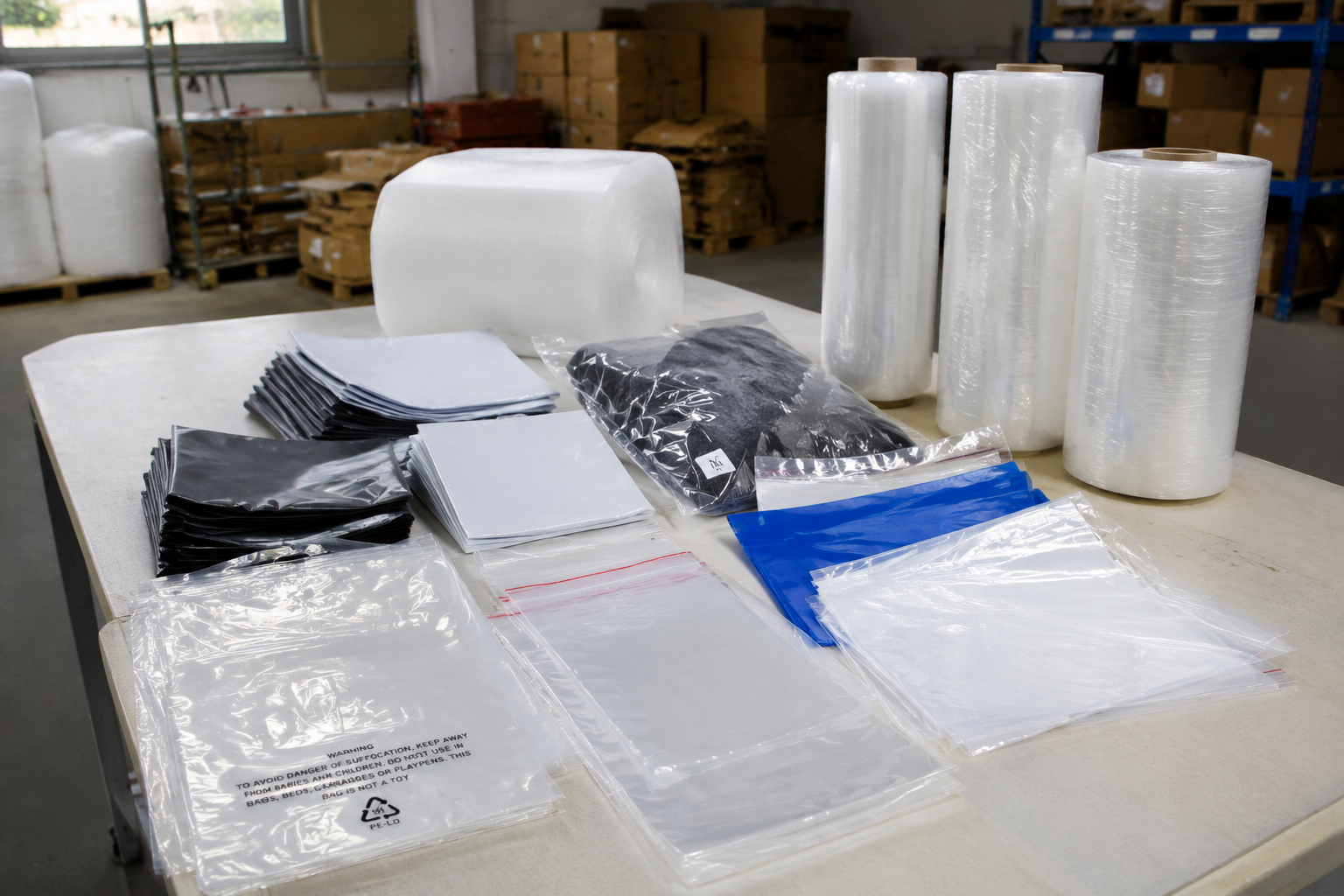
Individual Product Packing vs. Outer Shipping Protection
Individual product packing sits closest to the item. Its job is usually cleanliness, separation, presentation, or light surface protection. Clear bags, garment bags, and small product packing bags can keep dust off the product, stop loose accessories from separating, and make it easier for workers to identify the item before it goes into a carton or mailer.
Outer shipping protection has a different job. A courier bag or poly mailer must handle friction, sorting equipment, labels, sealing, and repeated handling during delivery. It can be a good choice for soft goods, textiles, documents, and other low-crush-risk products, but it does not provide the rigid protection of a corrugated box. If the product can bend, dent, crack, or break under pressure, the buyer should consider cushioning, a carton, or a combined packaging structure rather than relying on a shipping bag alone.
Storage, Carton Handling, and Pallet Movement
Packaging work does not end after the product is placed in a bag. Cartons may sit in storage, move through warehouse aisles, travel on pallets, and face vibration or compression during transport. This is where liner bags and stretch film become important. A carton liner can help keep bulk goods contained inside the box and reduce direct contact between the product and corrugated board. Stretch film helps hold cartons together on the pallet so the load is easier to move and less likely to shift during handling.
For export packing, the carton, inner bag, and pallet wrap need to work together. A strong carton can still become difficult to handle if the pallet stack is unstable. A clean product bag can still fail to protect goods if the carton is poorly lined for the product shape or weight. Buyers usually get better results when they treat plastic bags and film as part of a packing workflow, not as isolated items ordered only by size and price.
When the shipment route is demanding or the product value is high, buyers can move from informal sample checks to structured package validation. ASTM D4169 is a distribution-cycle performance testing practice for shipping containers and systems, while ISTA Procedure 3A is used as a packaged-product test overview for parcel delivery systems; these references support the idea that packaging performance should be checked against the actual distribution environment rather than assumed from material name alone.[1][2]
Clear Bags for Product Visibility, Dust Protection, and Item Organization
Clear bags are useful when workers, inspectors, retailers, or end customers need to see what is inside without opening the package. They are often used as inner packaging for apparel accessories, spare parts, documents, small consumer goods, bundled items, and replacement components. Their main value is visibility, cleanliness, and organization rather than impact protection.
In warehouse packing, transparent plastic bags can help teams organize SKUs, keep products clean, reduce handling contamination, and prevent small items from becoming mixed in the same carton. They are also useful when multiple parts need to stay together, such as a hardware kit, instruction sheet, and accessory set. For retail or distribution, clear product packing bags can make inspection faster because the product color, shape, label, or barcode can be checked without opening every bag.
Specification choices still matter. Bag size should allow the product to enter smoothly without excessive empty film around it. Thickness should match the handling risk: a light dust cover does not need the same strength as a bag used for heavier parts or sharp-edged items. Buyers may also need to confirm opening style, adhesive seal, resealable closure, zipper-style closure, hanging hole, warning text, and whether full transparency is required or simple dust coverage is enough.
Clear bags should not be treated as cushioning. A transparent bag may reduce scratches from casual handling, but it will not protect a fragile part from drops, compression, or heavy carton pressure. If the item is fragile, high-value, coated, or easily dented, it may still need bubble wrap, EPE foam, dividers, or a corrugated box around the clear bag.
When Product Visibility Helps Packing Accuracy
Visibility is especially useful when a packing team handles many similar products. If workers are picking black, navy, and charcoal apparel items, or several sizes of the same accessory, a clear bag can reduce unnecessary opening and checking. The same applies to small parts, sample kits, printed documents, and bundled promotional items where order accuracy depends on quick visual confirmation.
Clear packaging can also support receiving inspection and carton organization. A warehouse team can check whether the right item is in the right carton before sealing. Retail staff can confirm color, size label, or accessory count with less handling. This reduces the chance that products become wrinkled, scratched, or contaminated during repeated opening and repacking.
Seal Style Choices for Clear Bags
The closure should match the way the product is packed and used. Open-end clear bags are simple and economical when the bag will be folded, taped, heat sealed, or placed inside another package. Self-seal bags with an adhesive flap are useful for faster packing when workers need a clean, consistent closure. Resealable bags or zipper-style bags work better when the end user may need to open and close the package more than once.
Small details can affect daily output. An adhesive strip that is difficult to peel slows workers down. A bag opening that is too narrow can wrinkle apparel or scrape product surfaces. A resealable closure may improve user convenience but can add cost and thickness. For custom clear bags, buyers should confirm the opening direction, seal position, product orientation, label location, and any required warning text before sampling or bulk production.
Poly Mailers and Courier Bags for Lightweight E-Commerce Shipping
Poly mailers are widely used for lightweight e-commerce shipping because they reduce packing weight, take up less storage space than cartons, and are quick to close on a fulfillment line. They are suitable for many apparel items, textiles, soft goods, documents, and other non-fragile products that do not need crush protection. Courier bags, mailing bags, and shipping bags all fall into this general use area, though exact structure and features can vary by supplier and application.
The main trade-off is simple: a poly mailer is efficient, but it is flexible. It can resist normal handling friction and light moisture exposure, depending on the material and construction, but it does not stop bending, crushing, or hard impact. A T-shirt, hoodie, scarf, or fabric item may ship well in a properly sized mailer. A glass item, rigid cosmetic container, electronic device, or sharp metal part usually needs cushioning and a box, even if it also uses an outer mailer for privacy or branding.
Buyers should confirm mailer size from the packed product, not only from the flat product dimensions. Folded apparel may become thicker after being placed in a garment bag. A bundled order may need more opening allowance than a single item. If the mailer is too tight, workers may struggle to insert products and the side seams may be stressed. If it is too large, the package may look loose, waste material, and allow the contents to shift more during delivery.
When a Poly Mailer Can Replace a Box
A poly mailer can often replace a box when the product is soft, flexible, and not easily damaged by compression. Apparel, fabric accessories, bedding components, sample documents, and certain low-crush-risk goods are common examples. In these cases, the mailer acts as the outer shipping package, while the product’s own flexibility reduces the need for rigid protection.
The decision changes when the product has sharp corners, delicate surfaces, fragile parts, or a shape that can be crushed. Even if the item is lightweight, it may still need a carton if appearance or function can be damaged under pressure. For mixed orders, buyers should also check whether multiple items inside one mailer will rub against each other. Sometimes a simple inner clear bag or garment bag is enough to separate items; in other cases, bubble wrap, foam, or a small box is the safer choice.
Seal, Opacity, and Label Surface Details
The adhesive seal is one of the most important parts of a poly mailer. It should close quickly, hold during handling, and show clear evidence if the package has been opened. Some e-commerce sellers also use a return strip so customers can reuse the same mailer for returns. If this feature is needed, the buyer should confirm the strip position, opening direction, and whether the return process matches the brand’s fulfillment workflow.
Opacity matters for privacy and presentation. A dark or opaque mailer helps hide the contents, which is useful for apparel, documents, and customer orders where product visibility is not desired. The outside surface should also accept shipping labels reliably. If labels peel, wrinkle, or scan poorly, the low material cost of the mailer can turn into delivery delays and customer service problems. Buyers should check label adhesion, writable surface needs, barcode scanning area, and whether any printing interferes with shipping label placement.
Custom Printing for Brand Recognition
Custom printed mailers can support brand recognition, but the print should be planned around function first. Logo placement, background color, instruction text, warning text, and print direction should leave enough clean space for shipping labels and courier handling. A good-looking mailer can still create problems if the label area is crowded or if important information is hidden after the bag is folded or sealed.
Before production, buyers should share artwork files, print color expectations, bag orientation, seal position, and label placement requirements with the supplier. It is also helpful to confirm whether the mailer will be used for single-item orders, multi-item orders, or return shipments. These details affect not only appearance, but also packing speed, order accuracy, and the customer’s first impression when the package arrives.
For printed mailers, a simple flat artwork approval is not always enough. Buyers should check a physical sample or production proof with the bag sealed around a real packed item, because folding, product thickness, and label placement can change how the front surface looks. This also helps confirm whether ink coverage affects film stiffness, opacity, barcode scanning, or label adhesion in the actual packing workflow.
Specification Confirmation Note: Before custom printed bags or mailers move into production, the buyer and factory should confirm size, thickness, material style, sealing direction, artwork position, label space, packing quantity, and carton packing method so the approved sample can be repeated clearly.
Garment Bags for Apparel Packing, Cleanliness, and Presentation
Garment bags are designed around the way clothing is folded, handled, stored, and prepared for sale. They may look similar to general clear bags, but the sizing and details are usually more apparel-specific. A T-shirt packed flat, a dress on a hanger, a folded uniform set, and a thick winter coat do not need the same bag shape or opening style.
For apparel brands, garment factories, distributors, and e-commerce sellers, the main job is usually cleanliness and organization. The bag helps keep fabric away from dust, hand contact, warehouse surfaces, and carton abrasion before the item reaches the next packing stage. It can also help workers identify size, color, style, and SKU faster during sorting and order preparation.
Garment bags should not be treated as courier-grade shipping protection by themselves. Thin clothing bags can keep a folded shirt clean inside a carton or mailer, but they do not provide crush protection, puncture resistance, or cushioning for rough parcel handling. If the apparel has accessories, embellishments, rigid packaging, or a premium surface finish, the buyer may need to combine the bag with tissue, cardboard inserts, cartons, or other protective materials.
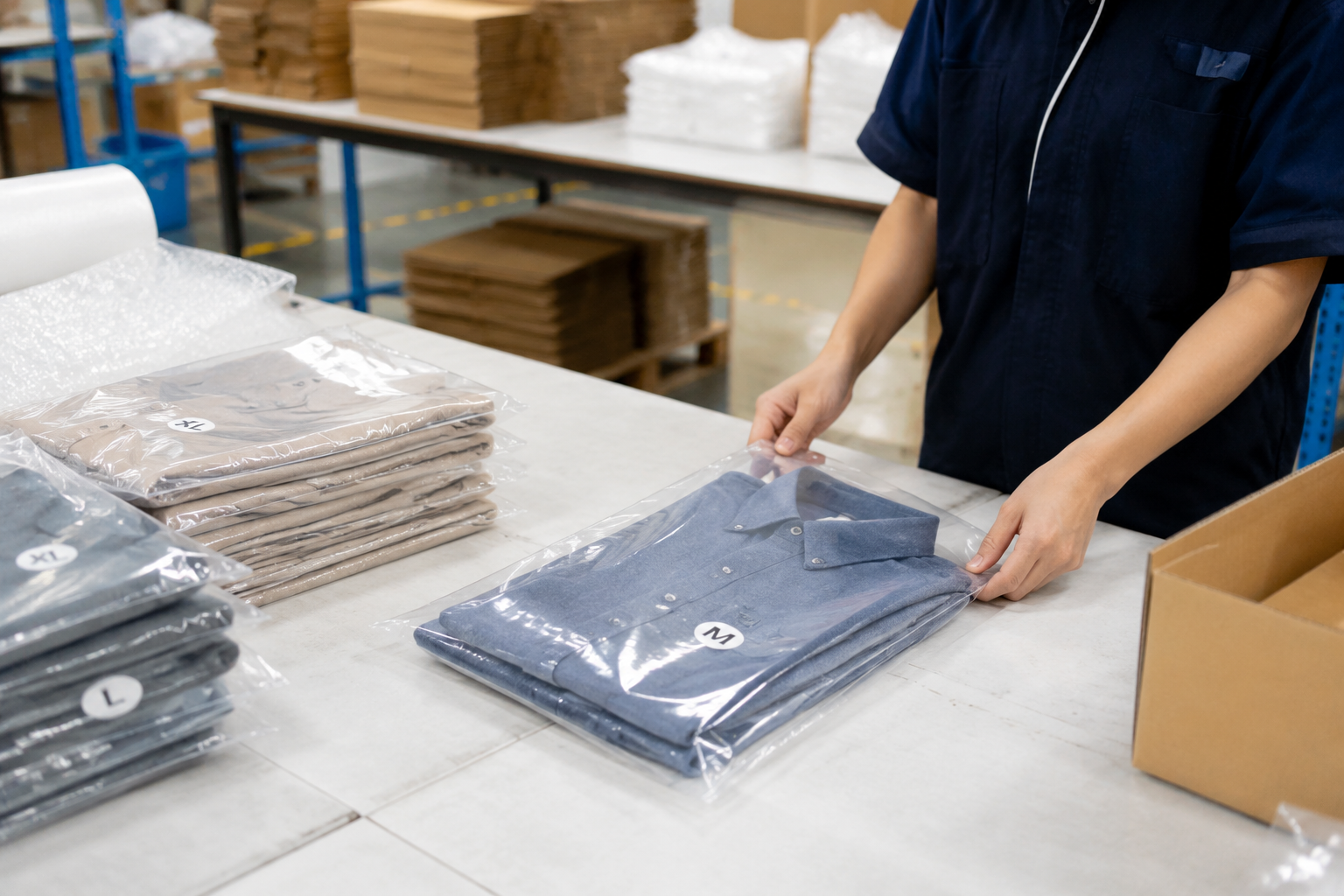
Folded Apparel vs. Hanging Apparel Requirements
Folded apparel usually needs a bag sized to the finished folded dimensions, not the original garment dimensions. A shirt may be wide when laid flat, but much smaller after folding. A hoodie or sweatshirt may look compact in length and width but need extra depth because of fabric thickness. If the bag is too tight, workers may struggle to insert the garment cleanly, the adhesive flap may not close properly, and the folded shape may become distorted.
For folded shirts, uniforms, underwear sets, scarves, or children’s clothing, buyers should confirm the packed length, packed width, folded height, and whether multiple pieces are packed together. A small allowance around the folded garment usually improves packing speed, but too much extra space can make the product look loose and less organized inside the carton.
Hanging apparel has a different requirement. Dresses, coats, suits, and long garments may need a longer clothing bag with an opening or hanger hole at the top. The bag may need to cover the shoulder area cleanly and protect the garment surface during warehouse storage, retail transfer, or showroom handling. Opening direction matters here: a top opening, bottom opening, side opening, or hanger-compatible design can affect how workers load garments onto racks and into cartons.
How Sealing Style Affects Packing Speed
The seal is a small detail that can change daily packing work. Self-adhesive garment bags are common for folded apparel because workers can insert the garment, remove the release strip, and close the flap quickly. This works well for apparel lines with steady volume, consistent folded size, and simple one-way packing flow.
Resealable styles may be useful when items need inspection, relabeling, retail checking, or return handling. They allow the bag to be opened and closed without immediately destroying the closure. The trade-off is that resealable closures may cost more and may not be necessary for basic factory-to-carton packing. Open-end bags can be economical and simple, but they may need folding, tape, or another closure method if the garment must stay fully covered during storage or transport.
Buyers should also consider how the worker holds the garment during packing. If the adhesive strip is on the wrong side for the packing table layout, workers may need to rotate every piece before sealing. That adds time, especially in bulk apparel packing. For higher-volume orders, confirming flap direction, opening side, and bag orientation during sampling can prevent slowdowns later.
Size Labels, Warning Text, and Brand Printing
Apparel packaging bags often need more than a plain transparent surface. Size labels, style codes, barcodes, warning text, and simple brand printing can help warehouse teams sort cartons, scan items, and reduce picking errors. For example, a distributor handling black T-shirts in five sizes may want the size mark to be visible in the same corner on every bag so workers can check items without unfolding them.
Printed garment bags can also support brand presentation, but printing should not interfere with inspection, scanning, or product visibility. A large logo may look good in a sample photo, yet block the area where the buyer needs to see color, fabric texture, or size marking. If barcode labels are applied later, the buyer should keep a clean label area free from heavy ink, wrinkles, or closure seams.
Warning text, ventilation holes, and size markings should be discussed before production. Vent holes may help release trapped air during packing and carton compression, but their position should not expose the garment to unnecessary dust or snagging. If the bag is used for children’s apparel or retail distribution, buyers should confirm any required warning language with their own market requirements before placing the order.
Inner Liner Bags for Carton Protection and Bulk Product Containment
Liner bags are used inside corrugated cartons to create a protective layer between the carton and the product. They are not meant to replace individual product packaging or outer shipping cartons. Their job is to line the carton, help contain bulk goods, reduce dust exposure, and provide a practical barrier against light moisture or carton debris during storage and transit.
Carton liner bags are common for bulk apparel, textiles, plastic components, hardware, industrial parts, and other non-food goods that are packed directly into boxes. They can help keep goods contained if the carton is opened for inspection, reduce contact with rough corrugated surfaces, and make it easier for warehouse teams to lift or manage grouped products. For products with sharp corners, heavy weight, or oily surfaces, the liner specification needs closer review rather than assuming any plastic liner will work.
A common mistake is ordering plastic liners based only on the carton’s outside size. The liner must fit inside the carton after allowing for carton wall thickness, product volume, folds, and closure method. If it is too small, workers may tear it while loading products. If it is too large, excess film can bunch at corners, waste material, and make carton closing less tidy.
How Liner Size Should Match Carton Dimensions
Liner size should start from the carton’s internal dimensions and the way the product fills the box. A liner for loose textiles may need more height allowance so the top can be folded over before the carton is sealed. A liner for components may need a stronger bottom and enough width to sit smoothly along the carton walls without pulling tight at the corners.
Gussets are useful when the liner needs to open into a box-like shape. A flat bag may work for simple items, but it can be awkward for cartons with more depth. A gusseted liner can fit the carton base more cleanly, reduce stress at the side seams, and make loading easier for bulky or irregular products. The buyer should confirm whether the liner must stand open during packing or whether workers will simply insert it and fold it around the goods.
Opening direction also matters. In most carton applications, workers place the liner into the empty carton, load the product, then fold, tie, or seal the top. If the opening is too narrow, loading slows down. If the liner height is too short, the top cannot close properly over the product. For export cartons, this detail can affect how cleanly cartons are closed, taped, labeled, and stacked.
When Thickness Matters More Than Transparency
Many liner bags do not need perfect visibility because the carton label, packing list, or outer carton mark identifies the goods. In these cases, thickness, puncture resistance, and fit are often more important than clarity. A thin liner may be acceptable for lightweight fabric, but it may tear quickly if used with metal parts, sharp plastic edges, or heavy mixed components.
Product weight should guide the choice. Heavy goods create stress at the bottom and corners of the liner when workers load, shift, or remove products from the carton. Even if the liner is not used as a carrying bag, it still faces pulling and friction during packing. Sharp edges, screws, fittings, or rough surfaces can puncture film during vibration or carton movement.
The buyer should also consider how the carton will be handled. A carton that stays in one warehouse may need less liner strength than a carton prepared for longer transport, repeated loading, or export handling. The liner works as part of the carton system, so carton strength, product shape, and inner protection should be reviewed together.
Sealing, Folding, or Tying the Liner
Not every liner needs a heat seal or adhesive closure. Many warehouse teams simply fold the top of the liner over the product before closing the carton. This is fast and practical for dry goods where the main goal is dust protection and basic containment. For bulk apparel or textiles, folding the liner neatly can help keep the top layer clean when the carton is opened later.
Tying may be useful when the contents are loose, small, or likely to spill inside the carton. It can also help during partial unpacking, where warehouse workers may open the carton and remove some contents while keeping the rest covered. The tying method should be realistic for the product volume; if the liner is filled too close to the top, workers may not have enough film left to close it securely.
Sealed liners may be considered when the buyer needs stronger containment, cleaner presentation, or better control during storage. The closure method should match the packing line and the product risk. A sealed liner can add process time, so the benefit should be clear before adding that requirement to a bulk packing operation.
Stretch Film for Pallet Stability, Warehouse Handling, and Transport Protection
Stretch film is not a bag, but it is one of the most important film packaging materials in warehouse and export packing. After products are packed into cartons, stretch film helps hold cartons together on the pallet, reduce dust exposure, and support cleaner handling during storage, forklift movement, and transport preparation.
The main function is load stability. Cartons that shift during pallet movement can create crushed corners, leaning stacks, damaged labels, or unsafe handling conditions. Stretch wrap helps bind the load, but it does not correct weak cartons, poor stacking patterns, overhanging boxes, or pallets that are not suitable for the load weight. Good pallet packing still starts with carton strength, proper stacking, and stable pallet layout.
Film selection should consider carton weight, pallet height, corner sharpness, storage time, handling method, and shipping distance. A low, square pallet of lightweight cartons may be easy to wrap. A tall pallet with uneven carton sizes, sharp edges, or heavy goods may need stronger film, better wrapping technique, edge protection, or a different stacking plan.
Hand Wrap vs. Machine Wrap
Hand stretch film is common in smaller warehouses, mixed-product operations, and packing areas where pallet volume changes throughout the day. It gives workers flexibility and does not require wrapping equipment. The trade-off is that wrap tension and film usage can vary by worker, pallet size, and fatigue. If one worker stretches the film tightly and another wraps loosely, pallet stability may not be consistent.
Machine stretch film is usually considered when pallet wrapping is repeated often and consistency matters. A wrapping machine can control tension, overlap, and film use more evenly than manual wrapping. This can help high-volume packing operations reduce variation, but it requires the right film specification for the machine and enough pallet volume to justify the process setup.
Buyers should confirm roll width, roll weight, core size, and whether the film is intended for hand or machine use. A roll that is too heavy can slow manual wrapping and increase worker strain. A film not suited to the wrapping method may tear, stretch unevenly, or fail to hold the pallet as expected.
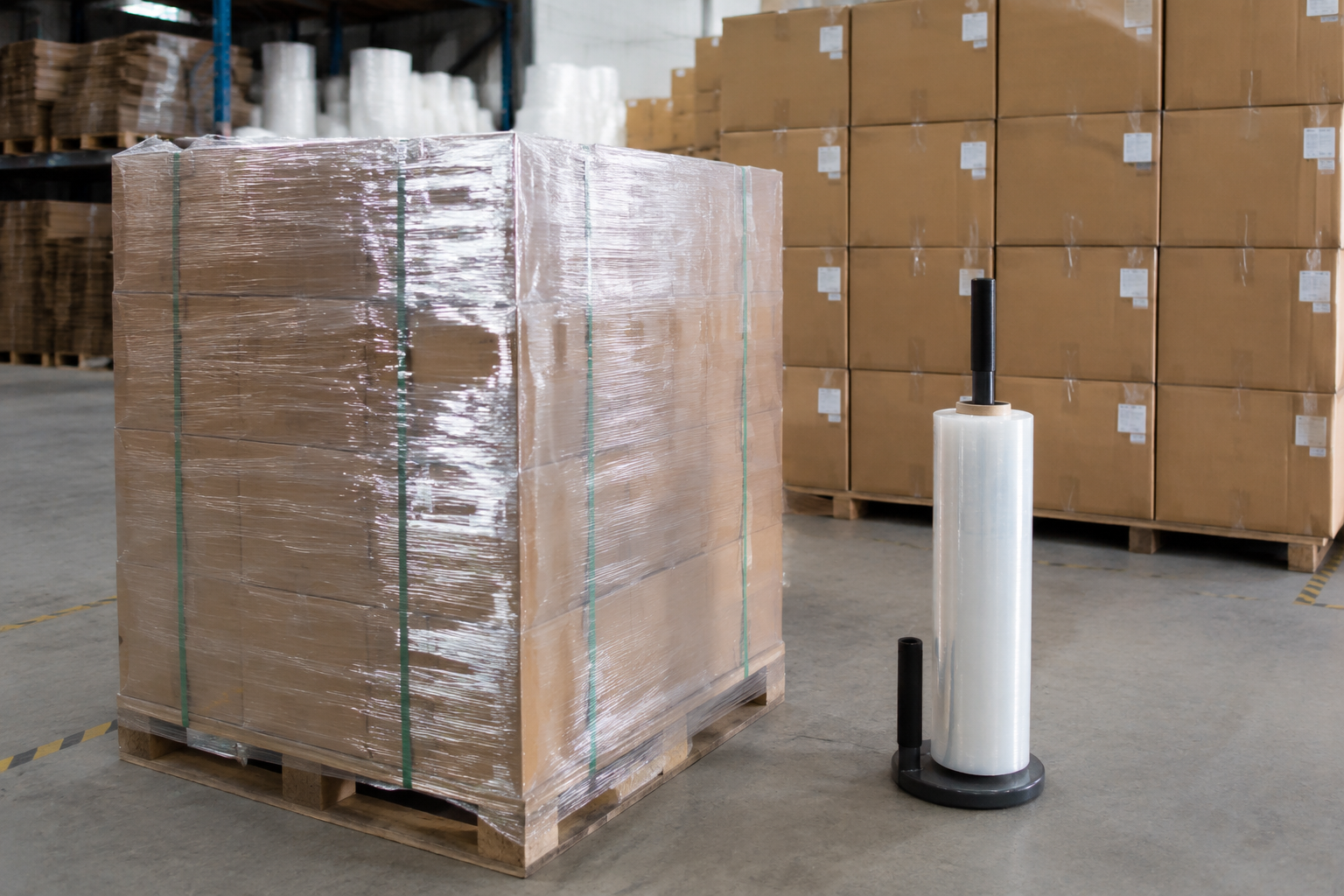
Thickness, Stretch, and Puncture Resistance
Film thickness is only one part of stretch film performance. A thicker film may feel stronger, but stretch behavior, cling, puncture resistance, and wrapping method also affect how well it holds a load. The goal is not always to use the thickest film. The goal is to use a film that can stretch properly, cling to itself, resist tearing at corners, and maintain enough holding force during movement.
Thin film may reduce material use on light, clean pallets, but it may tear on sharp carton corners or unstable stacks. Heavier film may improve puncture resistance and load control, but it can increase material cost and storage space. If workers compensate for weak film by wrapping many extra layers, the apparent savings may disappear.
For export shipments or long-distance transport, stretch film should be considered together with pallet quality, carton stacking, edge boards, top sheets, labels, and loading conditions. Film can reduce movement, but it should not be expected to prevent all damage from vibration, compression, moisture exposure, or rough handling.
Compression and vibration risk should be separated when reviewing a packed pallet or carton system. ASTM D642 addresses compressive resistance testing for shipping containers, while ASTM D4728 addresses random vibration testing for shipping containers; together, these references show why a carton that looks strong in stacking may still need separate review for transport vibration and why stretch film should not be treated as a stand-alone performance guarantee.[3][4]
How Pallet Shape Changes Film Use
Pallet shape has a major effect on film consumption. A neat, square pallet with aligned carton corners wraps efficiently because the film can stretch evenly around the load. Uneven cartons, mixed box sizes, overhang, and leaning stacks create stress points where the film may tear or lose tension. In these cases, workers often use more film to compensate for a poor stack.
Sharp carton edges and protruding products can also increase puncture risk. Edge protectors or corner boards may help the film slide over the pallet more smoothly and distribute holding force more evenly. For heavy cartons, they can also reduce the chance of film cutting into carton corners during transport.
Before choosing pallet wrap, buyers should look at the real pallet, not only the carton drawing. Pallet height, load weight, stacking pattern, forklift movement, warehouse storage time, and destination handling all affect the final wrapping requirement. A small adjustment to carton arrangement may reduce film waste and improve stability more than simply choosing a heavier roll.
How to Choose Size, Thickness, and Material Style Without Overpacking
Choosing plastic bag size and thickness should start with the packed condition of the product, not only the product’s catalog dimensions. A shirt that looks flat on a size chart may become much thicker after folding. A spare part may need bubble wrap before it goes into a clear bag. A carton liner may need enough extra film to fold over the top before the carton is closed. These details change the actual bag dimensions and can affect packing speed, product appearance, and material use.
The goal is not to choose the thickest or largest option by default. Overpacking increases material cost, takes more warehouse space, and may make cartons less efficient. Underpacking creates a different problem: tight bags can tear, thin film can puncture, and workers may spend extra time forcing products into packaging that does not fit the process. A good specification should be easy to pack, strong enough for the handling risk, and not larger or heavier than the product really needs.
Material style also matters, but it should be judged together with use case. LDPE bags are often chosen where flexibility, softness, and clarity are useful. HDPE bags can feel stiffer and may suit certain lightweight packing jobs where a thinner, crisper film is acceptable. For custom plastic bags, the better question is usually not only “Which material?” but “What product is being packed, how will it be handled, and what failure needs to be avoided?”
Measure the Packed Product, Not Just the Product
For accurate bag dimensions, measure the item after folding, wrapping, grouping, or adding any inner protection. Apparel is a common example. A T-shirt, a padded jacket, and a uniform set may all be clothing products, but their folded height and air space inside the bag can be very different. If the buyer measures only the garment laid flat, the final bag may be too tight once the product is packed for shipment or retail handling.
The same logic applies to hardware kits, accessories, documents, and bundled consumer goods. If several pieces go into one bag, measure the full bundle, including the thickest point and any uneven edges. If the product has inserted cardboard, foam, labels, hang tags, or instruction sheets, include those items in the size check. A small allowance around the packed product can help workers insert items smoothly, but too much allowance may make the package look loose and increase film waste.
For carton liners, measure the inner carton size and consider how the liner will sit inside the box. A liner that matches the carton exactly may not reach the corners well or may leave too little material for folding, tying, or sealing. A liner that is too large can bunch up inside the carton, reducing usable space and slowing packing. The best fit depends on carton length, width, depth, product weight, and closure method.
Thickness Should Follow Handling Risk
Film thickness should reflect how much stress the packaging will face. Thin films may be suitable for dust coverage, product grouping, or clean inner packing where the bag is not carrying much weight and is protected inside a carton. Heavier films are usually considered when the bag faces more friction, product weight, sharp edges, repeated handling, or direct courier movement.
For e-commerce shipping, the outer package may rub against conveyor belts, other parcels, and sorting equipment. A mailer that is too light for the product can split at the seal or corners. For carton liners, puncture risk often matters more than appearance, especially when packing metal parts, hardware, or dense bulk goods. For stretch film, the concern is different again: film must hold the pallet load together while resisting tearing at carton corners and during forklift handling.
There is always a trade-off. Thicker film can improve strength, but it also increases cost, roll weight, storage volume, and sometimes packing effort. Buyers can usually control cost better by matching thickness to the actual risk: light dust protection does not need the same film as pallet wrapping, and soft apparel does not create the same puncture risk as metal components.
| Specification Choice | Useful When | Risk If Chosen Poorly |
|---|---|---|
| Slight size allowance | Workers need fast insertion and clean folding | Too tight causes tearing; too loose wastes material |
| Higher film thickness | Product is heavy, sharp, or exposed to shipping friction | Unneeded thickness increases cost and storage space |
| Clearer film | SKU checking, retail visibility, or warehouse inspection matters | May not be the priority for hidden liners or pallet wrap |
| Stronger opening or gusset | Bulky, folded, or irregular products need easier loading | Poor opening design slows packing and causes wrinkles |
When Gussets or Larger Openings Help
Gussets and larger openings are useful when a flat bag does not give enough internal space. Bulky garments, bedding, coats, towels, and multi-piece apparel sets often need extra depth so the bag can close without strain. Without enough depth, the seal may sit under tension, corners may look stretched, and workers may need more time to adjust each item.
Carton liners also benefit from gusseted or wider-opening designs because the liner must open inside the box and reach the corners before goods are added. For irregular product shapes, a larger opening can reduce scraping against the product surface and make packing more consistent. This is especially helpful when the product has corners, handles, accessories, or uneven thickness.
The buyer should still avoid making the opening much larger than necessary. A large opening can improve loading speed, but it may require more film and create extra folding at closure. The right choice is usually the smallest practical size that lets workers pack the product without forcing it, tearing the film, or leaving the package visibly loose.
Sealing, Printing, and Labeling Details That Affect Daily Packing Work
Small design details in custom plastic bags can have a large effect on daily packing work. A seal that is difficult to close slows the line. A label area that does not hold a shipping label well creates scanning and delivery problems. Printing that covers the wrong side of the bag may interfere with barcode reading or make the package harder to identify during sorting.
Customization should support the packing process first and branding second. Logo printing can improve recognition, but the bag still needs to open in the right direction, close reliably, show or hide the product as required, and leave enough clean space for labels. For apparel, size marks and warning text may matter more than decorative printing. For e-commerce mailers, adhesive seal quality, return strip placement, and label surface can affect both warehouse speed and customer handling.
Before production, buyers should confirm artwork files, print position, bag orientation, sealing direction, closure type, label placement, and any required packing instructions. These details are easier to adjust during sampling than after a bulk order has already been made. From a factory perspective, clear specifications also reduce confusion between similar bag sizes, print versions, and packing applications.
Seal Style Should Match the Packing Line
A permanent adhesive seal works well when the package only needs to be closed once, such as outbound e-commerce shipping or single-use apparel packing. The adhesive strip should be easy for workers to remove and align, especially in high-volume packing. If the release liner is awkward or the flap is too short, workers may slow down or create uneven seals.
A resealable bag is useful when the product may be inspected, returned, displayed, or accessed more than once. It can be helpful for apparel samples, accessories, documents, and organized parts. The trade-off is that resealable closures may cost more and may not be necessary for simple one-way packing. Buyers should decide whether repeat opening is truly needed or whether a standard adhesive flap is enough.
Open-end bags and liner bags may use folding, tying, tape, heat sealing, or simple tuck-in methods depending on the product and warehouse process. For bulk goods inside cartons, the closure method should match the worker’s routine and the carton closing process. A closure that looks simple on paper can become inconvenient if workers must hold heavy product, fold excess film, and close the carton at the same time.
Printing Should Support Both Branding and Handling
Printing should be placed where it does not interfere with packing, sealing, or labeling. On a printed poly mailer, the logo may need to sit away from the shipping label area and adhesive strip. On apparel bags, size marks or product identification may need to face outward so warehouse teams can check SKUs without opening the bag. For liner bags, printing is usually less about appearance and more about identification, warning text, or simple handling instructions when needed.
Opacity is another practical detail. A shipping bag may need enough opacity to protect product privacy during courier handling. A clear or lightly printed bag may be better when workers need to identify colors, sizes, or accessories quickly. The decision should follow the application: privacy, visibility, brand presentation, and warehouse checking do not always point to the same film style.
Buyers should review print direction together with bag orientation. A design that looks correct on a flat drawing may appear upside down after the product is inserted or after the flap is folded. This is especially common with garment bags and mailers, where the opening direction, seal side, and front-facing surface must be confirmed before production.
Labels Need a Clean, Reliable Surface
Shipping labels and barcode labels need a surface that is clean, flat, and compatible with the buyer’s labeling process. If a bag has heavy texture, wrinkles, strong ink coverage, or seams in the label area, scanning can become less reliable. Even when the label sticks at first, poor adhesion may create problems during sorting, storage, or delivery handling.
For e-commerce fulfillment, the label area should be planned before printing. Workers should not have to search for a blank space on every bag, and the shipping label should not cover important warnings, return instructions, or brand information. For apparel and warehouse packing, barcode labels should be easy to scan without opening the bag or turning the product several times.
Label planning also helps repeat orders. If the label area, print position, and bag orientation stay consistent, warehouse teams can keep the same packing routine. That consistency reduces training time, avoids mislabeling, and makes it easier to reorder the same packaging specification later.
Moisture, Dust, and Surface Protection: What Plastic Film Can and Cannot Do
Plastic film packaging is useful for keeping products clean, reducing dust exposure, limiting light moisture contact, improving privacy, and separating items inside a carton. It can protect surfaces from minor handling marks when the product is not exposed to heavy abrasion or impact. These benefits make plastic bags, liners, and film products valuable in apparel packing, warehouse storage, e-commerce shipping, and export preparation.
At the same time, buyers should set realistic expectations. Moisture protection packaging is not automatically waterproof export packing. A dust bag is not cushioning. A poly mailer is not a rigid box. Stretch film helps stabilize a pallet, but it does not make weak cartons strong or prevent all damage from poor stacking. Film performs best when its job is clearly defined and, where needed, combined with other protective packaging.
The correct protection level depends on product risk. A folded garment may only need dust protection and clean presentation. A painted metal part may need surface separation, foam, and a strong carton. A fragile item may need bubble wrap or EPE foam before it is placed into a carton, then pallet wrap after cartons are stacked. Film is often one layer in the system, not the whole system.
Moisture Resistance Is Not the Same as Waterproof Packing
Many plastic bags and films can resist light moisture exposure during normal warehouse handling, short-term storage, or delivery contact. For example, a poly mailer can help protect apparel from light rain during courier movement, and a carton liner can reduce direct contact between goods and a dusty or slightly damp carton surface. This does not mean the package is suitable for standing water, long outdoor exposure, or uncontrolled condensation.
For export shipments, buyers should consider the full route instead of relying on the film alone. Goods may move from factory packing to warehouse storage, container loading, sea or air transport, destination unloading, and local delivery. If the product is sensitive to humidity, corrosion, odor, or surface staining, the buyer should discuss inner wrapping, carton strength, pallet cover, desiccant use where required, and loading condition with the supplier or freight partner.
Surface Protection Needs Product-Specific Review
Scratch-sensitive products need more than a general statement that they are “packed in plastic.” Smooth plastic film can still trap dust or allow parts to rub against each other if the carton is tightly packed or vibrates during transport. Painted metal, polished plastic, lacquered gift boxes, coated paper products, acrylic items, and display parts may need individual wrapping, soft film, tissue, bubble wrap, EPE foam sheets, or dividers to keep surfaces separated.
When buyers send photos or samples, they should point out the surfaces that must remain clean or unmarked. A supplier can then judge whether the plastic bag is mainly for dust protection, whether it should be paired with cushioning, or whether the carton needs internal separation. This step is useful because the highest-risk surface is not always obvious from product dimensions alone.
If a bag, liner, or film will touch food directly, buyers should treat it as a separate compliance question rather than a normal dust-protection request. European food-contact materials rules and U.S. polymer food-contact regulations both show that direct food-contact use depends on the material, additive system, application conditions, and destination market; therefore, food-contact suitability should be confirmed separately before the packaging is approved for that use.[5][6]
Sensitive Applications That Need Extra Review Before Production
Some plastic bag and film projects require more careful review because the packaging use may affect product safety, transport rules, customer documentation, or destination-market requirements. Food-contact packaging, medical or pharmaceutical packaging, cosmetics packaging, child-related products, lithium batteries, electronics, hazardous goods, anti-static protection, and moisture-sensitive goods should not be treated as ordinary dust-cover projects. The first question should be whether the film will simply protect a finished retail pack from dust, or whether it will directly contact the product or support a regulated shipment.
For electronics, buyers sometimes ask for anti-static or ESD packaging, but ordinary clear bags, poly mailers, and liner bags should not be described that way unless the material and structure are specifically selected and supported for that purpose. If anti-static performance matters, the buyer should state the product type, handling environment, packaging layers, and any documentation required before the supplier quotes. For lithium batteries or hazardous goods, packaging and shipping preparation may be controlled by transport rules, so the buyer should confirm applicable carrier, freight forwarder, and destination requirements before production.
For cosmetics, food, or medical-related products, the packaging role must be defined precisely. A bag used around an already sealed retail carton is different from a bag that directly contacts cream, powder, tablets, food, or sterile components. If direct contact or special hygiene handling is required, the buyer should confirm the applicable material requirements, documentation, and production controls separately. Daipak can discuss packaging form, size, sealing, and protective structure, but regulated-use approval should not be assumed from the material name alone.
How Plastic Bags and Film Packaging Affect Storage, Labor, and Shipping Cost
For B2B buyers, the cost of plastic bags and film packaging is not only the unit price on a quotation. A bag that looks inexpensive can become costly if it tears during packing, slows workers down, causes loose carton packing, or creates customer returns because the product arrives dirty or poorly presented. The better question is whether the specification fits the daily packing job with the least waste and the fewest handling problems.
This is especially true for wholesale plastic bags and bulk packaging orders. Small differences in size, thickness, seal quality, roll length, or carton packing can affect warehouse space, packing labor, and repeat-order consistency. A procurement team may save on material cost but lose that saving through extra tape, repacking, larger cartons, rejected labels, or unstable pallets.
Plastic film also affects shipping cost indirectly. Poly mailers can reduce parcel weight compared with boxes for soft goods, but only if the product does not need crush protection. Clear bags can improve picking accuracy, but oversized bags may make products look loose and take more carton space. Stretch film can support pallet stability, but poor film selection or uneven wrapping can increase film consumption without improving the load.
Low Unit Price Can Create Higher Handling Cost
A lower-priced bag usually becomes a problem when it does not match the product or the packing method. If the film is too thin for the product weight or edge condition, workers may see tearing at the seal, corners, or opening. That creates extra handling: the product must be removed, repacked, and sometimes inspected again before it can move to the next step.
Slow sealing is another hidden cost. A weak adhesive strip, a flap that is hard to align, or a bag opening that is too tight can add a few seconds to every pack. In a small order, this may not matter much. In a busy e-commerce or apparel packing line, those seconds multiply quickly and can affect the number of orders a team can finish in one shift.
Inconsistent fit also creates labor waste. If a poly mailer is too small, workers may force the packed item inside and damage the seal or wrinkle the product. If a garment bag is too large, workers may spend extra time folding excess film, and the final presentation may look untidy. If a carton liner is too short, it may not fold over the contents properly; if it is too thin, it may puncture when bulk goods shift inside the box.
The goal is not to buy the thickest or most expensive film. It is to avoid the type of failure that forces the warehouse to touch the same item twice. For many buyers, packaging cost control starts with reducing rework, not simply reducing material weight.
Correct Sizing Helps Carton and Warehouse Efficiency
Correct sizing helps packing teams work faster and helps cartons fill more predictably. A bag should allow the product to enter smoothly, close securely, and sit properly in the carton. If it is too tight, workers lose time and the seal area may be stressed. If it is too loose, the packed product can take more space, look less professional, and reduce the number of units that fit into each carton.
Carton size matters because excess film and air around the product can change carton utilization. Apparel packed in oversized bags may stack poorly, making cartons bulge or leaving unused space. Small parts packed in bags that are too large may shift during handling, creating more disorder inside the carton. For warehouse teams managing many SKUs, consistent bag dimensions also make counting, picking, and shelf organization easier.
Storage space should be part of the buying decision. Rolls of stretch film, bundles of poly mailers, and cartons of clear bags all occupy warehouse space before they are used. Very heavy rolls may reduce roll change frequency, but they may be harder for workers to handle manually. Smaller cartons may be easier to move, but they may require more frequent replenishment at the packing station. The right packing format depends on the warehouse layout, order volume, and worker process.
For stretch film, sizing and usage connect directly to pallet cost. A load with clean carton edges and stable stacking may require less film than a mixed, uneven pallet with sharp corners and overhanging cartons. Poor pallet shape can increase film use while still leaving the load unstable. In that case, the cost issue is not only the stretch film itself; it may also involve carton selection, stacking pattern, edge protection, and pallet preparation.
Repeat Orders Need Stable Specifications
Repeat orders work best when the packaging specification is clear and stable. Buyers should keep confirmed size, thickness, material style, seal type, print position, roll or bag packing method, and carton quantity records. Without this information, a repeat order may look similar on paper but perform differently at the packing table.
For custom printed bags or poly mailers, artwork position and bag orientation should also stay controlled. A logo placed too close to the seal may be hidden after closure. A shipping label area placed over heavy printing or a textured surface may create scanning or adhesion issues. For garment bags, size marks, warning text, adhesive strip location, and opening direction should remain consistent so workers do not need to relearn the packing process.
Stable specifications also help a film packaging supplier control production and packing details. If one order uses rolls and the next uses pre-cut bags, or if carton packing quantities change without review, the buyer may see differences in warehouse handling, inventory counting, or packing station replenishment. This is why samples, drawings, photos, and approved specifications are useful long after the first order is finished.
For procurement teams, repeat-order consistency is often more valuable than chasing small unit-price differences each time. A stable bag or film specification can reduce training time, avoid packing mistakes, simplify inventory control, and make future quotation comparisons more accurate.
Recyclability, Compostability, and Environmental Claims Need Careful Wording
Buyers often ask whether a plastic bag, mailer, or film is “eco-friendly,” but that word is too broad for a reliable packaging specification. A better request is to identify the exact claim needed: recyclable, recycled-content, downgauged, compostable, reusable, or simply reduced material use. U.S. FTC Green Guides treat environmental marketing claims as claims that need clear qualification, which is why buyers should avoid broad green wording unless the material, market, and disposal route support it.[7]
For plastic film packaging, recyclability depends on design details such as resin type, inks, labels, adhesives, color, additives, and the collection or sorting system in the destination market. APR and RecyClass both provide design-for-recycling guidance for plastic packaging, supporting the practical point that a package should be reviewed as a complete structure rather than described as recyclable only because one base material may be recyclable in some systems.[8][9]
Compostable claims require even more caution because ordinary plastic bags and stretch film are not compostable just because they are thin or lightweight. If a buyer requests compostable packaging, the inquiry should specify the intended composting environment, labeling needs, destination market, and any certification or standard requirement before the supplier quotes material, printing, or performance expectations.
How to Discuss Reduced Material Use Without Overclaiming
Reducing film thickness, improving bag fit, or selecting a better roll format may reduce material use for a specific application, but it should not be presented as a universal environmental benefit without checking the whole packaging system. A thinner bag that tears during packing can increase waste through repacking, replacement packaging, and delayed shipments. A better-balanced specification is one that uses only the material needed for the product and route while still performing reliably in the buyer’s actual workflow.
If environmental messaging will appear on a retail pack, shipping mailer, website, or customer document, the wording should be reviewed before printing. Phrases such as recyclable, compostable, biodegradable, or made with recycled content can carry different expectations in different markets. Buyers should confirm the material composition, documentation, disposal pathway, and local communication rules before using those statements on finished packaging. Where the claim cannot be supported clearly, a neutral functional description such as “lightweight protective mailer” or “carton liner for dust reduction” is usually safer and more accurate.
What to Confirm Before Ordering from a Plastic Bags and Film Packaging Supplier
Before ordering from a plastic bags and film packaging supplier, buyers should prepare enough information for the supplier to understand the product, the packing process, and the shipment conditions. A simple product name is rarely enough. The same “clear bag” or “poly mailer” can require different sizes, seals, thicknesses, and printing details depending on whether it is used for apparel, spare parts, e-commerce parcels, carton lining, or pallet handling.
For overseas buyers working with a China packaging materials supplier, clear communication at the beginning saves time during quotation, sampling, and production preparation. Product photos, packed dimensions, current packaging samples, carton sizes, and packing workflow details help the supplier recommend practical options instead of guessing from a general description.
At Daipak, the discussion usually starts with the application rather than the material name. A buyer may ask for plastic bags, but the actual need could be product visibility, dust protection, shipping privacy, carton lining, or pallet stability. Each purpose leads to a different specification and, in some cases, a combined packaging structure.
Specification Details to Include in a Quote Request
A good quote request should describe the packed product, not only the product itself. For apparel, this means folded size, fabric thickness, packing quantity per carton, and whether the bag needs a self-adhesive flap, vent holes, size marks, or printed warnings. For e-commerce shipping, it means the item size after inner packing, the expected mailer size, seal style, opacity, label area, and whether a return strip is needed. For liner bags, it means carton dimensions, product weight, gusset needs, and closure method.
Buyers should include the main specification details in a structured way so the supplier can quote the correct item and avoid unnecessary back-and-forth:
- Application: inner product packing, apparel packing, courier shipping, carton lining, pallet wrapping, or another specific use.
- Dimensions: length, width, depth or gusset, opening direction, and whether the size is based on the packed product.
- Thickness or strength target: any current film thickness, sample reference, or handling problem that needs to be solved.
- Material preference: LDPE, HDPE, co-extruded film, stretch film, or no fixed preference if the supplier should recommend.
- Seal and closure: open-end, adhesive strip, resealable style, zipper-style closure, tying, folding, or heat sealing where applicable.
- Printing and labeling: logo, warning text, barcode area, shipping label surface, artwork file, color reference, and print position.
- Order and packing details: estimated quantity, roll or bag packing preference, carton packing needs, shipping marks, and destination requirements.
The more clearly these details are confirmed, the easier it is to compare quotations from different suppliers. Without the same specification basis, one quote may look cheaper simply because it uses a smaller size, thinner film, different seal, or simpler packing method.
Factory Coordination Note: For mixed packaging projects, Daipak’s communication should connect the bag or film specification with any related foam, bubble wrap, corrugated carton, labels, carton marks, and pallet wrapping needs so production and packing details are reviewed as one workflow.
Why Samples Matter Before Bulk Production
Samples are useful because plastic bags and film products are handled by people, machines, cartons, and carriers. A drawing can confirm dimensions, but a sample shows how the film feels, how the product fits, how the seal closes, and whether the packing team can use it comfortably at normal speed.
For clear bags and garment bags, samples help check product fit, visibility, flap position, and whether the bag looks too tight or too loose after packing. For poly mailers, buyers can test whether the packed item slides in easily, whether the adhesive seal closes cleanly, whether the surface accepts a shipping label, and whether the opacity meets privacy needs. For carton liner bags, the sample should be placed inside the actual carton to check corner fit, fold-over allowance, and closure method.
Printed samples or pre-production confirmation can also prevent avoidable mistakes. Logo position, warning text direction, barcode clearance, bag opening direction, and print alignment can affect both appearance and packing work. If workers must rotate every bag before use, or if a label area is placed on the wrong side, the issue may not show up until daily packing begins.
Before bulk production, buyers should confirm the approved sample, specification sheet, artwork version, packing quantity, and carton marks. For export orders, checking carton marks and destination-related packing details early can affect shipment preparation and repeat-order communication.
A practical pre-production review should also identify who is responsible for each confirmation point. The buyer may need to approve artwork, label position, destination marks, and packed-product fit, while the factory checks material style, cutting size, sealing direction, roll or bag packing format, and carton quantity. Clear responsibility reduces the chance that a small detail is assumed by both sides but confirmed by neither.
Production and Packing Checkpoints Should Match the Approved Spec
Once a sample or drawing is confirmed, the specification should become the reference for production checks. Cutting size, film thickness, seal width, print position, and opening direction should be checked against the approved sample rather than against a general product name. That makes it easier to see whether the actual batch still matches the agreed use case.
Finished product review should also compare the practical details that matter in daily work. For bags, that may include whether the seal opens and closes smoothly, whether the film is clean, whether the bag lies flat, and whether labels or prints sit where the buyer expected. For stretch film, it may include roll winding, film edge condition, and whether the roll behaves consistently during wrapping. For liner bags, the check should confirm fit in the real carton and the amount of material left for folding or tying.
Packing review is another part of traceability that helps buyers avoid confusion later. Carton quantity, inner packing method, carton marks, and pallet arrangement should be recorded so the shipment can be unpacked and counted in the same way the order was packed. If a buyer later asks why a bag or roll performed differently, these packing details often explain the difference more clearly than the unit price does.
For repeat orders, the strongest reference is usually the last approved sample plus the packing note that went with it. That combination gives the factory a clearer basis for cutting, sealing, printing, and carton packing, and it gives the buyer a practical benchmark for order consistency.
Compliance and Documentation Questions to Ask Early
Before production starts, buyers should separate ordinary packaging preferences from requirements that may need documentation. Ordinary preferences include size, color, opacity, seal type, printing, and carton packing. Documentation-sensitive requests may include direct food contact, special transport requirements, recycled-content statements, compostable claims, anti-static performance, moisture-barrier performance, or customer-specific restricted-substance requirements. These points should be raised before sampling, because they may affect material selection, printing, lead time, and whether the project is suitable for a standard film structure.
For export orders, buyers should also confirm destination-market and logistics details that may influence packaging marks or shipment preparation. Plastic bags and stretch film may be only one part of the full export package, which can also include cartons, pallets, labels, and handling marks. If wood pallets or wood packaging materials are involved, international and destination rules may apply separately from the plastic film specification. The buyer, freight partner, and supplier should align these details before the packaging is finalized.
A clear document set can make repeat orders easier without creating unnecessary complexity. Useful records may include the approved sample reference, material description, size drawing, print artwork, carton packing method, shipment marks, and any buyer-required statements that have been reviewed. If a requested statement cannot be supported by available information, it is better to revise the wording or leave it off the package than to print a claim that may create problems later.
How Daipak Supports Mixed Packaging Needs
Many products do not need only one packaging material. A garment may use a printed garment bag first, then a poly mailer for e-commerce shipping. A delicate coated product may need a clear bag for dust protection, EPE foam or bubble wrap for surface and cushioning support, and a corrugated box for outer packing. A bulk carton may need an inner liner bag and then stretch film after the cartons are palletized.
Daipak Packaging supports standard and custom plastic bags, film packaging, bubble wrap, EPE foam, corrugated boxes, and custom protective packaging. The practical value is not simply having several product categories available. It is the ability to compare how those materials work together around product size, weight, surface finish, carton space, shipping distance, and warehouse handling.
For custom packaging, Daipak usually needs product size, packed dimensions, photos or drawings, target quantity, packing method, printing requirements, carton packing details, and shipping destination before making a practical recommendation. This information helps the team discuss whether a simple bag is enough, whether cushioning should be added, whether the carton should change, or whether pallet wrapping and carton marks need to be coordinated for export handling.
A reliable supplier discussion should end with clear specifications that both sides can repeat: size, thickness, material style, seal, printing, packing method, carton quantity, labels, and shipment preparation details. That level of confirmation helps buyers manage cost, reduce packing problems, and keep future bulk orders more consistent.
After delivery, feedback from the packing team should be collected while the order is still fresh. If workers report slow insertion, weak seals, label adhesion issues, film tearing, carton-count confusion, or pallet wrapping problems, those points should be recorded before the next purchase order. Repeat-order improvement is easier when the supplier can compare the new feedback with the last approved sample, packing note, and finished shipment condition.
When these notes are kept together, the buyer can trace a packaging decision from product details to material choice, from sample to production, and from packed cartons to the next order revision. That simple record is usually enough to make Daipak-style packaging more predictable without turning the process into something bureaucratic.
References
[1] ASTM International, “ASTM D4169 Standard Practice for Performance Testing of Shipping Containers and Systems,” distribution-cycle performance testing reference for shipping containers and packaging systems, available at ASTM D4169 Shipping Container Performance Testing.
[2] International Safe Transit Association, “ISTA Procedure 3A Overview,” packaged-product test overview for parcel delivery systems and small package shipping contexts, available at ISTA Procedure 3A Overview.
[3] ASTM International, “ASTM D642 Standard Test Method for Determining Compressive Resistance of Shipping Containers,” packaging test method reference for compressive resistance discussions, available at ASTM D642 Compression Resistance.
[4] ASTM International, “ASTM D4728 Standard Test Method for Random Vibration Testing of Shipping Containers,” random vibration test reference for shipping containers and transit packaging validation, available at ASTM D4728 Random Vibration Testing.
[5] European Commission, “EU Food Contact Materials,” regulatory reference for food-contact material safety and packaging articles in the European Union, available at EU Food Contact Materials.
[6] U.S. Electronic Code of Federal Regulations, “21 CFR Part 177 Polymers,” U.S. federal regulations for indirect food additives involving polymers used in food-contact contexts, available at 21 CFR Part 177 Polymers.
[7] Federal Trade Commission, “FTC Green Guides,” U.S. environmental marketing guidance for recyclable, degradable, compostable, and other green claims, available at FTC Green Guides.
[8] Association of Plastic Recyclers, “APR Design Guide Overview,” design guidance reference for plastic packaging recyclability, available at APR Design Guide Overview.
[9] RecyClass, “Design for Recycling Guidelines,” European plastic packaging design-for-recycling guideline and protocol reference, available at RecyClass Design for Recycling Guidelines.