
When electronics, instruments, glassware, or precision parts are packed for shipment, the main decision is not just which material looks protective, but whether the full system actually controls movement, pressure, rubbing, and carton compression. Generic cartons and loose fill can be enough for simple items, yet higher-value products often need fitted foam, layered cushioning, dividers, films, or bags that match the product’s shape, surface sensitivity, and shipping route.
This article helps you compare custom protective packaging choices by product type and risk level. It shows when EPE foam, bubble wrap, air cushion packaging, corrugated boxes, and plastic bags or film work best together, and what to confirm before requesting a quote. If you are buying from a China packaging materials supplier or planning repeat packing for export orders, the key is to balance protection, packing speed, carton size, and handling consistency without creating unnecessary cost or waste.
Quick Packaging Decision Guide
| Buyer Question | Practical Reading | What to Check |
|---|---|---|
| Is the product shaped or fragile enough for custom inserts? | Fitted packaging is usually better when movement or surface contact can cause damage. | Size, weight, fragile zones, and where the product touches the pack. |
| Should I use foam, bubble wrap, or air cushions? | Each works for different risk levels and product shapes. | Impact risk, surface finish, irregular edges, and packing speed. |
| Do I need separation inside the carton? | Yes if parts can rub, shift, chip, or mix during handling. | Dividers, trays, bags, film, and whether pieces must stay counted. |
| Will export handling change the pack design? | Longer routes and more transfers usually need stronger carton control. | Compression strength, stacking, moisture exposure, and transit distance. |
| Is the cheapest material really the best choice? | Not if it increases damage, repacking, or freight space. | Total packing cost, labor time, and damage risk after shipping. |
| What should I send before asking for a quote? | Clear product data leads to a more usable pack recommendation. | Dimensions, weight, photos, quantity, shipping method, and packing goals. |
Quick Questions Before You Read
Q: When is custom protective packaging worth it?
It is worth it when product value, surface quality, or breakage risk is higher than the cost of a fitted pack.
Q: Can bubble wrap replace foam inserts?
Sometimes for lighter or less structured items, but foam is usually better when exact positioning matters.
Q: What product details matter most for a quote?
Send size, weight, fragile areas, finish concerns, accessories, carton quantity, and shipping route.
Q: How do I know if the carton is too small or too large?
Check whether the item can move, whether cushioning is compressed, and whether the carton wastes space.
Why High-Value Products Need Custom Protective Packaging Instead of Generic Packing
Generic packing is usually built for convenience. High-value products need something more specific: custom protective packaging that controls movement, cushions impact, protects the surface, and keeps the product stable from packing table to final delivery. A standard carton with loose fill may be acceptable for low-risk items, but it often leaves too much room for fragile products to shift, rub, or take repeated impact during handling.
For high-value goods, the packaging decision should start with the product’s failure points. A heavy item may need stronger bottom support. A glossy or painted item may need a soft inner layer before cushioning. A product with a screen, cap, connector, lens, or thin edge may need clearance around the weak area instead of direct pressure. The same carton size can perform very differently depending on whether the product is locked in position, loosely wrapped, or allowed to move inside a large void.
For buyers who need a more formal validation route, protective packaging can be checked against recognized distribution and parcel test methods instead of relying only on visual judgment. ASTM D4169 is a standard practice for performance testing shipping containers and systems, while ISTA Procedure 3A is designed around packaged products moving through parcel delivery systems; these references do not guarantee a perfect result, but they give buyers and suppliers a clearer way to discuss vibration, impact, handling, and shipment simulation when damage risk is high.[1][2]
Compliance and End-Use Boundaries Buyers Should Confirm Early
Protective packaging can help reduce handling and transit risk when it is matched to the product, carton, packing method, and shipment condition, but it should not be treated as a guaranteed result in every route or carrier environment. Before production, buyers should confirm which risks the package is expected to reduce, which conditions are outside the supplier’s control, and whether any destination-market documentation is required for the product or packaging material.
Some orders need extra review because the packaging is connected to a regulated or claim-sensitive use. If the package will directly contact food, food-contact requirements should be confirmed separately before production, and the material selection should be reviewed against the buyer’s destination market and intended contact condition.[6] If the shipment includes lithium batteries, hazardous components, chemicals, or other regulated goods, the buyer should confirm transport classification and packaging requirements with the responsible logistics or compliance party before relying on a general protective packaging recommendation.[7]
Environmental language also needs care. Terms such as recyclable, compostable, biodegradable, or environmentally friendly can depend on material composition, coatings, labels, local recovery systems, and how the final package is used. If these claims matter for retail, customs, or customer communication, buyers should confirm the exact structure and applicable claim rules before printing or marketing the packaging with environmental statements.[5]
Electronics Packaging: Cushioning, Accessory Control, and Surface Care
Electronics protective packaging usually needs a combination of cushioning, separation, dust protection, and carton organization. Control units, small devices, sensors, chargers, displays, panels, and electronic assemblies may not look as fragile as glass, but they can still be damaged by corner impact, pressure on ports, scratched housings, loose accessories, or dust entering exposed openings. A good electronics pack should protect the main unit and keep cables, adapters, brackets, manuals, and small parts from rubbing against the device during transport.
For electronics with a finished shell, printed logo, screen, or coated surface, an inner plastic bag, film sleeve, or soft sheet can be useful before the cushioning layer. EPE foam inserts are often suitable when the product has a fixed shape and repeat order quantity because the device can sit in the same cavity every time. Bubble wrap may work for lighter or less sensitive products, but the wrapping method should be defined clearly so one operator does not use two layers while another uses five. If the product ships with accessories, separate cavities, small bags, or carton dividers can reduce surface marks and make receiving checks easier.
Buyers should also confirm whether the electronic product needs a retail box, an inner protection pack, or direct export carton packing. These are different situations. A retail box may still need outer cushioning if it is shipped by courier. A bulk export carton may need fixed quantities per carton, clear carton marks, and enough compression strength for stacking. Before production, the supplier should review product dimensions, weight, surface finish, packed set details, carton quantity, and whether the packing team needs a fast insert-and-close method.
If electronics require anti-static, ESD, or moisture-barrier performance, that requirement should be stated clearly before sampling. A normal plastic bag, foam insert, or bubble wrap format should not be assumed to provide anti-static or barrier protection unless the specific material structure, handling method, and supporting documentation have been reviewed for that order.
Instrument Packaging: Fixed Positioning for Sensitive Shapes and Functional Parts
Custom packaging for instruments usually starts with one basic problem: the product cannot be allowed to shift, press, or rub inside the box. Measuring instruments, testing equipment, and other sensitive tools often have handles, screens, lenses, buttons, connectors, or protruding parts that do not sit well in generic packing. A loose wrap may keep the item covered, but it does not solve the real risk if the load transfers to a weak point during transport.
For this product group, the packing design should support the strong parts and avoid pressure on the weak parts. That usually means a fitted EPE foam insert, a layered foam structure, or a combination of support points that match the product shape. The goal is not to squeeze the instrument tight everywhere. The goal is to hold it stable where it can safely bear load, while leaving fragile areas free from direct stress.
In export and warehouse handling, the outer carton still matters. Even a well-made inner insert can fail if the carton sags, shifts, or leaves too much empty space. A stable outer box helps the inner structure do its job during stacking, loading, and repeated handling.
Supporting the product without pressing fragile areas
Instrument packaging should avoid loading the parts that are easiest to damage. Screens, lenses, knobs, switches, ports, and decorative covers should not carry direct pressure from the insert or from other packed items. If an insert presses on a control area or a protruding part, the product may look secure at first but still suffer damage from vibration, carton compression, or a short drop.
A better approach is to let the insert contact the stronger sections of the body, such as the base, side supports, or reinforced frame. Soft contact materials like foam pads or cut cavities can create a stable hold without forcing the product into a rigid squeeze. For packed sets with accessories, a separate cavity for cables, probes, adapters, or small components also helps prevent rubbing and confusion when the carton is opened.
Using layered foam for irregular or heavier instruments
Irregular shapes often need more than one foam layer. A bottom layer can carry the product weight, a middle cavity can lock the body in place, and a top pad can prevent vertical movement. This type of structure is useful for heavier instruments because the load can be spread across a larger contact area instead of concentrated on one edge or corner.
Layered foam also helps when the instrument has uneven height or mixed protrusions. One cavity can be cut deeper for the main body while another section is left shallower for accessories or raised parts. That keeps the packaging compact without forcing every part of the product into the same depth. For repeated orders, this kind of repeatable structure is easier to pack consistently than loose filling or ad hoc wrapping.
Preparing instrument details before custom design
Before a supplier can design the insert, the buyer should prepare the product dimensions, weight, weak points, packed quantity, carton limits, and shipping method. A product that ships by courier may need a different carton layout from one that goes by pallet or export freight. Even a small change in width or height can affect whether the insert fits cleanly and whether the carton can close without pressure.
If the instrument includes accessories, they should be listed clearly. Separate parts often change the insert layout, the carton size, and the packing sequence. At Daipak, this kind of specification review is usually more useful than talking about the material name alone, because the final structure depends on how the product is handled from packing table to destination.
Glassware and Ceramic Packaging: Separation, Impact Spacing, and Edge Protection
Glassware protective packaging needs to control contact and spacing as much as it controls impact. Glass cups, jars, bowls, ceramics, decorative pieces, and similar fragile items usually fail when they hit a hard surface, strike another item, or sit too close to the carton wall. Chips and cracks often start at an edge or corner, so the packing structure has to protect those weak points before the carton is even sealed.
The main risk is not only a single drop. Product-to-product contact inside a multi-unit carton can create small impacts every time the box is moved, set down, or stacked. Carton compression adds another layer of risk if the inner pack is too loose or if the outer box is filled in a way that leaves no room for the cushioning layer to work. Good fragile packing creates both separation and spacing, then reinforces that with a strong outer carton.
Different materials solve different parts of the problem. Air column bags work well for some bottle-like or individual fragile units, bubble wrap gives flexible cushioning, foam inserts help with shaped or higher-value items, and corrugated dividers keep multiple pieces separated inside the same box.
Why product-to-product contact causes breakage
When fragile items touch each other, the carton does not need to fall far for damage to start. A light bump can turn into a crack if the contact point is hard and repeated. That is why separation matters so much in packed sets and bulk cartons. Each item should have its own space, or at least its own protected zone, so movement does not transfer from one piece to the next.
In a mixed carton, contact risk often increases near the edges and top layer. If a divider is too thin or the spacing is too tight, the products may press against one another as soon as the carton is lifted or tilted. The safest packing layout is usually the one that keeps each piece from becoming a moving part of the next piece’s risk.
Choosing between air column bags, bubble wrap, and foam inserts
Air column bags can be useful when the product shape is fairly regular and the item benefits from inflatable side protection. They are often a practical choice for bottle-like products or individual fragile units that need a snug buffer without adding too much bulk. Bubble wrap is more flexible and can wrap around uneven shapes, which makes it useful for lighter items, varied product sizes, or cartons that need extra void fill around the load.
Foam inserts are better when the product needs a fixed position or a shaped cavity. They usually make sense for higher-value fragile items, specialty glass pieces, or products that need more control over spacing and orientation. The right choice depends on the product shape, the packing speed needed in the warehouse, and how much movement the carton will face in shipping. A buyer should not assume one material is always enough for every type of glass.
Material Selection Note: For fragile and high-value products, Daipak recommends choosing foam, bubble wrap, air column packaging, film, and corrugated cartons according to product risk, surface sensitivity, carton fit, and handling route rather than by habit or lowest unit price alone.
Outer carton strength for fragile shipments
Even a careful inner pack can fail if the outer carton is weak or oversized. A box that collapses under stacking pressure can push the inner cushions out of position. A box that is too large can let the contents shift and build up impact energy before the cushioning catches it. For fragile shipments, the outer carton should fit the product system closely enough to support the inner layers without crushing them.
For export packing, the carton must also survive warehouse handling, pallet movement, and route changes. That is why carton strength, board quality, and box size should be discussed together with the inner protection. Fragile products need a complete structure, not a single good material standing alone.
When stacking is a major concern, carton strength should be treated as a measurable design point rather than a guess based only on board appearance. ASTM D642 provides a standard test method for determining the compressive resistance of shipping containers, which is relevant when buyers need to evaluate how cartons may behave under vertical load, stacking pressure, or warehouse storage conditions.[3]
Bottle and Cosmetic Packaging: Surface Finish, Leakage Risk, and Retail Appearance
Protective packaging for bottles and cosmetics has to manage more than breakage. Glass bottles, jars, pumps, caps, and retail-ready containers can be damaged by scratches, label rubbing, leakage contamination, or poor carton presentation even when the product itself is not shattered. This is why the packaging structure needs to protect both the item and the way it arrives to the buyer.
For this category, the right solution often combines a surface barrier, a cushioning layer, and a carton that keeps the pack organized. Air column packaging can be useful for glass bottles with a fairly regular body shape. Foam inserts or dividers are often better for premium sets, mixed packs, or products with caps and pumps that need to stay separated. Plastic bags or film can help isolate one item from another and reduce dust or residue transfer inside the carton.
It is also worth separating product responsibility from packaging responsibility. The closure, cap tightness, and primary sealing method belong to the product maker. Protective packaging cannot make a leaking product leak-proof, but it can help isolate the contents if leakage happens and reduce contact damage to neighboring items.
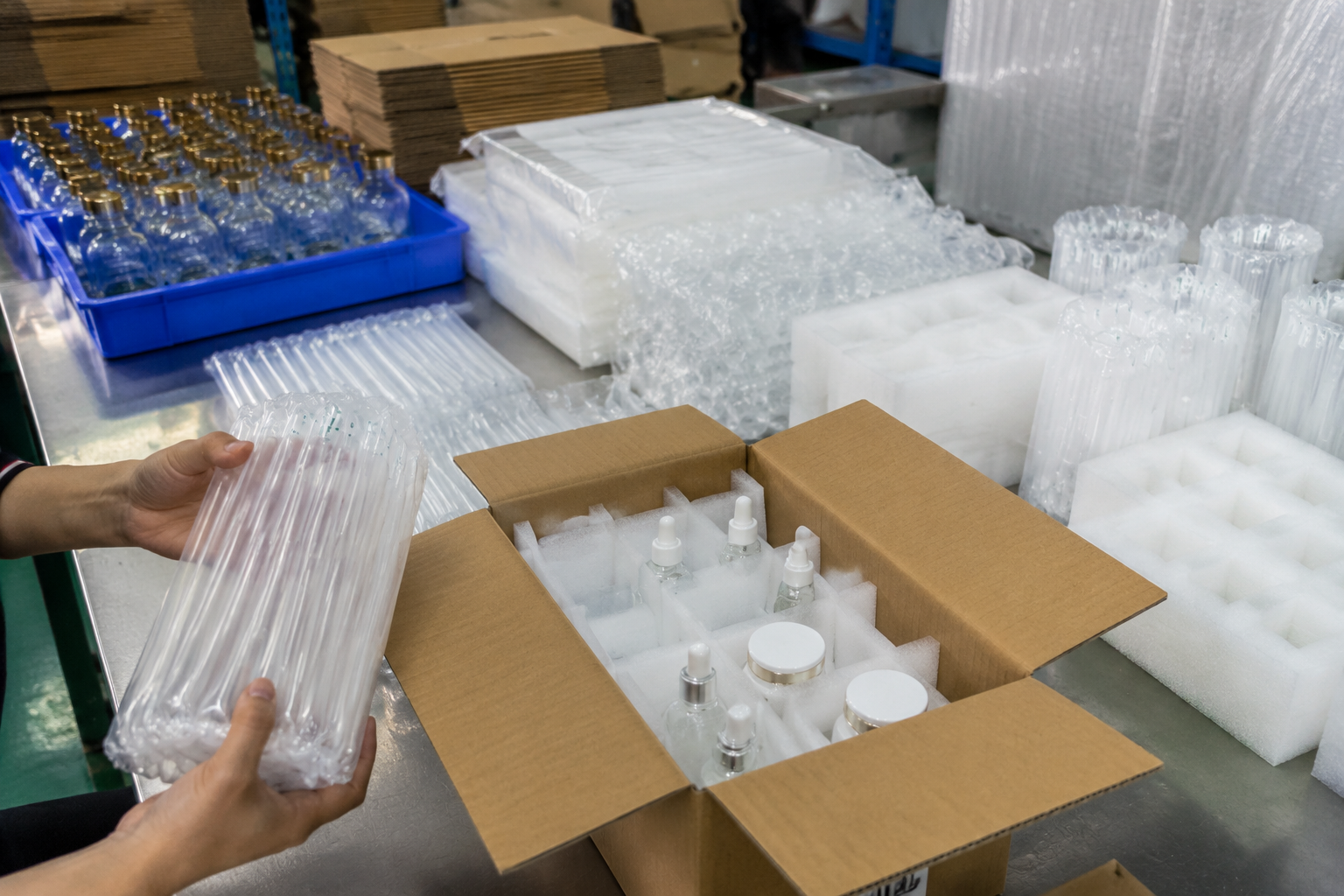
Protecting caps, pumps, labels, and decorated surfaces
Caps and pumps are often the first parts to suffer damage because they stick out from the main body. If they take a direct hit, the product may still look intact but become harder to use or less suitable for retail sale. Labels and decorated surfaces also need soft contact, since rubbing inside the carton can scuff printing, blur branding, or leave visible marks on the pack.
For this reason, the insert design should keep protruding parts from carrying load. A molded cavity, a foam ring, or a divider can create space around the cap or pump while the main body stays supported elsewhere. The same idea applies to glossy coatings and printed surfaces: the less direct friction they see, the better the product will look when opened.
When air column packaging fits bottle-shaped products
Air column packaging fits best when the product has a regular bottle-like shape and needs cushioning around the body. The inflatable structure can create a protective layer without adding much pre-formed bulk, which helps with carton efficiency and packing speed. It is especially useful when the bottle is individual, the shape is fairly consistent, and the shipping route includes handling that may cause repeated impact or vibration.
That said, the fit still has to be checked carefully. Tall bottles, short wide jars, and items with unusual neck or shoulder shapes may need a different structure. A good fit means the bottle sits securely inside the inflated support rather than floating loosely in the bag.
How plastic bags and liners help isolate leakage and dust
Plastic bags, liners, and film sleeves play a supporting role in this category. They can separate one container from another, reduce dust contact, and help contain minor leakage so it does not spread across the full carton. That makes packing and receiving easier, especially when many units are shipped together.
These materials should not be treated as a replacement for sealing or for proper cushioning. Their job is to isolate and protect the surface environment around the product. When they are used together with the right insert or cushioning layer, they help keep the carton cleaner, the products easier to handle, and the retail presentation more consistent.
Precision Parts Packaging: Clean Separation, Surface Protection, and Repeatable Bulk Packing
Precision parts packaging is often less about obvious fragility and more about controlled contact. A machined aluminum part, polished metal fitting, optical component, anodized housing, or small plastic assembly may survive a drop but still fail inspection because of scratches, dents, rubbed surfaces, deformation, or mixed parts in the carton. For many buyers, the damage complaint is not “broken in half.” It is “surface finish rejected,” “corner marked,” “parts mixed,” or “quantity hard to verify.”
This is why packaging for precision parts needs organization as much as cushioning. Bulk packing loose parts into one bag or carton may look efficient at first, but sharp edges, hard surfaces, and stacking pressure can create quality issues during storage and transport. A better structure may use individual plastic bags, foam sheets, foam trays, film protection, carton dividers, or custom protective packaging that keeps each item separated and countable.
Repeat-order consistency also matters. Precision parts often have fixed dimensions, fixed packed quantities, and regular reorder schedules. Once the buyer confirms a working packing method, the supplier should be able to repeat the bag size, foam thickness, tray cavity, carton layout, and packing count without changing the workflow each time.
Preventing scratches from part-to-part contact
Many precision parts are damaged because similar hard surfaces rub against each other during vibration, carton movement, or manual handling. This is common with machined components, anodized parts, polished metal pieces, optical parts, plastic housings, and assemblies with coated surfaces. Even if the part is structurally strong, the surface may not tolerate direct contact.
Individual plastic bags are a simple way to reduce rubbing and keep dust away from each part. For parts with more sensitive finishes, a film sleeve, foam pouch, or foam sheet between layers can provide softer contact. When the part has sharp corners or edges, foam separators or cavity trays can keep those edges from pressing into neighboring pieces.
The right choice depends on the part shape and finish. A flat polished plate may need interleaving sheets and firm carton support. A small metal bracket may need separated cavities to prevent tangling. A plastic precision part may need a soft bag first, then a divider or tray to avoid compression marks. The goal is not to add material everywhere, but to place separation where contact would create a quality problem.
Keeping small or similar parts organized
Small parts create another risk: packing confusion. When different versions, sizes, left-right pairs, or similar-looking components are packed together without clear separation, the buyer may face sorting work, count disputes, or assembly delays. Packaging should help the warehouse identify, count, and remove parts without damaging them.
Foam trays, separated cavities, carton dividers, and labeled bags can all help. A foam tray is useful when each part needs its own position and the quantity per layer should stay fixed. Plastic bags work well when parts are grouped by model, color, finish, or order line. Corrugated dividers can separate larger quantities inside a carton when the part is not highly sensitive but should not be loose packed.
Carton layout should be confirmed before bulk production. Buyers should check how many parts fit per layer, how many layers fit per carton, whether top and bottom protection are needed, and whether the carton can be opened and checked without disturbing the whole packing structure. Good precision parts packaging should protect the parts and make receiving inspection easier.
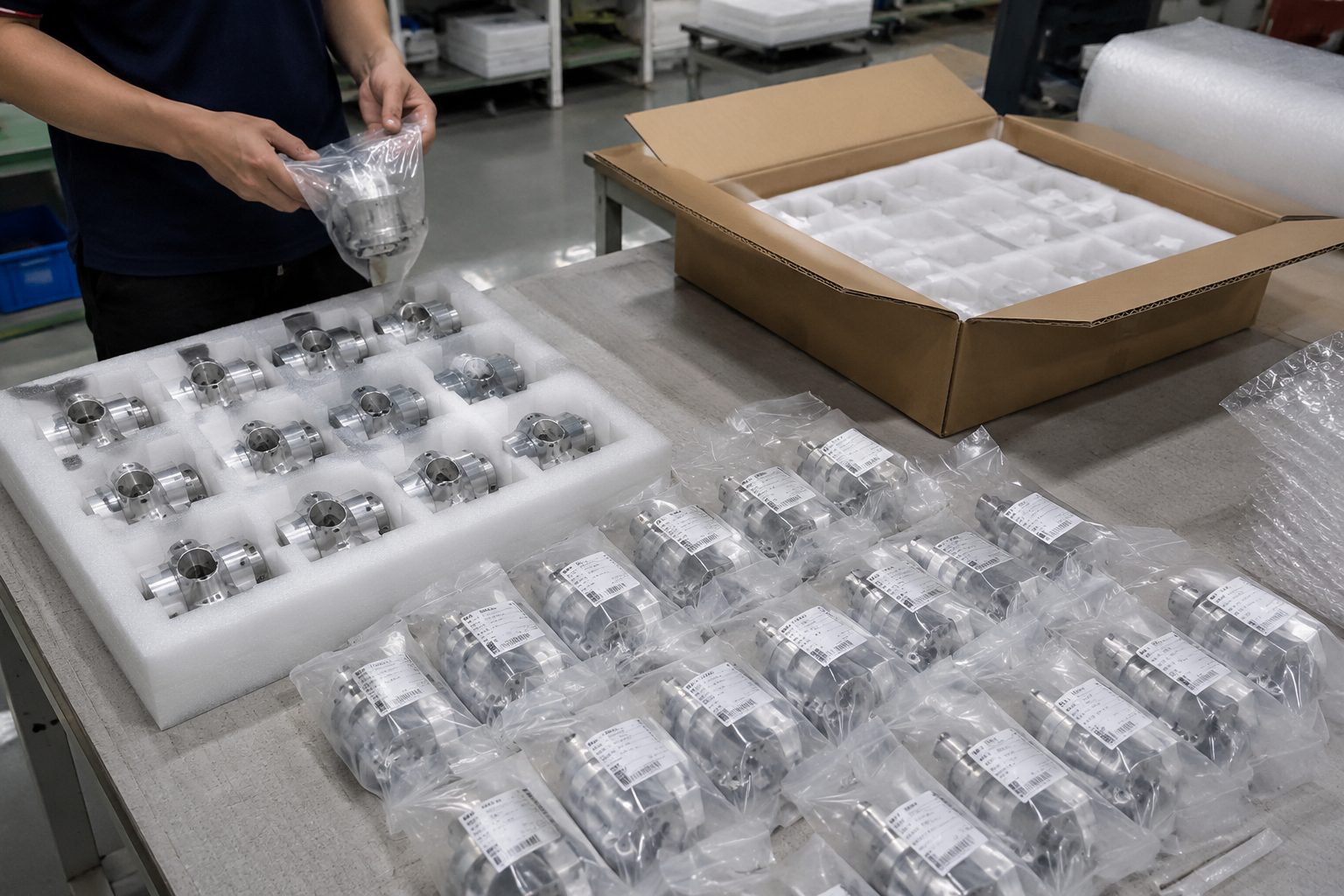
Balancing protection with packing speed
Overly complex packaging can protect the part but slow the packing line. If each small component requires multiple wrapping steps, special folding, tight taping, and careful placement, labor cost may rise and packing consistency may drop. Warehouse teams also need to unpack the goods efficiently at the destination.
A practical structure balances protection, labor, and repeatability. For example, a foam tray with cut cavities may cost more than loose foam sheets, but it can make placement faster and reduce packing decisions for repeat bulk orders. A simple bag plus divider may be better for lower-risk parts because it protects the surface while keeping the packing process quick. For heavy parts, stronger separation may be needed so that the lower layers do not carry excessive pressure.
Before confirming the design, buyers should test the packing workflow: how the operator inserts the part, whether the part shifts when the carton is moved, whether the surface touches any hard edge, and whether the receiving team can remove the part without scraping it. The best structure is not always the most complicated one. It is the one that protects the part reliably while fitting the real packing process.
How Foam Inserts, Air Column Bags, Bubble Wrap, Plastic Bags, and Cartons Work Together
Custom protective packaging materials work best when each layer has a clear job. One material rarely solves every risk. A plastic bag may protect the surface from dust and light rubbing, but it does not position a heavy part. Bubble wrap can cushion a flexible range of products, but it may not prevent movement in a large carton unless the void space is controlled. EPE foam packaging can hold a product in place, but the outer corrugated box still needs enough strength for stacking, handling, and export movement.
A useful packaging structure usually starts at the product surface, then adds positioning, cushioning, void control, and outer carton support. The inner layer protects against scratches, dust, or surface contact. The cushion layer absorbs impact and reduces movement. The outer box contains the packed goods, supports stacking, and carries carton marks or shipping labels. For high-value products, these layers should be selected as a system rather than as separate material purchases.
| Material | Main role | Best-fit use | Common limitation | Common pairing |
|---|---|---|---|---|
| EPE foam inserts | Positioning, cushioning, separation | Electronics, instruments, precision parts, shaped products | Needs accurate dimensions and confirmed fit | Plastic bag, carton, top pad |
| Air column packaging | Inflatable impact protection | Bottles, cylindrical products, selected fragile items | Not suitable for every shape or sharp edge | Inner bag, corrugated box |
| Bubble wrap | Flexible wrapping and light-to-medium cushioning | Irregular products, small fragile goods, carton filling | Protection depends on wrapping consistency | Plastic bag, carton, divider |
| Plastic bags and films | Dust, scratch, and surface separation | Finished surfaces, accessories, grouped parts | Limited cushioning by itself | Foam, bubble wrap, carton |
| Corrugated boxes | Outer containment and stacking support | Export cartons, e-commerce shipments, warehouse storage | Cannot replace proper inner protection | All inner protective layers |
The table is a starting point, not a fixed formula. A lightweight plastic accessory may only need a bag, bubble wrap, and a properly sized carton. A heavy instrument may need a shaped EPE foam insert, top and bottom pads, accessory slots, and a stronger corrugated carton. A glass bottle may fit air column packaging well, but the carton still needs to control movement and compression.
When several materials are used together, buyers should ask how each layer will be produced, packed, and checked. A foam insert may be cut at one size, a plastic bag may be sealed at another size, and the outer carton may have its own quantity and marking requirements. If these details are confirmed separately without checking the assembled pack, the final carton can become too tight, too loose, or difficult for the packing team to repeat.
EPE foam inserts for shaped support and repeatable packing
EPE foam inserts are useful when the product needs fixed positioning, corner support, surface separation, and repeatable packing. The insert can be cut into cavities that match the product shape, with room for accessories, cables, handles, or small parts. For heavier or irregular items, layered foam can create bottom support, side protection, and a top pad that keeps the product stable when the carton is closed.
The important design point is where the foam supports the product. Good foam packaging should support stronger areas and avoid pressing directly on screens, lenses, knobs, thin edges, or delicate protrusions. Buyers should provide dimensions, weight, photos, and weak-point details before sample production. Small changes in product size can affect cavity fit, packing speed, and carton layout.
For repeat orders, foam inserts can reduce variation at the packing table. Operators place the product into the same position every time, accessories go into the same slots, and the carton layout stays consistent. This can be helpful when bulk packing needs stable quality and predictable carton quantities.
Air column packaging for inflatable impact protection
Air column packaging is often useful for bottle-shaped products, cylindrical containers, and selected fragile items where inflatable protection can surround the product body. It is also space-efficient before inflation, which can help with storage and material handling at the packing site. Once inflated, the air columns create a cushion around the product and help reduce impact during shipping.
The fit should be confirmed before bulk use. Air column bags do not suit every product shape, especially items with sharp edges, wide protrusions, unstable caps, or uneven profiles that prevent even support. The buyer should check product height, diameter, cap shape, packed quantity, and carton size. Inflation quality also matters because underinflated or overinflated packaging can change protection and carton fit.
Air column packaging often works best with a properly sized corrugated box. If the outer carton is too large, the packed unit can still move. If the carton is too tight, pressure may transfer to the product or closure. The inner inflatable structure and outer box need to be reviewed together.
Bubble wrap and air cushion materials for flexible cushioning
Bubble wrap is flexible and useful for wrapping irregular products, separating surfaces, filling small voids, and adding cushioning around light-to-medium weight items. It can be supplied as rolls, sheets, or bags depending on the packing process. For products that change shape or size across orders, bubble wrap may be easier to use than a fixed insert.
Air cushion materials, such as air pillows or similar void-fill formats, can help fill carton space and reduce movement for lighter products. They are often more useful for void filling than for precise positioning. If the product is heavy, sharp, or highly sensitive, buyers should check whether flexible cushioning alone is enough.
The main risk with loose wrapping is inconsistency. Two operators may wrap the same product differently, use different layers, or leave different carton gaps. If the product is fragile or high value, the packing method should be written clearly: wrap direction, number of layers, tape method if used, carton position, and whether extra pads or dividers are required.
Plastic bags, films, and sleeves for surface and dust protection
Plastic bags, film sleeves, and protective films are usually inner-layer materials. They help reduce dust, light moisture exposure where appropriate, surface rubbing, and direct contact with other packaging materials. For electronics, accessories, finished metal parts, cosmetic containers, and retail-facing goods, this inner layer can prevent small surface defects that cushioning alone may not address.
These materials should not be treated as impact protection by themselves. A bag can separate and protect the surface, but it does not hold a product in place inside a carton. A film sleeve can protect a finish, but it does not absorb a drop. For this reason, bags and films are commonly paired with foam inserts, bubble wrap, air column packaging, dividers, or corrugated boxes.
Buyers should confirm bag size, film thickness, opening direction, sealing method if needed, and whether the product must be easy to insert and remove. A bag that is too tight can slow packing or rub against the finish. A bag that is too loose may wrinkle, shift, or interfere with insert fit.
Corrugated boxes as the final protective layer
Corrugated boxes are the final protective layer, but they are not just containers. The carton controls outer dimensions, stacking strength, packing quantity, label placement, and handling during storage or export shipping. Even strong inner packaging can fail if the carton collapses, is oversized, or allows the contents to shift.
Carton size should match the inner protective structure. Too much empty space requires more void fill and may increase shipping cost. Too little space can compress foam, air columns, bubble wrap, or product edges. For export handling, buyers should also consider carton marks, pallet preparation, loading conditions, and whether the carton will face long storage or multiple transfer points.
Corrugated packaging is widely discussed as a recyclable packaging format, but buyers should still match recyclability language to the destination recovery system and the exact finished structure. The Fibre Box Association provides corrugated recyclability context, while environmental marketing guidance from the FTC Green Guides shows why claims such as “recyclable,” “compostable,” or “eco-friendly” should be qualified when conditions or material combinations affect consumer understanding.[4][5]
As a China packaging materials supplier, Daipak often helps buyers compare the full structure rather than only one material. Foam, bubble wrap, air cushion packaging, plastic film, and corrugated boxes can each perform well when used for the right job. The practical question is how they work together around the product, carton, packing method, and shipping route.
Where Buyers Often Underestimate Packaging Cost and Damage Risk
Protective packaging cost is not only the unit price of foam, bubble wrap, bags, or cartons. The real cost includes packing labor, carton size, storage volume, damage claims, replacement product cost, repacking work, and the time spent correcting inconsistent packing. A low material price can become expensive if it creates higher damage risk or slows the warehouse.
Buyers often compare two packaging options by material cost alone. That can work for simple, low-risk products, but it can mislead decisions for electronics, glassware, instruments, bottles, cosmetics, and precision parts. For these products, the packaging structure affects how fast operators pack, how tightly cartons fit, how much space the shipment uses, and how consistently the goods arrive.
The goal is not to choose the most expensive structure. Some products do not need custom inserts. Bubble wrap, air cushions, plastic bags, and a suitable carton may be enough for flexible, lower-risk packing. Other products benefit from a more controlled structure because movement, surface contact, or inconsistent wrapping creates repeated problems. The best cost decision comes from comparing total risk, not only unit material price.
Why low unit price can create higher total cost
A cheaper loose-wrap method may save material cost on paper, but it can require more labor at the packing table. Operators must decide how much material to use, how to wrap each part, where to place it, and how to fill the remaining carton space. If those steps are not consistent, the same product may receive different protection from one carton to another.
Inconsistent packing can create hidden costs. Products may arrive scratched, dented, cracked, or mixed. Warehouse teams may need to repack goods before resale. Customer claims may require replacement shipments. Export buyers may lose time communicating about damage that could have been reduced by better separation, carton fit, or packing instructions.
Custom foam, trays, or dividers may cost more upfront, but they can reduce decisions during packing for products with stable dimensions and repeat orders. The value comes from repeatable placement, fewer loose components, and a clearer packing standard. For lower-risk products or changing product sizes, flexible materials may still be the more practical choice.
How carton size and material volume affect shipping cost
Overpacking can also raise cost. A large carton filled with excessive cushioning may look safe, but it can increase dimensional weight, use more pallet space, and take up more warehouse storage. If cartons are too large for the packed product, the goods may still shift unless the void is controlled correctly.
Material volume matters before and after packing. Bubble wrap rolls, foam sheets, inflated air cushions, and large cartons all require storage space. Air column or air cushion materials may save storage space before inflation, but the final packed carton still needs the right dimensions. Foam inserts provide controlled positioning, but the design should avoid unnecessary thickness that enlarges the carton without improving protection.
For bulk packaging orders, buyers should review the full packed size: product dimensions, inner protection thickness, carton quantity, carton dimensions, pallet pattern, and container or courier requirements where relevant. A small change in carton size can affect shipping cost more than a small change in material price.
When custom inserts can improve packing efficiency
Custom inserts can improve packaging efficiency when the product repeats often, has a fixed shape, includes accessories, or needs precise positioning. Instead of asking operators to wrap and judge each unit individually, the insert gives a defined location for the main product and related parts. This can reduce packing variation and make carton checks easier.
For example, an electronic device with cables and adapters may use foam cavities to keep the set organized. A precision part may use a tray layout so each carton contains a fixed count. An instrument may need bottom support and a top pad so it does not shift during export handling. In these cases, the insert does more than cushion the product; it simplifies the packing process.
Custom inserts are not the right answer for every product. If product dimensions change frequently, if order quantities are small, or if the damage risk is low, a flexible structure may be more efficient. Buyers should compare sample fit, packing speed, carton layout, storage needs, and expected handling risk before deciding. The strongest packaging choice is the one that protects the product while keeping the operation practical.
What to Prepare Before Requesting a Custom Protective Packaging Quote
A useful custom protective packaging quote starts with product details, not only with a material request. If a buyer asks for “foam packaging” or “air column bags” without explaining the product size, weight, surface condition, and shipping method, the supplier can only make a rough suggestion. That often leads to extra emails, unclear samples, or a package that protects one risk while ignoring another.
Before contacting Daipak or another packaging materials supplier in China, buyers should prepare enough information for the supplier to understand how the product can fail during packing, storage, and transportation. A glass bottle, a control unit, a testing instrument, and a polished metal part may all need protection, but they do not need the same structure. The more clearly the product risk is described, the easier it is to compare foam inserts, bubble wrap, air column packaging, plastic bags, liners, and corrugated cartons in a practical way.
Traceability From First Quote to Sample Approval
For Daipak packaging projects, the clearest traceability starts with the buyer’s original product data and ends with one approved sample or drawing. The supplier should be able to point back to the source of the recommendation: product size, weight, photos, weak points, packing quantity, shipping route, and destination handling conditions. That gives the recommendation a practical basis, because the proposed material choice is tied to confirmed product information rather than to a generic packaging label.
Once the quote is issued, the sample or drawing should become the reference point for later checks. If the approved version specifies cavity depth, bag size, carton dimensions, label position, or packed quantity, those details should be carried into production. This makes the order easier to control because the buyer can compare the finished pack against one agreed reference instead of relying on memory or a verbal description.
Product information the supplier needs first
The first information to prepare is the basic product specification: length, width, height, weight, and general shape. For irregular items, photos from several angles are often more useful than a simple dimension list. If the product has handles, screens, caps, ports, lenses, sharp corners, thin edges, or removable accessories, those details should be visible in photos or drawings.
Weak points matter as much as overall size. A product may be strong in the main body but fragile at one corner, one attached fitting, or one decorated surface. For example, an instrument may need support under a rigid base while avoiding pressure on a display. A cosmetic bottle may need protection around the cap and label area. A precision part may need separation because the surface finish is more important than impact resistance.
Buyers should also explain the surface requirement. If scratches, dust, fingerprints, rubbing marks, or coating damage are not acceptable, the supplier may recommend a plastic bag, film sleeve, foam sheet, soft pouch, or another inner barrier before the cushioning layer. If the product includes accessories, cables, tools, caps, inserts, or manuals, the supplier should know whether those items need separate cavities, bags, dividers, or grouped packing.
A practical information set usually includes:
- Product dimensions and weight: needed to estimate foam thickness, air column size, carton space, and compression risk.
- Photos or drawings: useful for identifying protruding parts, weak areas, and surface-contact points.
- Fragile or sensitive areas: screens, glass, edges, lenses, caps, pumps, coatings, polished surfaces, or sharp corners.
- Accessories and packed set details: important for cavity layout, bag grouping, and carton organization.
- Surface protection needs: helps decide whether bags, films, foam sheets, or soft wrapping should be used before cushioning.
- Packaging goal: retail presentation, warehouse storage, e-commerce shipping, wholesale cartons, or export packing.
Shipping and packing details that change the recommendation
The same product may need different packaging depending on how it will ship. A single e-commerce parcel handled by courier has different risks from a master carton shipped on a pallet. Courier shipments often face more individual drops and sorting impacts. Export cartons may face compression, container loading, pallet movement, and longer storage time. Warehouse transfer may require faster packing and clear quantity control.
Buyers should tell the supplier how many units will be packed per inner box, master carton, or pallet if that information is already known. Quantity per carton affects divider design, foam cavity layout, carton size, and total weight. If the carton becomes too heavy, the inner packaging may still look correct while the outer carton becomes difficult to handle or more vulnerable to compression.
Shipping destination and handling conditions also matter. Long-distance export shipping, repeated warehouse transfers, humid storage areas, pallet stacking, and mixed-load transport can all influence material choice. Protective packaging does not replace proper product sealing or careful logistics, but it can be designed more realistically when the supplier understands the route and handling environment.
If the packaging is for e-commerce fulfillment, packing speed may become a major decision point. A structure that looks protective but requires too many manual steps can slow the warehouse team. If the packaging is for repeat wholesale or export orders, consistent carton layout, carton marks, and pallet preparation may be more important than a very decorative inner pack.
Export buyers should also clarify whether packaging materials will ship to their own factory for packing, to a contract manufacturer, or as part of a finished-goods shipment. This affects how materials should be packed, labeled, bundled, and counted. Foam inserts may need nesting direction, plastic bags may need clear bundle counts, and cartons may need marks that match the buyer’s internal receiving system. These details do not change the protective function, but they can prevent delays and confusion when the goods arrive at the warehouse.
Sample confirmation before bulk production
Sample confirmation should check more than whether the product “fits.” A good sample review looks at fit, removal, surface contact, carton layout, and packing workflow. If the product is difficult to insert, the foam grips too tightly, the air column presses on a weak cap, or the bag creates wrinkles against a decorated surface, the structure may need adjustment before bulk production.
Buyers should test how the package works in the real packing sequence. For example, confirm whether the product goes into a plastic bag first, then into a foam insert, then into an inner box or export carton. Check whether accessories stay in place after the carton is moved. Look for contact between products, between the product and carton wall, and between the product and any hard edge inside the package.
Sample checking should also include carton-level review. The buyer should confirm packed quantity, carton dimensions, carton weight, void space, closure method, carton marks if required, and whether the carton can be handled safely by warehouse staff. If the sample is approved without checking these details, small problems can become expensive when the same structure is repeated across a bulk order.
When a buyer wants evidence beyond a handling check, the sample can be treated as the starting point for a written validation plan. A practical plan may define the product configuration, carton size, cushioning material, packed quantity, closure method, handling route, and pass/fail observations before any vibration, compression, or parcel simulation is requested; this keeps the test result connected to the real package instead of to a material name alone.[1][2][3]
At Daipak, the quotation discussion usually becomes more accurate after product details and sample expectations are clear. The goal is not to ask buyers for unnecessary technical data, but to make sure the recommended structure can be sampled, checked, and repeated with fewer surprises.
Specification Confirmation Note: Before production, Daipak recommends confirming size, thickness or density direction, structure, quantity, printing, labels, packing method, carton marks, and sample expectations so the approved pack can be repeated more consistently in bulk orders.
From Approved Sample to Production and Packing Checks
Once a sample is approved, the confirmed version should become the production reference. Cutting, sealing, bonding, folding, printing, and carton assembly should be checked against the same sample, drawing, or signed order detail so the finished product matches the agreed structure. If the pack includes accessories, the inner cavity layout and packing count should also stay aligned with the confirmed version.
This is where traceability becomes practical rather than bureaucratic. The buyer can ask which size, which material thickness or density, which label position, which carton mark, and which packing quantity were used for the approved order. That makes it easier to compare later deliveries, spot changes early, and keep the next repeat order on the same standard without reworking the whole specification.
Claim-Sensitive Specifications to Put in Writing
Before bulk production, buyers should separate ordinary packaging specifications from special claims or regulated requirements. Ordinary specifications may include size, thickness, cavity shape, sealing method, print color, carton quantity, and pallet arrangement. Special claims may involve food contact, anti-static performance, moisture barrier expectations, recycled content, compostability, recyclability, or destination-market labeling. These should be confirmed in writing because the same material name can describe different grades, additives, coatings, and documentation levels.
Daipak Packaging can support product-matched protective packaging discussions, but the buyer should provide the intended use and any required documentation before production starts. If a claim will appear on retail packaging, shipping documents, product listings, or customer-facing materials, the claim should match the exact finished packaging structure and the market where it will be used. This helps avoid overpromising while keeping the specification practical for purchasing, sampling, and repeat orders.
How a China Packaging Materials Supplier Supports Custom Protective Packaging Projects
A China packaging materials supplier can support a custom packaging project in several ways: material recommendation, sample development, specification confirmation, production coordination, packing review, and shipment preparation. For overseas B2B buyers, the main value is not only buying one material at a low unit price. It is getting a packaging structure that matches the product risk, packing method, and order requirements.
Daipak Packaging, as a protective packaging manufacturer, works across foam, bubble wrap, air cushion materials, plastic bags and film, and corrugated boxes. That matters because many high-value products need combined packaging. If a supplier only focuses on one material, the recommendation may miss the role of inner surface protection, carton strength, void filling, or fixed positioning.
Material recommendation across foam, air cushion, film, and corrugated packaging
Material selection should start from the product, not from a fixed preference. EPE foam may be useful when the product needs shaped support, repeatable cavities, corner protection, or separation between accessories. Air column packaging may work well for certain bottle-shaped or fragile units where inflatable cushioning can surround the product. Bubble wrap can be practical for flexible wrapping, light-to-medium cushioning, and carton filling. Plastic bags, sleeves, liners, and films help with dust control, surface separation, and inner grouping. Corrugated boxes provide the outer structure for packing, stacking, storage, and shipping.
The supplier’s role is to compare these options against the product’s real risks. A heavy machined part may need denser or thicker foam than a light plastic device. A glass bottle may benefit from air column protection, but the cap shape and bottle diameter still need to be checked. An electronic set may need a foam insert for the main unit and a separate bag or cavity for cables. A polished surface may need film or soft wrapping even when the cushioning layer is already strong.
This comparison also helps buyers avoid overpacking. More material is not always better. Extra wrapping can increase carton size, slow packing, and raise freight cost. At the same time, under-protection can create breakage, scratches, repacking, or customer claims. A practical custom packaging supplier should help the buyer find a workable balance between protection level, packing labor, carton size, and order budget.
Sample, specification, and bulk order coordination
Once a packaging direction is selected, the project needs clear specifications. These may include foam thickness or density direction, cavity dimensions, bag size, film thickness, bubble size, air column size, carton size, board type, packed quantity, printing or label requirements, and carton marks. The exact items depend on the packaging structure, but the principle is the same: the sample and the bulk order should be based on the same confirmed details.
Sample checking should be connected to production preparation. If the buyer changes the product size, adds an accessory, changes the packed quantity, or requests a different carton layout after sampling, the packaging may need to be adjusted. Even a small change in product height can affect foam cavity depth, carton closure, and pallet quantity.
From the operations side, Ms. Tang often keeps sampling, specification confirmation, and production preparation connected because these steps affect each other. Clear confirmation helps reduce avoidable changes after material has been prepared or production has started. This is especially important for repeat orders, where buyers expect the same packing method, size, appearance, and carton quantity to remain consistent over time.
Bulk order coordination also includes practical communication about packing method. The supplier should know whether packaging materials will be delivered flat, pre-formed, nested, inflated, bagged, bundled, or packed into cartons. This affects storage space, warehouse handling, and how easily the buyer’s team can use the materials on the packing line.
Quality review before shipment
Quality review for custom protective packaging begins with clear specifications and continues through production and packing. A final look at finished goods is useful, but it cannot replace earlier confirmation of size, material, cutting, sealing, bonding, printing, and carton requirements. If the specification is unclear, the finished product may look acceptable but still fail to fit the buyer’s product or carton layout.
Practical checks before shipment may include material appearance, dimensions, thickness or density direction where relevant, cutting accuracy, sealing quality, cavity fit, bag opening size, film roll condition, carton strength, packing quantity, outer carton marks, and pallet preparation when required. For foam inserts, the supplier may review whether the cavities are cleanly cut and whether the product can be placed without forcing. For plastic bags, sealing and size consistency matter. For corrugated cartons, folding, closure, printing, and carton condition should be checked.
For export packing, the shipment preparation details are also part of the buyer experience. Carton marks, item codes, packing quantity, and carton condition can affect warehouse receiving and repeat-order control. A packaging supplier does not control every part of international