
Choosing a China packaging materials supplier is not only about finding a factory that can quote foam, bubble wrap, cartons, film, or plastic bags. The bigger decision is whether the supplier can match materials to your actual product risk, packing method, carton space, shipping route, and repeat-order requirements. A good choice should help reduce scratches, impact damage, movement inside cartons, slow packing, and specification drift over time.
For many buyers, the first mistake is treating packaging as a generic purchase. In practice, the right choice depends on whether the product is rigid or flexible, coated or uncoated, heavy or light, and fragile in one spot or across the whole surface. A packaging supplier that understands those differences can often help the buyer avoid paying for material that looks suitable on paper but performs poorly during packing or shipping.
This guide helps buyers compare direct factories, trading companies, and single-product suppliers in a practical way. It also explains what information to prepare before requesting a quote, how to confirm samples, why written specifications matter, and how to judge total packaging cost beyond the material unit price. Daipak is discussed as a factory-side packaging partner for buyers who need multi-material protection, export packing coordination, and consistent repeat orders.
When buyers think this way, they usually get better answers from suppliers as well. The quotation becomes more realistic, the sample becomes more useful, and the final packing system is more likely to work the same way in production, warehouse handling, and export transit. That is especially important when the packaging is expected to protect a product across several handling stages rather than only during one short warehouse move.
Practical traceability starts at this first discussion. If the buyer provides product size, weight, photos, drawings, packing method, order quantity, and shipment destination, the supplier has a clearer basis for connecting the recommendation to the actual product instead of guessing from a material name alone.
For higher-risk export programs, buyers can also ask whether the proposed pack should be checked against a recognized transport-packaging test method instead of relying only on appearance or supplier experience. ASTM D4169 is a standard practice for performance testing shipping containers and systems, and ISTA Procedure 3A is commonly referenced for packaged products moving through parcel delivery systems; these references do not guarantee safe delivery, but they give buyers a more concrete way to discuss vibration, handling, compression, and shipment simulation when the product value or damage risk justifies formal validation.[1][2]
Quick Packaging Decision Guide
| Buyer Question | Practical Reading | What to Check |
|---|---|---|
| Should I choose a direct factory or a trading company? | Direct factories suit custom, repeat, or technical packaging orders; trading companies may help with mixed sourcing. | Customization ability, communication depth, sample control, and repeat-order records. |
| Is the supplier recommending a complete protection system? | Good packaging often combines surface protection, cushioning, void fill, cartons, labels, and pallet preparation. | How each layer handles scratches, impact, shifting, dust, compression, and export handling. |
| What should I send before asking for a quote? | Accurate details help the supplier avoid guessing and recommend workable materials. | Product size, weight, photos, fragility, finish, packing method, quantity, route, and existing samples. |
| How do I confirm custom packaging before bulk production? | Samples should be tested with the real product, carton, accessories, and packing workflow. | Fit, clearance, thickness, density, printing, carton strength, and written approval. |
| Is the lowest unit price actually cheaper? | A low material price can create higher costs through damage, rework, wasted carton space, or slow packing. | Total packaging cost, freight impact, packing speed, storage efficiency, and quality consistency. |
Quick Questions Before You Read
Q: Do I need custom packaging for every product?
Not always. Standard materials may work for simple products, but custom sizes, foam shapes, carton structures, or film specifications become important when fit, protection, packing speed, or repeat consistency matters.
Q: How can I compare China packaging suppliers fairly?
Compare how they ask about your product, shipping route, packing process, sample approval, quality checks, and repeat-order control, not only the product list or first quotation.
Q: Why should samples be tested with the real product?
Appearance alone is not enough. The sample must protect the actual product, fit the carton, work with accessories, and be practical for the packing line.
Q: What makes export packing different from domestic packing?
Export orders often face longer routes, more handling, carton stacking, pallet movement, labeling requirements, and higher communication risk, so specifications and records need tighter control.
Compliance Boundaries Buyers Should Confirm Early
Some packaging questions are not only technical. If the package will touch food, support medical or pharmaceutical goods, carry environmental claims, be used for hazardous materials, or protect electronics with special static-control needs, buyers should confirm the applicable requirement before production. A China packaging materials supplier can help review material, size, structure, and packing method, but the buyer should not treat a general packaging recommendation as official approval for a regulated use.
If packaging will contact food directly, the material, additives, inks, adhesives, and intended contact condition should be checked separately. Food-contact requirements may vary by market, material type, temperature, food category, and use condition; the European Commission and U.S. FDA both publish food-contact material information that buyers can use as part of their review process.[14][15] The supplier should describe the packaging material clearly, and the buyer should confirm whether additional documentation, testing, or market-specific review is needed before using the package for that application.
Environmental wording also needs careful handling. Words such as recyclable, compostable, biodegradable, or environmentally friendly should not be used broadly unless the buyer has support for the exact material, design, destination market, and disposal route. The same caution applies to moisture resistance, anti-static performance, heavy-duty stacking, and carrier damage reduction: these may depend on material grade, thickness, structure, closure method, carton fit, handling route, and validation method, so they should be confirmed for the actual order rather than assumed from the material name.
For regulated or higher-risk shipments, buyers should separate packaging supply from compliance responsibility. Daipak Packaging can discuss foam, bubble, film, corrugated, and custom packaging options, but it is not a regulator, certification body, or testing laboratory. Where special rules apply, buyers should confirm requirements with their internal compliance team, destination-market adviser, carrier, or qualified testing partner before finalizing the packaging specification.
What a China Packaging Materials Supplier Actually Does for B2B Buyers
Overseas buyers are usually not just buying foam, bubble wrap, plastic bags, or boxes. They are trying to reduce product damage, control packing cost, keep warehouse packing efficient, and make export shipments more predictable. A capable China packaging materials supplier should help connect those goals with the right materials, sizes, structures, packing method, and production details.
This matters because packaging performance depends on the product and the shipping situation. A lightweight apparel order may need poly mailers, garment bags, and efficient carton packing. A fragile glass item may need surface protection, cushioning, and a corrugated outer box that fits the internal protection properly. A heavy industrial part may need EPE foam separation, corner protection, and stronger export cartons. The supplier’s job is not only to quote a material, but to help the buyer decide whether that material will work in the real packing and shipping process.
A packaging materials supplier in China may support standard products, custom packing supplies, and bulk packaging orders, but the value is highest when the supplier can review the full packing system. This includes product contact protection, cushioning, void filling, outer cartons, labels, carton marks, pallet preparation, and repeat-order records. At Daipak, the discussion usually starts with the product details rather than the material name, because the same roll of foam or bubble wrap can perform very differently depending on weight, surface finish, carton space, and shipping distance.
That practical approach is useful because packaging problems are often cumulative. A product may look safe in one layer but still fail once it is packed, stacked, moved, and stored. A supplier that thinks only in terms of one material may miss the interaction between layers, while a supplier that thinks in terms of the whole packing system can usually give more reliable advice.
Traceability in this context is not a complicated system. It is the habit of connecting each recommendation back to the product information, the confirmed specification, the approved sample, the production method, the finished packing check, and the shipment preparation details so the buyer can see why a material was chosen and what production should follow.
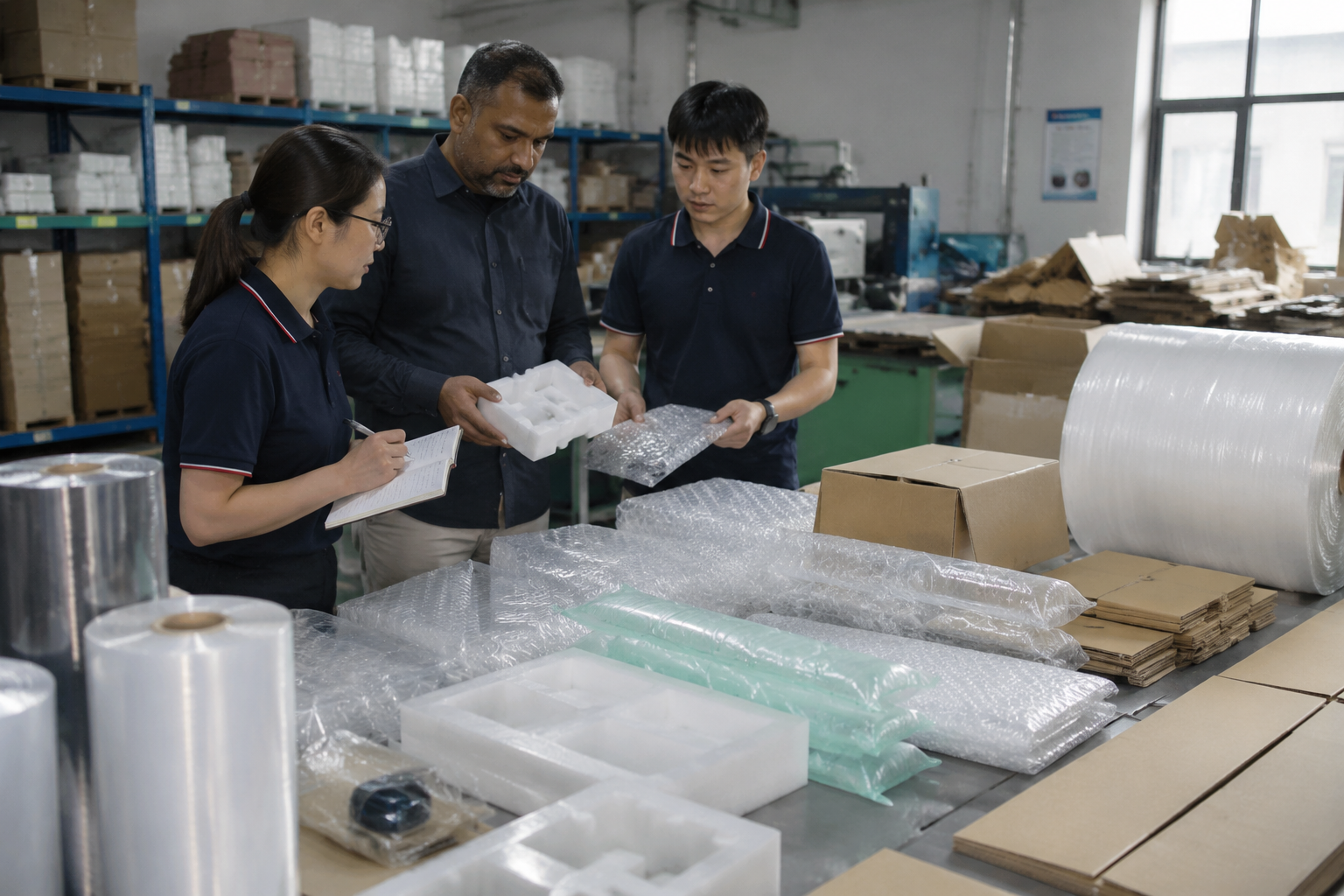
Packaging Materials Are Part of the Product Protection System
Packaging materials rarely work alone. Foam, bubble wrap, plastic film, bags, air cushions, and corrugated boxes often need to support each other. The inner layer may prevent scratches. The cushioning layer may reduce impact and vibration. The outer carton may resist compression and organize products for handling. Stretch film may help stabilize cartons on a pallet. If one layer is weak or poorly sized, the rest of the system may not perform as expected.
For example, EPE foam can separate parts, protect surfaces, and create shaped inserts for fragile or irregular products. Bubble wrap can provide flexible wrapping for light-to-medium fragile items and help fill carton space. Plastic bags and liners can protect against dust and handling marks. Corrugated cartons provide the outer structure for storage, e-commerce delivery, and export handling. A protective packaging manufacturer should understand where each material fits instead of treating every product as a single-material decision.
The main risk is not only breakage. Poor packaging can create scratches, crushed corners, loose movement inside the carton, slow packing, oversized cartons, unstable pallets, or receiving problems at the buyer’s warehouse. A buyer can usually avoid many of these issues by asking the supplier to review the product, inner packing, outer carton, and shipment method together.
It also helps to think about where the product touches packaging first. Some surfaces can tolerate light abrasion but not pressure. Others can tolerate pressure but not a sticky film or rough texture. A supplier that asks about finish, edge shape, and handling sequence is usually trying to match the protection layer to the actual failure risk, not just to the product category name.
Supplier Support Should Begin Before the Quote
A useful packaging quote starts before the price is calculated. The supplier should first understand the product size, weight, shape, fragile points, surface finish, packing method, carton size, order quantity, and shipping route. Without this information, the quote may be fast, but it may not be accurate or useful.
Product dimensions show whether the packaging needs to wrap, separate, suspend, fill, or hold the product in position. Product weight affects foam density, bubble size, carton strength, and how much movement can be allowed inside the box. Fragility affects whether the buyer needs simple wrapping, molded-style support, edge protection, or a combination of materials. Surface finish matters for coated, painted, polished, or easily scratched products because the packaging must protect the appearance as well as the structure.
The packing method also changes the recommendation. A warehouse team packing hundreds of e-commerce parcels per day may need easy-open bags, pre-cut sheets, or mailers that speed up work. A manufacturer packing heavy export goods may care more about repeatable foam inserts, stable carton quantity, and clear carton marks. If the supplier asks detailed questions early, it is usually a sign that they are thinking beyond a simple price list.
Buyers should also be ready to describe the handling conditions. A package that travels locally in small quantities may not need the same protection level as a carton that will be stacked, transferred, and stored for a long export route. The shipping environment changes how much compression, vibration, and abrasion the materials need to absorb, so the supplier’s questions are not delay for delay’s sake; they are part of selecting the correct structure.
The same early questions also create a simple order trail. When the quote states which product size, material thickness, foam density, bag structure, carton dimension, label, and packing quantity it is based on, the buyer can later compare the sample and bulk order against the same starting point.
Why Overseas Buyers Need More Than a Price List
A price list can show a starting point, but it cannot confirm whether the packaging will fit the product, fit the carton, support the packing workflow, or handle export conditions. Two suppliers may quote the same product name, such as “foam sheet” or “poly mailer,” while using different thicknesses, densities, materials, sealing methods, printing details, or packing quantities. The lower unit price may not be comparable if the specification is different.
Overseas buyers also need information that affects real order execution: sample options, production tolerance, packing method, carton dimensions, labels, shipping marks, and repeat-order control. A custom packaging supplier should help clarify these details before bulk production, especially when the buyer needs custom sizes, printed bags, foam inserts, air column packaging, or custom corrugated boxes.
For a bulk packaging order, the final decision should balance price, fit, protection, packing speed, and consistency. A low-cost material can become expensive if it causes rework, product claims, slow packing, or frequent specification changes. The better question is not only “What is the unit price?” but “Will this packaging work reliably for our product, carton, warehouse process, and shipping route?”
That is also why the quotation stage should be treated as a technical discussion. If the supplier only responds with a number and no follow-up questions, the buyer may still be missing the real risk points. A careful supplier usually wants enough detail to reduce assumptions before the quote becomes a commitment.
How to Match Supplier Capability with Your Packaging Application
Different packaging applications require different supplier capabilities. A buyer should not only ask, “Can you make this?” The more useful question is, “Can this supplier support my product type and shipping risk reliably?” A custom packaging supplier that works well for lightweight apparel may not automatically be the right fit for fragile machinery parts, and a supplier focused on one standard material may not be able to coordinate a complete protective packaging structure.
The application should guide the supplier evaluation. Product weight affects material strength and carton pressure. Fragility affects cushioning and movement control. Surface finish affects whether the packaging needs soft contact protection. Moisture sensitivity may require liners or film protection, depending on the product and storage conditions. Carton space affects freight cost and void fill choice. Packing speed affects whether pre-made bags, cut sheets, rolls, or inserts make more sense on the packing line.
A good packaging materials manufacturer will ask about the product and the process before making a final recommendation. The supplier should be able to explain why EPE foam, bubble wrap, air cushion packaging, plastic film, or corrugated cartons are suitable for a specific use, and where those materials may not be enough. The goal is not to choose the most familiar material. The goal is to choose packaging that matches the actual handling, storage, and shipping risk.
This is one of the easiest ways for buyers to separate practical suppliers from purely transactional ones. If the recommendation changes when the product description changes, that is normal. If the supplier gives the same answer regardless of product type, handling method, or carton requirement, the buyer should be cautious.
Application-based traceability is useful because it shows the reason behind each choice. If foam density was selected because of product weight, or a bag thickness was selected because of sharp edges and sealing needs, that reason should be visible in the specification so later production and repeat orders do not drift away from the original protection logic.
Fragile Products Need Cushioning and Structure
Fragile products usually need more than soft material around the outside. They need controlled movement, enough clearance, and a structure that keeps high-risk areas away from direct impact. A glass item, electronic component, ceramic product, or coated part may need surface protection first, then cushioning, then a carton that holds the protective layers in place.
EPE foam can be useful when the product needs shaped protection, corner support, separation, or a stable insert. Bubble wrap can work well for flexible wrapping and light-to-medium cushioning, especially when the product shape is simple or when the warehouse needs a fast wrapping method. Air cushion packaging and air column bags can help with lightweight cushioning and void filling in selected shipping applications. Corrugated cartons provide the outer structure, but the internal protection must prevent the product from moving too much inside the box.
The trade-off is between protection, carton size, packing labor, and material cost. Too little cushioning increases damage risk. Too much bulky protection can increase carton volume and freight cost. A custom protective packaging factory should help the buyer test the balance with the real product and carton, not only with a drawing or rough size estimate.
When fragile products have mixed risk points, it may be better to combine a few materials instead of trying to force one material to do everything. A foam pad can protect one edge, a bubble layer can prevent abrasion, and a carton can manage shipping load. The right combination is usually simpler than a heavy overbuild, but it still needs to be confirmed with the real product in hand.
E-Commerce Packaging Needs Speed and Consistency
E-commerce packaging has a different pressure point: repeatable packing speed. Online sellers often handle many small orders, changing SKUs, and tight dispatch schedules. The packaging needs to protect the product, but it also needs to be easy for warehouse staff to use without slowing down the line.
For apparel and soft goods, garment bags, poly mailers, courier bags, and inner plastic bags may be more important than heavy cushioning. For small fragile products, the seller may need bubble bags, bubble wrap sheets, air pillows, or small corrugated mailer boxes. For mixed orders, carton filling and product separation can matter because items may move against each other during parcel handling.
Consistency is especially important for e-commerce operations. If bag size changes slightly, labels may not fit well or packed products may look uneven. If mailer sealing quality is inconsistent, parcels may open during handling. If void fill is difficult to use, packing time increases. A supplier that understands e-commerce orders should be able to discuss packing workflow, not only material type.
In practice, e-commerce teams often care about the time cost of each extra action. A package that saves a few cents but requires fiddly sealing or repeated inspection can be more expensive than a slightly better-specified mailer or box. The supplier should understand that speed and repeatability are part of the packaging specification, not an afterthought.
Industrial and Export Goods Need Repeatable Specifications
Industrial and export goods often place heavier demands on specification control. A machinery part, metal component, lighting product, tool, or assembled unit may be heavier, less forgiving, and more exposed to long-distance handling. For these products, the buyer should confirm dimensions, material thickness, foam density, carton strength, packing quantity, and carton marks before approving bulk production.
Repeatability matters because a small specification change can create large packing problems. If a foam insert is cut too loose, the product may shift inside the carton. If the film or bag thickness is reduced, tearing may increase during packing. If the corrugated carton size changes, pallet efficiency and container loading may be affected. If the packing quantity per carton is unclear, the buyer’s warehouse may face receiving and inventory problems.
For export cartons, the inner protection and outer carton should be reviewed together. Heavy products may require stronger separation and better carton fit. Products with sharp edges may need pads, corner protection, or thicker bags. Long-distance shipping and multiple handling points can increase compression, vibration, and abrasion risk. The supplier’s capability should match those realities, especially for repeat orders where the same packaging needs to perform consistently across batches.
Where export destinations involve more stacking or more carrier transfers, buyers should ask whether the carton dimensions and closure style still make sense. A carton can be technically correct yet inconvenient if it is awkward to palletize, difficult to label, or too weak at the seams for the way the shipment will be handled.
For these orders, traceability should connect the approved sample or drawing to production checks such as cutting size, foam slot accuracy, sealing strength, carton forming, label placement, carton marks, and final packing quantity. That connection makes it easier to see whether the finished shipment matches what was approved, rather than only whether it looks generally similar.
Factory, Trading Company, or Single-Product Supplier: Which One Fits Your Order?
Overseas buyers looking for a China packaging materials supplier will usually meet three common sourcing options: a direct packaging factory, a trading company, or a single-product supplier. None of these is automatically right or wrong. The best choice depends on the buyer’s product range, customization needs, communication requirements, order volume, and how much packaging coordination is needed.
A direct factory supplier can be useful when the buyer needs custom sizes, sample refinement, production control, and direct technical discussion. A trading company may help when the buyer is sourcing many unrelated items and wants one communication channel. A single-product supplier can work well when the buyer only needs one standardized packaging material with limited customization. The trade-off is usually between convenience, technical depth, specification control, and coordination across materials.
| Supplier Type | Best Fit | Main Trade-Off to Check |
|---|---|---|
| Direct packaging factory | Custom packaging, repeat orders, technical specification control, coordinated protective packaging | Product range and export communication should match the buyer’s needs |
| Trading company | Highly mixed sourcing across many product categories | Extra communication layers may affect specification accuracy and response detail |
| Single-product supplier | One standard material, simple repeat purchase, limited customization | May not support full packing system planning across foam, bags, film, and cartons |
The buyer should compare suppliers based on the order’s real requirements. If the project involves foam inserts, bubble wrap, plastic bags, corrugated cartons, and export packing details, a multi-category factory-style supplier may make communication and specification control easier. If the order is only one standard roll size or one bag size, a narrower supplier may be enough.
It is often helpful to think about what kind of mistake would be most costly. If the biggest risk is a wrong size or wrong structure, direct technical communication usually matters more. If the biggest risk is fragmented purchasing across many unrelated items, coordination convenience may matter more. The best supplier type is the one that reduces the specific risk in your order.
Factory Coordination Note: When an order uses foam, bubble wrap, plastic film, bags, and corrugated cartons together, buyers should confirm who coordinates each layer, how changes are recorded, and whether the final packout is reviewed as one system before production moves forward.
When a Direct Factory Supplier Is the Better Fit
A direct factory supplier is often the better fit when the packaging needs to be made to the product, not simply selected from stock. Custom foam inserts, printed poly mailer bags, bubble bags, custom carton sizes, and combined protective packaging all require specification discussion. The buyer may need to adjust dimensions, test a sample, confirm material thickness, and review packing quantity before approving production.
Direct factory communication can also reduce misunderstanding. Technical questions about cutting, sealing, bonding, lamination, printing, carton forming, or packing can be answered closer to production. This is helpful when a buyer needs to confirm whether a design can be repeated consistently in bulk production, or whether a small change will affect cost, carton quantity, or packing speed.
Factories are not automatically the best choice for every order, and buyers should still check communication quality, product range, sampling process, and quality control steps. But for custom packaging and repeat production, a direct factory relationship can make it easier to control details from quotation through shipment preparation.
For buyers who work with multiple SKUs or several product versions, this can also reduce the risk of confusion between old and new designs. A factory that keeps versions clean and traceable is often easier to work with than a source that relies on memory alone.
Direct factory traceability is especially useful when a small design revision affects several details at once. For example, changing a foam insert can also change carton fit, packing quantity, label placement, and pallet loading, so the supplier should confirm which downstream details are affected before production follows the revised version.
When a Trading Company May Be Useful
A trading company may be useful when the buyer is sourcing many different product categories from China and wants one supplier contact to coordinate them. For example, a buyer may need packaging materials along with unrelated warehouse supplies, display items, or retail accessories. In that situation, sourcing convenience may be more important than deep production communication for each packaging material.
The buyer should still understand the possible trade-off. If technical details pass through several communication layers, small specification issues can be missed. Thickness, density, sealing method, printing position, carton marks, and packing quantity need clear written confirmation. If the order involves custom protective packaging, the buyer should ask how samples, drawings, revisions, and production checks will be managed between the trading company and the actual factory.
A trading company can be a practical option for fragmented purchasing, but buyers should be careful when the packaging itself is critical to product protection. In those cases, the supplier must still provide clear specifications, reliable sample confirmation, and enough production visibility to reduce risk.
If the trading company cannot show a stable approval process for the packaging itself, the buyer may end up doing more internal checking than expected. That can be workable for simple goods, but it can become inefficient when the order needs repeatability and technical accuracy.
When a Single-Product Supplier Can Work Well
A single-product supplier can work well when the buyer needs one packaging material with stable specifications and limited customization. Examples may include a standard bubble wrap roll, a common poly bag size, a regular stretch film size, or a standard corrugated carton. If the product risk is low and the buyer already knows the exact material, this type of supplier may be efficient.
The limitation appears when the buyer needs the material to work as part of a larger protection system. A supplier focused only on one product category may not be able to advise whether the bubble wrap should be combined with foam pads, whether the carton size is wasting space, or whether a plastic liner is needed for dust protection. The buyer may need to coordinate several suppliers and make the packaging structure decisions internally.
For simple repeat orders, that may be acceptable. For fragile, high-value, export, or custom-packed products, buyers should consider whether the supplier can support the full application. The right sourcing choice depends on how much packaging judgment the buyer needs from the supplier, not only on the product name shown in the quotation.
This is why the same supplier type can feel excellent for one buyer and frustrating for another. If the buyer already has a tested specification, a narrower supplier may be enough. If the buyer still needs help designing the packing structure, a factory-side partner usually adds more value.
Product Range Matters When Packaging Materials Need to Work Together
A packaging materials supplier in China should not be evaluated only by how many product categories appear on its website. For overseas buyers, the more important question is whether those materials can work together as a practical packing system. A roll of bubble wrap, an EPE foam insert, a poly bag, a stretch film roll, and a corrugated box may each solve a different part of the same shipping problem.
Most products do not fail in transit because one material is missing. They fail because the layers do not match the product risk. A glass item may need surface protection to prevent scratches, cushioning to absorb impact, and an outer carton that limits compression. Apparel may need a garment bag or poly mailer for dust protection, then carton packing for warehouse handling. Industrial parts may need foam separation inside the carton so metal edges do not rub, chip, or damage nearby components.
This is why product range has value only when the supplier can help the buyer choose the right combination. A wider range gives more options, but it also requires better judgment. The supplier should understand which layer touches the product, which layer fills space, which layer carries shipping load, and which layer supports palletizing or storage.
In many orders, the most practical solution is not the most complicated one. It is the one that gives enough protection, keeps the packing line manageable, and does not create unnecessary material waste. A supplier that understands material roles can often simplify the decision instead of complicating it.

Inner Protection: Foam, Bubble, Bags, and Surface Protection
Inner protection is the packaging that comes closest to the product. Its job is often more specific than general cushioning. It may need to prevent scratches, keep parts separated, block dust, reduce abrasion, or hold a product in position before the outer carton takes over.
EPE foam packaging is useful when the product needs a soft contact surface, spacing, or shaped protection. Foam sheets and pads can separate layers of parts. Foam bags and pouches can protect coated, polished, painted, or plated surfaces. Custom EPE foam inserts can hold fragile goods in a stable position so they do not move freely inside the carton.
Bubble wrap is more flexible. It can wrap irregular shapes, cover fragile surfaces, and add light-to-medium cushioning around individual items. It works well when the packing team needs a material that can be cut, folded, and wrapped quickly. However, for heavy products or sharp corners, bubble wrap may need support from foam pads, corner protectors, or a stronger carton structure.
Plastic bags and film packaging usually serve a different purpose. Clear bags, garment bags, inner liner bags, and protective film help keep products clean, grouped, and protected from dust or handling marks. They may offer some moisture resistance depending on the material and sealing method, but buyers should confirm the requirement clearly if moisture exposure is a serious risk. These materials are not usually a replacement for cushioning; they are part of the product contact and presentation layer.
For surface-sensitive products, buyers should pay attention to whether the packaging could leave marks of its own. A rough edge, a hard fold, or a sticky adhesive placed in the wrong position can create the very defect the packaging was meant to prevent. That is why the inner layer should be tested directly against the product surface rather than assumed to be safe because it is soft or transparent.
For inner protection, the traceable detail is usually simple but important: which side touches the product, what material and thickness are approved, whether the surface is safe for the finish, and how the item should be inserted or wrapped. Those details help production and warehouse teams repeat the same contact protection instead of improvising.
Carton Filling and Cushioning: Bubble Wrap, Air Cushions, and Foam
Carton filling and cushioning are related, but they are not the same. Void fill mainly prevents products from shifting inside the carton. Cushioning absorbs shock and reduces the force transferred to the product. A light e-commerce item may only need air pillows or bubble wrap to limit movement. A heavier or fragile product may need foam, molded support, edge protection, or a tighter carton fit.
Air cushion packaging and air column bags can be useful for lightweight cushioning and void filling, especially where shipping weight and packing speed matter. Air pillows fill open space efficiently in many parcel shipments. Air column bags can protect certain bottle-shaped or electronic products by creating air chambers around the item. The buyer should still check whether the product weight, sharp edges, and carton pressure are suitable for that style of packaging.
Bubble wrap can also fill space, but too much loose wrapping can slow the packing line and create inconsistent carton density. Foam can provide more stable support when a product needs separation or load-bearing structure inside the box. The right choice depends on product weight, fragility, carton space, drop risk, and how the warehouse team actually packs each order.
The important point is that void fill should not be used to hide a poor carton fit. If the box is too large, the team may end up adding material simply to make the package look complete. A better carton size often reduces the amount of filler needed and gives the package a more stable structure from the start.
Outer Packaging: Corrugated Boxes, Postal Boxes, and Export Cartons
The outer carton is often the first layer handled by carriers, warehouses, and export logistics teams. Corrugated boxes, postal boxes, zipper boxes, moving boxes, printed boxes, and custom cartons help protect the full package during stacking, sorting, storage, and delivery. Their performance depends on board quality, size, structure, closure method, and the way the inner protection fits inside.
A strong carton that is too large can still perform poorly if the product moves inside. A compact carton that leaves no clearance may transfer impact directly to the product. Buyers should review the product dimensions, inner packing thickness, carton size, and packing quantity together. Small changes in carton dimensions can affect freight volume, pallet loading, warehouse storage, and the number of units per master carton.
For export packing, the outer carton and inner protection need to support each other. Fragile products may need foam inserts or bubble wrapping inside a corrugated carton with suitable strength. Apparel shipments may need garment bags or poly mailers packed into export cartons. Industrial goods may need separation pads, corner protection, and clear carton marks so the receiving warehouse can identify and handle the goods correctly.
Buyers should also consider how easy the carton is to close and seal under real warehouse conditions. A design that looks fine in a sample room can be awkward on a busy packing line if tape adhesion, flap alignment, or stacking behavior is not practical. In that sense, the box is part of the working process, not just a container.
When carton strength is important, buyers should avoid relying only on material names such as “strong corrugated box.” Compression resistance can be tested under defined conditions using ASTM D642, while broader distribution testing may use methods such as ASTM D4169 when the buyer needs a structured way to evaluate the full shipping container system.[3][1]
Warehouse and Shipment Support: Film, Stretch Film, and Bulk Packing
Some packaging materials do not directly protect a single product but still matter to the shipment. Stretch film, protective film, pallet wrap, liner bags, and bulk packing bags help with grouping, dust protection, pallet stability, and warehouse handling. These materials can reduce disorder during loading and unloading, especially for mixed cartons or bulk packaging orders.
Stretch film is commonly used to secure cartons on pallets, but the correct film choice depends on load weight, pallet height, storage condition, and handling method. Too little wrap may allow cartons to shift. Too much wrap can waste material and slow warehouse work. For export shipments, pallet preparation should also consider carton marks, label visibility, edge protection, and whether the goods may face long storage or multiple handling points.
Film and bulk packing materials can also support production-side efficiency. For example, parts may be grouped in liner bags before being placed into cartons. Finished retail units may be protected with film before master carton packing. The goal is not to add more material by default, but to use each layer where it improves handling, cleanliness, shipment stability, or receiving accuracy.
For buyers working with multiple SKUs, this layer often decides whether the warehouse process feels organized or chaotic. Clear grouping materials can make counting, stacking, and palletizing much easier, even when the item itself is simple.
Shipment-support traceability should include carton counts, pallet pattern if used, label visibility, carton mark wording, and any loading notes that affect receiving. These details are not decorative; they help the destination warehouse verify what arrived and match the shipment to the approved packing plan.
Sustainability and Recycling Claims Need Careful Wording
Packaging buyers often ask whether a material is recyclable, compostable, or eco-friendly, but those terms should be handled carefully in export purchasing. Corrugated packaging has strong recyclability and recovery context in many paper-based systems, yet the correct claim still depends on the destination market, coating, contamination, and local collection rules.[4] Plastic packaging recyclability is also design-dependent; guidance from APR and RecyClass treats features such as resin choice, labels, inks, closures, and adhesives as factors that can affect recycling compatibility.[5][6]
For compostable packaging, buyers should not treat “biodegradable” wording as a substitute for recognized criteria or market-specific labeling review. ASTM D6400 covers plastics designed to be aerobically composted in municipal or industrial facilities, while ASTM D6868 addresses biodegradable plastic coatings or additives on paper and other compostable substrates.[7][8] If the package will carry environmental marketing claims in the United States, the FTC Green Guides are a useful reminder that claims such as recyclable, degradable, or compostable should be qualified and supportable rather than broad or vague.[9]
Customization Support Should Be Judged by Specification Control, Not Just “Can Customize”
Many suppliers can say they are a custom packaging supplier. Buyers need to look deeper than that phrase. Real customization means the supplier can turn product details into a packaging specification that can be sampled, checked, produced, packed, and repeated in future orders.
Custom protective packaging may involve size, thickness, density, structure, printing, sealing, cutting, bonding, carton layout, and packing quantity. A foam insert may need a specific slot size and depth. A custom poly mailer bag may need a certain film thickness, adhesive strip position, and print placement. Custom corrugated boxes may require board selection, structure confirmation, printing files, and carton strength suitable for the product and shipping route.
Unclear specifications create avoidable problems. The first sample may not fit. The quote may change after the real thickness or printing requirement is confirmed. Production may be delayed while drawings, artwork, or packing quantities are corrected. In worse cases, the final packaging may look acceptable but fail during packing because the product does not slide in smoothly, the carton becomes too tight, or the warehouse team needs extra time to pack each unit.
The supplier should be able to explain not only what can be customized, but what needs to be locked down first. In practical terms, that means deciding the dimensions, the material structure, the contact surface, the sealing or cutting method, and the packing target before the order is sent to production.
This is where practical traceability becomes most valuable. A custom order is easier to control when the supplier can point from product information to the sample, from the sample to the written specification, from the specification to production details, and from production details to finished packing review.
Specification Confirmation Note: Before custom packaging moves into production, buyers should confirm size, thickness, density, material structure, quantity, printing files, labels, carton marks, and packing method in writing so the sample, quotation, production run, and repeat order all refer to the same approved details.
Custom Size and Fit Are the First Control Points
Size is usually the first place where customization succeeds or fails. Buyers should provide product length, width, height, weight, and any important shape details such as sharp corners, handles, protruding parts, cables, caps, or fragile edges. Photos are useful, but they should not replace measured dimensions.
Fit should be checked across the full packing process, not only against the product. A foam insert may fit the product but leave too little room inside the carton. A bag may fit the product when flat but become too tight after the item is folded or stacked. A carton may fit one unit well but become inefficient when the buyer needs a specific number of units per master carton.
Movement control also matters. Some products need a tight fit to prevent shifting. Others need clearance for cushioning material. If the packaging is too loose, the product may rub, rotate, or hit the carton wall. If it is too tight, workers may damage the item during packing or struggle to maintain packing speed.
It is worth checking fit after the product is packed with all accessories, not just by itself. Chargers, manuals, lids, cables, or extra parts can change the final size enough to matter, especially in custom mailers or compact cartons.
For fit-related traceability, the approved dimensions should show what was measured: the bare product, the product with accessories, the product with inner wrapping, or the final packout. That small distinction can prevent confusion when a reorder is checked months later.
Material Thickness, Density, and Strength Affect Real Protection
Appearance alone does not confirm performance. Two foam samples may look similar but have different density or compression behavior. Two plastic bags may have the same size but different thickness, sealing quality, or tear resistance. Bubble wrap may differ in bubble height, film strength, and cushioning retention. Corrugated cartons may look alike while using different board structures or strength levels.
For foam inserts, buyers should confirm the material type, density where relevant, thickness, cutting accuracy, bonding method if used, and whether the foam needs to protect the surface, absorb impact, or separate parts. For bags and films, thickness, sealing, opening style, adhesive strip, print area, and packing method should be clear before production. For corrugated boxes, the buyer should confirm dimensions, board selection, flute or structure where applicable, printing, closure style, and internal fit with the chosen protection.
The correct material level depends on the product and shipping risk. A lightweight textile item does not need the same protection as a fragile glass product. A heavy metal component may crush weak void fill or cut through thin film. A polished product may need soft surface protection even if it is not easily broken. The supplier should explain these trade-offs before the buyer approves a final specification.
Density and strength are often the difference between a package that merely looks protective and one that actually performs under handling pressure. If the buyer is unsure, requesting a side-by-side comparison sample can be more useful than debating the spec on a call.
Printing and Branding Need Production Details
Printing is not only a visual decision. It affects artwork preparation, material choice, production setup, sample review, and sometimes packing direction. Buyers should provide usable artwork files, color expectations, print position, size, and whether the design applies to a bag, carton, film, or label.
For custom poly mailer bags, the buyer may need to confirm bag size, flap direction, adhesive strip position, print side, barcode or warning text placement, and carton packing quantity. For custom corrugated boxes, artwork should be checked against the box structure so logos, handling marks, and product information appear in the correct panels after folding. For printed film or bags, color expectations should be discussed carefully because material background and printing method can affect the final appearance.
Sample confirmation is especially useful for printed packaging. A digital file may look correct on screen, but the buyer still needs to confirm print size, placement, readability, and whether the printed package works with the product and packing process. If branding details are important for retail or e-commerce presentation, they should be treated as part of the production specification, not as a last-minute addition.
Buyers should also confirm whether the printed area needs to survive handling, scuffing, or stacking. A logo that looks sharp on a sample can still suffer if it sits on a high-friction area or a fold line. That is a simple reason to review both appearance and packaging function together.
Printing traceability should identify the artwork version, print position, color expectation, warning text, barcode location, carton mark, and label requirement that production is following. If any file is revised, the revised version should replace the old one clearly before printing begins.
Repeat Orders Depend on Clear Specifications
Repeat-order consistency depends on what was confirmed before the first bulk production. A buyer may reorder “the same foam insert” or “the same printed bag,” but the factory needs clear records: size, thickness, material, density where relevant, printing file, color reference, packing quantity, carton label, and any sample version approved by the buyer.
When specifications are vague, repeat orders can drift. A small change in bag thickness may affect sealing and carton quantity. A minor foam dimension change may affect product fit. A different carton structure may change stacking behavior or freight volume. These are not always obvious when the buyer compares only unit price.
For long-term custom packaging, written specifications, sample photos, drawings, and order history are practical tools. They help the buyer compare future quotes accurately and help the supplier prepare production with fewer assumptions. At Daipak, specification confirmation is usually treated as part of the packaging work itself, because the confirmed details are what make sampling, production, packing review, and repeat orders easier to control.
That same record also helps if the buyer changes the product later. If the original packaging file is organized, the supplier can judge whether the new version needs a full redesign or only a minor adjustment. That can save time and reduce repeated sample cycles.
Repeat-order feedback should also be recorded in practical terms. If the warehouse reports that a carton was hard to close, a label was difficult to scan, or a foam insert slowed packing, that feedback can help the next order improve without losing the approved protection level.
What Buyers Should Prepare Before Requesting a Quote
A useful packaging quotation depends on the quality of information the buyer provides. If a supplier receives only a product name and a requested unit price, the quote may be fast but not very reliable. The final price can change once size, material thickness, printing, packing quantity, carton packaging, shipping destination, or sample requirements become clear.
Good preparation helps buyers compare suppliers fairly. One supplier may quote a thinner bag, lighter foam, smaller bubble size, or weaker carton unless the specification is defined. Another may include carton packing or printing setup details that are missing from the first quote. Without the same information base, the lowest unit price may not represent the same product.
If the buyer does not know the best packaging material yet, that is not a problem. The buyer can describe the product, the risk, and the shipping method, then ask the packaging materials supplier to recommend options. For custom packaging, Daipak usually needs product size, weight, photos, packing method, target quantity, and shipping destination before making a practical recommendation.
The more complete the initial information, the easier it is to compare not just prices but also the logic behind each supplier’s recommendation. That is usually where the real difference between a strong supplier and a merely responsive one becomes visible.
Quotation traceability is simple: the buyer should be able to see what the quote includes and what assumptions it uses. If the quote is based on a certain bag thickness, foam density, carton size, printing area, packing quantity, or destination, those details should be visible before the buyer compares prices.
Product Details That Help the Supplier Recommend Materials
The most useful product details are the ones that affect protection and fit. Buyers should provide product dimensions, product weight, shape, fragile parts, surface finish, and whether the product can be scratched, dented, crushed, bent, or broken. A coated metal part, a glass bottle, an electronic accessory, and a folded garment may all need different packaging even if their carton size looks similar.
Photos are helpful because they show corners, edges, openings, handles, surface finish, and packing direction. If the product has sensitive areas, the buyer should mark them clearly. For example, a polished face may need non-abrasive surface protection, while a protruding knob may need extra clearance or cushioning. If the product is already packed in an inner box, that inner box should also be measured.
The packing method also affects material selection. The supplier should know whether workers wrap each item by hand, place products into pre-made foam inserts, use mailers for individual e-commerce orders, or pack multiple units into a master carton. Packing speed, labor steps, and carton space can change the most practical recommendation.
If the product has several variants, buyers should state whether all variants share one packaging design or whether each version needs its own insert or bag size. This avoids late surprises when one model is a few millimeters larger than the others and no longer fits the same packout.
For traceability, product photos and drawings should be labeled clearly enough to show which model, size, or version they represent. That helps the supplier avoid mixing a previous product version with a current packaging request.
Order Details That Affect Price and Production Planning
Order information is just as important as product information. Buyers should share the estimated order quantity, whether the order is one-time or repeated, required material, target thickness or density if known, printing requirements, packing quantity per carton, carton size requirements, and shipping destination. These details affect material use, production setup, packing plan, and quotation accuracy.
Customization needs should be stated early. A standard clear bag, a printed poly mailer, a custom foam insert, and a printed corrugated box involve different preparation steps. If the buyer needs logo printing, barcodes, warning text, carton marks, or retail-facing packaging, those details should be included before the quote is finalized.
Shipping destination and packing terms can also affect the discussion. Export cartons may need clear labels, suitable packing quantity, and stronger handling preparation than a local warehouse transfer. If the buyer expects pallet preparation, carton marks, mixed-item packing, or special receiving requirements, those points should be discussed before production planning begins.
Even when the buyer does not know every detail yet, stating what is fixed and what is still open helps the supplier respond better. A supplier can usually recommend a sensible range when it knows which variables are non-negotiable.
Existing Samples or Drawings Can Shorten the Process
Existing samples, drawings, and carton layouts can reduce misunderstanding. A physical reference sample shows material feel, thickness, structure, sealing style, printing position, and packing method more clearly than a written description alone. If the buyer has a current package that works well, the supplier can use it as a reference while still checking whether any improvements are needed.
Drawings are especially useful for foam inserts, custom boxes, shaped protection, and products with tight fit requirements. CAD drawings, dielines, carton layouts, or simple measured sketches can help the supplier understand clearances, fold lines, slot positions, and packing direction. Even a well-marked photo can help if formal drawings are not available.
Buyers should also share what is not working with current packaging. If bags tear, cartons crush, foam takes too much space, bubble wrap slows packing, or products arrive with scratches, that information helps the supplier recommend a better structure. A clear starting point makes the quote more useful and helps sample confirmation move faster.
When possible, it is useful to include both the good and the bad in the reference material. Showing a package that works well and a failure that does not can help the supplier see the gap more quickly than a broad verbal explanation.
How to Check Samples Before Approving Bulk Production
Sample confirmation should do more than show what a package looks like. It should prove that the packaging fits the product, fits the carton, supports the packing method, and matches the agreed specification before bulk production starts. A sample that only looks acceptable on a desk can still fail when it meets the real product, the real packing line, or the real shipping carton.
That is why sample review needs to cover function, dimensions, material, structure, printing, and packing method together. A custom packaging sample should answer practical questions: Does the insert hold the product firmly? Does the bag still fit after the product is packed? Does the carton close properly with the intended inner protection? Does the material feel and thickness match what was discussed? If the answer is unclear, the sample is not ready for approval.
At Daipak, sample and specification confirmation usually starts with the product itself rather than the packaging material name. A foam insert, bubble pouch, printed carton, or poly mailer can all look acceptable in isolation, but the real test is whether the packed product stays stable and the order can be repeated without confusion later.
When buyers approve a sample too quickly, the hidden cost usually appears later in packing labor, receiving complaints, or reorder confusion. A few more minutes at the sample stage often prevent much larger problems after production starts.
Sample traceability means the approved sample should be tied to the exact specification it represents. If the buyer approves a sample after changing thickness, slot size, print position, or carton quantity, the final approved version should be the one that production follows.
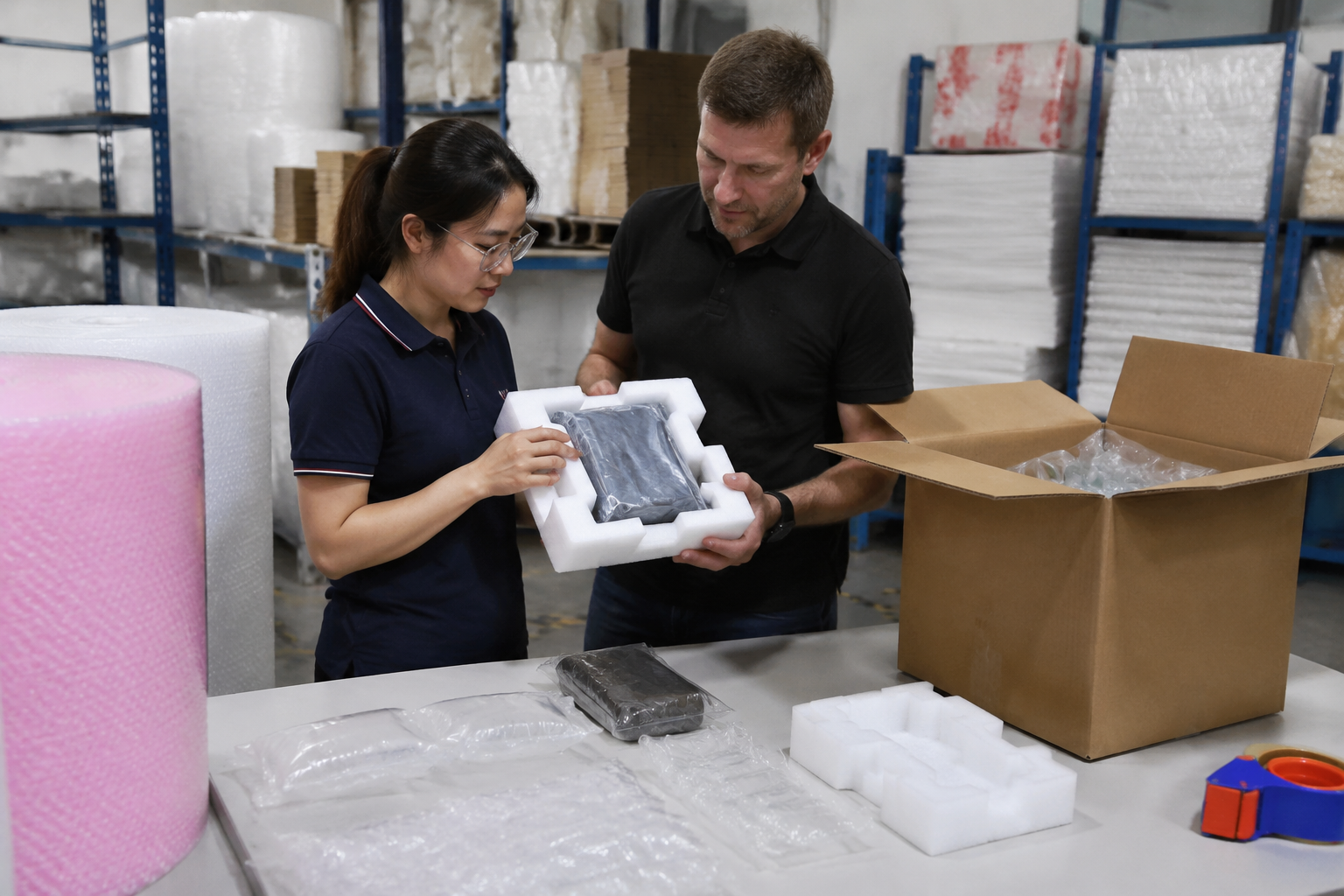
Check Fit with the Real Product and Carton
The first test is physical fit. Place the real product into the sample and check how it sits, where it touches, and whether it shifts when the carton is moved. A foam insert may look correct on paper, but if the product has a coating, an uneven edge, or a fragile corner, the contact points may need adjustment. The same issue applies to bags and cartons: a sample that appears correct by size can still be too tight once the product is packed with accessories, labels, or protective layers.
Buyers should also check clearance and carton space. Too little clearance can slow packing and create pressure on the product. Too much clearance can increase movement and raise drop risk. For bulk production, the packing team also needs to know whether the sample can be inserted, folded, sealed, or stacked quickly enough for the actual workflow. A good sample is not only protective; it is workable on the packing line.
It is also smart to mimic handling, not just placement. Tilting the carton, giving it a small shake, and checking how the product settles can reveal whether the fit is stable enough for shipping and warehouse movement.
Compare the Sample Against the Confirmed Specification
After fit is confirmed, compare the sample against the written specification. Check dimensions, thickness, density, structure, printing, and material type against the approved version. A buyer may receive two samples that look similar, but one uses a different density foam, a thinner film, or a lighter board grade. Those differences matter because they change protection, appearance, and consistency in bulk production.
This is also where common mistakes appear. Some buyers approve a foam insert without testing it with the real product. Others check a bag size without loading the product to see the packed thickness. Printed cartons are sometimes approved for color and layout, while carton strength is never checked with real stacking or handling conditions. Sample review should catch those gaps before the order moves forward.
The comparison should be specific enough for production to follow. Instead of only saying “sample approved,” the buyer and supplier should confirm the approved size, material, thickness, density where relevant, printing file, carton count, labels, and packing method that the approved sample represents.
Record Changes Before Mass Production
Any sample adjustment should be written down before bulk production begins. Revised sizes, photos of the approved sample, drawing updates, and written approval all help prevent disputes later. If the final sample differs from the first one, the production team needs to know exactly what changed and why. Otherwise, the order can drift between versions, especially when repeat production happens weeks or months later.
Documentation is not just for the supplier. It protects the buyer’s warehouse team, too, because the receiving staff can compare the finished goods against the confirmed reference instead of relying on memory. When Daipak supports sample and specification confirmation, the goal is to keep the approval process clear enough that both sides know what bulk production is supposed to match.
It is also wise to keep the approved sample accessible after production starts. When a later shipment needs review, the buyer can compare it quickly instead of rebuilding the approval history from chat messages or scattered images.
Quality Control Should Cover Materials, Production, Packing, and Shipment Readiness
Packaging quality control should not be treated as a final glance before shipment. It starts earlier, with material preparation and specification alignment, and continues through production inspection, finished product review, packing quantity checks, labels, carton marks, and shipment readiness. When each step is defined in advance, the buyer and supplier are less likely to argue over what “good quality” means after the order is already complete.
For a protective packaging manufacturer, QC needs to match the material and the job. Foam requires checks on dimensions and density. Bags need checks on thickness and sealing. Bubble wrap and air cushion products need checks on consistency and usable performance. Corrugated cartons need checks on dimensions, board quality, and compression-related concerns. Printing must match the approved artwork and layout, and packing quantities need to stay consistent from the first bundle to the last carton.
The most useful QC conversations happen before production starts. Buyers should agree with the supplier on which points will be checked, what counts as acceptable, and which version of the sample or drawing is the reference. That is how packaging quality control supports repeat orders, reduces claims, and makes receiving easier at the buyer’s warehouse.
QC also matters because packaging defects are often small but cumulative. A tiny variation in film thickness or a slight shift in carton size may not show up on one unit, but it can create recurring problems over an entire batch.
A practical quality review does not need to be complicated, but it should be visible. Buyers can ask the supplier to confirm which dimensions, appearance points, sealing areas, cutting edges, bonding points, printing locations, label details, packing quantities, and carton marks will be checked before shipment, especially when the order will be received by a warehouse team that was not involved in the original sample approval.
Traceable QC means each check has a reference point. The factory is not only checking whether a carton, bag, foam insert, or printed item looks acceptable; it is checking whether the finished product matches the approved sample, drawing, order detail, or confirmed requirement.
Material Checks Prevent the Wrong Packaging from Entering Production
Material checks confirm that the order begins with the right base. That means checking thickness, density, film type, board quality, color, and any other agreed detail before the line runs. A material that feels close to the sample may still be wrong if the film grade changed, the foam density shifted, or the carton board is lighter than expected. If those differences are found late, the whole order may need to be adjusted or reworked.
For buyers, the value of a material check is simple: it keeps the supplier from producing the wrong thing at scale. A printed box with the correct size but the wrong board grade is still a problem. A foam insert with the correct shape but the wrong density may not protect the product properly. Confirming the base material first saves time on both sides.
This is especially useful when an order uses multiple layers. If the buyer confirms only the outer carton but not the foam or bag inside, the final package may still fail even though the visible part looks fine.
In-Process Checks Catch Problems Before the Whole Order Is Finished
In-process checks look at what happens during cutting, sealing, forming, printing, and assembly. This is where small deviations can become large losses if they are not caught early. A slight size drift, a sealing line that is not stable, a print position that is moving, or a formed carton that is not staying square can all create inconsistency across the batch.
From a factory perspective, this stage matters because it shows whether the order can stay stable under real production conditions. Daipak’s production review should focus on whether the line can keep size, sealing, and forming consistent before the full run is completed. That kind of check is more useful than waiting until the shipment is fully packed and then discovering that part of the order sits outside the agreed tolerance.
In-process control is also where the factory can catch issues that are hard to see in a sample. For example, one side of a carton may crease more easily than expected, or a bag may seal well in a small test but become inconsistent at volume. Those are the kinds of issues that are easier to solve while the order is still running.
For traceability, in-process checks should relate back to the approved production details: cut length, seal position, foam slot size, bonding point, lamination direction, print location, carton forming size, and any packing requirement that affects the finished order.
Finished Packing Checks Matter for Export Orders
Finished packing checks focus on what the overseas buyer will actually receive. That includes carton quantity, packing method, labels, carton marks, and whether the cartons are prepared in a way that fits the shipment plan. If carton marks are unclear, counts are inconsistent, or the packing method differs from what was confirmed, the buyer may face delays when goods arrive at the warehouse.
For export orders, finished packing review also helps prepare the shipment for ordinary handling conditions. Cartons should be packed in a way that makes handling easier and can help reduce avoidable damage risk during transit. Buyers should ask the supplier what will be checked before dispatch and how the finished goods will be identified. That is where export packing support becomes practical, not just descriptive.
It can also be useful to confirm whether outer cartons are bundled or palletized in a way that matches the receiving plan. A shipment that is technically packed well but awkward to unload can still create headaches on arrival.
Finished packing traceability should connect the shipment to the buyer’s receiving needs. Carton quantity, inner packing, labels, marks, pallet preparation, and loading information should be checked against the confirmed order details so the destination team can identify and count the goods without relying on guesswork.
Export Communication Can Decide Whether the Order Runs Smoothly
For overseas B2B buyers, communication is an operational capability, not a courtesy. A China packaging supplier may have the right materials and production setup, but the order can still go wrong if the quote is unclear, the sample file is incomplete, or the packing mark is never confirmed. Good export communication reduces those risks by keeping the specification, sample, production, and shipment details connected.
Fast replies help, but they are not enough. A reliable export packaging supplier should ask the right questions early, confirm written details, share sample photos when needed, clarify carton labels and shipping marks, and keep the order record organized for future reorders. For technical packaging jobs, direct factory communication is especially useful because the people reviewing the request can ask about thickness, structure, sealing, carton fit, and packing quantity before production starts.
Daipak should treat these details as part of the quotation and shipment process. If the buyer’s message leaves out a unit, a logo file, a packing count, or the destination requirement, the quote may look correct on the surface but still fail in production. The more complete the communication, the less likely the order will move in the wrong direction.
In real export work, the biggest communication failures are often simple ones: missing units, unclear model names, inconsistent artwork versions, and assumptions about who is responsible for the final packout. Fixing those early is far easier than fixing them after production begins.
Export communication should also identify whether the shipment involves regulated conditions that ordinary packaging advice cannot cover. Wood pallets, crates, or dunnage used in international trade may need ISPM 15 treatment and marking under international phytosanitary rules, and USDA APHIS provides wood packaging material guidance for import/export contexts involving the United States.[10][11] If the product is classified as dangerous goods or hazardous material, packaging and shipment preparation should be reviewed against the applicable transport rules rather than treated as a standard carton order.[12][13]
For non-regulated export packaging, buyers should still share the destination, carton space target, loading method, pallet preference, label requirements, and any receiving instructions from the destination warehouse. These details help the supplier prepare packing that is easier to identify, count, unload, and store after arrival, instead of focusing only on the product leaving the factory.
Good export traceability is built from the same ordinary details: which specification was approved, which sample version was followed, which carton mark was printed, which packing quantity was used, and which shipment preparation instructions were confirmed. When those details are connected, both sides can resolve questions faster if the receiving warehouse asks for clarification.
Clear Specification Records Reduce Cross-Border Misunderstanding
Written confirmations matter because they create a shared reference. Units should be clear, drawings should match the latest version, sample photos should be labeled, and any revision should be saved instead of discussed only in chat messages. When the buyer and supplier both rely on the same written record, it is easier to avoid confusion about size, thickness, print placement, or packing quantity.
This is especially important in export packaging, where time zones can slow back-and-forth communication. A short message may seem clear to one side but mean something different to the other. A good written record removes that uncertainty and makes the next step easier for both parties.
It also makes it easier to compare future reorders. If the approved file is organized, the buyer can confirm whether the next order matches the previous one instead of relying on memory or old photos alone.
Production Updates Help Buyers Plan Receiving and Inventory
Buyers do not need unrealistic promises; they need reasonable production updates. A useful update tells the buyer what stage the order is in, whether the sample has been approved, whether printing or cutting is in progress, and whether there are any specification questions that need attention. That kind of information helps the buyer plan receiving, warehouse space, and downstream packing schedules.
What matters is not constant messaging, but useful messaging. If a supplier provides updates only when there is a problem, the buyer cannot plan well. If the supplier shares enough to show progress without overpromising exact delivery timing, the order usually runs more smoothly.
That balance matters because many buyers are coordinating packaging with product production, inbound freight, and warehouse labor. A realistic update gives them enough room to adjust the rest of the chain.
Production updates can also support traceability when they identify the stage that was completed against the approved requirement. For example, confirming that cutting, sealing, printing, forming, or packing has followed the approved version gives the buyer more confidence than a general statement that the order is “in production.”
Repeat Orders Are Easier When the Supplier Keeps Order History Organized
Repeat orders depend on stable records. Previous sample references, approved specifications, carton details, and packing records all make reordering faster and less error-prone. When those details are organized, the buyer does not need to restart the discussion from zero each time the order comes back.
That is where direct factory communication becomes a practical advantage. A supplier that keeps clear order history can answer reorder questions faster, confirm whether the old specification still applies, and reduce the chance of mixing versions. For long-term packaging buyers, that consistency often matters more than any single quotation.
It also helps when the buyer wants to make a controlled improvement rather than a full redesign. A clean history makes it easier to say what should stay the same and what should change slightly in the next version.
Where Low Unit Price Can Mislead Packaging Buyers
For a wholesale packaging materials supplier, the lowest unit price is only one part of the real cost. Packaging affects product damage, packing speed, carton space, storage space, and shipping cost, so a cheaper material can become expensive if it creates rework or complaints later. A buyer comparing a custom packaging quote should look at the full packing system, not just the price of one item.
That is why procurement teams often need to compare more than material price. A thin bag that tears, a weak carton that crushes, or low-quality bubble wrap that loses cushioning can all raise labor time and product damage. In some cases, a slightly better-specified material may lower total packaging cost because it fits the product better and reduces handling problems in the warehouse or at the destination.
At Daipak, the discussion usually starts with how the product will be packed, stored, and shipped. That gives a clearer picture of whether the real savings come from material price, packing efficiency, or fewer replacements over time.
The point is not that low price is always bad. The point is that price without context can hide risk. If a material is under-specified for the job, the “saving” may simply move into another budget line later.
Traceability also helps price comparison because it shows whether two quotes are really based on the same thing. If one price includes confirmed thickness, density, printing, carton marks, and packing quantity while another leaves those details open, the two numbers may not be comparable.
Material Savings Can Create Damage or Rework
Under-specified packaging often looks attractive on paper because the unit price is lower. The problem appears later, when the product starts moving inside the carton, the bag tears during packing, or the foam insert does not hold the item in place. Once that happens, the buyer may face claims, returns, repacking labor, or urgent replacement orders.
This is especially common when the packaging is doing more than one job. A product may need surface protection, cushioning, and separation at the same time. If one layer is made too light or too thin, the packing line may still run, but the finished result can be unstable. For bulk packaging, a small savings per unit can disappear quickly if the receiving team has to inspect, rework, or reject shipments.
Buyers should also consider the cost of interruption. If a package design fails after the line is already set up, the extra labor and delay can cost more than the packaging itself. That is why sample testing should always include real handling, not only visual approval.
Oversized Packaging Can Raise Freight and Storage Costs
Packaging that is larger than necessary can increase total cost even if the material itself seems affordable. Oversized cartons take up more pallet space, create more void space, and can raise shipping cost because the shipment occupies more volume than it should. The same issue applies to oversized foam inserts or excessive void fill, which can slow packing and reduce warehouse efficiency.
For export orders, carton dimensions and pallet efficiency matter as much as material selection. A box that is too large may leave the shipper paying for empty space. A box that is too small may force the buyer to choose heavier protection or more labor-intensive packing. The best choice usually balances carton fit, handling speed, and protection level rather than chasing the lowest material price alone.
Material efficiency can also affect storage before shipment. Smaller, cleaner packouts usually make it easier for warehouse teams to store inventory, count stock, and prepare orders without wasting floor space.
Inconsistent Quality Can Increase Hidden Procurement Costs
Even when a package looks acceptable on the first order, inconsistent thickness, size, sealing, or printing can create hidden costs later. Warehouse teams may need to check every carton again. Buyers may need to switch suppliers. Production may stop while a replacement order is placed. These problems are hard to see in a unit-price comparison, but they affect the real packaging cost.
Consistency matters most for repeat bulk packaging orders. If one batch of bags is slightly smaller, one carton run has weaker board, or one bubble roll is softer than the previous lot, the packing team loses time adapting. A stable specification often saves more money than the smallest possible unit price because it reduces checking, avoids reordering, and keeps the packing process predictable.
In other words, consistency is a form of cost control. Buyers that care about total packaging cost usually end up caring more about repeatability than about a few cents of difference on paper.
When feedback from the first shipment is recorded clearly, repeat orders can improve without becoming uncertain. The buyer can keep the approved material and structure while adjusting practical details such as carton mark wording, label position, packing quantity, or pallet preparation.
A Practical Supplier Evaluation Checklist Before You Place an Order
When buyers compare suppliers, the goal is not just to find a reliable China packaging materials supplier once. The goal is to find a partner that can support samples, production, and repeat orders with clear communication. A simple packaging supplier checklist helps buyers compare suppliers in a fair way before they request samples or approve a bulk order.
Start by checking whether the supplier understands your application, not just the product name. A packaging materials manufacturer or custom protective packaging factory should be able to explain why one material combination fits your product better than another. If the answers stay vague, the order may need more review before production starts.
For overseas B2B buyers, the most useful checklist is often the one that connects product range, custom support, sample handling, quality control, and reorder consistency. The questions below help keep that review practical.
A traceability-minded checklist does not need formal language. It should simply test whether the supplier can show what information they need, what they will confirm, what production will follow, what QC will compare against, and how repeat-order records will be kept.
Questions to Ask Before Requesting Samples
Before asking for a sample, share enough product information for the supplier to make a realistic recommendation. That usually means product dimensions, weight, shape, surface condition, fragility, packing method, and shipping destination. If the supplier only receives a product name, the sample may not reflect the actual need.
- What product details do you need before recommending a material?
- Can you suggest more than one material combination if the product has different risk points?
- Do you need photos, a drawing, or an existing sample?
- Will the quote change if we choose a different thickness, density, or carton size?
- How do you confirm the sample size and structure before sending it?
It is also worth asking whether the supplier can explain the sample in plain terms. If the reply is full of product names but not packing logic, the buyer may still be missing the reason behind the recommendation.
Questions to Ask Before Bulk Production
Once a sample is approved, the buyer should confirm the final specification in writing. That includes size, thickness, density, printing details, packing quantity, carton marks, and any special handling requirement. This step matters because bulk production depends on the same details being repeated consistently.
- What exactly will be checked before production starts?
- Which sample or version is the approved one for bulk production?
- How are printing, cutting, sealing, or carton marks confirmed?
- What packing method will be used for shipment preparation?
- How will production updates be shared during the order?
The best answers here usually sound specific, not broad. If the supplier can describe the control points and who checks them, the buyer gets a much better sense of whether the order is ready to run.
Questions to Ask Before Repeat Orders
Repeat orders are easier when the supplier keeps clear records. Buyers should confirm that previous samples, written specifications, and packing details are organized in a way that can be referenced later. This reduces the chance of small changes slipping into a reorder without being noticed.
- Do you keep the confirmed specification and previous sample reference on file?
- How do you handle repeat orders when the buyer wants the same packaging again?
- What happens if the packing quantity or carton mark needs to be updated?
- Can you compare a new order against the last approved version?
- How do you avoid inconsistency between batches?
If the answers show that the supplier tracks history well, the buyer is more likely to get predictable replenishment. That matters a great deal when packaging is part of a production schedule rather than a one-off purchase.
How Daipak Supports Overseas Buyers Sourcing Custom Packaging from China
Daipak Packaging, Zhejiang Daipak Packaging Materials Co., Ltd., works as a China packaging materials supplier and protective packaging manufacturer for overseas B2B buyers who need both standard and custom packaging. The practical value is not just having products available. It is being able to discuss the product, the packing method, and the order details before deciding on a structure that fits the job.
For buyers sourcing custom packaging supplier support from China, that usually means direct factory communication, sample support, quotation discussion, production coordination, and packing review. If the buyer shares the product size, weight, fragility, packing purpose, and destination, the recommendation becomes easier to connect with the actual material choice, sample approval, and production requirement.
Daipak’s support is most useful when the buyer needs several packaging materials to work together. Foam, bubble wrap, bags, film, cartons, labels, and pallet preparation may all affect the final result. The discussion should therefore cover how the product is protected at the contact layer, how it is cushioned or separated, how it fits the outer carton, how the carton is marked, and how the shipment is prepared for receiving.
For custom orders, Daipak-style traceability is practical rather than formal. The buyer provides product information, the supplier confirms the specification, the sample or drawing becomes the reference, production follows the approved details, QC checks the finished goods against those details, and packing review confirms carton quantity, labels, marks, and shipment preparation.
This approach helps overseas buyers avoid common problems such as wrong assumptions, unclear sample versions, mismatched carton quantities, outdated artwork files, or packing instructions that were discussed but never confirmed. It also gives repeat orders a clearer starting point because the next order can refer back to the approved material, size, structure, and packing method instead of starting from memory.
Daipak’s Role in Material Recommendation
Daipak can help buyers compare foam, bubble wrap, bags, film, and corrugated packaging based on the actual product and packing condition. The recommendation usually depends on product weight, surface finish, fragile points, carton space, packing speed, order quantity, and shipping route. This is different from choosing packaging only by a product category name.
For example, a buyer with a coated metal product may need soft surface contact and separation rather than bulky cushioning alone. A buyer shipping glass items may need a stronger structure that keeps fragile points away from carton walls. A buyer packing apparel may care more about clean folding, garment bags, poly mailers, and carton efficiency. In each case, the recommendation should be traceable to the product risk and packing method.
When Daipak reviews a request, details such as thickness, density, bag size, sealing method, carton dimensions, print position, label requirement, and packing quantity should be confirmed before the order moves forward. This gives both sides a clearer record of what the quotation includes and what the sample should prove.
Daipak’s Role in Sample and Specification Confirmation
Sample confirmation is where the packaging idea becomes a practical reference. Daipak can support buyers by preparing samples or sample details based on the confirmed requirement, then checking whether the product fits, whether the carton closes properly, and whether the packing method is workable for the buyer’s process.
The approved sample should not stand alone without written detail. The buyer and supplier should connect the sample to dimensions, material type, thickness, density where relevant, structure, printing file, carton mark, packing quantity, and shipment preparation. If the sample is adjusted, the revised version should be recorded so production follows the final approval.
This matters for repeat orders because many packaging problems appear when the original sample is remembered broadly but not defined clearly. A good sample record helps Daipak and the buyer confirm whether the next order should match the old version or whether a controlled adjustment is needed.
Daipak’s Role in Production and Packing Review
During production, the important point is that the line follows the approved details. Cutting, sealing, bonding, lamination, printing, forming, and carton packing should be checked against the confirmed requirement rather than judged only by appearance. This helps catch practical issues before they become a full shipment problem.
Finished packing review is also important for overseas buyers. Carton quantity, inner packing, labels, carton marks, pallet preparation, and loading information can affect receiving as much as the packaging material itself. If the destination warehouse expects certain marks, counts, or pallet handling, those requirements should be confirmed before shipment preparation.
Daipak’s role is therefore not only to manufacture packaging materials, but to help connect the buyer’s product information with the final packaging that arrives at the warehouse. When the recommendation, sample, production, QC, and packing review are connected, the buyer has a clearer basis for future orders and fewer avoidable surprises.
Daipak’s Role in Repeat-Order Improvement
Repeat orders are easier when both sides know which details are fixed and which details can be improved. If the first order worked well, the buyer may want the same size, material, and packing method again. If the warehouse found a problem, the buyer may want a small change to label placement, carton mark wording, bag opening style, foam clearance, or packing quantity.
Daipak can help by treating this feedback as part of the next order discussion. The goal is not to redesign everything every time, but to preserve the approved protection while making practical improvements where the buyer’s packing or receiving experience shows a need.
This kind of traceability is especially useful for long-term B2B packaging programs. It keeps the product details, material choice, production requirement, finished packing, shipment preparation, and buyer feedback connected from one order to the next.
Final Thoughts for Buyers Comparing China Packaging Materials Suppliers
Choosing a China packaging materials supplier should be a practical decision based on product risk, material capability, sample control, production consistency, export communication, and repeat-order support. The buyer should not judge the supplier only by product list or first unit price. The better test is whether the supplier can explain how the packaging will protect the product, fit the carton, support the packing process, and stay consistent in future orders.
For simple orders, a standard material and clear size may be enough. For custom, fragile, export, or repeat B2B packaging, buyers should look for a supplier that can connect product information to material selection, sample confirmation, written specifications, production checks, finished packing review, and shipment preparation. That connection is what makes packaging easier to trust.
Daipak is positioned for buyers who need factory-side support across multiple packaging materials, especially when foam, bubble wrap, bags, film, cartons, labels, and export packing details need to work together. The most successful projects usually begin with complete product and order information, then move through sample testing, specification confirmation, production review, and repeat-order feedback in a clear sequence.
In the end, good packaging is not chosen by a product name alone. It becomes reliable when the recommendation, sample, specification, production, packing review, and buyer feedback all point to the same approved requirement.
References
[1] ASTM International, “ASTM D4169 Shipping Container Performance Testing,” standard practice reference for performance testing shipping containers and systems, available at ASTM D4169 Shipping Container Performance Testing.
[2] International Safe Transit Association, “ISTA Procedure 3A Overview,” packaged-product test overview for parcel delivery systems and small package shipping contexts, available at ISTA Procedure 3A Overview.
[3] ASTM International, “ASTM D642 Compression Resistance,” packaging test method reference for determining compressive resistance of shipping containers, available at ASTM D642 Compression Resistance.
[4] Fibre Box Association, “Corrugated is Recyclable,” industry resource on corrugated packaging recyclability and recovery context, available at Fibre Box Association Corrugated is Recyclable.
[5] Association of Plastic Recyclers, “APR Design Guide Overview,” design guidance reference for plastic packaging recyclability and recycling compatibility considerations, available at APR Design Guide Overview.
[6] RecyClass, “RecyClass Design for Recycling Guidelines,” European plastic packaging design-for-recycling guidelines and protocol context, available at RecyClass Design for Recycling Guidelines.
[7] ASTM International, “ASTM D6400 Compostable Plastics,” standard specification reference for plastics designed to be aerobically composted in municipal or industrial facilities, available at ASTM D6400 Compostable Plastics.
[8] ASTM International, “ASTM D6868 Compostable Coated Packaging,” compostability reference for biodegradable plastic coatings or additives on paper and other compostable substrates, available at ASTM D6868 Compostable Coated Packaging.
[9] Federal Trade Commission, “FTC Green Guides,” U.S. environmental marketing guidance for recyclable, degradable, compostable, and other green claims, available at FTC Green Guides.
[10] International Plant Protection Convention, “IPPC ISPM 15 Wood Packaging,” international phytosanitary standard for wood packaging material used in international trade, available at IPPC ISPM 15 Wood Packaging.
[11] USDA APHIS, “USDA APHIS Wood Packaging Material,” guidance for wood packaging material and ISPM 15 import/export compliance contexts, available at USDA APHIS Wood Packaging Material.
[12] United Nations Economic Commission for Europe, “UNECE UN Model Regulations Rev. 24,” UN dangerous goods model regulations with packaging-related provisions for regulated shipments, available at UNECE UN Model Regulations Rev. 24.
[13] Pipeline and Hazardous Materials Safety Administration, “PHMSA Hazardous Materials Regulations,” U.S. hazardous materials transport regulations relevant to regulated packaging and shipping preparation, available at PHMSA Hazardous Materials Regulations.
[14] European Commission, “EU Food Contact Materials,” food contact materials rules and safety context for packaging articles in the European Union, available at EU Food Contact Materials.
[15] U.S. Food and Drug Administration, “FDA Food Packaging and Food Contact Substances,” consumer-facing reference for food packaging and substances that may come into contact with food, available at FDA Food Packaging and Food Contact Substances.