
If you are deciding between bubble wrap and air cushion packaging, the real question is not which material is better in general, but which one fits the product, carton, and packing workflow. This article breaks down when rolls, sheets, bags, air columns, and air pillow film make sense based on product size, weight, fragility, surface sensitivity, and how much void space needs to be controlled inside the box.
It is especially useful when you need to balance protection with packing speed and total cost. You will see why some items need surface wrap first, why fragile goods may need side support or corner protection, and why a lower material price can still lead to higher labor or damage risk. If you are comparing packing methods for export orders or asking a supplier like Daipak for a recommendation, this guide helps you prepare the right product details before requesting samples or quotation.
A practical recommendation is easier to trace when the inquiry includes product size, weight, photos or drawings, current packing method, carton size, order quantity, and shipping destination. These details give the supplier a clearer basis for choosing bubble size, film thickness, bag dimensions, air column structure, pillow size, carton quantity, and export packing method instead of quoting from a product name alone.
Because protective packaging performance depends on the exact product and route, buyers should avoid treating any bubble wrap, air column, or air pillow format as a universal solution. The same material can perform differently when the carton is oversized, the item has sharp corners, the product surface is easy to scratch, or the shipment passes through many handling points. A practical review should connect the cushion, carton, packing method, and shipping condition before production.
Quick Packaging Decision Guide
| Buyer Question | Practical Reading | What to Check |
|---|---|---|
| Do I need surface wrap or void fill? | Use bubble wrap for contact protection, air pillows for empty space. | Product finish, carton gaps, and whether the item touches the box wall. |
| Should I choose rolls, sheets, or bags? | Choose based on packing speed and repeatability, not just material cost. | Order quantity, line speed, and whether product sizes are stable. |
| Is an air column bag suitable for my product? | Best for fragile items that need structured side and corner support. | Product weight, fragile points, carton fit, and inflation consistency. |
| Will bubble wrap slow down production? | Rolls are flexible, but manual wrapping can add labor at higher volume. | Cutting steps, handling time, and whether pre-cut formats reduce waste. |
| What makes export packing different? | Shipping distance and handling risk can justify stronger cushioning or combined layers. | Route, carton strength, loading method, and any sample testing needs. |
| What should I send before requesting a quote? | Clear product data helps match the material to the real packing condition. | Dimensions, weight, photos, carton size, and fragile areas. |
Quick Answers Before You Read
Quick Questions Before You Read
Q: When is bubble wrap better than air cushion packaging?
Bubble wrap is better when you need direct surface protection for varied shapes or irregular items.
Q: Are air columns only for fragile products?
They are most useful for fragile goods, bottles, jars, ceramics, and items that need stable side support.
Q: Is air pillow film enough for fragile items?
Usually not by itself. It is mainly for filling empty space, not for protecting bare fragile surfaces.
Q: What information helps a supplier recommend the right format?
Send product dimensions, weight, photos, carton size, shipping route, and any fragile or surface-sensitive areas.
How Bubble Wrap and Air Cushion Packaging Solve Different Packing Problems
Most shipping damage starts with a simple problem: the product is not held safely inside the package. A glass jar can hit the carton wall, a cosmetic box can rub against another item, an electronic part can shift during courier handling, and a ceramic edge can crack after repeated vibration. Bubble wrap and air cushion packaging are both used for protective packaging, but they do not solve every packing problem in the same way.
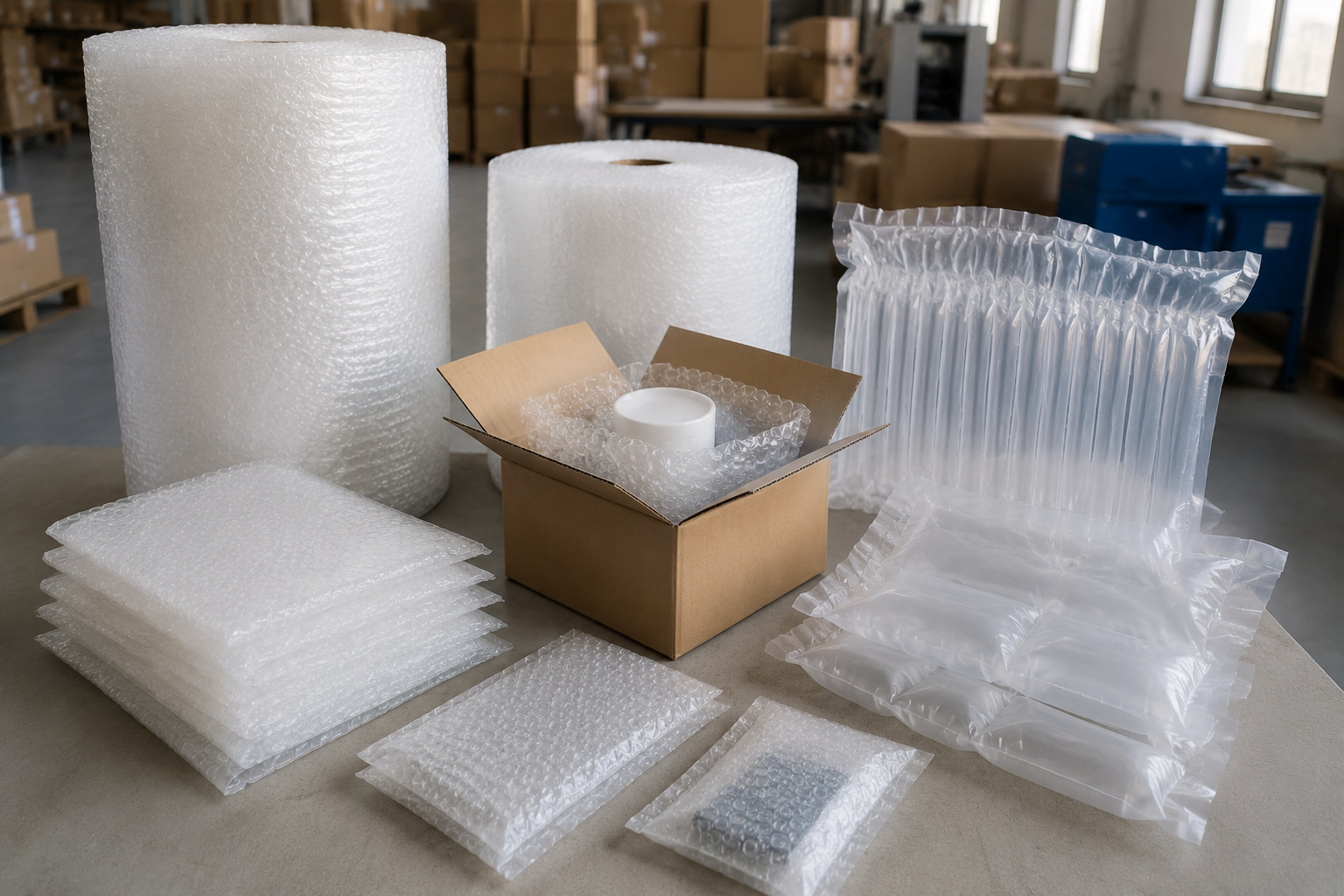
Bubble wrap rolls, bubble wrap sheets, bubble bags, air column bags, and air pillow film each fit a different part of the packing system. Some formats are better for wrapping the product surface. Some are better for absorbing impact around a fragile item. Others are mainly used to fill empty carton space so the product does not move during shipping. A good packaging choice starts by identifying the protection job first, then matching the material and format to that job.
For example, a small electronic accessory may need a bubble bag to prevent scratches and light impact, then a corrugated mailer for outer protection. A glass bottle may need air column packaging around the product body, plus a strong outer carton. A boxed e-commerce item may already have product-level protection, so the main need may be air pillows to block movement inside the shipping carton. These are different risks, and they call for different cushioning decisions.
Surface protection, cushioning, and void filling are not the same job
Surface protection means preventing scratches, scuffs, dust marks, or rubbing damage. This matters for products with glossy finishes, printed retail boxes, coated metal parts, painted surfaces, cosmetics, and electronics housings. Bubble wrap, bubble sheets, bubble bags, foam sheets, and protective film can all help separate the product surface from carton walls or other items. The goal is not only to stop breakage, but also to keep the product looking acceptable when the customer opens the package.
Cushioning is different. It deals with impact and vibration. If a carton drops, slides, or gets stacked under other cartons, the packaging must slow down the force before it reaches the product. Bubble wrap can provide light-to-medium cushioning when wrapped with enough coverage. Air column bags create a more structured cushion around bottles, glass containers, ceramics, and certain electronics. The right choice depends on product weight, fragile points, and how much space is available between the product and the outer carton.
Void filling is another job again. Empty space inside a carton allows the product to move, rotate, and hit the sides of the box. Air pillow film is often useful here because it can fill empty carton space efficiently and help stabilize products that already have primary protection. But void fill alone does not always protect fragile surfaces or sharp corners. If a bare glass item is placed in a large carton with only loose air pillows around it, the surface and impact zones may still be poorly protected.
A practical packaging review should also look at contact points before choosing the material. If two painted parts touch each other, if a retail box rubs against a corrugated wall, or if a plated metal surface can collect dust marks, the buyer may need a clean separating layer before adding stronger cushioning. In many real cartons, damage is caused by small repeated movement rather than one large impact, so surface wrap, interleaving, and carton tightness should be checked together.
Why many fragile shipments need more than one cushioning format
Many fragile shipments fail because the package relies on one material to do too many jobs. A single layer of bubble wrap may protect against scratches, but it may not stop a heavy item from shifting inside an oversized carton. Air pillows may fill open space, but they may not protect a thin ceramic handle or a sharp metal corner. Air column packaging may protect the product body well, but it still needs a carton that fits correctly and can handle stacking and handling pressure.
A stronger packing structure often combines materials in a simple sequence: wrap the product, protect the impact zones, then stabilize the carton space. Glassware may use bubble wrap or a bubble bag for surface protection, an air column sleeve for higher impact risk, and a corrugated outer carton sized to prevent movement. Spare parts may use bubble wrap between pieces, a plastic bag for dust protection, and void fill to keep the group from shifting. For export cartons or heavier shipments, the outer carton strength and pallet preparation also become part of the protection plan.
At Daipak, the discussion usually starts with the product details rather than the material name. Product size, weight, shape, finish, carton layout, and shipping method can change the recommendation quickly. Bubble wrap and air cushion packaging can be standard or custom, but the useful question is not simply which product is popular. The better question is which combination helps protect fragile items, reduce unnecessary movement, and support the real packing workflow in the warehouse.
Evidence-based checks for higher-risk shipments
For higher-risk products, buyers should separate a quick sample fit check from formal transport validation. A sample fit check confirms whether the product can be packed quickly and without obvious movement, while distribution testing standards such as ASTM D4169 and parcel-delivery procedures such as ISTA 3A are designed for evaluating packaged products under defined shipping and handling conditions.[1][2]
Carton compression should also be treated as a separate question from inner cushioning. Bubble wrap, air columns, or pillows may reduce movement around the product, but the outer shipping container still needs enough stacking resistance for the actual load and handling route; ASTM D642 is one recognized method for evaluating compressive resistance of shipping containers.[3]
Bubble Wrap Rolls: Best for Flexible Wrapping and Daily Warehouse Use
Bubble wrap rolls are often the most practical choice when a warehouse packs many product sizes and needs one flexible cushioning roll on hand. Staff can pull the material from the roll, cut it to length, and wrap products by hand as orders come through. This makes rolls useful for distributors, fulfillment centers, repair parts suppliers, furniture hardware, ceramics, glassware, and mixed wholesale shipments where the product mix changes from day to day.
A bubble film roll can be used in several ways: wrapping individual products, layering between items, lining the bottom or sides of a carton, covering protruding parts, or adding extra cushioning around irregular shapes. This flexibility is the main advantage. A buyer does not need to keep a separate bag or sheet size for every SKU. The trade-off is labor. If every item must be measured, wrapped, cut, taped, and checked by hand, rolls can slow down a high-volume packing line compared with pre-cut sheets or ready-made bags.
Rolls also require practical warehouse planning. A wide roll may cover large products faster but can be harder to handle at a small packing station. A narrow roll may be easier for small products but may require more wrapping passes for bigger items. Perforated rolls can reduce cutting time if the perforation length matches common packing needs. Non-perforated rolls give more freedom but depend more on scissors, knives, or cutting tools at the bench.
When rolls are better than pre-cut sheets or bags
Rolls are usually a better fit when product dimensions vary, shapes are irregular, or packing volume is low to medium. A warehouse that ships glass panels one day, ceramic parts the next, and mixed spare parts after that may not want to stock many fixed bubble bag sizes. A roll gives the packing team room to adjust coverage based on the actual product and carton space.
They are also useful when the product has uneven surfaces or fragile extensions. A molded component, furniture part, handle, bracket, or decorative item may need protection only in certain areas. With a roll, staff can add extra layers around corners or exposed points without changing the full packaging format. This is harder with a fixed pouch size, especially when the product does not fit cleanly into the bag.
The decision should still consider packing speed. If a warehouse ships hundreds or thousands of the same small item every day, repeated hand wrapping can become expensive in labor time and inconsistency. In that case, pre-cut bubble wrap sheets or bubble bags may be more efficient even if the material format appears less flexible. Rolls are strongest where flexibility matters more than strict repeatability.
Key specifications buyers should confirm for bubble wrap rolls
Before ordering bubble wrap rolls, buyers should confirm more than the general product name. Roll width and roll length affect both packing coverage and storage planning. Bubble size affects how the material wraps around the product and how much space it adds inside the carton. Film thickness direction should be discussed clearly with the supplier because different buyers may describe thickness, layer structure, or material strength in different ways.
Perforation is another important detail. If a roll is perforated, the perforation length should match the typical wrap size used at the packing table. If the perforation is too short, workers may need multiple pieces. If it is too long, material waste can increase. Core size, roll outside diameter, roll weight, and packing quantity per carton or bundle can also affect how the product is stored, moved, and used in the warehouse.
Buyers should also think about storage space before selecting roll dimensions. Bubble wrap contains air, so finished rolls can take up more room than flat film or uninflated air cushion film. A low material price may not be the best choice if the rolls are too large for the packing area, difficult for staff to handle, or shipped in a format that does not match warehouse storage conditions. Clear roll specifications help keep repeat orders consistent and reduce surprises when bulk packaging arrives.
For custom roll orders, it is worth confirming the cutting method, perforation accuracy, winding tightness, and outer packing method before production. A roll that is too loosely wound can deform during storage, while a roll that is difficult to unwind can slow down the packing bench. If the material will be used for products with clean surfaces, buyers should also ask how the rolls are packed for dust protection during warehouse storage and export transport.
For repeat roll supply, the confirmed specification should connect the buyer’s approved sample to the production checklist. Roll width, roll length, bubble size, film structure, perforation distance, winding direction, core size, carton quantity, and carton marks should usually be checked against the same order detail before shipment. This does not need to be a formal tracking system, but it helps prevent a reorder from changing in a way that affects cutting, storage, or packing speed at the buyer’s warehouse.
Bubble Wrap Sheets and Bubble Bags: Better for Repeated Packing Tasks
Bubble wrap sheets and bubble bags are better suited to packing operations that repeat the same task many times. Instead of pulling a roll, measuring material, cutting it, and deciding how much to use, staff can take a pre-cut sheet or ready-made pouch and follow the same packing step for each product. This improves consistency when the warehouse handles stable SKUs, repeat orders, samples, accessories, cosmetics, small electronics, spare parts, or retail goods.
The main difference is how much flexibility the packer still needs. Bubble wrap sheets are pre-cut, but they can still be folded, wrapped, layered, or used as separators between items. Bubble bags, also called bubble pouches in many packing operations, are more standardized. They work best when the product fits the pouch size properly and does not require much adjustment. For the right product, this can make packing faster and easier to train across multiple workers.
These formats can also help control waste. When workers cut from rolls by hand, different people may use different lengths for the same item. Some may overwrap to feel safe; others may underwrap to save time. Pre-cut bubble wrap and protective packaging bags reduce that variation. The actual savings depend on order volume, product consistency, and whether the selected sheet or bag size is well matched to the product.
When pre-cut sheets reduce waste and handling time
Pre-cut sheets are useful when the warehouse repeatedly packs products within a known size range. A sheet can be placed at the packing bench, wrapped around the item, used as an interlayer, or added as top protection before closing the carton. The worker does not need to stop and cut material for every order, which can improve packing flow during busy periods.
Sheets also make it easier to set a packing standard. For example, a cosmetic set may require one sheet around each retail box, while a small ceramic item may need two sheets with extra coverage around the edges. Once the sheet size and quantity are confirmed, supervisors can train staff more easily and check whether the packing method is being followed. This matters for repeat orders because packaging consistency affects both protection and customer presentation.
The buyer should still avoid choosing sheet sizes only by product length and width. The sheet must have enough area for folding, overlap, and any extra coverage around fragile corners. If the sheet is too small, staff may add tape, extra pieces, or inconsistent wrapping steps. If it is too large, the extra material may increase waste and make the finished pack too bulky for the carton.
When bubble bags are more practical than wrapping by hand
Bubble bags are often more practical when the product can slide into a pouch cleanly and needs quick surface protection with light cushioning. Small electronics, cables, accessories, cosmetics, samples, printed items, and replacement parts are common examples. The pouch format reduces handling steps because the worker does not need to wrap the product from multiple sides or decide where to fold the material.
Fit is the key issue. A bag that is too tight can be slow to load and may place pressure on corners or packaging edges. A bag that is too loose may allow the product to shift inside the pouch and may use more carton space than necessary. Buyers should confirm inside dimensions, product thickness, closure style, and whether the product will be packed alone or grouped with other items inside the outer carton.
Open-top bubble bags can work well when the pouch is placed inside another carton or mailer and does not need its own closure. Self-seal styles may be useful where the packing team wants a cleaner, faster closing step. For custom sizes and bulk orders, sample confirmation is especially useful because a few millimeters of fit can affect packing speed, appearance, and repeat-order consistency.
When sheets or bags are ordered for a fixed SKU, the buyer should keep the approved product photo, drawing, bag opening direction, inside dimension, closure style, and packing quantity linked to the confirmed sample. During production, cutting accuracy, sealing position, adhesive strip condition, and carton labels can then be reviewed against the agreed order detail. This makes it easier to repeat the same pouch-style packing method without relying on memory from the previous order.
Air Column Bags and Custom Air Column Packaging for High-Risk Fragile Items
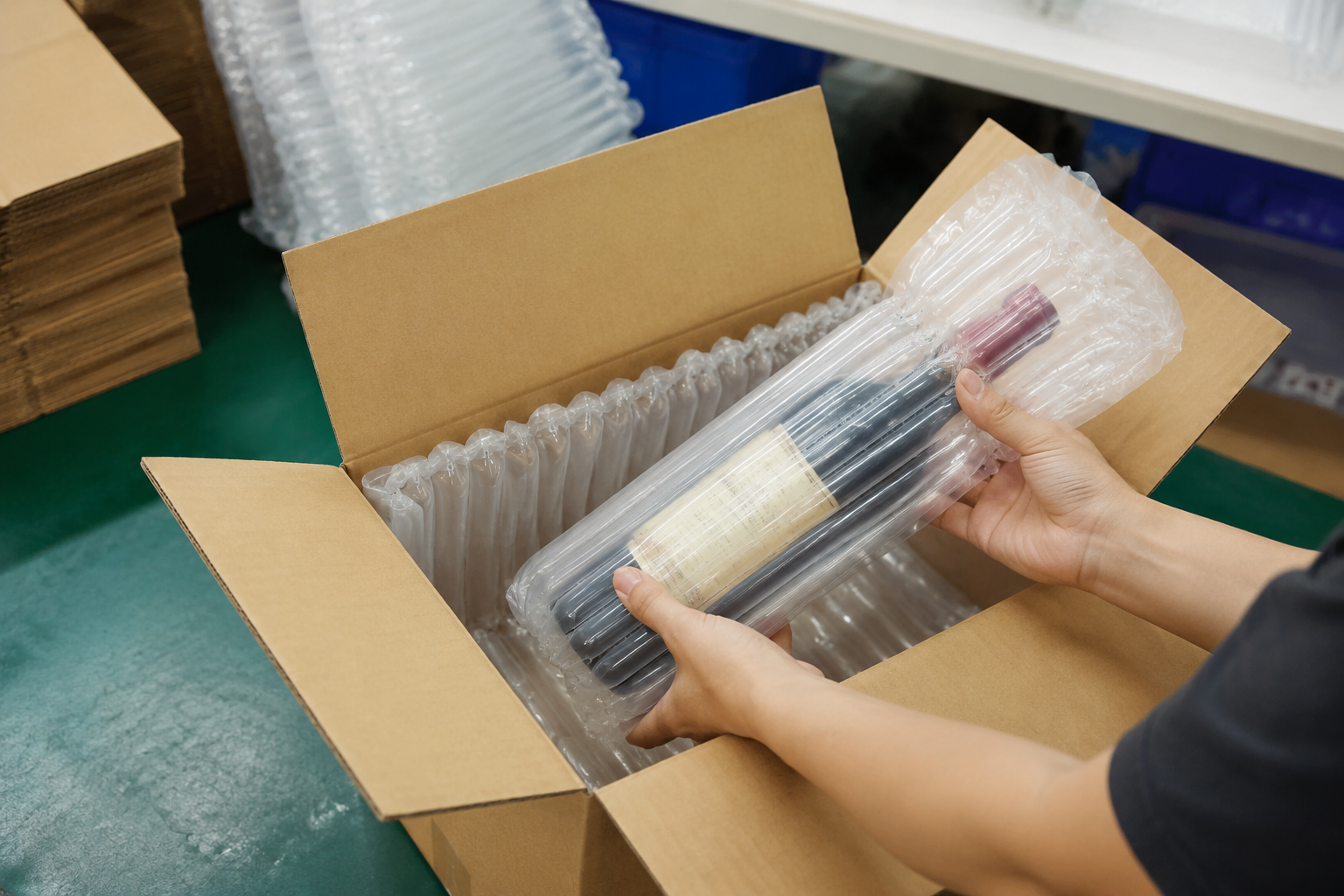
Air column bags are built for products that need more structure than loose wrapping alone can provide. Instead of a single soft layer, the connected air chambers form a sleeve-like cushion around the product, which helps protect bottles, glass containers, ceramics, and some electronics during handling and transport. For buyers shipping fragile items in cartons that may be stacked, moved, or dropped during routine logistics, that extra structure can matter.
The main value of custom air column packaging is fit. When the chamber layout follows the product shape and the carton size, the package can hold the item more steadily and reduce movement around corners and sidewalls. That does not mean it replaces every other protective layer. It works best when the product dimensions, weight, and carton layout are already understood, and when the sample is checked before bulk use.
At Daipak, the discussion usually starts with the product itself. A bottle, a ceramic cup, and a boxed electronic accessory may all be fragile, but they do not need the same protective structure. That is why air column packaging should be treated as a fit-based protective packaging choice, not a one-size-fits-all answer.
When air columns outperform loose bubble wrapping
Air columns are often the better option when the product has a predictable shape and a higher risk of impact damage. Bottles, jars, and many glass items need side protection and corner coverage that stays in place during movement. A loose bubble wrap layer can cushion the product, but it may shift, fold, or leave uneven coverage if the item is tall, narrow, or easily knocked against the carton wall.
They can also be useful for ceramics and electronics that need a more defined protective sleeve. The chambers help create a buffer around the item without relying only on hand wrapping skill. For warehouse teams, that can make the packing result more consistent from one operator to another, especially when the same fragile SKU is packed repeatedly.
The key is to match the structure to the risk. If the product mainly needs light surface protection, bubble wrap may still be enough. If the product has brittle edges, a narrow footprint, or a higher chance of corner impact, air columns usually deserve a closer look.
What makes a custom air column design different from a standard bag
A standard air column bag works well when the product size and carton size already fit a common format. Custom air column packaging is different because the chamber layout, sleeve width, length, and opening style are adjusted around the actual product. That matters when the item is unusually tall, wide, round, or sensitive at specific points.
For a useful custom design, the supplier should understand the product dimensions, weight, fragile areas, and how the item sits inside the carton. Corner coverage may need to be wider on one side. The inflation fit may need to be tighter or looser depending on how much movement must be controlled. Carton compatibility also matters, because a good inner sleeve can still fail if the outer box is too tight or leaves too much empty space.
Buyers should also think about production repeatability. If the same design will be used again, the dimensions and chamber pattern need to stay consistent from sample to batch order. That is where specification confirmation becomes important before full production starts.
Custom air column work should also confirm the practical inflation condition, not only the flat film drawing. The inflated size, valve direction, sealing position, and loading method all affect how quickly workers can pack the product and how well the cushion sits inside the carton. If the packing team must rotate the product, force it into the sleeve, or trim excess material during daily use, the design may need to be adjusted before bulk production.
Specification Confirmation Note: Before custom air column production, buyers should confirm product size, weight, fragile points, inflated fit, chamber structure, carton size, quantity, labels, and packing method so the approved sample can be repeated clearly in bulk production.
Common mistakes when using air column packaging
One common mistake is under-inflation. If the chambers are not filled properly, the sleeve loses shape and cannot hold the product as intended. Another mistake is over-tight carton fit, where the outer box compresses the sleeve so much that the protective chambers cannot absorb impact the way they should.
Wrong product size is another frequent issue. A bag that is too large allows movement, while a bag that is too small can stress the seams or leave fragile parts exposed. The outer carton also needs enough strength to support the package. A strong inner sleeve cannot fully compensate for a weak shipping box that crushes easily in transit.
Finally, sample testing is often skipped. For fragile item packaging, that is risky. A small trial run can show whether the chamber placement, carton layout, and handling method actually work together before the buyer commits to a bulk order.
Air Pillow Film: The Efficient Choice for Void Filling, Not Direct Product Wrapping
Air pillow film is mainly used to fill empty space inside cartons and keep products from shifting during shipping. It is a void fill material, not a primary wrap for sharp, heavy, or highly fragile goods. That distinction matters because many damage problems come from carton movement, not from the absence of cushioning alone.
The practical advantage is storage efficiency. Uninflated film takes up far less room than pre-filled cushions, so it is easier to keep at a packing station or in a warehouse corner. When paired with suitable inflation equipment, it can also support faster order packing, especially in e-commerce and fulfillment operations where cartons need to move quickly through the station.
Buyers usually get better results when they think of air pillow film as a carton-control tool. It helps stop products from sliding, tilting, or colliding with the box wall during transport. It does not replace wrapping or shaped cushioning when the product itself is delicate.
When air pillows work best inside shipping cartons
Air pillows work best when the product is already boxed, wrapped, or durable enough that the main risk is carton void space. This is common with e-commerce parcels, boxed consumer goods, and mixed shipments where the inner product container is already doing part of the protection work. In those cases, the pillows help lock the items in place and reduce rattling.
They are also useful for warehouse teams that need a quick way to fill different carton sizes. A carton may be half full in one order and nearly full in the next. With the right film format and inflation setup, the packer can add the amount of void fill needed without holding many bulky pre-made fillers on the shelf.
For fast-moving shipping lines, that can improve station flow. The packer fills empty space, closes the carton, and moves on without overpacking the box with unnecessary material.
Where air pillow film should not be used alone
Air pillow film should not be the only protection for bare fragile products. Glassware, ceramic pieces, and other breakable items usually need surface protection or structured cushioning before the void fill is added. Without that first layer, the carton may be full, but the product can still suffer from direct contact or point impact.
It is also a weak choice for heavy goods with sharp corners. A heavy part can crush the pillows, and a sharp edge can damage the film or reduce the support effect. In those situations, bubble wrap, air columns, or a stronger combination structure may be more appropriate.
Buyers should also check whether the film matches the inflation equipment and packing station layout. If the roll format, seal quality, or pillow size does not fit the workflow, the efficiency benefit can disappear quickly.
Special-use claims should be confirmed before ordering film
Some buyers need more than ordinary cushioning, such as anti-static protection for electronics, higher moisture resistance for certain routes, or special handling for sensitive products. These features should not be assumed from the product name. The buyer should confirm the exact film structure, additive or coating requirement where applicable, test basis, storage condition, and destination-market expectation before using the packaging for that purpose.
If the order involves lithium batteries, regulated chemicals, aerosols, or other hazardous goods, inner cushioning is only one part of the shipment decision. Packaging and transport requirements may vary by product classification, route, and destination, and hazardous-materials frameworks such as the UN Model Regulations and U.S. PHMSA rules are separate from ordinary protective packaging selection.[10][11]
How to Compare Rolls, Sheets, Bags, Air Columns, and Air Pillow Film
When buyers ask which packaging should I choose, the right answer usually depends on the product, the packing process, and the shipping risk. A broad comparison helps because each format solves a different problem. Some are better for wrapping, some for fixed-size packing, some for structured cushioning, and some for void fill inside a carton.
The table below gives a practical starting point, but the best choice still depends on the real product and workflow. For a procurement manager or warehouse team, the useful question is not which material sounds strongest. It is which format fits the item, the labor process, and the storage space available.
| Format | Best Use | Main Strength | Main Limitation |
|---|---|---|---|
| Bubble wrap rolls | Flexible wrapping, mixed SKUs, irregular shapes | Can be cut to length for many product sizes | Requires more hand labor and measuring |
| Bubble wrap sheets | Repeated packing of similar sizes | Speeds up consistent wrapping and handling | Less flexible than rolls for unusual items |
| Bubble bags | Small items and repeat pouch-style packing | Fast insertion and cleaner packing flow | Depends on product fitting the bag size |
| Air column bags | Fragile bottles, jars, ceramics, and shaped items | Structured side and corner cushioning | Needs correct sizing and sample confirmation |
| Air pillow film | Void filling inside cartons | Saves storage space before inflation | Not a direct wrap for delicate bare products |
A good comparison should also include packing labor. A roll may seem flexible, but if every order needs measuring and cutting, that labor adds up. A sheet or bag may cost more per unit, but it can reduce handling time and make packing more consistent. Air pillows may not touch the product directly, yet they can keep shipping cartons from moving internally and help reduce damage caused by shifting.
Comparison by protection role
The protection role is the first filter. Bubble wrap rolls and sheets are mainly for wrapping, surface protection, and light cushioning. Bubble bags are useful when a product needs a simple sleeve or pouch. Air column bags provide more defined impact cushioning and corner coverage. Air pillow film is mainly for blocking movement and filling empty carton space.
That is why no single format should be treated as the answer for every shipment. A fragile product may need a wrap layer plus a void fill layer. A boxed product may only need air pillows. A glass item may need a shaped sleeve before the carton is closed.
Comparison by packing process
The packing process changes the choice just as much as the product does. Roll material works well when staff can wrap by hand and cut to length on the spot. Sheets reduce handling time for repeated sizes. Bubble bags are faster when the product fits a pouch that is already close to the right size.
Air column bags require inflation and fit confirmation before use, but they can streamline fragile packing once the design is settled. Air pillow film works best in stations that can inflate pillows on demand and place them quickly around boxed goods. If the warehouse changes order types often, the process itself may push the buyer toward one format over another.
For combined packaging projects, the buyer should also ask how each material will be used in sequence at the packing bench. A design that looks reasonable as separate components can become slow if workers must switch tools too often, search for different sizes, or add extra tape at every step. Coordinating bubble wrap, air columns, pillows, cartons, and labels as one workflow helps reduce avoidable packing variation.
Comparison by product and shipment risk
Fragile, high-value, or shape-sensitive products usually need more structure. Bottles, glass jars, ceramics, and electronics tend to benefit from air columns or a combined structure rather than loose wrapping alone. Heavy or sharp-edged products may need stronger outer packaging and a more careful choice of inner cushioning.
Boxed goods with stable surfaces may only need void fill. High-volume e-commerce products may favor sheets, bags, or pillows because speed matters as much as protection. Irregular industrial parts often need roll material or a combined solution because the shape does not fit a standard pouch or sleeve cleanly.
In practice, a careful approach is to compare product risk first, then packing speed, then storage space, and only then unit price. That sequence often leads to a better packaging decision.
How Product Details Change the Right Cushioning Choice
For protective packaging for fragile products, the material name alone is never enough to make the right decision. A buyer may ask for bubble wrap, but the product may really need a combination of wrapping, corner support, carton stabilization, and void fill. The right structure depends on product weight, dimensions, shape, fragility, surface finish, edge sharpness, carton layout, shipping distance, and the way the parcel will be handled after it leaves the warehouse.
At Daipak, our team usually starts with the product itself. A lightweight cosmetic item, a glass bottle, a coated industrial part, and a boxed electronic product can all be fragile, but they do not need the same cushioning material selection. When buyers share product photos and packing details early, it becomes much easier to recommend a practical structure instead of guessing from a material name.
The most useful way to think about custom protective packaging is to match the packaging function to the risk. Some products mainly need surface protection. Others need impact cushioning. Some need the carton space controlled so the product does not move during transport. A good recommendation usually combines these jobs instead of forcing one material to do everything.
Daipak can usually suggest a more practical structure when buyers provide the product size, weight, fragile areas, carton size, shipping route, and packing method. That kind of information helps narrow the options quickly and reduces vague requests such as “send price for bubble wrap.”
The same product information should continue through the next steps of the order. Once a recommendation is made, the sample, drawing, specification sheet, production size, and finished packing review should all refer back to the confirmed product and carton details. This practical trace from inquiry to sample to production helps the buyer see why a certain material thickness, air column pattern, bag size, or pillow format was selected.
Product weight and fragility level
Weight changes how much stress the packaging must handle. A heavier product creates more pressure on the bottom layer, more load on corners, and more risk if the carton is dropped or stacked. A light product can often use softer wrapping, but a heavier item may need a stronger outer carton, thicker cushioning, or a more structured insert so the product does not sink into the packing material during transit.
Fragility matters just as much. A product that can chip, crack, bend, or deform may need more than a simple wrap. Glass, ceramics, coated surfaces, and precision parts often need a more careful structure than general consumer goods. The buyer should also consider whether the damage risk is from impact, compression, vibration, or surface rubbing, because each risk points to a different packing approach.
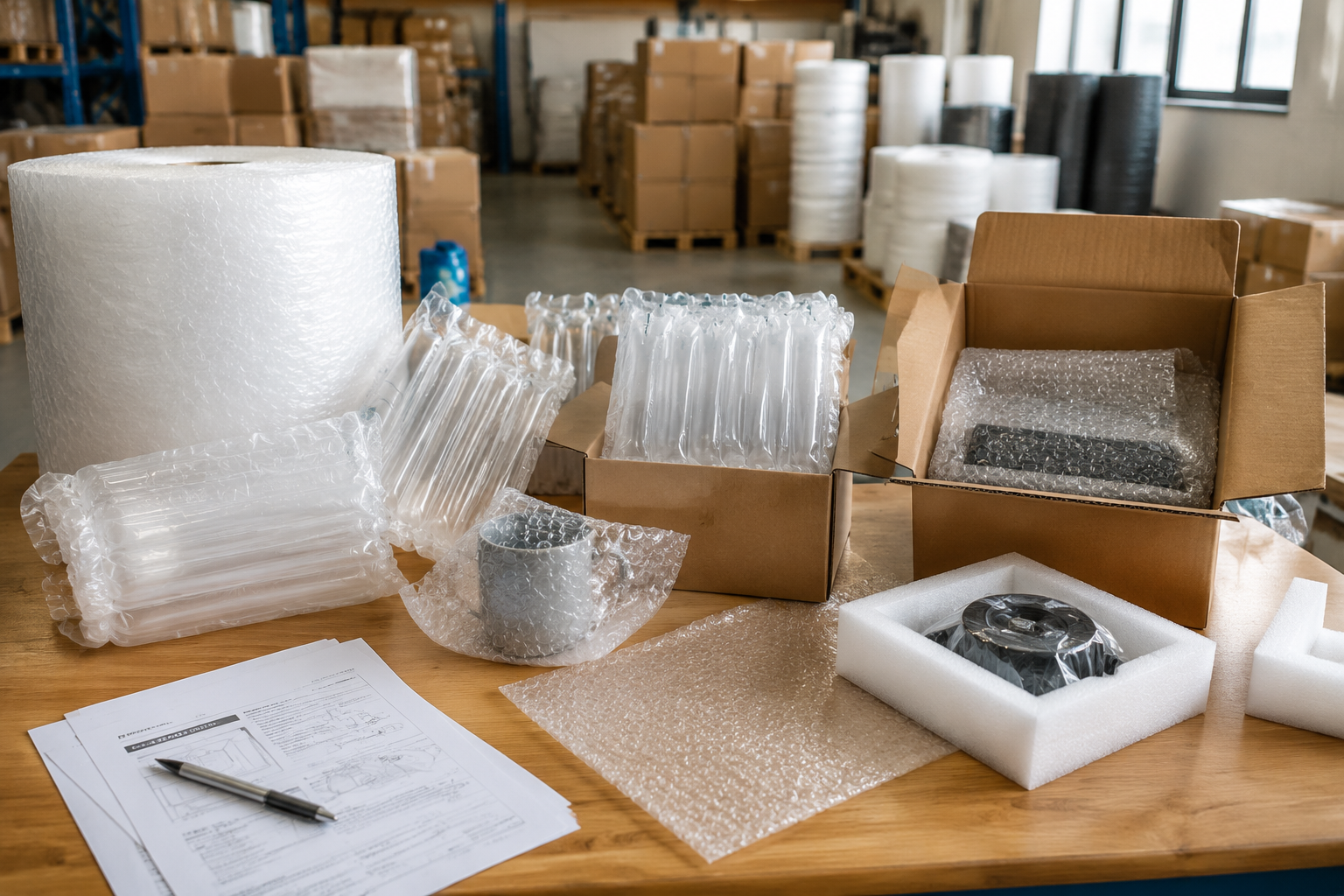
For example, lightweight cosmetics may travel safely in bubble bags inside an outer carton, while a fragile glass bottle may need air column bags or another structured sleeve. Heavy industrial parts may be better served by bubble wrap rolls combined with foam pads or separators. The point is not to choose the strongest material in theory, but the structure that fits the product’s real risk.
Shape, corners, and surface sensitivity
Shape often decides whether a product can be wrapped quickly or needs a more fitted solution. Round containers, long narrow parts, irregular industrial components, and products with protruding handles or edges all create different packing challenges. A product with an unusual shape may leave empty corners in the carton or create pressure points where the wrapping shifts during shipping.
Corners and edges deserve special attention. Sharp edges can cut through soft cushioning, while exposed corners are often the first place to suffer impact. In those cases, the buyer may need wrapping plus separation, or corner protection plus outer boxing, instead of only one layer of material. When the packaging is chosen only by price or habit, these contact points are easy to miss.
Surface sensitivity matters as well. Matte coatings, polished finishes, painted surfaces, plated parts, and printed panels can scratch even if the product itself is not fragile in a structural sense. In those cases, the packaging should reduce rubbing as much as it reduces impact. That may mean a softer wrap, a clean separating layer, or a custom insert that keeps product surfaces from touching each other during movement.
Carton size and shipping route
Carton size changes how much movement the product can make inside the package. If the carton is too large, the product can shift, tilt, and take repeated impact from the inside. If the carton is too tight, the cushioning may not compress properly or the product may press against the carton wall. The right packaging choice depends on how the product fits inside the final shipping box, not only on the product alone.
Shipping route matters just as much. Courier parcels, export cartons, pallet movement, and warehouse handling all create different kinds of stress. A parcel that moves through multiple handoffs may need more stable cushioning than a carton that stays on a local delivery route. Export handling often adds more vibration, stacking, and transfer points, so buyers should share destination and shipping method when asking for a recommendation.
Empty space is another risk. Too much void space increases movement, but it also increases the chance that the carton is crushed inward during stacking. That is why product protection, carton size, and void control should be considered together. A packaging structure that works in a small domestic parcel may not work the same way in export packing or palletized shipment.
Food-contact and regulated-use questions need separate confirmation
If bubble bags, air cushion film, or paper-based cushioning will directly touch food, the buyer should not rely on a general “protective packaging” description. Food-contact packaging may need to be checked against the destination market’s material rules, such as the European Commission framework for food contact materials or U.S. FDA regulations for polymers and paper or paperboard used in food-contact contexts.[4][5][6]
The same caution applies to medical, child-safety, hazardous-goods, anti-static, or moisture-barrier claims. Unless the supplier has confirmed the exact material, intended use, test basis, and destination requirement, these claims should be treated as separate compliance questions rather than assumed features of ordinary bubble wrap or air cushion packaging.
Where Packing Efficiency and Total Cost Matter More Than Unit Price
When buyers compare wholesale protective packaging, the quoted unit price is only one part of the real cost. A lower material price can become more expensive if it slows down packing, creates more waste, uses larger cartons, takes more warehouse space, or allows more damaged shipments. The better question is not only “what costs less per piece,” but “what lowers total packing cost for this product and workflow.”
For bulk packaging orders, the real cost also depends on labor time, SKU consistency, and how the packaging is used every day. Rolls may look economical because they are flexible, but they can take longer to cut and wrap. Sheets and bags can reduce handling time, but only if the product sizes are consistent enough to benefit from standardization. Air pillows save storage space before inflation, while air columns may cost more per piece but can better support higher-risk fragile products.
From a packaging cost control standpoint, the best option is often the one that reduces trouble downstream. Fewer damaged shipments, less rework, less wasted material, and faster pack-out speed can matter more than a small difference in unit price. That is especially true in warehouses where packing labor and order consistency affect the whole shipping operation.
Material price is only one part of packaging cost
Material price is easy to compare, but it rarely tells the full story. Labor, waste, storage, equipment needs, and carton size all influence the final cost. If a cheaper material takes longer to handle or creates more offcuts, the apparent savings may disappear quickly.
Storage is another hidden cost. Rolls and stacked sheets take up warehouse space, while uninflated air cushion film stores compactly before use. That difference can matter for buyers with limited inventory space or high order turnover. In some operations, the space saved in storage is just as important as the money saved on the material itself.
Damage replacement cost should also be counted. If a lower-cost cushion leads to more breakage, the real expense is not the packaging alone. It becomes the replacement product, customer complaint handling, and lost time in the warehouse. For many buyers, a slightly more protective format is the lower-risk choice overall.
Freight cost should be included in the comparison as well. A thicker cushion or oversized carton can increase carton volume, pallet height, and container space, while an under-protected pack can create damage costs after arrival. For export orders, the better choice is often the structure that balances material use, carton cube, pallet stability, loading condition, and damage risk instead of only chasing the lowest cushion price.
How standardization can reduce packing complexity
Standardization helps the packing team work faster and more consistently. When sheet sizes, bag sizes, air column layouts, or pillow sizes repeat from order to order, staff do not need to stop and measure every item as often. That can make training easier and reduce mistakes during busy shipping periods.
It also helps with repeat ordering. If the same packing size is used again and again, the warehouse can keep a steady process and avoid last-minute adjustments. That is useful for e-commerce sellers, distributors, and brand owners with regular replenishment. A standardized format may not solve every protection problem, but it often improves daily efficiency.
Mr. Wang usually looks at whether a chosen size can be repeated cleanly in production and used consistently in packing. That kind of factory-side check is useful because a format that seems simple on paper can become difficult if the dimensions are not stable enough for batch use.
When a higher-cost cushion can be the lower-risk choice
Some products deserve a more protective structure even when the unit cost is higher. High-value fragile goods, export shipments, and products with a poor tolerance for scratches or breakage often fall into this group. In those cases, the packaging cost is small compared with the risk of returns, damage claims, and customer dissatisfaction.
The same logic applies when shipping conditions are harsh. Long transit routes, multiple transfers, pallet movement, or mixed warehouse handling can all raise the chance of impact. A more structured cushion may reduce the chance of movement or corner damage even if it uses more material.
The right decision is usually based on the product’s value, fragility, and shipping risk, not only on the lowest price. A buyer who looks at total packaging cost usually makes better long-term decisions than one who only compares the first unit price on a quotation.
Environmental claims should be specific, not decorative
When buyers need recyclable, compostable, biodegradable, or “eco-friendly” packaging claims, the claim should match the exact material, market, and disposal route. U.S. FTC Green Guides caution marketers against broad environmental claims that are not properly qualified, while packaging design resources from the Sustainable Packaging Coalition frame sustainability as a design and system decision rather than a single-material label.[7][8]
Corrugated outer cartons may have strong recovery and recyclability context in many markets, but that does not automatically make a mixed pack fully recyclable if it also contains films, tapes, coatings, labels, or contaminated components. Corrugated recyclability should be considered alongside the full pack design and destination-market recovery system.[9]
If a buyer wants to communicate a compostable or biodegradable claim for a packaging item, the claim should be checked against the exact material and recognized compostability or organic recycling criteria where applicable. Standards such as ASTM D6400 for compostable plastics and ASTM D6868 for coated packaging are examples of references used for specific compostability evaluations, not general proof that all film or cushion packaging is compostable.[12][13]
What Buyers Should Confirm Before Ordering Bubble Wrap or Air Cushion Packaging
When working with a packaging materials supplier in China, clear specification details make the process much smoother. A supplier can only recommend the right format if the buyer shares enough product information to judge protection needs, packing method, and carton fit. That is especially important for custom sizes and bulk orders, where a small misunderstanding can affect sample approval and repeat production.
For a practical inquiry, the buyer should prepare product dimensions, product weight, photos, fragile areas, carton size, shipping method, monthly volume, preferred format, custom size needs, printing or labeling needs if relevant, and the packing method used in the warehouse. The more complete the information, the easier it is to compare options and confirm a sensible structure before production.
Daipak usually treats sample confirmation as part of the order process, not a separate formality. Clear product details help the factory recommend bubble wrap, air cushion packaging, or a combined structure with less back-and-forth. That improves communication and helps the buyer move from inquiry to sample to bulk protective packaging with fewer delays.
Product and carton details to send with an inquiry
Buyers should send the actual product size, weight, shape, surface condition, and any fragile points that need special attention. Photos or drawings are especially useful because they show whether the product has corners, protrusions, coatings, or uneven surfaces that may change the packaging approach.
Carton details matter too. The supplier should know the intended carton size, how many pieces go into each carton, and whether the product will be wrapped individually or packed in groups. If the carton is already fixed, the packaging structure must fit that space. If the carton is still being decided, the packaging recommendation may influence the final carton design.
Buyers should also state the shipping method and destination. Courier shipping, export shipping, and warehouse-to-warehouse movement create different handling risks. A clear inquiry makes it easier for the supplier to recommend a structure that fits the real shipping condition instead of a generic protection idea.
A useful inquiry can also include the current packing method and the reason for changing it. If the buyer is trying to reduce breakage, save packing time, reduce carton size, improve warehouse storage, or standardize repeat orders, that goal should be stated early. The same bubble wrap or air cushion format may be judged differently depending on whether the main problem is impact damage, rubbing marks, slow packing, or inconsistent carton filling.
Sample testing before bulk production
Sample testing helps confirm whether the packaging actually works in practice. The buyer should check fit, inflation level where relevant, wrapping coverage, carton movement, packing speed, and the overall appearance after packing. A sample that looks good in a photo may still leave too much movement or take too long to pack during daily operation.
It is also worth testing how the product behaves after the carton is closed and moved. If the item shifts, rubs, or presses against the wall, the structure may need adjustment. This is especially important for fragile items and export orders, where the handling environment may be less controlled.
For repeatable transit confidence, buyers can decide whether the sample only needs an internal handling check or whether the packed product should be evaluated against a recognized distribution or parcel test method. That decision depends on product value, damage history, sales channel requirements, and the level of risk the buyer is willing to accept before bulk shipment.[1][2]
Ms. Tang usually keeps sampling and specification confirmation closely connected so that small changes are caught early. A slight size adjustment during the sample stage is much easier to handle than discovering the issue after bulk production has started.
Repeat-order details that should stay consistent
Once a package structure is approved, the repeat-order details should stay stable. Size, thickness direction, roll length, sheet count, bag dimensions, inflation fit, carton packing, and labeling should all match the confirmed sample unless the buyer requests a change. Consistency matters because even a small variation can affect packing speed or fit in the carton.
Labeling and carton marks should also remain consistent if they are part of the packing method. That helps the warehouse keep orders organized and reduces the chance of mismatch during shipping preparation. For buyers with regular replenishment, a stable specification is one of the easiest ways to keep packing operations predictable.
When buyers give the same specification information every time, the repeat order process is smoother and less likely to drift. That is one reason clear confirmation matters before the first production run and before any reorder is placed.
Repeat-order feedback should be specific enough to guide the next production run. Notes such as “too loose” or “too hard to pack” are less useful than comments tied to the actual detail, such as bag opening width, inflated air column tightness, pillow size, roll perforation length, carton quantity, label position, or pallet loading condition. When this feedback is connected to the previous sample or order specification, Daipak can review whether the next order should keep the same requirement or adjust one confirmed detail.
Production checks that help prevent packing problems
Before shipment, buyers and suppliers should align on the checks that matter for the selected format. For bubble wrap and sheets, this may include size, roll length, perforation, cutting accuracy, winding condition, and carton packing quantity. For bubble bags, sealing position, opening size, adhesive strip condition, and usable inside dimensions should be checked against the approved sample.
For air column bags and air pillow film, inflation performance, seal consistency, roll compatibility, and finished cushion size should be reviewed carefully. These checks do not need to be complicated, but they should match the real use of the packaging. A small production variation that looks minor in the warehouse can become a problem if it changes carton fit, packing speed, or protection around fragile points.
Quality Review Note: For bulk protective packaging, a practical review should cover dimensions, appearance, sealing, cutting, bonding, printing or labels where used, carton packing quantity, and carton marks before shipment preparation.
For export orders, packing review should also include how the finished packaging products are counted, bundled, cartoned, and marked for loading. Bubble wrap rolls may need enough compression control to avoid deformation, while air cushion film rolls should be packed so the edges, seals, and roll cores are not damaged before use. These details do not replace the buyer’s own receiving inspection, but they help reduce preventable order confusion before the shipment leaves the factory.
A practical shipment preparation review should connect the finished goods to the buyer’s order detail: carton quantity, inner packing, carton dimensions, label content, carton marks, pallet method, and loading information should usually be checked before dispatch. This is especially helpful when one order includes several sizes of rolls, bags, or air column designs, because clear marks and packing counts make warehouse receiving easier after arrival.
Export, customs, and destination-market details
Export packing can include requirements that are separate from cushion selection. If wood pallets, wood crates, or other wood packaging materials are used with the shipment, the buyer and supplier should confirm whether destination-market rules require ISPM 15 treatment or marks; IPPC and USDA APHIS references provide guidance for wood packaging material used in international trade.[14][15]
Destination-market labeling, recycling symbols, material declarations, or product-specific shipping documents may also need to be checked before production. A packaging supplier can prepare agreed packing marks and order documents, but buyers should confirm the final import, retail, platform, or carrier requirements that apply to their product and market.
How Daipak Supports Bubble Wrap, Air Cushion, and Custom Protective Packaging Orders
Daipak Packaging, Zhejiang Daipak Packaging Materials Co., Ltd., works as a practical China packaging materials supplier for buyers who need protective packaging that fits the product, the carton, and the shipping method. In this kind of order, the starting point is usually not the material name. It is the product itself, the handling risk, and the way the warehouse actually packs each item.
For bubble wrap, air cushion packaging, EPE foam packaging, plastic bags and film packaging, corrugated boxes, and custom protective packaging, the useful discussion is usually the same: what needs to be protected, how it will be packed, how much space is available in the carton, and whether the format needs to be repeated every day or adapted for different SKUs. That is the kind of order flow Daipak is set up to support as a protective packaging manufacturer and factory-side supplier.
For buyers comparing several protective packaging options at once, Daipak can help organize the discussion by separating surface protection, impact cushioning, void filling, carton fit, and export packing preparation. This keeps the recommendation practical: one product may need only a bubble pouch, another may need an air column sleeve plus a carton change, and another may only need air pillows to control empty space around an already boxed item.
From product details to packaging recommendation
The clearest packaging recommendation usually comes from complete product details. When a buyer shares product dimensions, weight, shape, fragile areas, surface finish, carton size, and shipping route, Daipak can compare whether the order is better suited to rolls, sheets, bags, air columns, air pillow film, or a combined structure. A smooth ceramic part, a glass bottle, and a boxed electronic item may all need protection, but the packing structure is rarely the same.
That is also why “bubble wrap” by itself is not always the full answer. Some products need surface protection and wrapping, while others need structured side protection or carton void filling. A combined pack can be more practical than a single material. For example, a fragile item may need bubble wrap or a foam layer around the product, plus air pillows or carton fillers to stop movement inside the outer box. From a factory perspective, the right answer depends on how the product behaves inside the carton, not only on how the material looks on paper.
At Daipak, the recommendation process is most useful when the buyer can discuss product details clearly and early. That makes it easier to match the packaging structure to the packing method, the storage condition, and the shipping destination without guessing.
From sample confirmation to repeat bulk orders
Once the format is selected, the next step is usually sample confirmation. This is where the buyer checks fit, coverage, inflation level, carton space, and packing speed before placing a repeat bulk order. Ms. Tang often treats sampling and specification review as part of the same order flow, because even a small size change can affect material use, packing count, and warehouse handling.
For bulk supply, the important part is consistency. The confirmed size, thickness direction, roll length, bag dimension, inflation fit, and carton packing method should stay stable from sample to production. Mr. Wang usually checks whether the cutting, sealing, bonding, or sizing detail can be repeated the same way during batch production. That matters for buyers who need repeat supply, because a format that works once but shifts in production can create packing delays later.
For overseas orders, export packing support is also part of the work. Ethan Lee typically focuses on the practical order details that affect shipment preparation, such as packing quantity, carton marks, destination requirements, and how the goods will be prepared for loading. That keeps the order discussion connected to the real shipping process instead of stopping at the quote stage.
After delivery, repeat-order feedback is useful when the buyer has comments from warehouse staff, receiving teams, or downstream customers. If workers found the bag opening too tight, the roll too wide for the bench, the pillow size too large for the carton, or the air column loading step too slow, those details can be reviewed before the next production run. Practical feedback helps keep repeat orders closer to the real packing operation instead of treating each reorder as only a price and quantity repeat.
In the end, Daipak’s role is not just to supply packaging material. It is to help buyers move from product details to a workable structure, then from sample confirmation to repeat orders with fewer surprises. For teams that need a steady packaging supply, that factory-side coordination is often as important as the material itself.
References
[1] ASTM International, “ASTM D4169 Standard Practice for Performance Testing of Shipping Containers and Systems,” distribution-cycle packaging performance testing reference for shipping containers and systems, available at ASTM D4169 Shipping Container Performance Testing.
[2] International Safe Transit Association, “ISTA Procedure 3A Overview,” parcel-delivery packaged-product test overview for small package shipping contexts, available at ISTA Procedure 3A Overview.
[3] ASTM International, “ASTM D642 Standard Test Method for Determining Compressive Resistance of Shipping Containers,” packaging test method reference for evaluating shipping container compression resistance, available at ASTM D642 Compression Resistance.
[4] European Commission, “EU Food Contact Materials,” regulatory framework reference for materials and articles intended to come into contact with food in the European Union, available at EU Food Contact Materials.
[5] Electronic Code of Federal Regulations, “21 CFR Part 177 Polymers,” U.S. federal regulatory reference for polymer materials used as indirect food additives in food-contact contexts, available at 21 CFR Part 177 Polymers.
[6] Electronic Code of Federal Regulations, “21 CFR Part 176 Paper and Paperboard,” U.S. federal regulatory reference for paper and paperboard components used as indirect food additives in food-contact contexts, available at 21 CFR Part 176 Paper and Paperboard.
[7] Federal Trade Commission, “FTC Green Guides,” U.S. environmental marketing guidance relevant to recyclable, degradable, compostable, and other environmental packaging claims, available at FTC Green Guides.
[8] Sustainable Packaging Coalition, “Packaging Design,” packaging design reference for sustainable packaging decision-making and system-level packaging design considerations, available at Sustainable Packaging Coalition Packaging Design.
[9] Fibre Box Association, “Corrugated is Recyclable,” industry resource on corrugated packaging recovery and recyclability context, available at Fibre Box Association Corrugated is Recyclable.
[10] United Nations Economic Commission for Europe, “UNECE UN Model Regulations Rev. 24,” dangerous goods model regulations reference with packaging-related provisions for regulated shipments, available at UNECE UN Model Regulations Rev. 24.
[11] Pipeline and Hazardous Materials Safety Administration, “PHMSA Hazardous Materials Regulations,” U.S. hazardous materials transport regulatory framework relevant to packaging and shipping preparation, available at PHMSA Hazardous Materials Regulations.
[12] ASTM International, “ASTM D6400 Compostable Plastics,” standard specification reference for labeling plastics designed to be aerobically composted in municipal or industrial facilities, available at ASTM D6400 Compostable Plastics.
[13] ASTM International, “ASTM D6868 Compostable Coated Packaging,” compostability reference for biodegradable plastic coatings on paper and other compostable substrates, available at ASTM D6868 Compostable Coated Packaging.
[14] International Plant Protection Convention, “IPPC ISPM 15 Wood Packaging,” international phytosanitary standard reference for wood packaging material used in international trade, available at IPPC ISPM 15 Wood Packaging.
[15] United States Department of Agriculture Animal and Plant Health Inspection Service, “USDA APHIS Wood Packaging Material,” guidance reference for wood packaging material and ISPM 15 import/export compliance, available at USDA APHIS Wood Packaging Material.